
 Services
 Solutions
 Main platform
 Technology
 White Label
  Offshore
 Hire developers



Are you considering selling into the Australian market, or looking for the right ecommerce platform to build your online store from scratch? Whatever your goal, the first question you need to answer is: where is the Australian ecommerce market in 2026, and how does it actually work?
This is not an easy market. Australian consumers are far more demanding than average. They compare prices carefully, expect fast delivery, require a smooth mobile checkout experience, and almost treat BNPL (Buy Now Pay Later) as a standard entitlement when shopping online. At the same time, it is a highly attractive market where consumers spend an average of AU$4,040 per person per year online, and total ecommerce spending reached AU$82.6 billion in 2025 alone.
In this review, based on years of hands-on experience in SEO and ecommerce in the Australian market, I will walk through the complete picture: the latest market data, consumer profiles, detailed comparisons of the most popular ecommerce platforms (Shopify, WooCommerce, BigCommerce, and Maropost), Australia’s unique payment ecosystem, and the key trends that are genuinely shaping the industry in 2026, not theory, but what is happening in the real world.
Quick Summary:
- Australians spent AU$82.6 billion online in 2025, up 14% year over year.
- The Australian ecommerce market is valued at USD 51.22 billion in 2026 and is projected to reach USD 90.57 billion by 2031.
- Shopify is the most widely used platform, with approximately 40,000 Australian merchants and 18% domestic market share.
- BNPL (Buy Now Pay Later) accounts for 24% of all online transactions, making Australia one of the world’s leading BNPL markets.
- 77% of store traffic comes from mobile devices, and 68% of orders are completed on smartphones.
- The top-performing product categories are fashion, electronics, and health and beauty.
1. Overview of Ecommerce in Australia 2026
If you are searching for “ecommerce Australia review” to decide whether the Australian market is worth entering, this is the most important information you need to know first.
The Australian ecommerce market is no longer an emerging market. It is a mature, highly competitive market that continues to accelerate. Between 2012 and 2026, the market expanded by 151%, with a compound annual growth rate (CAGR) of 6.6%. Growth has become even stronger over the past two years.
Key Numbers You Cannot Ignore
According to the Australia Post eCommerce Report 2026 and data from the Australian Bureau of Statistics (ABS):
- AU$82.6 billion in total online spending in 2025, up 14% year over year
- 9.8 million households shopped online, setting a new record in 2025
- 41% of households purchase online at least once every two weeks
- 18 million Australians shop online, spending an average of AU$4,040 per person annually
- Ecommerce now accounts for nearly 15% of total retail sales, compared with less than 10% before the pandemic
- AU$4.5 billion in monthly online retail turnover in May 2025, up 16% compared with the previous year
One particularly important trend is that basket sizes are becoming smaller while purchase frequency is increasing. Australians are placing around four more online orders than they did a year ago, but each order is worth less on average. This reflects inflation pressures and the growing “value-seeking” behavior across the market.
2. Who Is Shopping Online in Australia?
Understanding the customer profile is essential when evaluating the Australian ecommerce market.
Generational Breakdown (2026)
| Generation | Share of Spending | Key Characteristics |
| Millennials (1981–1996) | 36% | The largest spending group, with strong expectations for seamless shopping experiences |
| Generation X (1965–1980) | 28% | Larger basket sizes and strong loyalty to familiar brands |
| Generation Z (1997–2012) | 17% | Highly engaged in social commerce, TikTok Shop, and the heaviest users of BNPL |
| Baby Boomers (1946–1964) | Fastest-growing (+23%) | Online shopping adoption increased from 52% to 75% after COVID |
| Seniors (65+) | Growing rapidly | Adoption rose from 40% to 60%, reflecting a permanent shift after the pandemic |
Key Insight: COVID-19 permanently changed the shopping behavior of older generations. This is a valuable customer segment that many brands still have not fully understood or targeted effectively.
3. Top-Selling Product Categories in Australia
According to data from the Australian Bureau of Statistics and Australia Post:
- Fashion and Apparel: The number one category, driven by conscious shopping and the growth of second-hand marketplaces.
- Electronics and Technology: Stable demand, but highly competitive due to Amazon Australia and Kogan.com.
- Health and Beauty: Strong growth, especially for wellness products marketed as “Made in Australia.”
- Homewares and Furniture: Benefiting from the continued work-from-home trend.
- Online Grocery and Food: Still relatively new but growing rapidly, led by Coles and Woolworths.
- Sports and Outdoor Products: Consistently strong, reflecting Australia’s outdoor lifestyle culture.
Important Note for Sellers: Marketplaces accounted for 39% of online spending growth in 2024 and generated approximately AU$16 billion in sales. Any serious ecommerce strategy for Australia must include marketplace channels such as Amazon Australia, eBay Australia, and Catch.com.au.
4. Review of the Most Popular Ecommerce Platforms in Australia (2026)
This is the section most people are looking for when searching for “ecommerce Australia review.” The following platform reviews are based specifically on Australian market conditions rather than generic global perspectives.

4.1. Shopify
Market Share in Australia: Approximately 18%
Australian Merchants: 40,000+
Key Advantages for the Australian Market:
- Automatic GST Calculation: Accurately applies Australia’s 10% GST without manual setup.
- Native Integration with Afterpay and Zip Co: Essential in a market where BNPL represents 15% of online transactions.
- Official Australia Post App: Generates shipping labels, provides tracking, and integrates directly with the national postal network.
- Shopify Magic (AI): Automatically creates SEO-friendly product descriptions and analyzes customer behavior.
- During Black Friday 2025, Shopify processed US$9.5 billion in global sales without any major outages.
Drawbacks to Consider:
- Transaction fees of 2.2% to 2.7% if you do not use Shopify Payments, which can become significant at scale.
- Additional app costs can grow to AU$150–300 per month as the store becomes more complex.
- Customization is limited if you are not familiar with Liquid templating.
Pricing (AUD, 2026)
- Basic: ~AU$56/month
- Shopify: ~AU$152/month
- Advanced: ~AU$611/month
Best For:
Startups, SMEs, dropshippers, and retailers that want to scale quickly without relying heavily on developers.
Read more: Shopify Australia Review: A Practical Look from the User’s Perspective
4.2. WooCommerce
Market Share in Australia: Approximately 13%
Australian Stores: 28,000+
WooCommerce is a free WordPress plugin that turns any WordPress website into a fully functional online store. It is the world’s most widely used ecommerce platform by store count, with over 4.65 million stores globally, but it requires greater technical expertise.
Key Strengths:
- Complete SEO Freedom: Full control over URLs, canonical tags, and schema markup. No platform offers more granular SEO control than WooCommerce.
- Zero Platform Licensing Cost: You only pay for hosting and optional plugins.
- No Vendor Lock-In: You own your data and infrastructure.
- Blog and Store in One Platform: Ideal for content-driven marketing strategies.
Drawbacks:
- Requires knowledge of WordPress and self-management of hosting, security, and updates.
- Hidden costs can include hosting, SSL certificates, premium plugins, and developer support.
- Not suitable for users without a technical background.
Pricing:
Free platform, plus hosting from AU$10–50 per month, with optional plugin costs.
Best For:
Content creators, bloggers moving into ecommerce, development agencies, and brands where SEO is the primary growth channel.
4.3. BigCommerce
Positioning: Mid-market to enterprise
Key Advantage: Zero transaction fees
BigCommerce is increasingly chosen by mid-sized and large Australian businesses due to its clear cost advantages at scale.
Key Advantages for the Australian Market:
- $0 transaction fees across all payment gateways: A major advantage when revenue grows at scale.
- Native multi-currency, GST support, and B2B pricing: No need for extra apps to enable core business functions.
- Supports 65+ payment providers and 140+ currencies.
- Strong API capabilities for ERP, PIM, and OMS integrations.
- Better built-in SEO control compared to default Shopify setups.
Drawbacks:
- Admin interface is less user-friendly than Shopify.
- Fewer free themes available.
- Automatic plan upgrades based on GMV thresholds can lead to unexpected cost increases.
Pricing:
From around US$29/month (~AU$45/month) to enterprise-level pricing.
Best For:
B2B companies, high-volume retailers, and businesses that need enterprise-grade functionality without accumulating app costs.
4.4. Maropost (Neto)
Maropost (formerly Neto) is one of the lesser-known platforms internationally, but it is highly respected within the Australian ecommerce ecosystem.
Key Advantages:
- Integrated POS (Point of Sale): Strong omnichannel retail capability.
- Built-in support for GST, Afterpay, and Australia Post from the start.
- Strong focus on B2B and wholesale operations.
- Local customer support in Australian time zone (not offshore support).
Best For:
Traditional retailers moving into omnichannel commerce, and wholesale or B2B-focused businesses operating in Australia.
Quick Comparison Table (2026)
| Criteria | Shopify | WooCommerce | BigCommerce | Maropost |
| Ease of use | ⭐⭐⭐⭐⭐ | ⭐⭐⭐ | ⭐⭐⭐⭐ | ⭐⭐⭐ |
| GST automation | ✅ | ⚠️ (plugin) | ✅ | ✅ |
| Afterpay/Zip support | Native | Plugin | Native | Native |
| Australia Post integration | Official app | Extension | Limited | Native |
| Transaction fees | Yes (if no Shopify Payments) | None | None | None |
| SEO control | ⭐⭐⭐⭐ | ⭐⭐⭐⭐⭐ | ⭐⭐⭐⭐ | ⭐⭐⭐ |
| Scalability | ⭐⭐⭐⭐⭐ | ⭐⭐⭐⭐ | ⭐⭐⭐⭐⭐ | ⭐⭐⭐⭐ |
| Startup cost | Medium | Low | Low–Medium | Medium |
5. Payment Ecosystem – What You Must Know
Payments are a make-or-break factor in Australian ecommerce. Unlike many other markets, Australians have very specific payment preferences.
Most Popular Payment Methods (2026)
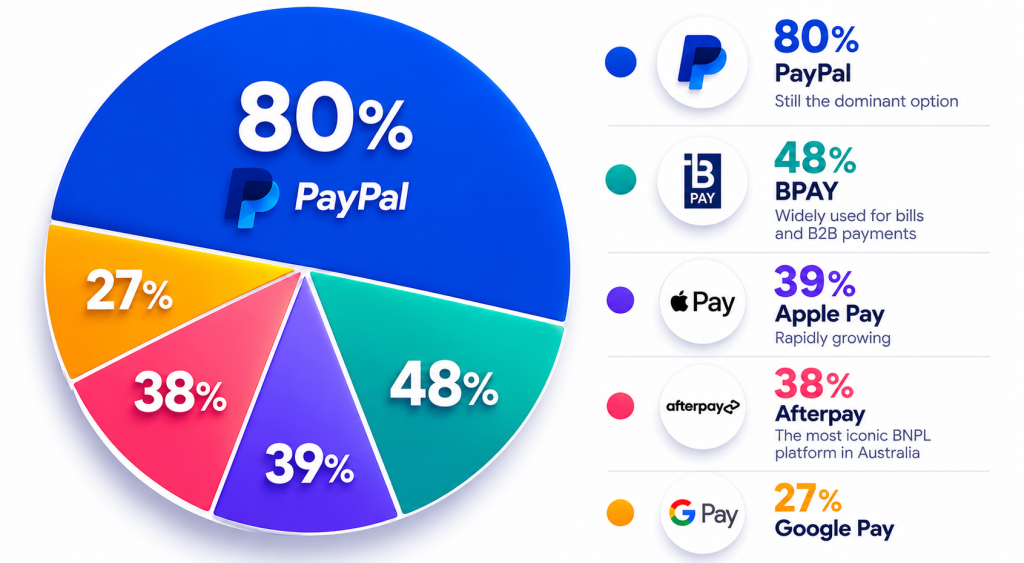
- PayPal: 80% usage, still the dominant payment option
- BPAY: 48%, widely used for bills and B2B payments
- Apple Pay: 39%, growing rapidly
- Afterpay: 38%, the most iconic BNPL platform in Australia
- Google Pay: 27%, stable usage with ongoing adoption growth
BNPL – A Unique Feature of the Australian Market
Australia is one of the world’s most advanced BNPL markets.
- Around 7 million active BNPL accounts, roughly 30% of the population.
- BNPL accounts for 15% of all online transactions.
Major providers include:
Afterpay (market leader with 3.5M+ users in Australia), Zip Co, Klarna, Humm, and Openpay.
Important 2026 Regulatory Update:
From June 10, 2025, all BNPL providers in Australia are required to hold an Australian credit license and comply with responsible lending obligations under the National Consumer Credit Protection Act 2009. This is the most significant regulatory change in the history of Australia’s BNPL industry and directly affects ecommerce integration strategies.
In addition, the Australian government is considering banning debit card surcharges starting January 1, 2026, which could significantly change checkout experiences across all online stores.
6. Mobile Commerce – No Longer a Trend, It’s Reality
If your ecommerce website is not mobile-first, you are losing money every single day.
- 77% of store traffic comes from smartphones
- 68% of orders are completed on mobile devices
- Mobile commerce is growing at 28.8% year-over-year in Australia
- More than two-thirds of users under 30 regularly use mobile payments
Key takeaway for sellers:
Cart abandonment caused by poor mobile checkout experience is the number one reason customers leave. The second most common reason is unexpected fees appearing at checkout.
7. Key Ecommerce Trends in Australia 2026
AI Personalization Becomes the New Standard
AI-driven product recommendations are no longer a competitive advantage, they are now a baseline expectation.
Tools like Shopify Magic and other AI engines are widely adopted to:
- Personalize product recommendations in real time
- Generate SEO-optimized product descriptions
- Analyze customer behavior automatically
Brands that do not use AI personalization are already falling behind in conversion performance.
Social Commerce Is Exploding
Social platforms are now becoming the starting point of shopping journeys, especially for younger users.
- TikTok Shop and Instagram Shopping are capturing increasing market share in product discovery.
- Gen Z no longer starts with Google, they start with short-form video content.
- Around 83% of shoppers research products online before making a purchase decision.
Social commerce is no longer optional; it is becoming a core acquisition channel.
Omnichannel Is No Longer Optional
Retailers with a strong omnichannel strategy retain 89% of their customers, compared to only 33% for single-channel businesses.
Key insight:
- Omnichannel shoppers generate 30% higher lifetime value (LTV) than single-channel shoppers.
This means physical stores, ecommerce websites, marketplaces, and social channels must work together as one unified system.
Sustainability Influences Buying Decisions
Australian consumers, especially Millennials and Gen Z are increasingly influenced by sustainability factors.
Key expectations:
- Ethical sourcing
- Reduced packaging waste
- Local or transparent supply chains
- Environmental responsibility
Brands without a clear sustainability message are losing trust and conversion rates in these segments.
Headless Commerce for Enterprise Growth
Large enterprises are shifting toward headless architecture to gain more flexibility in user experience while maintaining a strong backend system.
Benefits include:
- Full control over frontend experience
- Faster performance optimization
- Easier integration with multiple sales channels
This approach is becoming standard for enterprise-level ecommerce in Australia.
Same-Day and Instant Delivery Expectations
Delivery speed is becoming a key competitive factor.
- Major cities are moving toward 2-hour delivery windows
- Dark store networks are expanding rapidly
- Click-and-collect is widely adopted by retailers
Customer expectations are clear: fast delivery is no longer a premium feature, it is expected.
8. Biggest Challenges of Ecommerce in Australia
Despite strong growth, the Australian market comes with real challenges.
High Logistics Costs:
Australia’s large geographic size and dispersed population make shipping expensive, especially to regional and rural areas.
Strong Cross-Border Competition:
Platforms like Amazon Australia, Temu, and Shein are increasing pressure with aggressive pricing strategies.
Regulatory Complexity:
Businesses must comply with:
- GST (Goods and Services Tax)
- Australian Consumer Law (ACL)
- BNPL regulations
This requires ongoing legal and operational management.
High Cart Abandonment Rates
Main causes include:
- Unexpected fees at checkout
- Poor mobile optimization
- Complicated checkout flows
Cost of Living Pressure
Consumers are more price-sensitive than ever:
- 8/10 shoppers actively compare deals before purchasing
- Basket sizes are shrinking while deal-hunting behavior increases
9. Major Sales Events in Australia
Australia has several key retail events that strongly influence ecommerce performance.
| Event | Timing | Notes |
| Click Frenzy | November | One of the biggest local sale events |
| Black Friday / Cyber Monday | Late November | Increasingly dominant in Australia |
| EOFY Sale | June–July | End of Financial Year, uniquely important in Australia |
| Afterpay Day | March | BNPL-driven sales event |
| Boxing Day | December 26 | Traditional and still extremely strong |
| Australia Day Sales | January | Smaller but growing |
Key Insight: Peak season (Black Friday + Christmas 2025) processed 110.7 million parcels via Australia Post, up 7.6% year over year. Parcel locker usage also increased by 18%, showing strong demand for flexible delivery options.
10. Conclusion
The Australian ecommerce market in 2026 is large, stable, and competitive. Growth is strong, but so are expectations around speed, mobile experience, and payment flexibility. Success is no longer about simply launching a store, but about how well you handle conversion, logistics, and customer experience under real market pressure.
For most businesses entering or scaling in Australia, the real challenge is execution: choosing the right platform, integrating local payment methods like BNPL, and building systems that can handle high customer expectations without driving up operational cost.
This is where experienced implementation matters.
ONEXT DIGITAL helps ecommerce brands and retailers build and optimize Shopify, WooCommerce, and custom ecommerce systems tailored for the Australian market. From platform selection and migration to performance optimization and AI-driven customer experience, the focus is on reducing wasted cost, improving conversion, and scaling sustainably in competitive conditions like Australia.
If you’re planning to enter the Australian market or want to improve your current ecommerce performance, contact ONEXT DIGITAL to get tailored consultation and a clear execution roadmap.
READ MORE: WordPress Australia Review: Is It a Practical Choice for Your Business?
FAQs
Is the Australian ecommerce market still worth entering in 2026?
Yes, but it is a mature and competitive market. Growth still exists, but success depends on execution quality, pricing strategy, and customer experience rather than early-market advantages.
What is the biggest challenge for ecommerce businesses in Australia?
High logistics costs, strong cross-border competition, and high customer expectations around fast delivery, mobile checkout, and flexible payment options like BNPL.
Which ecommerce platform is best for Australia?
There is no single best platform. Shopify is widely used for ease of scaling, WooCommerce is strong for SEO-focused businesses, BigCommerce suits B2B and high-volume operations, and Maropost is popular for local omnichannel retail.
How important is BNPL in the Australian market?
Very important. BNPL accounts for a significant share of transactions, especially among younger consumers. Integrating providers like Afterpay or Zip can directly impact conversion rates.
Do Australian customers prefer mobile or desktop shopping?
Mobile dominates. Most traffic and a large share of purchases come from smartphones, making mobile-first UX and checkout optimization essential.
How can ONEXT DIGITAL help with entering the Australian ecommerce market?
ONEXT DIGITAL supports businesses with platform selection, Shopify/WooCommerce development, system integration, performance optimization, and AI-driven ecommerce solutions tailored specifically for the Australian market.