
 Services
 Solutions
 Main platform
 Technology
 White Label
  Offshore
 Hire developers



Shopify is one of the most popular ecommerce platforms in Australia, especially for DTC brands, growing retailers and businesses that want to launch online without building a custom system from scratch.
But popularity does not automatically mean Shopify is the right choice for every Australian business.
In 2026, ecommerce in Australia is more competitive, more margin-sensitive and more operationally demanding than it was a few years ago. Customers expect fast checkout, flexible payments, reliable delivery, transparent return policies and a trustworthy shopping experience. At the same time, merchants need to think carefully about subscription fees, payment costs, app expenses, POS requirements, shipping integrations and long-term scalability.
This Shopify Australia review looks beyond the basic feature list. It examines where Shopify fits in the Australian market, what it really costs, how it performs for payments, POS, shipping and omnichannel selling, and where the platform may create limitations as a business grows. If you are planning to build or scale a Shopify store in Australia, our Shopify development services can help with strategy, design, development and system integrations.
1. Australia Ecommerce Market Context in 2026
Australia’s ecommerce market continues to grow strongly in 2026. According to the Australia Post eCommerce Report 2026, Australians spent $82.6 billion online, representing an increase of approximately 14% compared with the previous year. Around 9.8 million households, equivalent to roughly 82% of Australian households, shopped online in 2025. Among them, 41% purchased online at least once every two weeks, showing that ecommerce has become a mainstream shopping habit in Australia, rather than just a secondary sales channel.
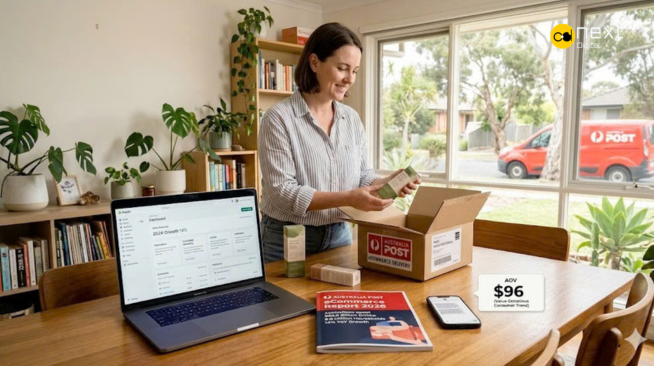
However, this growth also comes with new pressure. Australian consumers are shopping online more frequently, but they are also becoming more value-conscious. The average basket value is now around $96, approximately $10 lower than in 2020.
Therefore, when evaluating Shopify in the Australian market, businesses should not only look at its ability to create an online store. The more important question is whether Shopify can properly support promotions, bundles, email/SMS marketing, loyalty programs, upselling, fulfilment, checkout, and conversion rate optimisation.
2. Shopify’s Market Share and Popularity in Australia
According to BuiltWith, Shopify is the ecommerce technology with the largest number of websites in Australia, with around 168,266 current Shopify customers/websites. BuiltWith also records approximately 4,595 Shopify Plus websites in Australia. It is important to note that BuiltWith measures detected website technology, not revenue or GMV.
StoreLeads provides another perspective. Australia accounts for around 4.6% of all Shopify stores globally, with approximately 130,228 Shopify stores in its May 2026 update. StoreLeads also reports that Shopify stores in Australia increased by 7% year over year in Q1 2026 and 0.6% quarter over quarter.
Expert Insight: Shopify has a very strong position in Australia, especially among DTC, fashion, beauty, lifestyle, homeware, food and beverage brands, and businesses that need to sell across multiple channels. Compared with BigCommerce, Shopify has clearer advantages in ecosystem maturity, developer community, app marketplace, and merchant familiarity.
3. Shopify Australia Pricing in 2026
According to Shopify Australia’s official pricing page, the main annual plans include:
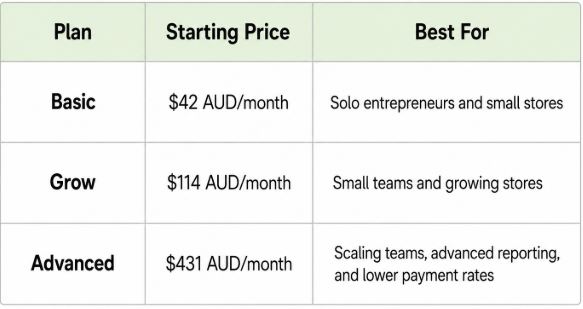
Shopify Australia also displays card rates starting from 1.75% + 30¢ AUD for the Basic plan when using Shopify Payments.
For Shopify POS in Australia, Shopify POS Lite is included in paid plans, while POS Pro costs $129 AUD/month per location. Shopify Australia’s POS pricing page also lists card rates from 1.75% + 30¢ AUD online and 1.95% + 0¢ AUD in person for the Basic plan.
Expert Insight: Shopify may look predictable in terms of monthly subscription fees, but the total cost in Australia must also include payment fees, third-party app fees, premium themes, POS Pro location fees, development costs, migration costs, and additional fees when using third-party payment providers.
4. Payment Trends in Australia and Their Impact on Shopify
Shopify is strong in Australia because it offers Shopify Payments, POS, online card payments, social commerce support, and multiple payment integrations. However, from 1 October 2026, Australia will ban debit and credit card payment surcharges under reforms introduced by the Reserve Bank of Australia.
Reuters reported that this change will apply to eftpos, Mastercard, and Visa, while the RBA will also reduce interchange fees. Consumers are expected to save approximately A$1.6 billion per year.
What This Means for Shopify Merchants in Australia: Once surcharges are removed, merchants will find it harder to pass card payment costs directly to customers. This makes Shopify Payments rates, payment mix, AOV, profit margin, and pricing strategy more important. For stores with thin margins, payment costs are no longer a minor operational detail.
5. Shopify POS and Omnichannel Commerce in Australia
Shopify POS is a strong advantage for Australian merchants that sell both online and through physical stores, pop-up stores, showrooms, or retail locations. According to Shopify, basic in-person selling is included in paid plans, while POS Pro is designed for permanent retail operations.

A detailed review of Shopify POS in Australia highlights several strengths, including solid ecommerce integration, a built-in payment system, good product management, an easy-to-use interface, and 24/7 support. However, the drawbacks include the need for a subscription, card rates that are not the cheapest, limited offline mode, and customer service that some users consider inconsistent.
Summary: Shopify POS is suitable for Australian retailers that want to manage online and offline sales within one system. However, if a business has multiple stores, requires stronger offline capabilities, complex loyalty workflows, or advanced inventory logic, it should carefully evaluate POS Pro costs and operational limitations before implementation.
6. Shopify POS Reviews
Capterra reviews for Shopify POS show that users often praise its ease of use, payment flexibility, inventory syncing, and mobile checkout. However, common complaints include pricing and limited offline functionality.
Another Shopify POS review notes that the platform has an easy-to-use interface and flexible payment options, but limited features at the free/basic level.
For small and mid-sized retailers in Australia, Shopify POS can be a practical fit, especially when online and offline sales need to stay in sync. Larger retail teams, businesses with several locations, or stores that rely heavily on offline selling should test the setup carefully and factor POS Pro into the total cost before committing.
7. Shipping, Fulfilment, and Australia Post
Shipping is a critical factor in Australia because of the country’s large geographic distances, complex regional delivery requirements, and customers’ high sensitivity to shipping costs. Shopify has many apps that support Australia Post, shipping labels, shipping rates, and tracking.
Reviews on the Shopify App Store for Australia Post shipping apps show mixed feedback. Some merchants give positive reviews because the apps help them create labels, integrate cleanly with the Shopify admin, and manage orders more easily. For example, a review of the PC: Australia Post Ship app says that the setup is straightforward, the integration with Shopify admin is clean, and label creation is easy.
However, there are also negative reviews. For the AMP: Australia Post Shipping app, one merchant complained that label creation was slow, some addresses were incorrectly marked as undeliverable even though shipping was possible, and certain orders behaved inconsistently.
Summary: Shopify has a strong shipping ecosystem in Australia, but businesses should not assume that every Australia Post app will work smoothly. For merchants with many SKUs, multiple free-shipping rules, regional delivery needs, or bulky goods, the shipping app should be thoroughly tested before launch.
8. Marketplaces, Ghost Stores, and Consumer Trust Issues
One very important point in a Shopify Australia review is that the article should not only focus on the positives. In Australia, the issue of “ghost stores” has become a major topic. Guardian Australia reported that more than 140 ghost stores impersonating local Australian retailers had been identified, and many of these websites used Shopify and advertised through Meta. The ACCC issued public warnings and called on platforms such as Shopify and Meta to take stronger action.

According to the ACCC, ghost stores often present themselves as local boutiques, family-owned shops, or businesses running a “closing down sale” in order to build trust and push customers to buy quickly. Guardian Australia also reported that more than 140 ghost stores impersonating local Australian retailers had been discovered, with many of them using Shopify and running ads through Meta. The ACCC later urged platforms such as Shopify and Meta to take stronger action.
This does not mean Shopify itself is the problem. However, it shows that legitimate Shopify stores in Australia need to invest more seriously in trust signals, including clear business information, ABN/ACN where applicable, transparent shipping and return policies, verified reviews, real contact details, and reliable customer support.
In other words, in the Australian market, trust signals are no longer a secondary part of an ecommerce website. They directly affect conversion rates and customer confidence.
9. Customer Reviews of Shopify: Strengths and Weaknesses
1. Shopify G2 Reviews
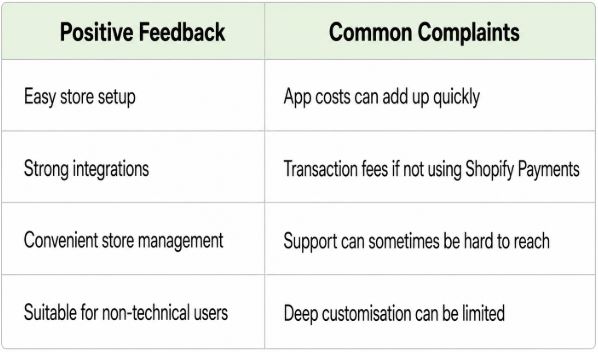
G2’s 2026 review data for Shopify shows that users often praise Shopify for being easy to use, having strong integrations, and allowing users to set up and manage a store without much technical knowledge. However, users also complain that costs can rise quickly because of transaction fees and the need for additional apps.
2. Shopify Capterra Reviews
Capterra includes many verified reviews for Shopify. One reviewer described Shopify as a “leader in easy out-of-the-box e-commerce solutions” and rated it highly for ease of use, customer service, features, and value for money. However, the same review also complained about transaction fees when using third-party processors, especially in restricted industries such as CBD.
Capterra also includes reviews saying that Shopify makes it easy to connect with social media channels for selling, but the setup process can be difficult if the merchant lacks the required documents or information to upload.
3. Insight
Merchant reviews generally agree that Shopify is very easy to start with. However, costs and limitations around payments and customisation become more visible as the business grows or operates in a restricted industry.
4. Shopify Trustpilot Reviews
As of 2026, Shopify.com has around 4,500–5,000 reviews on Trustpilot, with a TrustScore fluctuating at around 1.3–1.5 out of 5. This is a low score, but it should not be interpreted too simply as proof that Shopify is a poor-quality platform.
The reason is that many negative reviews on Trustpilot do not come from merchants using Shopify to build and run their stores. Instead, they often come from end customers who had poor experiences buying from individual stores built on Shopify. Common complaints include undelivered orders, unclear tracking, difficult refunds, product quality issues, and poor customer support. These are mostly issues caused by individual sellers, but in customers’ eyes, Shopify’s brand perception can still be affected.
For businesses in Australia, this data highlights an important lesson: Shopify remains a strong ecommerce platform, but trust signals need to be handled properly from the beginning. Stores should include clear business information, ABN/ACN where available, transparent shipping and return policies, order tracking, verified reviews, and reliable customer support. This helps reduce the risk of customers becoming suspicious, especially as Australian shoppers become more cautious about online stores that lack transparency.
10. Shopify Trends in Australia in 2026
Trend 1: DTC Remains Strong, but Competition Is Higher
Shopify is a strong fit for DTC brands in beauty, fashion, supplements, homeware, pet, and lifestyle categories. However, because AOV is decreasing and customers are becoming more price-sensitive, merchants need to optimise retention, email/SMS marketing, bundles, loyalty programs, and onsite conversion.
Trend 2: Omnichannel Becomes the Standard
Retailers in Australia increasingly need to synchronise their online store, POS, inventory, marketplaces, and social channels. Shopify has a major advantage here thanks to its ecosystem and POS capabilities.
Trend 3: Trust and Transparency Matter More
The ghost store issue has made buyers more cautious. Shopify stores in Australia should clearly display ABN, address/contact information, shipping policy, return policy, local support, and real customer reviews.
Trend 4: Payment Costs Will Receive More Attention
From 1 October 2026, when Australia bans card surcharges, merchants will need to factor payment fees into margins and pricing strategy instead of passing those costs directly to customers.
Trend 5: AI and Agentic Commerce Start to Influence Ecommerce
Shopify is investing heavily in AI. Reuters reported that Shopify said traffic and orders from AI increased sharply in Q1, while weekly active stores using Sidekick quadrupled. This signals that Shopify is moving from being an ecommerce builder toward becoming an AI-assisted commerce operating system.
11. Conclusion
Shopify is a strong choice for ecommerce businesses in Australia in 2026, especially DTC brands, growing retailers, and businesses that sell across multiple channels.
The platform stands out for its ease of use, fast deployment, strong payment integration, POS capabilities, broad theme selection, and large app ecosystem. However, Shopify is not always the cheapest or most flexible option. Businesses need to carefully calculate app costs, payment fees, POS Pro costs, shipping requirements, checkout limitations, and the total operating cost before making a decision.
At ONEXT DIGITAL, we help businesses assess the right ecommerce platform, build Shopify stores, optimise UX/UI, and integrate payments, POS, shipping, apps, and operational systems.
With experience delivering multiple ecommerce projects and real-world case studies, ONEXT DIGITAL helps businesses not only “open an online store”, but also build an ecommerce system that can grow sustainably in the Australian market.
See more of our Shopify projects here: https://onextdigital.com/case-studies/
FAQs
Is Shopify worth it for Australian businesses in 2026?
Yes, Shopify is a strong option for many Australian businesses, particularly DTC brands, growing retailers and merchants that want to launch quickly and scale across online, retail and social channels. However, the real value depends on your business model, margins, operational complexity and how many apps or integrations you need.
How much does Shopify cost in Australia?
Shopify’s monthly subscription is only one part of the total cost. Australian merchants should also factor in payment processing fees, app subscriptions, premium themes, development costs, POS Pro fees, and integration expenses. For growing businesses, the total operating cost can be significantly higher than the advertised plan price.
Does Shopify work well with Australia Post?
Yes. Shopify has multiple apps and integrations that support Australia Post for shipping rates, label generation and tracking. That said, app quality varies, so businesses with complex shipping rules or bulky products should test their preferred integration carefully before launch.
Is Shopify good for omnichannel retail in Australia?
Yes. Shopify is one of the strongest ecommerce platforms for combining online sales, retail stores, pop-up shops and social commerce. Its POS system and ecosystem make it well suited for merchants that want to manage inventory, customers and orders across multiple channels.
What are the main disadvantages of Shopify in Australia?
The most common drawbacks are rising app costs, payment fees, limited checkout flexibility on lower plans, and additional charges for advanced POS features. As businesses grow, they may need custom development or more sophisticated integrations to support complex operations.