
 Services
 Solutions
 Main platform
 Technology
 White Label
  Offshore
 Hire developers



WordPress is not a new platform, but its scale still matters. For Australian businesses in 2026, the question is no longer whether WordPress is popular. The better question is whether it can support modern SEO, AI search visibility, ecommerce growth, cybersecurity expectations and long-term website ownership.
The answer is yes, but with conditions. WordPress can still be a strong platform for Australian SMEs, service businesses, content-led brands and WooCommerce stores. It gives teams control over content, structure, integrations and future development. However, it is not a low-maintenance website builder. It needs the right architecture, hosting, plugin discipline, security setup and ongoing support.
This review looks at WordPress from an Australian business perspective, using 2026 market data and practical examples. It explains where WordPress fits, where WooCommerce makes sense, and when businesses should consider Shopify, BigCommerce, Magento or a more custom setup instead.
Key Australian context for 2026
Data point | Why it matters for WordPress decisions |
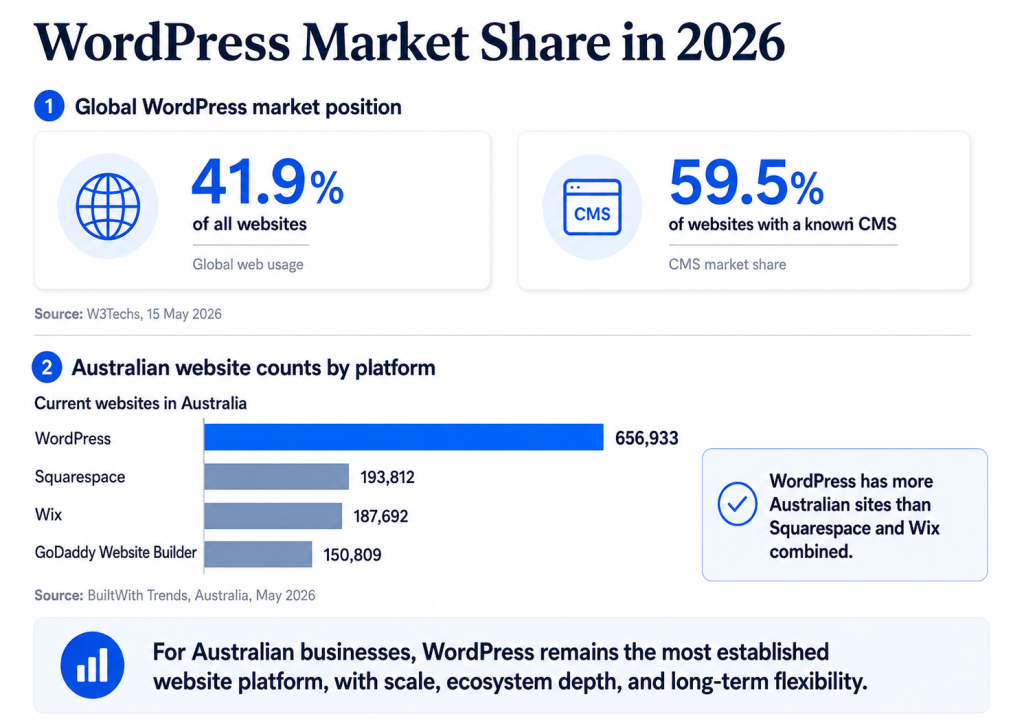
| WordPress powers 41.9% of all websites globally and 59.5% of websites with a known CMS, according to W3Techs data viewed on 18 May 2026. | The platform has a large developer pool, mature plugin ecosystem and lower long-term platform risk than niche CMS options. |
| BuiltWith lists 656,933 current WordPress websites in Australia. | WordPress is not a fringe option in Australia. Agencies, developers, hosts and plugin vendors actively support it. |
| BuiltWith lists 88,724 current WooCommerce Checkout websites in Australia. | WooCommerce already has meaningful adoption among Australian online sellers, especially small to mid-market stores. |
| Australia Post reports that 82% of Australian households, or 9.8 million households, shopped online in 2025. | Ecommerce websites now compete in a mature market where speed, trust, checkout quality and fulfilment clarity matter. |
| ASD’s ACSC reported over 84,700 cybercrime reports in FY2024-25, around one every six minutes. | Security, backups and maintenance are not optional for Australian business websites. |
WordPress Market Share in 2026
WordPress and WooCommerce in Australia’s 2026 Ecommerce Landscape
Australia’s ecommerce market is no longer in an early growth phase. It is mature, competitive and more demanding. Australia Post’s 2026 eCommerce Report says 82% of Australian households shopped online in 2025, equal to 9.8 million households, and 41% of those households now shop online at least fortnightly. Australia Post also reported record online spend of $82.6 billion in 2025, up around 14% year on year.
That context changes how businesses should think about WooCommerce. WooCommerce is not only a plugin that adds a cart to WordPress. For the right retailer, it can become a flexible ecommerce layer where product content, SEO landing pages, guides, reviews, promotions and checkout sit in one controllable system. BuiltWith lists 88,724 current WooCommerce Checkout websites in Australia, showing that it is already a serious option for local retailers, niche ecommerce brands and product-led businesses.
WooCommerce works best when the business needs strong content and flexible product storytelling. For example, an Australian skincare brand, furniture retailer, B2B supplier or specialty food store may need buying guides, suburb or city landing pages, product education, FAQs, comparison content and email capture. WordPress and WooCommerce can support that naturally because the store is not separated from the content engine.
However, the Australian ecommerce market also brings pressure. Australia Post’s marketplace data shows that 73% of online shoppers made a purchase on a marketplace in 2025, and 29% start product discovery on marketplaces. That means WooCommerce stores cannot rely on having a website alone. They need SEO, product schema, fast mobile pages, clear shipping logic, payment options familiar to Australian shoppers and integration with marketplaces, POS, inventory or fulfilment systems where relevant.
The practical rule is simple: WooCommerce suits small to mid-market Australian retailers that need ownership, SEO and flexible product experiences. It becomes harder when the operation needs complex multi-warehouse fulfilment, advanced B2B pricing, ERP-heavy inventory, high order volume or deep omnichannel workflows. At that point, Shopify Plus, BigCommerce, Magento or a custom ecommerce architecture may be more suitable.
Is WordPress Ready for AI Search and Modern SEO?
Yes, but only if the site is built for modern search rather than old-style keyword publishing. SEO in 2026 is no longer just writing blog posts and placing keywords in headings. Australian businesses now need to prepare for AI Overviews, entity-based search, structured data, author credibility, internal linking, content clusters and pages that answer specific buying or service questions clearly.
Google’s own Search Central documentation now explains AI features such as AI Overviews and AI Mode from a website owner perspective. Google also states that structured data helps it understand page content and the entities on a page. For WordPress sites, this is important because schema, content architecture and editorial structure can be managed with more control than on many closed website builders.
WordPress can support AI-ready SEO in several practical ways. A service business can build city-level pages for Sydney, Melbourne, Brisbane and Perth without losing control of templates. A B2B software company can create topic clusters around cloud migration, ecommerce development or cybersecurity. A WooCommerce store can combine product structured data, buying guides, FAQs and comparison content. A professional services firm can strengthen author pages, case studies, trust signals and internal links.
But WordPress does not make a site AI-search ready by default. A poorly structured site with thin pages, duplicated service content, weak internal linking and no schema will struggle. The opportunity is in how WordPress is planned: clean information architecture, reusable page templates, schema for organization, article, product, FAQ or local business where appropriate, and editorial workflows that make expertise visible.
For Australian businesses competing in local SEO, this matters even more. Search journeys are becoming more specific: users search by suburb, service urgency, pricing, industry and trust signals. A well-built WordPress site can support those journeys through service pages, case studies, location content, FAQs, comparison pages and conversion-focused landing pages.
Why Australian Businesses Still Choose WordPress?
The main reason WordPress continues to work for Australian businesses is control. Marketing teams can publish content, update landing pages, add case studies and improve SEO without waiting for a full development cycle. Developers can also extend the site with custom post types, API integrations, multilingual content, CRM connections, booking systems or ecommerce features.
For service-based companies, WordPress is especially useful because lead generation often depends on organic search. A law firm, healthcare provider, construction company, SaaS firm or IT services provider may need multiple service pages, local landing pages, long-form guides, testimonials, lead forms and downloadable resources. WordPress can support that structure better than simple site builders when the site is planned properly.

For Australian SMEs, the cost structure can also be attractive. WordPress itself is open source, so the business is not tied to one vendor’s closed environment. The real investment goes into hosting, design, development, plugins, maintenance and ongoing improvements. This can be more flexible than paying for a platform that becomes restrictive once the business needs custom functionality.
The risk is that flexibility can turn into technical debt. A WordPress site built quickly with a heavy theme, too many plugins and no content structure may look acceptable at launch but become slow and difficult to scale within one or two years. That is why businesses should treat WordPress as a long-term digital asset, not a one-off website project.
Cybersecurity Is a Bigger Issue for Australian Businesses
Cybersecurity deserves more attention in any Australian WordPress decision. The ASD’s Australian Cyber Security Centre reported more than 84,700 cybercrime reports in FY2024-25, around one report every six minutes. For businesses, the average self-reported cost per cybercrime report was $80,850 overall. The average cost was $56,600 for small businesses, $97,200 for medium businesses and $202,700 for large businesses.
This is directly relevant to WordPress because many security problems come from poor maintenance rather than WordPress itself. Outdated plugins, weak passwords, abandoned themes, no backups, poor hosting, exposed admin accounts and untested updates are common causes of risk. For a site that collects leads, customer details, payment information or account data, those risks can become business problems, not just technical problems.
Australian businesses should not choose WordPress unless they are prepared to maintain it. A sensible setup should include managed hosting or properly configured VPS infrastructure, SSL, strong admin access control, two-factor authentication, firewall protection, regular backups, plugin update testing, malware monitoring and a recovery plan. For WooCommerce, security is even more important because checkout, customer data and payment workflows are involved.
The right question is not whether WordPress is secure. It can be secure. The better question is whether the business has the right maintenance process and technical partner to keep it secure after launch.
Common Problems Australian Businesses Face When They Outgrow a Basic WordPress Site
Many Australian businesses start with a basic WordPress website because it is affordable and quick to launch. The problems usually appear later, when the website becomes more important to marketing, sales or operations.
The first common issue is performance. A site may be built with a heavy theme or page builder, then filled with plugins, uncompressed images and third-party scripts. After one or two years, the site becomes slow, hard to edit and expensive to improve. This is a major problem for Australian users browsing on mobile, especially when pages are hosted far from the target market or lack proper caching and CDN setup.
The second issue is content structure. Marketing teams often want to launch campaign pages, service pages, comparison pages or content hubs quickly. But if the original build did not include reusable templates, clean navigation and sensible custom post types, every new page becomes manual work. This slows down SEO campaigns and creates inconsistent layouts.
The third issue appears in WooCommerce stores. A simple store may work well at first, but as the business grows it may need shipping rules, Australia-specific delivery logic, stock sync, POS connection, ERP integration, wholesale pricing, marketplace feeds or better reporting. If the original setup relies on disconnected plugins, the store can become fragile and hard to troubleshoot.
The fourth issue is poor lead and data integration. Many websites collect form enquiries but do not sync properly with a CRM, email marketing platform or sales workflow. Leads sit in inboxes, attribution is unclear and follow-up becomes inconsistent. For B2B Australian companies investing in SEO or paid campaigns, this weakens the commercial value of the website.
The fifth issue is security being considered too late. Backups, staging environments, update testing and access control are often only discussed after a plugin conflict, hacked form, broken checkout or failed update. By then, the business has already lost time and trust.
How Much Does a Professional WordPress Website Cost in Australia?
A professional WordPress website in Australia can vary widely in cost. A small brochure site may sit in the lower thousands of AUD, while a custom lead generation website, WooCommerce store or integration-heavy build can move into five figures or more. The better way to think about cost is by business role, not page count.
A simple service website needs domain, hosting, design, development, analytics, basic SEO setup, forms and maintenance. A stronger SEO-led website needs information architecture, service page templates, blog or resource hubs, schema, speed optimisation, conversion tracking and ongoing content support. A WooCommerce build may also need payment gateways, shipping setup, tax rules, product data structure, checkout customisation and integrations.
Ongoing costs should also be planned. Hosting, premium plugins, backups, security tools, maintenance, bug fixes and improvements are part of the real cost of owning a WordPress site. Businesses that ignore ongoing support often pay more later when performance, security or compatibility issues appear.
WordPress vs Shopify, Wix, Squarespace and BigCommerce in Australia
WordPress is not always the best platform. Shopify may be better for Australian retailers that want a managed ecommerce platform, fast launch, simple product operations and less technical responsibility. Wix or Squarespace may be enough for very simple businesses that only need a small online presence and do not plan serious SEO growth. BigCommerce may be stronger for businesses with more complex ecommerce operations, B2B catalogues or backend workflows.
WordPress wins when the website needs content depth, SEO flexibility, custom structure and long-term ownership. WooCommerce wins when ecommerce needs to sit close to content, education and flexible landing pages. But if the core requirement is operational ecommerce complexity, WordPress should be compared carefully against dedicated commerce platforms.
For Australian businesses, the decision should come down to operating model. If the website is mainly a marketing and lead-generation engine, WordPress is often a strong fit. If the website is mainly a simple online shop, Shopify may be easier. If the website is a complex ecommerce system connected to ERP, POS and multi-channel fulfilment, BigCommerce, Magento or a custom solution may be more appropriate.
Final Verdict: Should Australian Businesses Choose WordPress in 2026?
WordPress is still a practical choice for many Australian businesses in 2026. Its market share, developer ecosystem, plugin maturity and content flexibility make it especially useful for businesses that care about SEO, lead generation, content marketing, ecommerce content and long-term control.
The strongest WordPress use cases in Australia are service businesses, professional firms, healthcare providers, agencies, content-led brands, B2B companies and small to mid-market WooCommerce stores. These businesses benefit from flexible content structures, local SEO capability, landing page control, schema implementation, CRM integration and ownership of the website environment.
The weakest WordPress use cases are businesses that want almost no maintenance, need only a basic online presence, or run ecommerce operations that are too complex for a plugin-led architecture. In those cases, a managed website builder, Shopify, BigCommerce, Magento or a custom build may be a better fit.
For ONEXT DIGITAL’s clients, the recommendation is not to choose WordPress because it is popular. Choose it when the business needs a scalable, SEO-ready and integration-friendly website that can grow over time. Build it with clean architecture, strong hosting, careful plugin choices, security from day one and a maintenance plan. That is when WordPress becomes more than a website platform. It becomes a long-term digital asset for the Australian market.
If you are evaluating whether WordPress, WooCommerce or Shopify is the right platform for your Australian business, contact ONEXT DIGITAL to discuss your requirements.
FAQs
Is WordPress good for Australian businesses?
Yes. WordPress works well for businesses that want flexibility, SEO capability and a website that can grow over time.Yes. WordPress works well for businesses that want flexibility, SEO capability and a website that can grow over time.
How much does a WordPress website cost in Australia?
Costs vary based on design, features and support needs. Besides development costs, businesses should also consider hosting, plugins and ongoing maintenance.
Is WordPress good for SEO?
Yes. WordPress gives businesses strong control over content, site structure and technical SEO, making it a solid option for long term organic growth.
Is WooCommerce good for Australian online stores?
WooCommerce can work well for small and mid sized stores, especially when SEO and content are important parts of the strategy.
Is WordPress better than Shopify?
It depends on the business. Shopify is often simpler for ecommerce, while WordPress offers more flexibility and content control.
Do WordPress websites need ongoing maintenance?
Yes. Regular updates, backups and security checks help keep a WordPress website secure and performing properly over time.