
 Services
 Solutions
 Main platform
 Technology
 White Label
  Offshore
 Hire developers



If you’ve ever searched online for Web Application Development Cost Estimation, you’ve probably noticed one frustrating thing: the numbers vary wildly, and it’s hard to know what to trust. The reality is, there’s no single formula for estimating costs. Every web application is unique, and the final price depends on factors like the app type, required features, design complexity, deadlines, and even the location of your development team.
Estimating costs without fully understanding your project often leads to misleading results. In this guide, we’ll break down the main elements that influence web application development cost estimation, show you how to plan a realistic budget, and share practical tips to optimize spending. By the end, you’ll have a clear picture of what your 2026 web app project might cost and how to plan it effectively from the start.
Key Takeaways:
- The main factors that affect web application development cost estimation include project scope, app type, design complexity, deadlines, hiring model, and developer location.
- Costs can be reduced by starting with a minimum viable product (MVP), using AI or low-code tools, planning carefully, leveraging cloud infrastructure, or outsourcing development.
- Depending on your project type and complexity, 2026 web application development costs can range from around $20,000 for a simple app to over $250,000 for large enterprise solutions.
What is a web application?
A web application is a type of software that runs directly in a web browser and is delivered to users over the Internet. Unlike traditional desktop applications that require installation on a local device, web apps are hosted on remote servers and can be accessed from anywhere through a web interface.
Some popular examples of web applications include:
- Google Docs: a cloud-based document editing platform.
- Gmail: a widely used web-based email service.
- Facebook: a social networking platform accessible through browsers.
- Trello: a collaborative project management tool.
- Netflix: a video streaming service available via the web.
Web applications are often compared with native apps and hybrid apps, as each type offers different advantages in terms of performance, accessibility, and user experience.
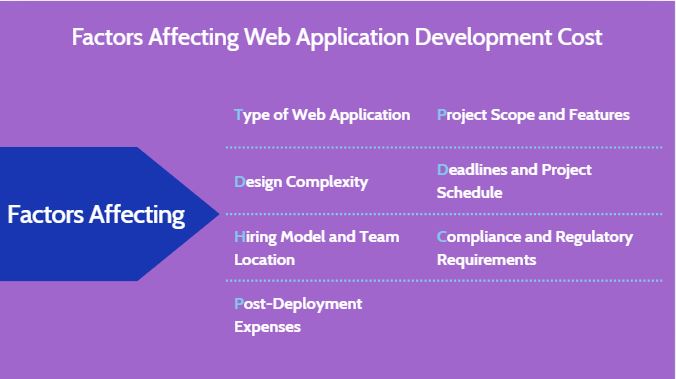
Factors Affecting Web Application Development Cost
Web application development is a complex, multi-layered process. Every decision from the type of application to the development team’s location can influence the final budget. Understanding these factors is critical for accurate web application development cost estimation and for planning an effective development strategy.
1. Type of Web Application
The type of web app you build is one of the first and most significant cost determinants. Different app structures come with distinct development requirements, maintenance demands, and infrastructure considerations.
Single Page Applications (SPAs)
SPAs dynamically update content without reloading the entire page, providing smooth, real-time user experiences. They are widely used for social media platforms, SaaS products, collaboration tools, and marketplaces. SPAs excel in fast interactions, mobile optimization, and seamless user experience.
Examples include Trello, Google Calendar, and Slack. Initial development costs for SPAs are generally higher due to complex frontend logic, but they become cost-effective over time due to reduced server dependency.
Multipage Applications (MPAs)
MPAs are structured around multiple pages and are ideal for content-heavy, SEO-driven platforms such as e-commerce sites, corporate portals, and educational platforms.
Examples include Amazon, Booking.com, and BBC. MPAs are well-suited to manage large volumes of information and provide robust SEO performance. While initial development may be lower than SPAs, long-term maintenance and server costs can accumulate due to multiple templates and heavier backend updates.
Progressive Web Applications (PWAs)
PWAs combine the functionality of web apps with native app experiences. They provide offline capabilities, caching, push notifications, and app-like performance in browsers. While PWAs require a higher upfront investment, their long-term infrastructure costs are lower.
Examples include Starbucks, Alibaba, and Flipkart. PWAs are ideal for businesses seeking scalable, high-performing solutions with mobile-first experiences.
Understanding your app type is essential for accurate web app development cost estimation, as it dictates infrastructure, development hours, and maintenance needs.
2. Project Scope and Features
Project scope is the backbone of any web application development cost estimation. A small online store with a few dozen products requires significantly less effort than a custom enterprise inventory management system with real-time analytics.
Key scope elements include:
- Features and Functionality: Advanced features such as AI-driven personalization, analytics dashboards, real-time communication, or multi-user roles increase development complexity and costs.
- Third-Party Integrations: Payment gateways, CRMs, marketing automation tools, GPS navigation, or APIs require additional time, testing, and maintenance.
- Requirement Changes: Unexpected changes or additions during development, also known as scope creep, will increase your web app development budget.
- Mobile Compatibility: With mobile devices generating over 60% of web traffic globally, responsive design and mobile-first optimization are essential.
- Tech Stack: Popular technologies like JavaScript, Python, and PHP are more cost-effective due to widely available developer talent, whereas niche frameworks may increase hourly rates.
A clear, detailed project scope allows precise web application development cost estimation and prevents surprises during development.
3. Design Complexity
The design of a web application greatly affects its development timeline and cost. Design complexity can vary depending on UI/UX elements, interactivity, branding, and responsiveness.
- Low Complexity: Standard landing pages, basic navigation, and simple forms. Suitable for small business websites and straightforward product showcases.
- Medium Complexity: E-commerce stores or SaaS platforms with interactive dashboards, product pages, and custom branding.
- High Complexity: Enterprise solutions, social networks, or platforms with fully custom interfaces, advanced UX workflows, real-time features, and data-driven visualizations.
Design typically accounts for 20-50% of overall web app development costs. Investing in thoughtful design at the planning stage reduces rework, improves user engagement, and ensures long-term ROI.
4. Deadlines and Project Schedule
Tight deadlines can increase your web application development cost estimation because they often require larger teams, overtime, and expedited workflows. Rushed development can also lead to bugs, higher maintenance costs, and potential project failure.
Tip: Base your deadlines on realistic project scope and team capacity, rather than external financial pressures. Proper scheduling reduces risk, ensures quality, and helps keep your web app development budget on track.
5. Hiring Model and Team Location
Who builds your application and where they are located directly impacts your development costs.
- In-house teams: Offer maximum control and integration with company culture but come with high upfront and ongoing expenses. Best suited for projects with sensitive data or long-term product development.
- Outsourcing: Provides access to highly skilled talent at lower cost, particularly in regions such as Eastern Europe or Southeast Asia. Outsourcing can save up to 40% of development costs without compromising quality.
- Freelancers: Ideal for small projects or specialized tasks but may carry risks related to consistency, reliability, or communication.
Regional cost differences for web app development are notable:
- North America: $140 to $175 per hour
- Eastern Europe: $65 to $75 per hour
- Southeast Asia: $30 to $45 per hour
- Latin America: $60 to $85 per hour
Selecting the right hiring model and location is crucial for balancing cost efficiency, quality, and timely delivery.
6. Compliance and Regulatory Requirements
Depending on your industry, compliance with regulations can significantly influence your web application development cost estimation.
- Healthcare: Apps must comply with HIPAA, EVV, HL7, and other regional standards.
- Finance: Solutions must adhere to PCI DSS, GDPR, and other local financial regulations.
- Global Operations: Expanding internationally may require compliance with regulations such as PIPEDA, GDPR, or LGPD.
Higher regulatory complexity increases development time, testing, and security measures, thereby raising your web app development budget.
7. Post-Deployment Expenses
Planning for post-launch costs is critical for accurate web application development cost estimation. These can amount to 10-30% of the initial project budget annually:
- Maintenance and Support: Security patches, updates, performance monitoring, and minor enhancements.
- Bug Fixes: Even well-tested apps can encounter issues requiring rapid response.
- Third-Party Software Fees: Licensing costs for APIs, CMSs, CRMs, or automation tools.
- Marketing and Business Development: Costs for user acquisition, onboarding campaigns, or external consultants.
Properly estimating post-deployment costs ensures your web app remains functional, secure, and scalable after launch.
How Much Does It Cost to Develop a Web Application?
Determining the web application development cost is one of the most challenging parts of starting a new project. The truth is, there’s no universal answer every web app is unique, and the total budget depends on its complexity, technology stack, team structure, and business goals.
While exact numbers require a detailed project analysis, it’s possible to create an informed web application development cost estimation based on typical project scales and deliverables.
Let’s explore what different types of web projects cost and what you get for each level of investment.
1. Proof of Concept (POC): Validating the Feasibility
If you are at the idea stage or need to convince investors that your concept is technically possible, developing a proof of concept is an ideal first step.
A POC is a lightweight version of your future application designed to test the technical viability of core features. It’s not intended for public use but serves as an internal prototype that helps you:
- Validate whether your technology stack can support planned functionalities.
- Demonstrate the project’s potential to stakeholders or investors.
- Reduce financial risk by identifying limitations early.
The average cost for a web-based POC typically ranges between $5,000 and $30,000, depending on the scope and functionality tested.
For example, a POC for a machine-learning-driven recommendation system will naturally cost more than a simple data entry prototype.
2. Minimum Viable Product (MVP): Testing the Market
Once your POC proves feasible, the next logical step is to create a Minimum Viable Product (MVP).
An MVP includes the essential features that allow early users to interact with your product, provide feedback, and validate your business model. It’s not just a prototype it’s a working version of your app with limited but meaningful functionality, designed to test your value proposition in real market conditions.
A web app MVP typically costs between $20,000 and $150,000, depending on its scale and functionality.
Basic MVPs often include:
- User registration and authentication.
- A simple dashboard or main functionality flow.
- Integration with basic APIs.
More advanced MVPs may include AI-powered features, complex user roles, real-time notifications, or compliance with industry-specific regulations such as HIPAA or GDPR.
Building an MVP first helps refine the product direction and prevents overspending on unnecessary features a crucial part of strategic web app development budgeting.
3. Full-Scale Web Applications: From Simple to Enterprise-Level
Once your MVP has proven its potential, you can expand it into a full-fledged product. Let’s look at the web application development cost estimation for three typical scales: simple, medium, and complex web apps.
| Factor | Simple Web App | Medium Web App | Complex Web App |
| Average Cost | $20,000 – $75,000 | $75,000 – $250,000 | $250,000+ |
| Project Duration | 800 – 1,200 hours | 2,000 – 3,000 hours | 3,000+ hours |
| Number of Pages | 5 – 20 | 20 – 100 | 100 – 500+ |
| Description | Basic business websites or landing pages with limited interactive features and simple navigation. | Mid-sized business applications featuring dashboards, databases, and moderate user interaction. | Enterprise-grade web apps with complex workflows, multi-role access, and advanced integrations. |
| Example Use Cases | Promo sites, small service pages, internal tools. | E-commerce stores, blogging platforms, CRM systems. | Banking portals, trading platforms, healthcare management systems. |
3.1 Simple Web Applications
Simple web apps are ideal for startups or small businesses looking for an online presence without heavy functionality.
They usually include:
- Static or semi-dynamic pages such as Home, About, Services, Contact.
- Basic authentication and limited integrations.
- Pre-built templates or UI kits.
These apps focus on presentation rather than interaction. The average development cost starts around $20,000 and can go up to $75,000 depending on customization needs and design quality.
3.2 Medium Complexity Web Applications
Medium-sized applications are where businesses start to see advanced functionality.
They often include:
- Custom dashboards and user authentication.
- Real-time data synchronization and analytics.
- Integration with CRMs, payment gateways, or third-party APIs.
- Personalized UX with responsive design and scalable backend infrastructure.
The cost of medium web applications ranges between $75,000 and $250,000, depending on the number of modules and integration complexity. These are common among SaaS products, online marketplaces, and e-commerce platforms that require performance and scalability.
3.3. Complex and Enterprise Web Applications
Complex enterprise-grade web applications are at the top end of the spectrum and understandably, the most expensive.
These systems are designed to handle large-scale data, ensure high security, and comply with strict regulatory requirements.
They often feature:
- Multi-level access control and advanced user management.
- Machine learning, AI, or data-driven decision systems.
- Real-time communication and reporting tools.
- Integration with multiple enterprise systems such as ERP or BI software.
- Regulatory compliance (HIPAA, PCI DSS, GDPR).
The starting cost for enterprise web apps typically begins at $250,000 and can easily exceed $500,000 depending on functionality and infrastructure requirements.
Industries like healthcare, banking, logistics, and government commonly invest in such solutions due to their need for stability, security, and data integrity.
3.4 Estimating Time and Resources
To better understand how your web application development cost estimation connects with project duration and team effort, consider the general resource breakdown:
Project Type | Average Duration | Core Team Composition |
| Simple Web App | 2–3 months | 1 Project Manager, 1–2 Developers, 1 Designer, 1 QA Engineer |
| Medium Web App | 4–6 months | 1 Project Manager, 3–4 Developers, 1 UI/UX Designer, 1 QA Engineer |
| Complex Web App | 6–12+ months | 1 Product Owner, 5–8 Developers, 2 Designers, 2 QA Engineers, 1 DevOps Specialist |
The number of developers, their hourly rates, and the chosen tech stack will further influence the final budget.
In summary, the web app development cost in 2026 ranges from $20,000 to over $500,000, depending on complexity, business goals, and technology choices. Startups can begin with a POC or MVP to validate their idea before investing heavily in full-scale development.
By planning your web application development cost estimation carefully, setting realistic milestones, and working with an experienced development partner, you can significantly reduce risks and optimize your return on investment.
How to Reduce Web Application Development Costs Without Compromising Quality?
Budget optimization is one of the biggest concerns for startups and growing businesses investing in web application development. While cutting costs may seem tempting, it can often lead to poor architecture, unstable performance, and limited scalability in the long run.
However, there are smart and sustainable ways to reduce web application development costs without sacrificing quality or functionality.
Let’s explore practical strategies that top-performing companies apply in 2026 to make their development process cost-efficient and future-ready.
1. Start with a Clear Project Scope and MVP
Unclear requirements are one of the main reasons why web app projects exceed their budgets.
Before hiring developers or an outsourcing team, define:
- The core features that are essential for your business goals
- The “nice-to-have” features that can be added later
- The user flow and primary use cases
By starting with a Minimum Viable Product (MVP), you can test your concept in real-world conditions and collect feedback from users.
This helps you avoid building unnecessary features and ensures that every dollar is invested in what truly matters.
Example: A startup in Singapore developed an MVP eLearning platform for $45,000 instead of the estimated $150,000 full version. After launch, real feedback helped them prioritize the right features saving nearly 70% of the projected costs.
2. Outsource to Reliable Development Partners
Outsourcing is one of the most effective ways to optimize your web app development budget.
Countries like Vietnam, India, and Eastern Europe offer high-quality developers at rates 2–3 times lower than in the US or Western Europe without compromising expertise.
| Region | Average Hourly Rate (2026) | Typical Advantages |
| North America | $80 – $150/hr | Advanced expertise, strong communication |
| Western Europe | $60 – $120/hr | High technical quality, EU compliance |
| Eastern Europe | $35 – $70/hr | Skilled teams, good English proficiency |
| Vietnam | $15 – $25/hr | Cost-effective, experienced outsourcing market, stable delivery |
| India | $20 – $30/hr | Large talent pool, flexible pricing |
Choosing the right outsourcing partner gives you access to experienced full-stack teams, modern tech stacks, and agile development methods, all while staying within budget.
Tip: When outsourcing, focus on agencies with a proven track record, transparent communication, and flexible engagement models (e.g., fixed-price or time-based).
3. Use Ready-Made Frameworks and Open-Source Tools
Instead of building everything from scratch, use existing frameworks, libraries, and open-source technologies to speed up development and reduce costs.
Modern tools like React, Laravel, Django, or Node.js allow developers to create scalable web apps quickly without reinventing the wheel.
| Tool / Framework | Purpose | Cost Advantage |
| React.js | Frontend UI library for dynamic apps | Reduces UI dev time by ~30% |
| Laravel / Django | Backend frameworks | Offers built-in security and structure |
| Firebase / Supabase | Backend as a service | Saves infrastructure setup costs |
| Stripe / PayPal SDKs | Payment integration | Eliminates the need for custom payment logic |
Leveraging these frameworks doesn’t only save money it ensures stability, security, and long-term maintainability.
4. Plan for Scalability from the Start
Building a web app that can scale efficiently is cheaper in the long run than refactoring it later.
Adopt modular architecture, cloud infrastructure, and microservices where appropriate.
This allows you to add new features or increase server capacity as your user base grows without expensive redevelopment.
Example: An enterprise SaaS platform that invested an extra 10% upfront in scalable AWS architecture reduced future infrastructure costs by 40% within two years.
5. Optimize Design and User Experience Wisely
A visually stunning design is important, but it doesn’t need to be overly complex.
Using design systems, UI kits, and component libraries can speed up design work while maintaining a professional look.
- Use prebuilt UI components for dashboards, forms, and modals.
- Prioritize intuitive navigation and accessibility over animations.
- Maintain a consistent design language to reduce revision time.
Result: You save both design and development hours which can translate into 15–25% cost savings overall.
6. Adopt Agile Development and Continuous Testing
Agile development allows teams to deliver projects in small and manageable sprints, ensuring steady progress and flexibility.
By applying continuous testing and collecting regular client feedback, you can identify and resolve potential issues early, preventing costly fixes later.
This approach improves product quality and ensures that your web application remains aligned with business objectives throughout the entire development process.
Approach | Key Benefit |
| Agile Development | Flexibility, faster iteration cycles |
| Continuous Testing (CI/CD) | Early bug detection, quality assurance |
| Regular Code Reviews | Reduces long-term technical debt |
| Post-launch Support Plan | Ensures stability and user satisfaction |
7. Use Cloud Services and Serverless Architecture
Modern cloud platforms such as AWS, Google Cloud, and Microsoft Azure provide pay-as-you-go pricing models that can significantly lower hosting and maintenance expenses.
Instead of maintaining costly fixed servers, you only pay for the resources your application actually uses making this approach ideal for startups and growing businesses that need flexibility and cost efficiency as they scale.
Service Type | Examples | Benefit |
| Cloud Hosting | AWS, Azure, DigitalOcean | Lower upfront costs, scalability |
| Serverless Functions | AWS Lambda, Google Cloud Functions | Pay only for active usage |
| Managed Databases | Firebase, MongoDB Atlas | Simplifies maintenance, improves uptime |
8. Regularly Review and Refactor Your Code
Long-term cost efficiency starts with clean, modular, and well-structured code. Poorly written code not only increases maintenance expenses but also slows down updates and future feature releases.
By consistently investing in code reviews, maintaining clear documentation, and refactoring when necessary, you keep your web application stable, scalable, and ready for future growth.
Reducing web application development costs isn’t about choosing the cheapest approach it’s about making strategic decisions at every stage. Start small, plan ahead, leverage modern technologies, and collaborate with the right development partner.
That’s how successful businesses in 2026 build cost-effective, high-performing, and future-ready web applications that stand the test of time.
Hidden Costs in Web Application Development You Should Know
When estimating a web application development cost, many businesses focus only on design and coding. However, the true total cost of ownership (TCO) extends far beyond the initial build. Hidden expenses often appear during deployment, scaling, and long-term maintenance and if not planned for, they can inflate your budget by 30% or more.
Below are the most common hidden costs that can significantly affect your web app development cost estimation.
1. Infrastructure and Hosting Costs
Once your web app goes live, it needs servers, databases, and content delivery networks (CDNs) to stay available and perform smoothly.
These costs vary depending on the app’s scale, traffic, and security requirements.
| Service Type | Typical Cost Range (Monthly) | Examples | Notes |
| Cloud Hosting | $20 – $500+ | AWS, Google Cloud, DigitalOcean | Depends on traffic and server size |
| CDN Services | $10 – $200 | Cloudflare, Akamai | Reduces latency and improves performance |
| SSL Certificates | $0 – $300 | Let’s Encrypt, DigiCert | Essential for HTTPS security |
| Domain Registration | $10 – $50 | Namecheap, GoDaddy | Annual renewal required |
Tip: Always include 10-15% of your total budget for infrastructure expenses in your web application development cost estimation.
2. Maintenance and Continuous Updates
After deployment, your app needs regular maintenance to remain secure, fast, and compatible with the latest technologies.
This is often overlooked, but it’s a critical cost factor.
Common Maintenance Activities Include:
- Updating frameworks and libraries
- Fixing bugs and security vulnerabilities
- Improving load speed and SEO performance
- Adding new features based on user feedback
Maintenance Type | Estimated Annual Cost | Description |
| Basic Updates | $5,000 – $15,000 | Security patches, bug fixes |
| Moderate Maintenance | $15,000 – $40,000 | Regular updates, UX optimization |
| Continuous Development | $40,000+ | Ongoing feature expansion, scaling |
Tip: Budget around 20% of your initial development cost annually for maintenance and updates.
3. Third-Party API and Integration Fees
Many modern web apps depend on third-party services payment gateways, analytics tools, CRM platforms, or AI APIs.
While integration saves time, it also adds recurring subscription costs.
Service | Purpose | Typical Pricing (Monthly) |
| Stripe / PayPal | Payment Processing | 2.9% + $0.30 per transaction |
| Google Maps API | Location Services | $5 – $200+ |
| SendGrid / Mailchimp | Email Notifications | $15 – $250+ |
| OpenAI / AWS AI APIs | AI and NLP Features | Pay-per-usage |
These hidden API costs can grow rapidly as your user base scales.
To stay cost-efficient, monitor API usage closely and consider alternatives when traffic increases.
4. Compliance and Security Costs
If your web application processes sensitive data such as financial, healthcare, or personal information, compliance is mandatory.
Adhering to regulations like GDPR, HIPAA, or PCI DSS requires thorough audits, robust encryption systems, and sometimes even legal consultation to ensure full data protection and regulatory alignment.
Compliance Requirement | Approximate Cost Range | Notes |
| GDPR Compliance | $5,000 – $25,000+ | Data protection for EU users |
| HIPAA Compliance | $20,000 – $50,000+ | For healthcare-related apps |
| PCI DSS Certification | $10,000 – $30,000+ | For apps processing payments |
Tip: Non-compliance can lead to heavy fines, so this cost should be viewed as an investment in trust and reliability, not an optional expense.
5. Scaling and Performance Optimization
As your app grows, performance tuning becomes essential.
Upgrading servers, optimizing databases, and implementing caching systems all require additional effort and cost.
Scaling Activity | Purpose | Estimated Cost |
| Load Balancing | Handles heavy traffic | $1,000 – $5,000+ |
| Database Optimization | Faster data access | $2,000 – $10,000 |
| Cloud Auto-Scaling | Dynamic resource allocation | $200 – $1,000+ / month |
Planning for scalability early in the development phase can reduce these costs dramatically later.
6. User Support and Customer Success
Another often overlooked expense is customer support.
Even the simplest web application should include a reliable way for users to report issues, ask questions, and receive timely assistance.
Support Type | Cost Estimate (Monthly) | Examples |
| In-house Support | $2,000 – $10,000 | Dedicated staff |
| Outsourced Support | $500 – $5,000 | Third-party helpdesk |
| Automated Chatbots | $50 – $300 | AI-powered assistance |
Providing quality support helps build user trust, reduce churn, and directly improve your overall return on investment (ROI).
7. Marketing and User Acquisition
A web application without users is like a store without customers.
Promoting your app through digital marketing is an essential yet often underestimated cost that many businesses overlook.
Marketing Budget Breakdown:
- SEO & Content Marketing: $1,000 – $5,000/month
- Paid Advertising (Google, Meta, LinkedIn): $2,000 – $10,000/month
- Influencer or Affiliate Campaigns: Varies by niche
These costs are crucial for visibility, especially during the launch phase.
8. Training and Documentation
If your web application is built for enterprise users, your team or clients may require training sessions and detailed documentation.
These resources help minimize onboarding challenges and ensure smooth, effective adoption of the system.
Type | Average Cost |
| User Training | $1,000 – $5,000+ |
| Technical Documentation | $500 – $3,000 |
| Video Tutorials | $300 – $2,000 |
When planning your web application development cost estimation, always look beyond the initial quote.
Hidden costs such as maintenance and compliance often determine whether your project will achieve long-term success.
By considering these expenses from the start, you can create a realistic and data driven budget that ensures stability, scalability, and profitability for the future.
Conclusion
Estimating web application development costs involves more than just the initial quote. Each project is unique, with expenses influenced by design complexity, features, technology, and maintenance needs. Ignoring hidden costs such as infrastructure, support, or marketing can lead to unexpected challenges later.
To ensure success, define a clear scope, set a realistic budget, and plan for growth. Start with an MVP, apply agile methods, and work with a trusted development partner who understands your goals.
At ONEXT DIGITAL, we help businesses build scalable, secure, and cost effective web applications that deliver long term value. Our team ensures every project is completed efficiently, transparently, and within budget.
Frequently Asked Questions About Web Application Development Cost Estimation
1. How do developers estimate the cost of a web application project?
Developers usually break the project into modules and estimate effort in hours for each part UI/UX, backend, integrations, and testing. The total effort is then multiplied by the hourly rate to calculate the estimated cost.
2. What’s the difference between estimating cost for an MVP and a full-scale web app?
An MVP (Minimum Viable Product) focuses on essential features, so its cost is significantly lower. A full-scale web app includes advanced functions like analytics, integrations, and scalability which increases both time and budget.
3. How does the choice of technology stack affect development cost?
Some frameworks and languages (like React, Node.js, or Django) allow faster development and lower maintenance, while enterprise-level stacks or outdated technologies can make development more expensive and slower.
4. Is it cheaper to outsource web app development or build in-house?
Outsourcing to countries like Vietnam, India, or Eastern Europe can reduce costs by up to 50-60% compared to hiring in-house developers in the US or Western Europe without compromising quality if you choose the right partner.
5. Can the cost estimation change during the project?
Yes. Costs may rise if new features are added, deadlines are shortened, or technical challenges appear. Using a Time & Materials engagement model allows flexibility while keeping spending under control.
6. Why is getting cost estimation from multiple vendors important?
Comparing estimates gives you a realistic market range, reveals possible overpricing or underpricing, and helps identify which vendor understands your project best not just who’s cheapest.