
 Services
 Solutions
 Main platform
 Technology
 White Label
  Offshore
 Hire developers



If you are an Australian CTO or founder seriously evaluating offshore development, one of the most common comparisons you will come across is Vietnam vs India Software Outsourcing. Both countries have large and capable developer talent pools. Both offer significant cost savings compared to hiring locally. And both have well established outsourcing ecosystems.
But for Australian companies in particular, there are important differences that often get missed in generic comparisons. This article breaks down those differences in a practical way, so you can make a clearer decision based on how teams actually work day to day, not just high level assumptions.
Quick Verdict (Based on Delivery Outcomes, Not Cost Alone)
For most Australian startups and product companies (≈10–200 engineers):
Vietnam is usually the better default choice when:
- You rely on tight iteration cycles (daily/weekly product changes)
- You need real-time collaboration with offshore engineers
- You are building modern SaaS, mobile, or cloud-native systems
- Speed of execution matters more than absolute lowest cost
India is usually the better choice when:
- You are building large-scale enterprise systems (ERP, CRM customisation, legacy modernization)
- You need very large teams across multiple specialised domains
- Your delivery model is structured, documented, and largely asynchronous
- You already operate with mature offshore vendor governance
Time Zone Alignment: The Factor Many Australian Founders Underestimate
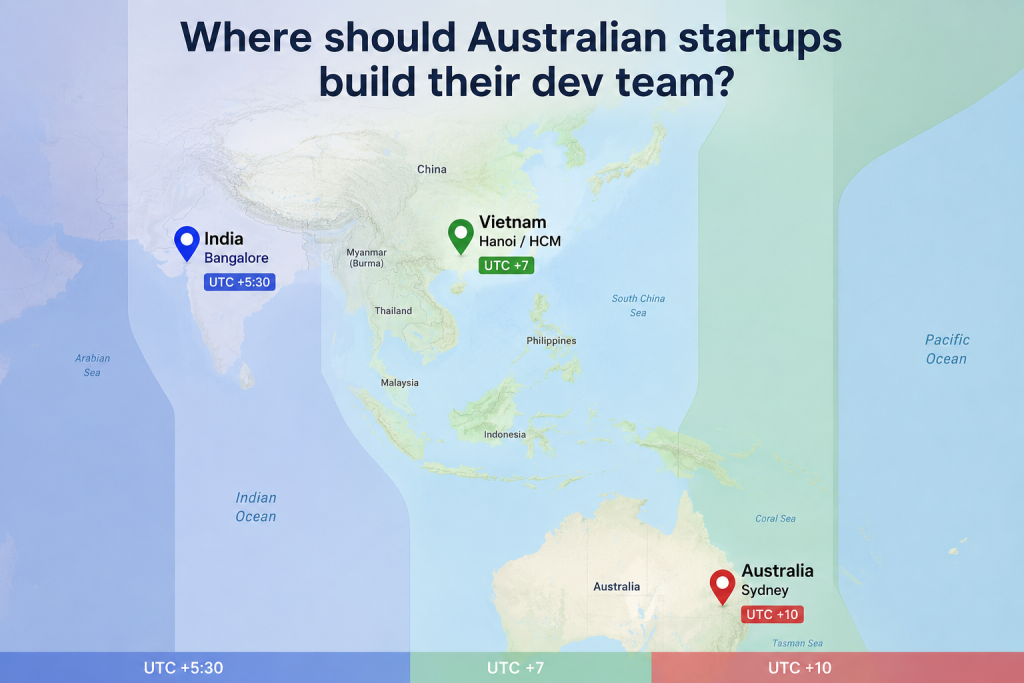
When Australian companies compare Vietnam and India for software development, discussions usually focus on cost, talent, and technical capability. However, one of the biggest operational differences often comes down to time zones.
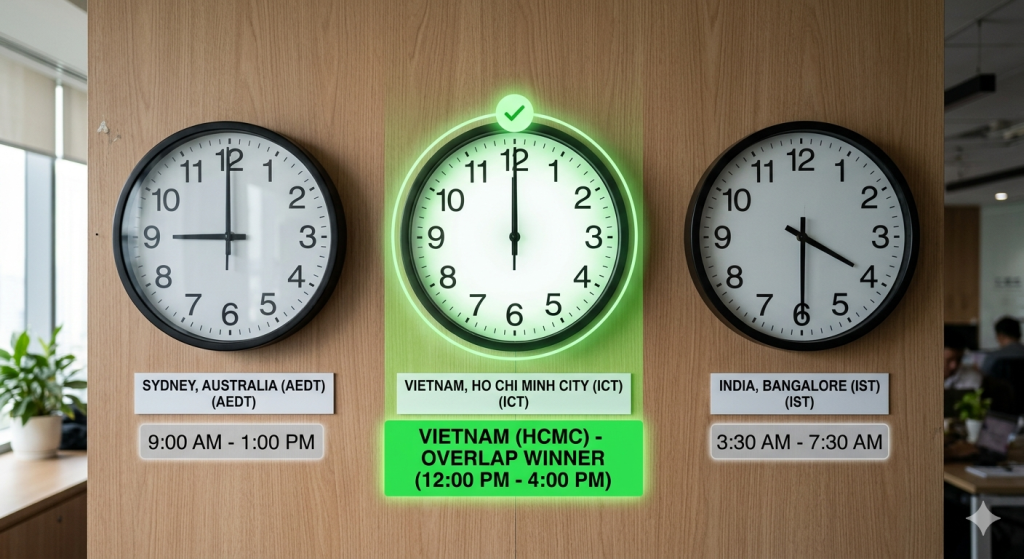
Vietnam operates on UTC+7, while Sydney and Melbourne are typically UTC+10 or UTC+11. This creates several hours of overlap during the working day, making real time collaboration much easier.
For Australian teams, that often means:
- Daily standups can be scheduled during normal business hours for both teams.
- Questions raised during the afternoon are often answered before the end of the day.
- Design reviews, sprint planning sessions, and technical discussions can happen live rather than through lengthy message threads.
- Production issues can be escalated and addressed immediately when both teams are online.
India operates on UTC+5:30, creating a larger gap with Australian business hours. As a result, many Australian companies work in a more asynchronous way, where tasks are handed off at the end of one day and reviewed the next morning.
This approach can still be effective, particularly for well defined development work. However, it becomes more challenging when projects require rapid feedback, close collaboration, or fast decision making.
For startups and scaling technology companies, even a few hours of additional overlap can have a noticeable impact on delivery speed. Teams spend less time waiting for answers, issues are resolved faster, and communication tends to feel more natural. Over the course of a year, those small efficiencies often add up to a meaningful advantage.
Cost: The Gap Is Smaller Than Many Companies Expect
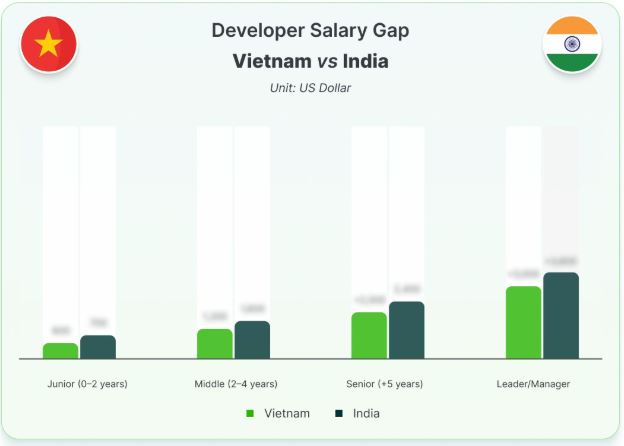
For a long time, India has been seen as the go to destination for low cost software outsourcing. That perception is still partly true today, especially for junior roles. However, the gap between India and Vietnam is not as wide as many Australian companies tend to assume.
Over the past few years, Vietnam’s tech sector has developed quickly. As demand for experienced engineers has grown, salaries have also increased. Because of that, the cost difference between Vietnam and India is now relatively small, particularly when hiring mid level and senior developers.
This aligns with broader industry findings from global consulting and workforce research, including the Deloitte Global Outsourcing Survey, talent and IT services reports published by NASSCOM, as well as aggregated salary benchmarking data from platforms such as Statista and Glassdoor, which are commonly used to track developer compensation trends across markets.
Indicative annual outsourcing cost ranges for Australian companies
These figures are indicative ranges compiled from multiple salary benchmarks and outsourcing market reports. Actual costs vary depending on city, experience, tech stack, and engagement model.
| Role | Vietnam (AUD) | India (AUD) |
| Junior Developer | $16,000–$22,000 | $14,000–$18,000 |
| Mid Level Developer | $22,000–$28,000 | $18,000–$24,000 |
| Senior Developer | $28,000–$38,000 | $26,000–$34,000 |
| QA Engineer | $14,000–$20,000 | $12,000–$18,000 |
India still tends to come out slightly cheaper at the junior level. But once you move into mid and senior roles, the difference becomes quite small in practice.
At that point, most Australian companies stop looking at cost alone and start thinking about delivery outcomes. Things like how quickly the team responds, how well they communicate, and how much coordination overhead is involved often matter more than a small difference in hourly rates.
In reality, teams that share more overlap hours with Australia and can work in tighter feedback loops tend to move faster. That speed can easily outweigh a modest cost advantage on paper, especially for startups where shipping quickly matters more than saving a few thousand dollars per engineer per year.
That is why more experienced buyers usually evaluate total delivery cost rather than just salary comparisons. A slightly more expensive team can still end up being the better option if it reduces friction and helps the product move faster.
English Communication: What Actually Matters in Day to Day Work
Both Vietnam and India have strong English capability across their technology workforces, and broad generalisations can be misleading. In practice, the differences are more subtle and tend to show up in specific working contexts rather than overall ability.
India has a long history of English being used in both education and professional environments. As a result, many engineers, particularly in established tech hubs such as Bangalore, Hyderabad, and Pune, are comfortable using English in day to day collaboration. Written communication is often a strong point, especially in structured professional settings.
Vietnam has improved significantly in English proficiency over the past decade, particularly among younger developers who are more exposed to global tools, documentation, and international teams. In day to day collaboration with Australian teams, written communication from mid and senior level engineers is generally clear and well structured. Spoken English on calls is usually easy to follow, although accent and phrasing differences can be noticeable at the beginning.
In most real project environments, these differences tend to matter less over time. Once teams establish clear working rhythms, communication quality is driven more by process than by language background. Things like clear ticket writing, well structured pull requests, and consistent async updates have a much bigger impact on delivery than nationality or accent.
These are also skills that can be trained and standardised across any offshore engineering team, regardless of location.
Tech Talent Depth: Stacks, Seniority, and Availability
India clearly has an advantage in terms of scale. With an estimated 5.4 million software developers, it is one of the largest tech workforces in the world. That scale makes it easier to find specialists across a wide range of technologies, including legacy enterprise systems, niche frameworks, and highly specific domain expertise.
Vietnam is smaller, with roughly 530,000 developers, but the talent pool has been growing steadily at around 9%/year. It is particularly strong in modern application development, including React, Node.js, Flutter, and React Native. There is also solid capability in cloud infrastructure work, with increasing momentum in data engineering and AI related roles.
For most Australian startups and mid sized product companies building SaaS platforms, mobile apps, or e commerce systems, Vietnam already offers sufficient depth across both junior and senior levels. Teams tend to be well aligned with modern stacks and product driven development practices.
India, on the other hand, tends to have an edge in highly complex enterprise environments, especially where large legacy systems are involved. This includes SAP, Oracle, Salesforce customisation at scale, and programs that require very large engineering teams operating across multiple specialised domains.
In practice, the difference is less about overall quality and more about where each market has built depth over time. Vietnam is stronger in modern product engineering, while India has broader coverage in legacy and large scale enterprise systems.
Cultural Fit with Australian Work Culture
This is a subjective area, but it is consistently mentioned by Australian founders when working with offshore engineering teams. The differences are less about technical ability and more about communication style, expectations, and day to day collaboration.
Vietnamese work culture tends to be structured and respectful of hierarchy in local environments, but generally adaptable when working with Australian teams. In practice, communication is often more cautious at the beginning of an engagement.
Common patterns include:
- Developers may avoid raising blockers early unless they are directly asked.
- Communication tends to be careful and context driven, especially in new working relationships.
- Estimates are often conservative, with teams preferring to under promise and deliver ahead of expectations.
- Once trust is established, teams tend to be stable with relatively low turnover in dedicated engagement models.
Indian work culture varies significantly by company and region, but Australian clients often describe a more direct communication style in day to day collaboration. Engineers are generally more comfortable challenging requirements and raising issues early in the process.
Typical patterns include:
- More assertive communication during planning and delivery discussions.
- Strong emphasis on structured documentation and formal processes.
- In some outsourcing models, higher turnover can occur, although this is often influenced by engagement structure rather than culture alone.
Neither approach is inherently better. They tend to suit different management styles. Australian founders who prefer highly direct collaboration often need to encourage more explicit early communication when working with Vietnamese teams. Those who value structured process and documentation often find the Indian approach more familiar and easier to plug into larger engineering organisations.
Legal and IP Considerations
Both Vietnam and India have established intellectual property frameworks and are signatories to international agreements such as TRIPS. In both markets, the legal foundations for protecting software IP are broadly in place, but the practical level of enforceability and contract execution can vary depending on how engagements are structured.
Vietnam has significantly modernised its IP laws over the past decade, particularly since around 2010. For Australian companies, the key is not only the local legal framework but how the working relationship is set up from day one.
In practice, strong engagements in Vietnam typically include:
- IP assignment clauses governed by Australian law rather than local jurisdiction
- Individual confidentiality agreements signed by each engineer
- Code ownership structured so all repositories are company owned from the first day of development
India operates under a similar IP framework and, in larger enterprise outsourcing engagements, often has more mature contract templates and procurement processes in place. For typical startup or mid market engagements, however, the practical approach to IP protection is largely the same.
The most important distinction is not the country itself, but the structure and quality of the engagement. Well governed contracts with clear ownership, access control, and legal alignment with Australia are generally low risk in both Vietnam and India. Poorly defined arrangements, on the other hand, introduce risk regardless of location.
The Verdict: Which Is Right for Your Situation?
There is no clear winner between Vietnam and India. The right choice depends on how your team operates, how fast you need to ship, and how much day to day collaboration your delivery process requires.
Vietnam tends to work better when:
- You need frequent real time communication with your development team
- You are building modern products like SaaS platforms, web or mobile apps
- Your team is relatively small and relies on fast feedback cycles
- You are an Australian startup that benefits from strong working hour overlap
India tends to work better when:
- You are building large scale enterprise systems or maintaining legacy platforms
- You need to scale engineering teams quickly across multiple areas
- Your delivery model is mostly asynchronous and less dependent on daily interaction
- You already have long standing vendors or delivery partners in India
For most Australian companies, time zone alignment ends up being one of the most noticeable operational differences. It affects how quickly decisions get made, how fast feedback moves, and how much coordination effort is needed each day.
Because of that, Vietnam is often considered by product focused teams when communication speed and close collaboration are a priority.
At ONEXT DIGITAL, we work with Australian companies to build Vietnam based engineering teams that fit into their actual delivery workflow. The focus is not just on cost, but on reducing friction in communication, improving response speed, and making offshore teams easier to work with day to day.
If you are comparing Vietnam and India, the most useful approach is to map both options against how your team really works, rather than relying on general market assumptions.
FAQs
Should I choose Vietnam or India if I want to build and iterate fast?
If your priority is speed of product delivery and rapid iteration, Vietnam is usually the better fit.
Why:
- Real working-hour overlap with Australia enables same-day feedback
- Faster sprint cycles (build → review → fix within days, not weeks)
- Easier real-time collaboration for product decisions
India is better suited for projects with stable scope and less frequent change, where work can be done in a more asynchronous delivery model.
What is the biggest operational difference between Vietnam and India?
The key difference is workflow timing:
- Vietnam: real-time collaboration (same-day communication and iteration)
- India: asynchronous delivery (handover today, review tomorrow)
For startups, this directly impacts:
- Feature delivery speed
- Bug fix turnaround time
- Number of feedback cycles per sprint
Is Vietnam significantly more expensive than India?
Not meaningfully when looking at total cost.
- India can be slightly cheaper at junior levels
- Mid and senior levels are broadly comparable
However, total delivery cost often shifts due to:
- Waiting time caused by time zone gaps
- Rework from delayed feedback loops
- Higher coordination overhead in async workflows
In many cases, Vietnam reduces these hidden costs through faster iteration.
Which country is better for scaling a team (50–100 engineers)?
- India: stronger for large-scale enterprise teams, multiple domains, and complex layered delivery structures
- Vietnam: stronger for product-focused teams, faster scaling at small-to-mid size, and leaner team structures
Summary:
- Enterprise-scale complexity → India
- Product startup scaling → Vietnam
Are IP protection and legal risks different between Vietnam and India?
Not significantly if the engagement is structured correctly.
In both Vietnam and India, risk depends more on setup than geography.
Best practices:
- Clear IP assignment from day one
- Code ownership under client-controlled repositories
- Individual NDAs for engineers
- Contracts aligned with Australian or neutral legal frameworks
When properly set up, risk levels are generally comparable.
When is Vietnam the better choice for Australian startups?
Vietnam is typically the right choice when you:
- Build SaaS products, mobile apps, or web platforms
- Need fast iteration cycles (weekly or daily)
- Want your offshore team to behave like an extension of your in-house team
- Value execution speed over marginal cost differences
In these cases, the main advantage is not cost — it’s reduced communication friction and faster shipping velocity.