
 Services
 Solutions
 Main platform
 Technology
 White Label
  Offshore
 Hire developers



Choosing a software development vendor can look straightforward until the proposals start coming in. Two vendors may quote for the same project but offer very different prices, timelines and team structures. One may come in cheap but leave you without a dedicated project manager or proper QA. Another may cost more but have a stronger delivery process and a team that has solved similar problems before. A third may have an impressive portfolio but little experience with a product like yours.
That is why hourly rates and polished case studies are not enough to make a good decision. The real question is whether a vendor can deliver the right product with manageable risk, clear communication and long term support.
This software development vendor evaluation framework gives you a practical way to compare vendors across technical capability, delivery, security, communication, commercial risk and long term fit.
How to Evaluate a Software Development Vendor Process overview

Choosing a software development vendor is about more than comparing quotes or looking at a portfolio. You need to understand whether the vendor has the technical capability, delivery process, team and security practices to build and support your product reliably.
A practical evaluation follows a simple process:

Why Vendor Evaluation Matters
The problems with a poor vendor choice often appear after the contract is signed. Requirements get misunderstood, delivery slips, code needs rework or the team lacks the experience to handle unexpected technical issues. Weak communication and security practices can create even bigger problems once the product is in production.
The purpose of vendor evaluation is to identify these risks before they become expensive to fix.
What Should You Evaluate?
A useful framework should cover the full delivery picture: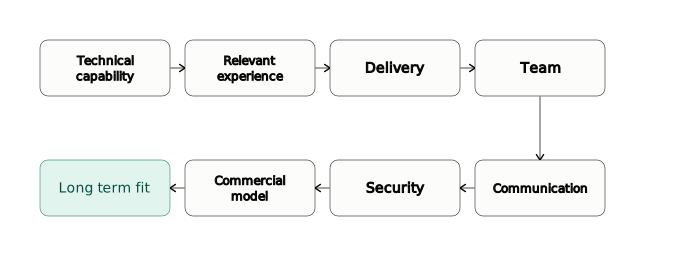 The weighting can vary by project. A healthcare platform may put more weight on security and compliance, while an early stage startup may prioritise delivery speed, technical flexibility and the ability to scale the team.
Use the same criteria for every vendor so you are comparing like for like rather than simply choosing the lowest quote.
The 8 Criteria for Evaluating a Software Development Vendor
Once you have a shortlist, the difficult part is comparing vendors on something more meaningful than price. A strong portfolio shows what a company has built, but it does not tell you how they work, how they handle problems or whether the same team can deliver your project.
A practical evaluation should cover eight areas: technical capability, relevant experience, delivery, team, communication, security, commercial fit and long term support. You can adjust the weighting based on your project and score every vendor against the same standard.
1. Technical Capability
Suggested weight: 20–25%
The first question is not whether a vendor knows a particular technology. Most established development companies can list a long stack of languages, frameworks and cloud platforms. What matters more is whether they know when and why to use them.
Evaluate the vendor’s experience with your required technology stack, system architecture, scalability, APIs and integrations, cloud infrastructure, DevOps, CI/CD, testing and code quality. If you are replacing or extending an existing system, look at their experience working with legacy code as well.
For example, a vendor saying they work with React, Node.js and AWS tells you very little by itself. Ask them to explain an architecture decision from a previous project, what alternatives they considered and what trade offs they accepted. That gives you a much better view of their engineering judgement.
Questions to ask:
- What technology stack would you recommend for this project and why?
- How do you approach architecture decisions?
- How is code reviewed before it reaches production?
- What is your testing strategy?
- How do you identify and manage technical debt?
Red flags:
- The proposal focuses heavily on technologies but says little about engineering decisions.
- The team cannot explain why a particular architecture was chosen.
- The portfolio mainly contains simple websites, while the vendor is proposing to build a complex SaaS platform.
- There is no clear QA or code review process.
Using React, AWS or Node.js does not prove technical capability. The ability to explain the engineering decisions behind them does.
2. Relevant Experience and Domain Expertise
Suggested weight: 15%
A vendor may have ten years of software development experience and still be a poor fit for your project. What matters is whether they have solved problems similar to yours.
Look for experience across several dimensions:
- Similar project type
- Similar industry
- Similar technical complexity
- Similar user or transaction scale
- Similar business model
- Similar regulatory or geographic requirements
A good case study should tell you more than which technology was used. Ideally, you should be able to follow the story from problem → approach → technology → delivery → result.
For example, “We built an ecommerce platform for a leading retailer” is not particularly useful. A stronger case study explains what the retailer was struggling with, what the vendor changed, how the solution was delivered and what improved afterwards.
Do not be afraid to ask what went wrong. A vendor that has delivered real projects will have encountered problems. Their answer can reveal how they manage risk far better than a polished success story.
Questions to ask:
- Can you show us a project similar to ours?
- What was the most difficult part of that project?
- What went wrong and how did your team handle it?
- What would you do differently if you built it again today?
- Can we speak with a previous client?
Red flags:
- Case studies are vague and contain no meaningful results.
- The vendor relies mainly on client logos as proof of experience.
- They cannot provide a relevant example.
- They refuse reasonable requests for client references.
You do not need a vendor that has built your exact product before. What matters is whether they have dealt with similar problems, complexity and constraints.
3. Delivery Capability and Project Management
Suggested weight: 15–20%
Good developers do not automatically make a good delivery team. A project can have excellent code and still fail because requirements were poorly managed, estimates were unrealistic or nobody was responsible for keeping the project on track.
Evaluate how the vendor handles planning, estimation, sprint management, QA, releases, risks, reporting, scope changes and escalation.
One useful area to test is how they deal with changing requirements.
A mature process should look something like:
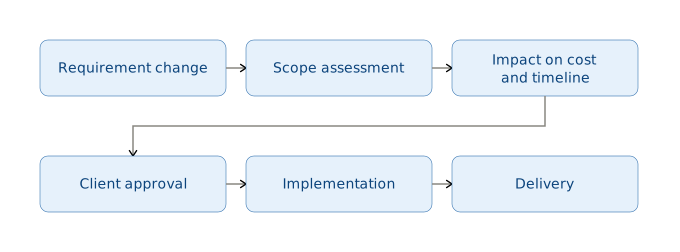
You should know what happens before the developer starts additional work.
Also ask what happens when a project falls behind schedule. “We always deliver on time” is not a particularly useful answer. A stronger vendor will explain how they identify delays, communicate the impact and recover the schedule.
Questions to ask:
- How do you estimate project timelines?
- How do you track delivery against the original plan?
- What happens when requirements change?
- How do you manage project risks?
- What happens if the project falls behind schedule?
- How often will we receive progress reports?
Red flags:
- Unrealistically short timelines with no assumptions.
- No clear process for change requests.
- No visible risk management.
- QA is treated as an afterthought.
- The vendor promises that projects are “always on time” without explaining how.
A proposal tells you what a vendor plans to deliver. Their delivery process gives you a better idea of how likely they are to deliver it.
4. Team Structure and Engineering Expertise
Suggested weight: 10%
Do not evaluate only the company. Evaluate the team that will actually build your product.
Ask who will be involved and what responsibilities each person will have. Depending on the project, this might include developers, QA engineers, a Tech Lead, Solution Architect, Project Manager or Business Analyst.
You should also understand whether those people are dedicated to your project or shared across several clients.
Pay particular attention to key person dependency. If one developer understands the entire system and nobody else can step in, you have a delivery risk regardless of how experienced that developer is.
Questions to ask:
- Who exactly will work on our project?
- Who will be the Tech Lead?
- How much experience does the proposed team have?
- Are team members dedicated or shared?
- What happens if a key developer leaves?
- How is knowledge transferred between team members?
Red flags:
- The proposal shows one team, but the actual delivery team is different.
- You cannot meet the technical lead before signing.
- One developer is responsible for most of the critical knowledge.
- The vendor cannot explain its backup or replacement process.
A vendor may have an impressive engineering team, but that does not mean those people will work on your project. Ask about the actual team you are buying, not just the capabilities listed on the company website.
5. Communication and Collaboration
Suggested weight: 10%
Communication problems are easy to underestimate when choosing an offshore development partner. A technically strong team can still become difficult to work with if requirements take too long to clarify, issues are not escalated or nobody knows when a decision is needed from the client.
For Australian businesses working with an offshore team, look at practical collaboration rather than simply asking whether the vendor “speaks English”.
Consider:
- Working hour overlap
- English communication
- Meeting frequency
- Response times
- Project management tools
- Documentation
- Reporting
- Escalation process
For example, a Vietnam based team may not work exactly the same hours as an Australian client, but planned working hour overlap can make daily communication much easier. The important thing is having a clear process for how the two teams will work together.
Questions to ask:
- How many working hours will overlap with our team?
- What communication tools do you use?
- How quickly do you normally respond to project issues?
- How are urgent issues escalated?
- Who is our main point of contact?
- How are decisions and requirements documented?
Red flags:
- Response times are undefined.
- Communication depends entirely on one account manager.
- There is no clear escalation path.
- Important decisions are made verbally without documentation.
- Meetings constantly have to accommodate one side’s schedule.
A good communication process should reduce the amount of project management the client has to do, not create another layer of work.
6. Security, Privacy and Compliance
Suggested weight: 10–15%
Security should be evaluated before development starts, not after the first production incident.
The level of scrutiny depends on what your software does and what data it handles. At minimum, ask how the vendor manages development environments, source code, credentials, production access and client data.
Areas worth evaluating include:
- Secure Software Development Lifecycle
- Access control
- Multi factor authentication
- Repository security
- Secrets management
- Data handling
- Backups
- Vulnerability management
- Incident response
- Employee access and offboarding
For Australian businesses, also consider privacy obligations and what happens when data is accessed or processed by an offshore team. You should understand where your data goes, who can access it and what controls are in place.
Questions to ask:
- Where is client data stored and processed?
- Who can access production systems?
- How are credentials and secrets managed?
- How is access removed when an employee leaves?
- What happens if a security incident occurs?
- How do you identify and address vulnerabilities?
Red flags:
- Production access is broadly available to developers.
- Credentials are shared through insecure channels.
- There is no documented incident response process.
- The vendor cannot explain how employee access is removed.
- Security responsibilities are unclear between the client and vendor.
One question is particularly important for offshore projects:
What happens to our data when your team accesses it?
The answer should be specific, not simply “your data is secure”.
7. Commercial Model and Total Cost
Suggested weight: 10%
Comparing vendors purely by hourly rate can produce a misleading result. A vendor charging $25 per hour is not necessarily cheaper than one charging $40 if the first team requires more rework, takes longer to deliver or needs significantly more management.
First, understand which commercial model fits your project.
| Model | Best suited for |
|---|---|
| Fixed Price | Clearly defined scope and requirements |
| Time and Materials | Projects where requirements are likely to evolve |
| Dedicated Team | Long term product development |
| Staff Augmentation | Adding specific skills to an existing team |
A more realistic view of total cost is:
Total Cost = Development + PM + QA + Infrastructure + Change Requests + Maintenance + Management Overhead
Ask exactly what is included in the proposal and what is not. A low initial quote becomes much less attractive when basic QA, project management, maintenance or change requests are charged separately.
Questions to ask:
- What is included in the quoted price?
- What is excluded?
- How are change requests priced?
- What happens if the original estimate is exceeded?
- What ongoing maintenance costs should we expect?
- Who owns the source code and intellectual property?
Red flags:
- The quote is significantly lower without a clear explanation.
- Assumptions are missing.
- Exclusions are not clearly documented.
- Change request pricing is unclear.
- Post launch maintenance costs are not explained.
A $25 hourly rate does not mean much if the project takes twice as long or requires heavy rework. Compare the expected cost of getting the product built, launched and maintained instead.
8. Long Term Fit and Support
Suggested weight: 5–10%
A software project does not end when the first version goes live. Bugs need fixing, infrastructure needs monitoring, users request new features and the product may eventually need to support a much larger workload.
That makes long term fit worth evaluating before you sign the initial contract.
Look at the vendor’s ability to provide:
- Maintenance and bug fixing
- Monitoring and operational support
- Scaling support
- Documentation
- Knowledge transfer
- Team expansion
- Product evolution
Also consider what happens if the relationship ends. Your business should retain control of its source code, documentation, infrastructure access and technical knowledge.
One of the most useful questions you can ask is:
If we stop working with you in two years, can another team take over the product?
Clear documentation, sensible architecture, source code ownership and knowledge transfer should make that transition possible.
Questions to ask:
- What support is available after launch?
- What are your response and resolution times?
- How is technical documentation maintained?
- How do you handle knowledge transfer?
- Can the team scale as our product grows?
- What happens if we decide to move development elsewhere?
Red flags:
- The vendor controls critical accounts or infrastructure without a clear ownership arrangement.
- Documentation is not part of the delivery process.
- Source code ownership is unclear.
- The vendor discourages independent access to the codebase.
- There is no defined transition or knowledge transfer process.
The best long term partner is not the vendor you can never leave. It is the vendor that delivers a product your business can continue to control, maintain and grow.
The Software Development Vendor Scoring Matrix
Once you have assessed each vendor, the next challenge is turning all that information into a decision. A scoring matrix gives you a consistent way to compare vendors against the same criteria instead of relying on impressions such as “Vendor A feels more experienced”.
The weights below are a practical starting point for a typical software development project. Adjust them based on your priorities. A healthcare platform, for example, may give security a much higher weight, while an early stage startup may prioritise delivery speed and technical flexibility.
| Criteria | Weight | Vendor A | Vendor B | Vendor C |
|---|---|---|---|---|
| Technical capability | 25% | 4/5 | 5/5 | 3/5 |
| Relevant experience | 15% | 5/5 | 3/5 | 4/5 |
| Delivery | 20% | 3/5 | 5/5 | 4/5 |
| Team | 10% | 4/5 | 4/5 | 3/5 |
| Communication | 10% | 3/5 | 5/5 | 4/5 |
| Security | 10% | 4/5 | 5/5 | 3/5 |
| Commercial | 5% | 5/5 | 3/5 | 4/5 |
| Long term fit | 5% | 3/5 | 5/5 | 4/5 |
How to Calculate the Final Score
Score each criterion from 1 to 5, then multiply the score by its assigned weight:
Final Score = Σ (Vendor Score × Weight)
For example, Vendor B scores 5/5 for technical capability, which has a 25% weight:
5 × 25% = 1.25
Repeat this for each criterion and add the results together. Because the weights total 100%, the final score remains on a 1–5 scale.
For Vendor B:
1.25 + 0.45 + 1.00 + 0.40 + 0.50 + 0.50 + 0.15 + 0.25 = 4.50/5
This gives you a more useful comparison than looking at quoted prices alone.
How to Interpret the Score
As a general guide:
| Final score | Interpretation |
|---|---|
| 4.50–5.00 | Strong candidate |
| 4.00–4.49 | Shortlist |
| 3.00–3.99 | Needs further validation |
| Below 3.00 | High risk |
These ranges are a decision aid, not an automatic hiring rule.
A vendor scoring 4.6 is not necessarily the right choice if that score hides a serious security, IP or contractual problem. A vendor scoring 4.1 may be a better fit if they have stronger experience with your industry and technology stack, a better team for your project and clearer ownership terms.
You should also define a few non negotiable criteria outside the scoring system. Failure to meet security requirements, unclear intellectual property ownership or an unacceptable approach to handling sensitive data can be enough to remove a vendor from consideration regardless of its overall score.
Use the matrix to create a consistent shortlist, then validate the areas carrying the most risk through technical discussions, reference checks, contract review or a paid discovery phase before signing.
How to Compare Offshore vs Local Software Development Vendors
Location can affect communication, time zones, cost and project oversight, but it should not be the deciding factor on its own. The better choice depends on your project requirements, internal team and how closely you need to work with the vendor.
Local Software Development Vendors
A local vendor can make collaboration easier when your project involves frequent meetings, complex stakeholder discussions or close coordination with an in house team. Working in the same market can also make communication around business requirements, regulations and customer expectations more straightforward.
The trade off is usually cost. Australian development teams tend to have higher engineering rates, particularly for senior developers and specialised technical roles. If the project requires a large engineering team or long term development support, this can have a significant impact on the overall budget.
Offshore Software Development Vendors
Offshore development can give businesses access to a larger engineering talent pool while reducing development costs. It can be particularly useful when you need to scale a team quickly or require technical skills that are difficult or expensive to hire locally.
For Australian businesses, Vietnam can be a practical offshore option. The relatively small time difference makes it easier to maintain overlapping working hours, while development costs are typically lower than hiring an equivalent team in Australia.
The main risks are not simply distance. Poor communication, unclear responsibilities, weak project management and limited visibility into the engineering team can create problems regardless of where the vendor is based. Before choosing an offshore partner, check how they handle communication, QA, security, documentation and day to day project management.
Local, Offshore or Hybrid?
For some projects, a local team makes more sense when face to face collaboration and close stakeholder involvement are priorities. Offshore delivery can be a better fit when engineering capacity and cost efficiency matter more. A hybrid model can combine both, with local stakeholders handling product and business communication while an offshore team provides engineering capacity.
For Australian companies, the decision should therefore come down to the operating model rather than location alone. Look for the balance of communication, cost, technical capability and control that your project actually needs.
How to Shortlist and Validate Your Final Vendors
Scoring gives you a shortlist, but it should not make the decision for you. Before signing a development contract, you need to validate whether the vendor can actually deliver what the proposal promises.
A practical process is:
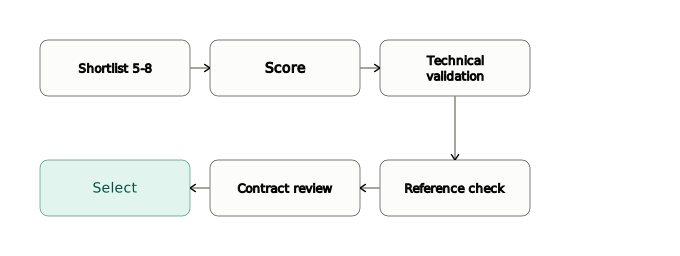
Start by narrowing the market to five to eight vendors that meet your basic requirements. Score them using the same criteria and weighting, then take the strongest candidates into a deeper technical discussion.
This is where you test the assumptions behind the proposal. Ask the vendor to explain how they would approach your architecture, integrations, testing, deployment and likely technical risks. You are not looking for a perfect answer. You want to see whether the team understands the problem and can explain its decisions clearly.
Where possible, check references from previous clients. Ask about delivery reliability, communication, code quality and how the vendor handled problems when things went wrong. How a vendor talks about difficult projects can often tell you more than a polished case study.
Before signing, review the contract carefully. Scope, assumptions, change requests, payment terms, intellectual property, source code ownership, security responsibilities, support and exit arrangements should all be clearly defined.
For complex projects, a paid discovery can be worth considering before committing to full development. It gives you a chance to see how the actual team handles requirements, architecture, risks and estimation before making a much larger commitment.
The aim is simple: reduce uncertainty before development begins. A vendor that looks strongest on paper is not necessarily the one that will deliver the best outcome.
Software Development Vendor Evaluation Checklist
Before making a final decision, use this checklist to confirm that the most important areas have been assessed and verified. Ideally, apply the same checklist to every shortlisted vendor.
Technical capability
- Does the vendor have experience with the required technology stack?
- Can the team explain its proposed architecture and key technical decisions?
- Is there a clear approach to testing, code review and technical debt?
- Can the solution scale with your expected growth?
Relevant experience
- Has the vendor delivered projects with similar complexity or requirements?
- Can they provide specific case studies with measurable outcomes?
- Can they provide a client reference where appropriate?
Delivery and team
- Is the development and project management process clearly defined?
- Are timelines, risks, dependencies and scope changes managed formally?
- Do you know who will actually work on the project?
- Is there a clear backup and knowledge transfer process?
Communication
- Are working hour overlaps clearly agreed?
- Are response times and escalation paths defined?
- Are requirements, decisions and progress properly documented?
- Do you know who is responsible for day to day communication?
Security
- How are source code, credentials and sensitive data protected?
- Who can access production systems?
- Is employee access removed when someone leaves the project?
- Are security responsibilities clearly defined?
Commercial and long term fit
- Are scope, assumptions and exclusions documented?
- Is the process for change requests clear?
- Are source code and intellectual property ownership clearly defined?
- Are post launch support and maintenance terms clear?
- Can your team or another vendor take over the product if needed?
Once the checklist is complete, combine it with your scoring matrix and use the results to guide the final vendor discussion. A strong score is useful, but any unresolved issue around security, ownership, delivery or commercial terms should be addressed before signing.
Ready to Evaluate Your Next Software Development Partner?
Choosing a software development vendor is not just about finding the lowest quote. The right partner should have the technical capability, delivery process, team structure and security practices to support your product over time.
If you are currently comparing development vendors or reviewing proposals, ONEXT DIGITAL can help you assess the options from a practical engineering and delivery perspective. We can review your requirements, proposed team and delivery model to identify potential risks before you commit.
Want to compare your current vendor options with us?
FAQs
What should I look for in a software development vendor?
Look for a vendor with the right combination of technical capability, relevant experience, delivery processes, team expertise, communication, security, commercial transparency and long-term support. Price and portfolio are useful, but they should not be the only factors in your evaluation.
How do I compare software development companies?
Use the same evaluation criteria and weighting for every vendor. Assess their technical capability, relevant experience, delivery approach, team, communication, security, commercial model and long-term fit, then use a weighted scoring matrix to compare the shortlisted companies.
What questions should I ask a software development vendor?
Ask about their proposed architecture, similar projects, development and QA process, actual project team, communication and escalation, security controls, pricing assumptions, intellectual property ownership and post-launch support. You should also ask what happens if the project falls behind schedule or a key developer leaves.
How do I evaluate an offshore software development company?
Evaluate an offshore vendor on the same core criteria as a local vendor, but pay particular attention to communication, working-hour overlap, project management, security, data access, documentation and knowledge transfer. Cost savings should be considered alongside delivery risk and management overhead.
What is the best scoring method for software development vendors?
A weighted scoring matrix is a practical approach. Score each vendor from 1 to 5 against defined criteria, multiply each score by its assigned weight and add the results to calculate an overall score. However, critical requirements such as security, intellectual property ownership and data protection should be treated as pass/fail conditions rather than relying only on the final score.
How much does it cost to hire a software development vendor?
The cost depends on the project scope, technology requirements, team size, engagement model, location and expected duration. Instead of comparing hourly rates alone, consider the total cost of development, project management, QA, infrastructure, change requests, maintenance and any additional management overhead.