
 Services
 Solutions
 Main platform
 Technology
 White Label
  Offshore
 Hire developers



In the summer of 2026, Shopify banned the sale of Electronic Nicotine Delivery Systems (ENDS) vapes, in plain English across its entire platform, worldwide, regardless of whether the products were legal in the merchant’s jurisdiction. The rollout was fast, quiet, and confusing, and it has become a case study in what it actually means to build a business on someone else’s infrastructure.

Shopify banned all Electronic Nicotine Delivery Systems (ENDS) vapes worldwide, regardless of local legality. The rollout was fast and gave merchants almost no time to react.
What Actually Happened With Shopify’s Vape Ban?
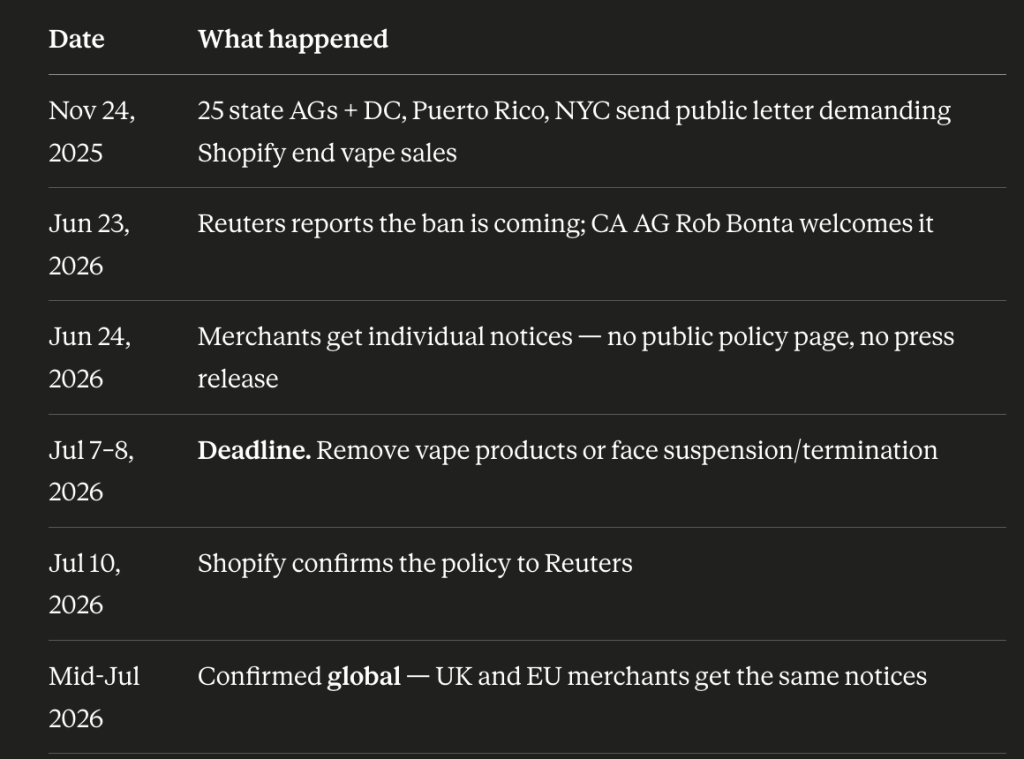
Key detail: press found out on June 23. Merchants found out one day later, June 24 and had until July 7–8 to comply. That’s the whole window. Why the Ban Is Stricter Than It Sounds
- Covers everything: hardware, e-liquids, pods, disposables, coils, accessories
- Includes 45 FDA-authorized products legality didn’t matter
- Applies even to UK vapes that are fully MHRA-compliant
- No official guidance for days merchants pieced deadlines together from emails and forums
Bottom line: this isn’t a government ban. It’s a platform’s house rule, and it overrides local law.
Not a change of heart is a risk decision. State AGs and city law enforcement pressured Shopify for months; Shopify decided the legal exposure wasn’t worth it.
That success is the real warning: if AGs can move a company Shopify’s size in under a year, they can do it again to other platforms, or to payment processors. Stripe, PayPal, and Square already exclude vape products from their policies.
The pattern is now proven and repeatable: Regulator pressure → policy change → short deadline → conditional access
Categories facing the same risk: CBD, nicotine pouches, peptides, supplements, knives, adult products.
The lesson isn’t “avoid Shopify.” It’s: any hosted platform can do this to any restricted category, at any time, with barely two weeks’ notice.
Why Does This Matter Even If You Don’t Sell Vape?
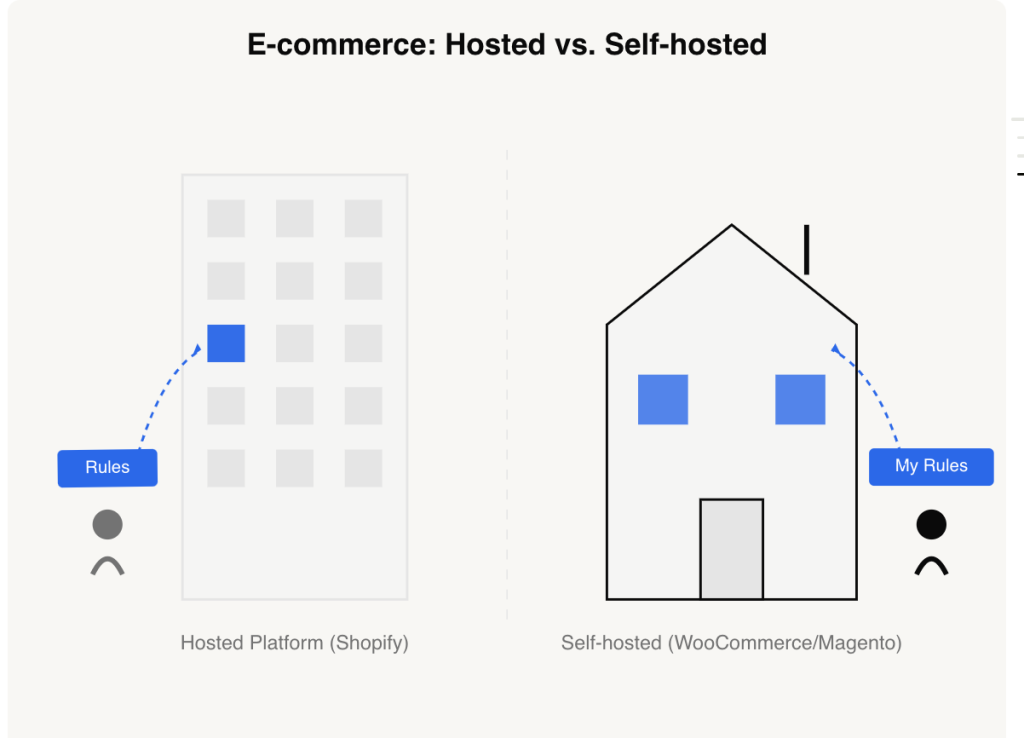
You get uptime, PCI compliance, and infrastructure. In exchange, the platform keeps a veto over what you sell invisible until it’s enforced.
| Hosted (Shopify) | Self-hosted (Magento/Medusa/WooCommerce) | |
| What you can sell | Platform’s Acceptable Use Policy | Whatever’s legal |
| Who can shut you down | The platform | Your host (easy to switch) |
| Where your data lives | Their database | Your database |
| Checkout customization | Only what’s allowed | Anywhere in the code |
| If pricing doubles | Pay or migrate | Move servers |
| Upgrade timeline | Platform decides | You decide |
Ask yourself: could your business survive two weeks’ notice if…
- Your product category suddenly got restricted?
- Your payment processor changed your risk profile?
- A critical app got acquired and shut down?
- Checkout customization became impossible overnight?
These aren’t hypotheticals they’ve already happened to real merchants, with zero say in the matter.
Who Else Is at Risk
The pattern that hit vape sellers works the same way for:
CBD · Nicotine pouches · Peptides · Supplements · Knives · Adult products
Regulator pressure has already made Stripe, PayPal, and Square exclude vape products from their own policies. Other categories are next in line it’s just a matter of when.
The question isn’t “which Shopify alternative is safest?” It’s “how do I stop being one policy email away from losing my business?”
Which of the Options Is Right for Your Online Store?
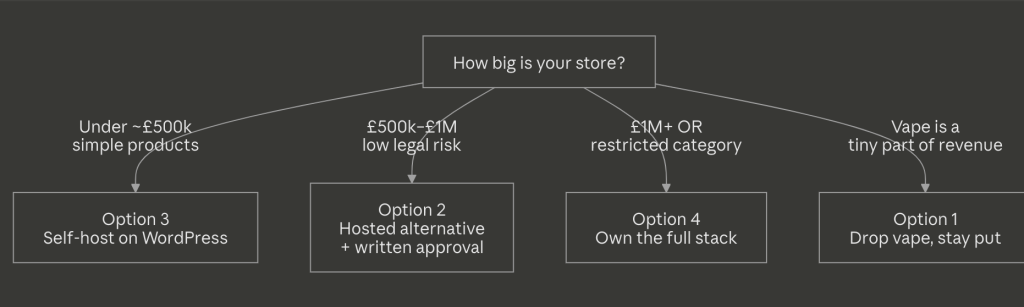
Think of these as four levels of “how much control do you want, and how much work are you willing to do for it?” There’s no single right answer. It depends on your store size and how risky your category is.
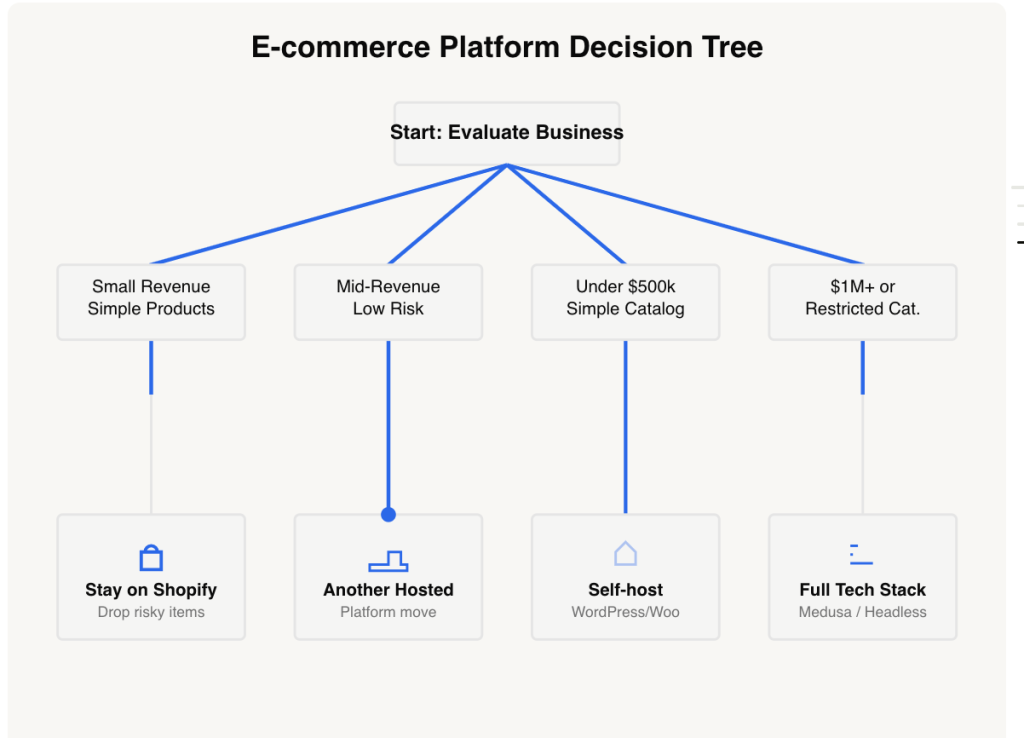
Option 1 :Stay on Shopify, drop the vape products
- Simplest option. Makes sense if vape is a small slice of your revenue.
- Do the math first (how much revenue you’d lose) before deciding out of frustration.
Option 2: Move to a different hosted platform (e.g., BigCommerce)
- Still “renting,” just from a different landlord.
- Get it in writing from a compliance officer not a sales rep that they’ll actually accept your products long-term.
- Risk: you’re betting that regulators go after Shopify first and leave this platform alone. History says that’s not guaranteed.
Option 3 : Run your own store on WordPress (WooCommerce) or Magento
- Good fit if your business is under about £500k in revenue and your catalog is fairly simple.
- Nobody can “kick you off” it’s your own website.
- Trade-off: you (or someone you hire) now handles hosting, security, and keeping things running smoothly.
Option 4: Fully own your tech stack (custom-built, open-source foundation like Medusa)
- No landlord, no acceptable-use policy to worry about.
- You design age-verification and compliance features exactly the way you need them not however an app allows.
- Most work upfront, but most freedom afterward. This used to be “enterprise only” it isn’t anymore.
Fair warning: most “how to leave Shopify” guides skip Option 4 entirely. That’s often because they’re written by agencies trying to sell you Option 2 or 3.
The bigger your store, or the riskier your product category, the more it’s worth owning your own tech instead of renting it. Small, low-risk stores can usually get away with renting a little longer.
Not every business needs to own its stack. If you’re selling a simple catalog say, 30 products, no special pricing deals, no complicated inventory systems a hosted platform is a perfectly reasonable trade-off. Ownership starts to matter once your category is considered “risky,” your pricing gets complicated, or your platform fees start eating into real profit.
Moving Off Shopify: What Actually Needs to Happen
Whichever option you pick, an actual migration involves more than just “signing up somewhere else.” Here’s what to do, in the order that matters.
Export everything, today, even if you haven’t picked a new platform yet.
- Products
- Customer list
- Order history
- Redirects
- Blog content
- Theme files
Why the rush: once Shopify suspends your store, you may lose access to your own data. And here’s the part people don’t realize your myshopify.com address and everything Shopify hosts for you isn’t actually yours. Only your custom domain name belongs to you. Everything else disappears with the store.
1.Don’t Lose Your Google Rankings
This is the step most merchants skip and it’s the most expensive mistake to fix later.
Every page on your old store has a web address (URL). Years of Google rankings are tied to those addresses. If you shut down the old store without a plan, all those links go dead and so does your search traffic.
The fix: before you turn off the old store, map every old page address to its new one, and set up automatic redirects so visitors (and Google) land in the right place.
Real example: for a £4.5M UK vape retailer, this meant mapping 2,938 web pages and setting up 9,418 redirects checked one by one to make sure nothing broke.
Learn more about Onext’s Shopify Migration Projects Here
2.Start Payment Processing Early . It’s the Slowest Part
Getting approved to accept payments for a “high-risk” category (like vape) can take weeks, not days.
If you wait until your new store is built to apply, you’ll end up with a finished store that can’t actually take orders. Apply for payment processing before you finish building anything else.
3. Keep Age Verification Working
If your business requires age verification, make sure it carries over customers who already proved their age once shouldn’t have to do it again on your new site.
Same case study: 52,559 completed age verifications were carried over without customers noticing a thing.
4. The Full Moving Checklist
| Category | What to bring over |
| Catalog | Products, variants, photos |
| Customers | Accounts, addresses, order history |
| Orders | Full order archive |
| SEO | URL map + redirects for every page you’re keeping |
| Payments | New processor setup |
| Shipping | Rates and rules rebuilt |
| Apps | Every app you rely on (see below) |
| Design | New theme — your old one won’t transfer |
6.The Hidden Trap: Forgotten Apps
Most stores run more “invisible” apps than the owner remembers things quietly handling subscriptions, discounts, loyalty points, or tax calculations in the background.
Before migrating, make a full list of every app you use. For each one, you’ll need to decide: does the new platform already do this natively, is there a similar app for it, or do you need something custom-built?
Bottom line: migrating is a real project usually months, not days but it has a clear finish line. Once it’s done, nobody can send you a two-week eviction notice again.
A Double Hit for UK Merchants
UK vape retailers aren’t just dealing with the Shopify ban, they’re facing a second, unrelated shock at almost the same time.
Starting October 1, 2026, the UK’s new Vaping Products Duty kicks in: duty-paid stamps, mandatory HMRC registration, and new compliance paperwork for anyone selling vape products.
That means a UK merchant forced off Shopify right now has to solve two problems that would normally happen years apart:
- Where do I move my store? (the platform problem)
- How do I comply with the new tax and stamping rules? (the regulatory problem)
The smart move: solve both at once. If you’re already rebuilding your store because of the platform ban, build it around the new duty rules from day one — rather than launching a new store now and then patching it again in October. One disruption is painful. Two, back to back, is avoidable.