
 Services
 Solutions
 Main platform
 Technology
 White Label
  Offshore
 Hire developers



E-commerce in Australia in 2026 is witnessing tightening consumer spending, which is significantly compressing merchants’ profit margins. In this context, optimizing operational costs is no longer simply about choosing the right subscription plan; it requires businesses to clearly understand every hidden fee, local tax mechanisms, and strategic break-even points.
This in-depth blog post breaks down the entire current Shopify fee structure in the Australian market in 2026, helping you build the most efficient payment system and maximize protection of your cash flow.
1. Shopify Subscription Pricing in Australia 2026 (Latest Update)
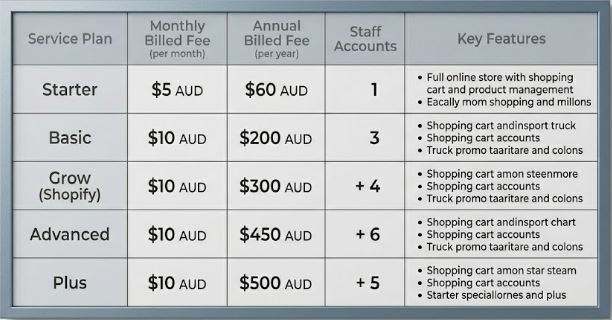
To meet the needs of businesses of all sizes, Shopify offers five main service plans with pricing listed directly in Australian Dollars (AUD) for standard plans, helping eliminate the risk of currency fluctuations. When choosing to pay annually in advance, merchants can receive a fixed 25% discount.
Tax Optimization Tip: How to Claim a 10% GST Exemption on Shopify Invoices
Under Australian regulations, all Shopify service invoices (including subscription plans and shipping labels) are subject to a 10% Goods and Services Tax (GST).
However, if your business has an Australian Business Number (ABN) and is registered for GST, you may be fully exempt from this 10% tax on Shopify invoices.
The setup process is very simple:
- Go to your Shopify admin dashboard and select Settings > Billing.
- Open the Billing profile
- Under Tax registration, click Yes, I’m GST registered.
- Enter your 11-digit ABN and click Add ABN.
Important note: This tax exemption only applies to invoices issued after your successful registration. It is not applied retrospectively to past invoices. Therefore, it is recommended to update your ABN details as soon as possible to avoid unnecessary costs.
2. Distinguishing “Credit Card Processing Fees” and “Third-Party Transaction Fees”
One of the most common mistakes made by new merchants is confusing credit card processing fees with third-party transaction fees.
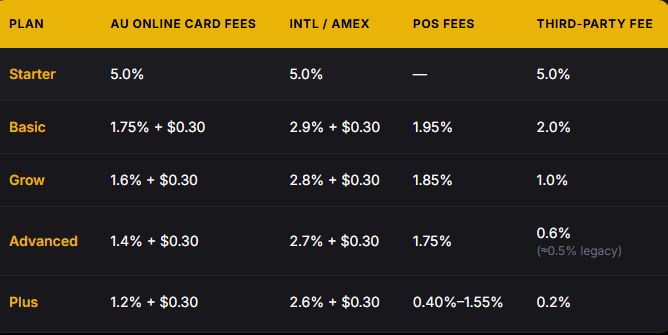
- Credit Card Processing Fees: These are mandatory technical costs paid to card networks (Visa, Mastercard, Amex) to complete the financial transaction from the buyer to the seller.
- Third-Party Transaction Fees: These are strategic fees imposed by Shopify on the total order value if a business chooses not to use Shopify’s integrated payment gateway, Shopify Payments.
Policy Update Warning (New Regulation)
From May 12, 2025, Shopify updated its billing policy for stores created after this date. Orders that include store credit or gift cards as a payment method may be subject to third-party transaction fees, applied only to the portion paid using those methods.
Stores established before this date are exempt from this new rule.
Analysis of 4 Real Transaction Scenarios
(Applicable to a $100 AUD order under the Grow plan)
To clearly understand the impact of payment gateway optimization on your revenue, consider the following real-world scenarios:
• Scenario A (Shopify Payments ON – Domestic Visa Card Payment)
The business only pays the standard domestic credit card processing fee:
Transaction fee=1.6%×100 AUD+0.30 AUD=1.90 AUD
• Scenario B (Shopify Payments ON – PayPal Express Checkout)
When Shopify Payments is enabled, Shopify fully waives the 1.0% penalty transaction fee for PayPal Express orders.
The merchant only pays the standard Shopify Payments processing fee for that transaction, avoiding any double-layer fee structure.
• Scenario C (Shopify Payments OFF – Using a Third-Party Gateway like eWay)
Assume eWay offers a discounted processing rate of 1.2% per transaction.
Because Shopify Payments is disabled, Shopify applies an additional 1.0% transaction fee on top:
eWay processing fee=1.2%×100 AUD=1.20 AUD
Shopify transaction fee=1.0%×100 AUD=1.00 AUD
Total cost=1.20 AUD+1.00 AUD=2.20 AUD
• Scenario D (Shopify Payments OFF – PayPal Payment)
When Shopify Payments is disabled, PayPal is treated as an alternative payment gateway.
PayPal Australia standard domestic rate is 2.6% + $0.30 AUD. On top of that, Shopify applies a 1.0% transaction penalty:
PayPal processing fee = 2.6% × 100 AUD + 0.30 AUD = 2.90 AUD
Shopify transaction fee = 1.0% × 100 AUD = 1.00 AUD
Total cost = 2.90 AUD +1.00 AUD = 3.90 AUD
3. International Selling: Exchange Rates and Currency Conversion Fees
If your store targets international markets such as the US, UK, and Europe, managing multi-currency cash flow is extremely important.
Fixed 2.0% Foreign Currency Conversion Fee in Australia
When customers pay in their local currency (such as USD or EUR), Shopify Payments processes the transaction and automatically converts the funds back into AUD for payout to your bank account.
In the Australian market, Shopify applies a fixed 2.0% foreign currency conversion fee. This fee is embedded directly into the exchange rate displayed on your store, allowing merchants to partially pass this cost onto international customers and protect profit margins.
Updated Foreign Currency Fee Calculation Mechanism (Effective April 6, 2026)
From April 6, 2026, Shopify will officially change how foreign currency conversion fees are calculated for orders processed via Shopify Payments. This update improves accounting transparency.
- Old method (before 06/04/2026):
The foreign currency conversion fee was calculated based on the order value after deducting Shopify Payments processing fees.
- New method (from 06/04/2026):
The FX conversion fee is applied directly to the gross order value before any payment processing deductions.
Example: For a $100 CAD order from Canada, under the new system, an Australian merchant will pay exactly $2 CAD in conversion fees when converting funds into AUD.
Multi-Currency Payout Mechanism
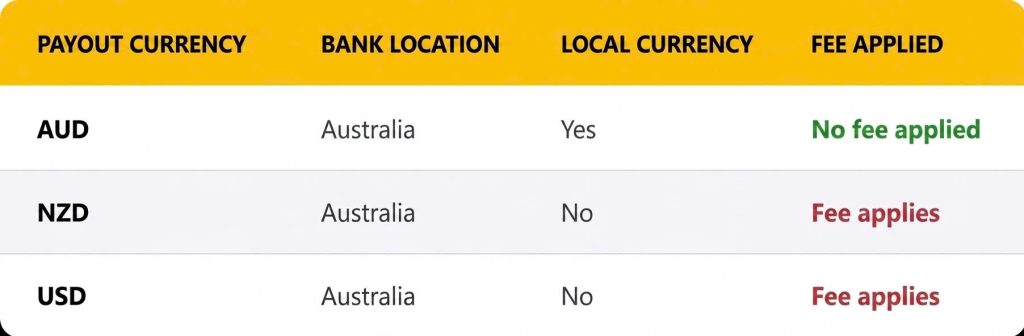
For businesses on Advanced or Shopify Plus plans, Shopify supports multi-currency payouts directly to designated bank accounts, without requiring automatic conversion through Shopify Payments.
4. Goods and Services Tax (GST) in Australia
All merchants operating on e-commerce platforms in Australia must strictly comply with the Goods and Services Tax (GST) regulations, which are set at a fixed rate of 10%.
GST Applied on Shopify Payments Processing Fees
A particularly important financial detail that is often overlooked by accountants: the 10% GST is applied directly on top of all Shopify Payments transaction processing fees.
This tax is not included in the published processing fee rates and is always charged additionally on top of the service fee.
Example: For an order with a processing fee of $2.00 AUD, Shopify Payments will deduct a total of $2.20 AUD from the merchant’s payout (including $2.00 AUD base fee plus $0.20 AUD GST).
Merchants are responsible for collecting these tax invoices for quarterly Business Activity Statement (BAS) reporting in order to claim input tax credits. These PDF invoices can only be downloaded by the Store Owner account after the 5th of each month via Settings > Payments > View payouts > Documents.
GST Registration Obligations for Sales Revenue
GST configuration requirements in Shopify depend directly on the business’s annual revenue threshold:
- Revenue below $75,000 AUD/year:
Businesses are not required to register for GST with the Australian Taxation Office (ATO). In Shopify, merchants must not enable GST charging for domestic customers. - Revenue of $75,000 AUD/year or more:
Businesses are required to register for GST via an ABN and must activate 10% GST collection on all domestic orders. In Shopify, this is configured under Settings > Taxes > Australia, with a standard 10% rate. - International exports:
All exported goods from Australia are GST-free, provided the goods leave Australia within 60 days of invoicing or payment. - Digital products:
Digital goods are still subject to the standard 10% GST if the business is GST-registered, regardless of whether the buyer is located inside or outside Australia.
5. When Should You Upgrade Your Subscription? Accurate Break-Even Formula
Upgrading to higher-tier plans means increasing fixed monthly costs, but it also significantly reduces variable costs per order through lower credit card processing fees.
To determine the exact moment when upgrading becomes financially beneficial, businesses use the following break-even formula:
Based on official Shopify financial analysis data for the Australian market in 2026, the recommended minimum break-even revenue thresholds for plan upgrades are defined as follows:
Upgrade from Basic to Grow (Shopify)
- If using Shopify Payments:
Domestic processing fee decreases by 0.15% (from 1.75% to 1.6%).
Due to a relatively large monthly subscription cost difference of $93 AUD/month, the financial break-even point is only achieved when the store reaches a minimum of approximately $400,000 USD/year (~$600,000 AUD/year) in revenue.
- If NOT using Shopify Payments:
Third-party transaction fees drop from 2.0% to 1.0% (a fixed saving of 1.0% on total revenue).
The break-even threshold becomes significantly lower, at around $60,000 USD/year (~$90,000 AUD/year).
Upgrade from Grow to Advanced
- If using Shopify Payments:
Domestic processing fee decreases by 0.2% (from 1.6% to 1.4%).
The fixed monthly cost difference is approximately $426 AUD/month.
The break-even point is reached at a minimum annual revenue of around $1,320,000 USD (~$2,000,000 AUD/year).
- If NOT using Shopify Payments:
Third-party transaction fees decrease from 1.0% to 0.6% (saving 0.4%).
The ideal break-even threshold is around $528,000 USD/year (~$800,000 AUD/year) or higher.
Upgrade from Advanced to Shopify Plus
Upgrading to the Enterprise tier (Shopify Plus) requires a significant jump in fixed cost, from $575 AUD to at least $3,700 AUD/month.
However, Shopify Plus reduces domestic card processing fees to 1.2% + $0.30 AUD, and third-party transaction fees to just 0.2%.
- Below $80,000 AUD/month revenue:
Upgrading to Plus is not recommended, as fixed costs would significantly reduce net profit margins.
- $80,000 – $150,000 AUD/month:
This is a transitional zone where businesses must carefully analyze financial metrics and scaling needs.
- Above $150,000 AUD/month:
Upgrading to Plus becomes economically efficient. Savings from lower processing fees, combined with reduced reliance on paid third-party apps (thanks to built-in automation tools like Shopify Flow and advanced checkout customization), can fully offset and potentially exceed the monthly subscription cost.
6. Total Cost of Ownership (TCO) Comparison: BigCommerce vs WooCommerce
To make a more accurate business decision, Shopify’s cost structure in Australia should be evaluated in direct comparison with its two main competitors: BigCommerce and WooCommerce. All three platforms are undergoing significant pricing and fee restructuring in 2026.
BigCommerce: Major Updates from June 2026
From June 1, 2026, BigCommerce officially introduces a new operating model, renaming its plans (Standard → Core, Plus → Growth, Pro → Scale) while also significantly reducing the GMV thresholds for each tier.
Most importantly, BigCommerce is eliminating its historical “no transaction fee advantage” by introducing an Open Payment Provider Fee ranging from 0.6% to 2.0% for self-serve plans when merchants use payment gateways outside its supported Embedded Payment Providers list.
This effectively makes BigCommerce’s cost structure similar in complexity to Shopify’s transaction fee system, while also adding an additional layer of conditional pricing based on payment provider selection.
WooCommerce: The Hidden Cost Structure Problem
WooCommerce is marketed as free open-source software, but the real-world cost of running a stable online store in Australia is often significantly higher than initial expectations.
- Managed hosting costs (e.g., Kinsta or WP Engine): approximately $350 – $1,150 AUD/year to ensure optimal performance and uptime.
- Essential plugins add recurring costs, including:
- Subscriptions management plugin: $279 USD/year
- Booking system plugin: $249 USD/year
These operational expenses quickly accumulate, pushing Total Cost of Ownership (TCO) to levels that often match or even exceed Shopify’s fixed monthly operating costs especially when accounting for maintenance, updates, security, and performance optimization requirements.
Conclusion
In 2026, Shopify profitability in Australia is no longer driven only by sales, but by how well merchants control fees, payment structure, and overall store configuration. Small differences in setup such as payment gateways, subscription tiers, and currency handling can significantly impact annual profit margins.
Because of this, many businesses are moving away from trial-and-error setups and instead working with experienced partners to ensure their Shopify stores are built with both cost efficiency and scalability in mind from the start.
At ONEXT DIGITAL, we support businesses in building and optimizing Shopify stores that are not only functional, but also structured to reduce hidden costs and improve long-term performance.
FAQs
How much does Shopify cost per month in Australia in 2026?
Shopify offers multiple pricing plans in Australia, including Basic, Grow, Advanced, and Shopify Plus. Monthly costs vary depending on the plan and whether you choose monthly or annual billing, with annual payments typically offering a discount. The total cost also depends on transaction fees and payment processing usage.
Does Shopify charge transaction fees if I use Shopify Payments?
If you use Shopify Payments, Shopify does not charge additional third-party transaction fees. You will only pay standard credit card processing fees. However, if you use an external payment gateway, Shopify will apply extra transaction fees on top of the provider’s charges.
What is the difference between credit card processing fees and third-party transaction fees?
Credit card processing fees are charged by payment networks like Visa, Mastercard, or Amex for processing the payment. Third-party transaction fees are additional fees charged by Shopify when you use external payment gateways instead of Shopify Payments.
How does GST work for Shopify stores in Australia?
In Australia, a 10% GST applies to most Shopify services and merchant sales if the business is GST-registered. Businesses with an ABN and GST registration can claim input tax credits. GST is also applied to Shopify Payments processing fees.
When should I upgrade my Shopify plan?
You should upgrade your Shopify plan when the savings from lower transaction and processing fees outweigh the higher monthly subscription cost. This break-even point depends on your annual revenue and payment structure, especially whether you use Shopify Payments or third-party gateways.
Is Shopify cheaper than BigCommerce and WooCommerce in Australia?
It depends on your business size and setup. Shopify offers predictable subscription pricing but includes transaction fees depending on configuration. BigCommerce and WooCommerce may have lower platform fees, but often come with higher hidden costs such as hosting, plugins, maintenance, and integration expenses.