
 Services
 Solutions
 Main platform
 Technology
 White Label
  Offshore
 Hire developers



Cloud computing has become the foundation of digital transformation, giving businesses the flexibility to innovate faster and scale without limits. Yet as organizations expand across different cloud environments, managing services effectively becomes more complex. Teams face challenges such as rising costs, performance fluctuations, compliance risks, and a growing lack of visibility.
This is where service management in cloud computing plays a vital role. It provides a structured approach to designing, delivering, and maintaining cloud services that are secure, reliable, and cost efficient. By combining elements of ITSM, CloudOps, and FinOps, service management helps organizations align technical performance with business objectives while keeping control of cost and risk.
In this guide, we will explore what service management means in the context of cloud computing, how it works in practice, and why it is essential for building stable, scalable, and well governed cloud operations.
How Service Management Works in Cloud Computing?

Service management in cloud computing is not simply about keeping systems running. It is about establishing a disciplined operating model that connects technology, people, and processes into one cohesive framework. When executed properly, it ensures that every cloud service whether in a public, private, or hybrid environment operates efficiently, securely, and with measurable business impact.
A mature service management approach follows a full lifecycle that includes design, provisioning, operation, and continual improvement. Each stage builds on the last, creating a foundation of accountability and resilience that grows stronger over time.
1. Service Design: Defining Purpose and Value
Every effective cloud service begins with intentional design. Teams first identify who the service is for, what outcomes it must deliver, and what constraints it must respect. These conversations translate into service level agreements (SLAs) and key performance indicators (KPIs) that give the service a measurable definition of success.
During this phase, architects decide on the most suitable deployment model public, private, or hybrid based on workload sensitivity, regulatory requirements, and performance goals. A financial perspective is also included early, as FinOps principles ensure cost transparency and alignment with business value from the start.
2. Provisioning and Configuration: Building the Foundation
Once objectives are clear, infrastructure is provisioned and configured using automation and infrastructure as code (IaC) tools such as Terraform, AWS CloudFormation, or Azure Resource Manager. These tools transform deployment from a manual, error-prone process into a reliable, repeatable workflow.
Policies and configurations are embedded within code, enforcing compliance and security standards automatically. Teams can create consistent environments across regions or providers in minutes a critical capability when operating at scale.
3. Monitoring and Incident Management: Maintaining Stability
After deployment, maintaining visibility becomes the top priority. Service management integrates observability tools like Prometheus, Grafana, or Datadog to collect logs, metrics, and traces that reveal real-time system health.
When anomalies appear, structured incident management processes guide response and recovery. Clear escalation paths, communication templates, and post-incident reviews ensure that each issue not only gets resolved but also drives long-term improvement. The result is a system that grows more resilient with every challenge it faces.
4. Change and Release Management: Balancing Speed and Control
In dynamic cloud environments, updates happen frequently from configuration tweaks to full-scale feature rollouts. Without governance, these changes can easily introduce risk.
Change management provides structure and predictability. Each change is reviewed, tested, and approved through automated pipelines that blend agility with safety. Integration with continuous integration and delivery (CI/CD) workflows allows teams to innovate rapidly while maintaining full traceability and rollback options when needed.
5. Continual Improvement: Learning from Every Cycle
The most advanced organizations treat service management as a living system. Performance data, user feedback, and cost analytics are regularly reviewed to uncover inefficiencies or new opportunities.
Through this cycle of continuous improvement, teams refine automation, adjust capacity, and strengthen governance. Over time, this transforms service management from a maintenance activity into a true enabler of innovation and growth.
Why Cloud Service Management Matters?

As organizations continue their digital transformation journeys, the cloud has become the foundation of agility and innovation. Yet, without a clear framework for governance, cloud environments can quickly spiral into chaos with uncontrolled spending, misconfigurations, and compliance gaps eroding both efficiency and trust. Effective cloud service management provides the structure needed to turn the cloud from a complex system into a strategic advantage.
1. Cost Optimization
One of the biggest challenges in cloud adoption is cost visibility. Studies by Gartner reveal that up to forty percent of cloud expenditure is wasted on idle or underutilized resources. Service management integrated with financial operations introduces intelligent automation in cost tracking, allocation, and resource scaling. This ensures that every workload operates at the right capacity while keeping budgets under control.
2. Operational Resilience
In a world where uptime defines reputation, resilience is not optional. Cloud service management enables proactive maintenance, disaster recovery simulations, and automatic failover mechanisms that safeguard business continuity even during regional outages. This approach minimizes downtime and builds a foundation of trust and reliability across every service layer.
3. Security and Compliance
Modern cloud ecosystems must adhere to strict security and regulatory frameworks. Continuous monitoring through platforms like Azure Policy, AWS Config, or HashiCorp Sentinel enforces data protection and compliance with international standards such as ISO 27001, PCI DSS, and HIPAA. Beyond meeting regulations, this commitment to governance strengthens enterprise credibility and customer confidence.
4. Cross Cloud Visibility
Managing multiple cloud providers often leads to data silos and fragmented oversight. A unified visibility framework brings together performance metrics, resource usage, and policy enforcement across all environments. With a centralized view, teams can make informed decisions, enhance operational efficiency, and align technology performance with business objectives.
Core Components of Cloud Service Management
Effective cloud service management is not built on tools alone. It relies on a cohesive framework that connects technology, processes, and people to deliver consistent performance and value. Each component plays a distinct role in ensuring that cloud environments remain secure, cost efficient, and strategically aligned with business goals.
1. Service Strategy and Governance
Every successful cloud management framework begins with a clear strategy. Governance defines the rules, policies, and accountability mechanisms that shape how cloud resources are used. It establishes standards for procurement, access control, compliance, and lifecycle management. With proper governance, organizations can maintain balance between innovation and control.
2. Service Design and Architecture
Designing cloud services requires more than technical configuration. It involves planning for scalability, availability, and security from the start. A well-defined architecture maps how services interact across platforms and ensures that the infrastructure can adapt to future growth without disruption. This proactive design philosophy reduces long-term risks and operational costs.
3. Service Operation and Monitoring
Operations management is where strategy meets execution. Continuous monitoring tracks performance, uptime, and resource usage across multiple environments. By integrating automated alerts, observability dashboards, and AI-driven analytics, teams can detect issues early, optimize workloads, and maintain consistent service quality for end users.
4. Incident and Problem Management
Even the most robust systems encounter disruptions. Incident management focuses on rapid response and recovery, minimizing downtime when issues arise. Problem management, on the other hand, addresses root causes to prevent recurrence. Together, they build operational resilience and enable continuous improvement within the organization.
5. Security, Compliance, and Risk Management
Security remains a cornerstone of every cloud initiative. Effective service management embeds security and compliance into every process, rather than treating them as separate tasks. Regular audits, encryption standards, and identity access controls help protect sensitive data while meeting industry regulations. This integrated approach transforms security from a defensive measure into a competitive advantage.
6. Performance and Cost Optimization
Optimization is not a one-time activity but an ongoing discipline. It involves analyzing consumption patterns, adjusting workloads, and fine-tuning configurations to ensure maximum efficiency. Leveraging FinOps practices and predictive analytics allows enterprises to align cost management with performance goals and long-term sustainability.
Benefits of Cloud Service Management
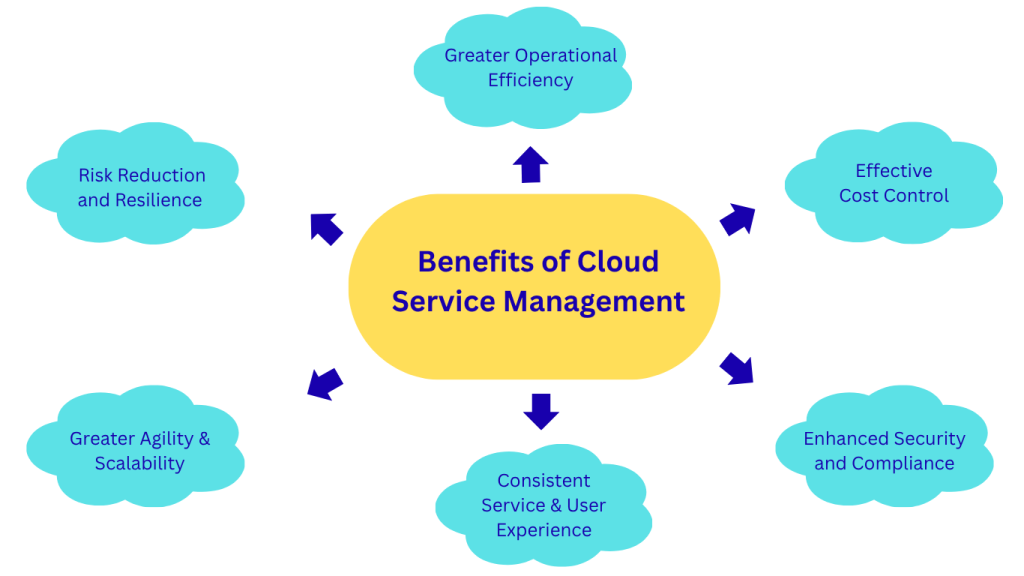
Modern cloud environments deliver immense potential, but that potential only becomes real when managed with discipline and clarity. Cloud service management brings structure to complexity, turning scattered resources into a unified system that delivers reliability, visibility, and control.
1. Greater Operational Efficiency
Structured service management streamlines processes, automates routine operations, and reduces manual effort. With clear workflows for provisioning, monitoring, and incident resolution, teams spend less time firefighting and more time innovating. This efficiency directly translates into faster service delivery and higher business agility.
2. Improved Cost Control and Accountability
Unmonitored cloud usage can quickly lead to budget overruns. Service management integrates FinOps principles to track consumption, enforce tagging policies, and optimize resource allocation. When teams can see exactly where their budgets go and why, financial governance becomes transparent, predictable, and data driven.
3. Stronger Security and Compliance Posture
Security is not an afterthought; it is built into every stage of service management. Continuous compliance checks ensure that configurations align with standards such as ISO 27001, PCI DSS, or HIPAA. Automated policies detect and remediate drift before it becomes a vulnerability. This proactive approach protects critical data while maintaining trust with customers and regulators.
4. Consistent Service Quality and User Experience
Service management enforces reliability through structured monitoring, defined service levels, and continuous improvement cycles. Real-time performance metrics and automated remediation ensure that users experience stable, responsive systems even under heavy demand. Consistent service quality builds confidence across both internal teams and external clients.
5. Enhanced Business Agility and Scalability
Cloud service management enables organizations to scale efficiently as needs evolve. Whether expanding into new regions, deploying new workloads, or integrating new vendors, a well-managed environment supports seamless growth. By maintaining a balance between governance and flexibility, businesses can adapt to change without losing control or performance.
6. Risk Reduction and Resilience
Effective service management embeds resilience into operations. Regular disaster recovery testing, failover automation, and version control ensure continuity even in the face of unexpected disruptions. These practices turn resilience from a reactive measure into a strategic capability that safeguards reputation and long-term success.
Tools and Platforms That Support Cloud Service Management
While strategy and governance form the foundation of cloud service management, the right tools bring that strategy to life. They provide visibility, consistency, and automation the three essentials for managing complex multi-cloud environments. Selecting and integrating these platforms effectively can determine whether cloud operations remain efficient or drift into chaos.
1. Cloud Management Platforms (CMPs)
A cloud management platform unifies control across multiple providers such as AWS, Azure, and Google Cloud. It consolidates inventory, monitors usage, and enforces policies from a single interface. CMPs allow organizations to view cost, compliance, and performance data side by side, creating a single source of truth. They also support automation for provisioning, scaling, and decommissioning workloads, which reduces errors and improves consistency.
2. Monitoring and Observability Tools
Modern cloud environments require deep observability to maintain performance and reliability. Tools like Datadog, New Relic, and Azure Monitor gather logs, metrics, and traces from distributed systems. When combined with AI-powered analytics, these insights help teams detect anomalies early, trace root causes, and forecast capacity needs. Observability turns raw telemetry into actionable intelligence that supports continuous improvement.
3. Configuration and Policy Management
Ensuring consistent configurations across environments is a critical challenge. Platforms such as HashiCorp Terraform, AWS Config, and Azure Policy automate configuration enforcement and prevent policy drift. By embedding compliance and security rules into code, organizations can apply governance automatically at deployment. This approach strengthens reliability and reduces the risk of human error.
4. Automation and Orchestration Platforms
Automation drives efficiency and scalability in cloud operations. Tools like Ansible, Chef, and Puppet orchestrate provisioning, patching, and updates through repeatable workflows. These platforms eliminate manual tasks, reduce response time, and ensure that every deployment follows standardized best practices. Automation allows teams to maintain high operational velocity without compromising control.
5. Security and Compliance Management Tools
Security cannot rely on periodic audits alone. Continuous compliance monitoring tools such as Prisma Cloud, AWS Security Hub, and Microsoft Defender for Cloud scan environments in real time to detect vulnerabilities, misconfigurations, and policy violations. They integrate directly into CI/CD pipelines to enforce security from the earliest stages of development.
6. Cost Management and FinOps Platforms
Financial accountability is an integral part of cloud service management. Tools like CloudHealth, Apptio Cloudability, and native cost explorers from major cloud providers provide visibility into spending patterns. They help track budgets, identify idle resources, and recommend optimization strategies. Integrated FinOps platforms connect finance and engineering teams, ensuring that cost decisions support overall business priorities.
7. Collaboration and Workflow Tools
Finally, no service management framework is complete without strong collaboration. Platforms like ServiceNow, Jira Service Management, and Slack streamline communication, ticketing, and incident response. When workflows connect directly to monitoring and automation systems, teams can resolve issues faster and maintain transparency across departments.
These tools and platforms form the operational backbone of modern cloud management. They reduce complexity, increase confidence, and give teams the data and control needed to make smart, timely decisions. Yet the true value emerges when these technologies work together under a clear strategy one that connects performance, cost, and security with the organization’s broader mission.
Best Practices for Implementing Cloud Service Management
Implementing effective cloud service management requires more than deploying tools or writing policies. It demands a structured approach that blends governance, automation, and cultural alignment. The following best practices help organizations move from fragmented operations to a cohesive, data-driven cloud strategy.
1. Define Clear Objectives and Governance Frameworks
Before implementation begins, organizations must establish clear business objectives and governance principles. Define the purpose of each cloud service, outline accountability across teams, and create measurable success indicators. A strong governance model ensures that every cloud decision aligns with business outcomes, not just technical convenience.
2. Embed Security and Compliance from the Start
Security must be integrated into the foundation of every process. Rather than applying controls after deployment, include compliance checks and risk assessments in the design phase. Implement identity management, access policies, and data protection measures that evolve with your workloads. This proactive mindset minimizes exposure and strengthens trust.
3. Automate Wherever Possible
Automation is the cornerstone of operational efficiency in the cloud. Use orchestration tools to handle provisioning, scaling, and updates automatically. Implement auto remediation for common incidents to reduce downtime and free up engineers to focus on innovation. The goal is to create a self-healing environment where manual intervention becomes the exception, not the rule.
4. Build Comprehensive Observability
Visibility is key to control. Integrate metrics, logs, and traces into a unified observability platform to gain real-time insights into performance, reliability, and user experience. Correlate these signals with cost data to reveal the true business impact of technical decisions. Continuous monitoring transforms cloud management from reactive to predictive.
5. Foster Collaboration Across Teams
Cloud service management succeeds when development, operations, and finance work in harmony. Encourage shared responsibility for performance, cost, and compliance. Platforms that connect workflows across these functions such as ServiceNow or Jira Service Management help maintain transparency and accountability across the organization.
6. Continuously Review and Optimize
The cloud is dynamic, and so should be your management approach. Conduct regular reviews of cost efficiency, resource allocation, and SLA performance. Use these insights to refine governance policies and automation rules. Continuous optimization ensures that cloud operations evolve in sync with business growth and market changes.
7. Invest in Skills and Culture
Technology alone cannot deliver sustainable success. Equip teams with the skills to manage complex cloud environments effectively. Encourage a culture of ownership, experimentation, and learning. When teams understand both the technical and strategic dimensions of cloud service management, they can make informed decisions that drive long-term value.
Cloud service management is not a static framework but a living system that matures with your organization. By combining automation, observability, and governance under a shared culture of accountability, businesses can transform cloud complexity into a structured, resilient, and scalable foundation for growth.
Conclusion
Cloud service management has become essential for modern IT. It brings structure, control, and visibility to complex cloud environments, turning scattered workloads into a unified system that supports business goals.
When managed well, the cloud becomes a driver of innovation rather than a source of chaos. Strong governance keeps costs predictable, automation boosts reliability, and observability connects performance with real business value.
At ONEXT DIGITAL, we help organizations design and operate cloud management frameworks that deliver measurable results. Our experts align technology, process, and strategy to ensure your cloud runs efficiently, securely, and at scale.
If you are ready to build a smarter, more resilient cloud environment, connect with us today and let’s transform the way your business operates in the cloud.
FAQs about Service Management in Cloud Computing
To help you better understand this topic, here are some frequently asked questions about cloud service management and how it impacts modern businesses.
1. What is service management in cloud computing?
Service management in cloud computing refers to the structured process of designing, delivering, and maintaining cloud services to ensure reliability, security, and cost efficiency. It combines ITSM, CloudOps, and FinOps principles to align technical operations with business goals.
2. Why is cloud service management important for businesses?
It helps organizations maintain control over complex multi-cloud environments by improving visibility, reducing costs, ensuring compliance, and enhancing service performance. Without it, companies risk inefficiency, security gaps, and rising cloud expenses.
3. What are the key components of cloud service management?
Core components include service strategy and governance, design and architecture, operation and monitoring, incident management, security and compliance, and cost optimization. Together, these create a unified framework for efficient cloud operations.
4. How does automation improve cloud service management?
Automation reduces manual errors and accelerates operations by handling repetitive tasks such as provisioning, monitoring, and patching. Tools like Terraform, Ansible, and ServiceNow streamline workflows, enabling faster, more reliable service delivery.
5. How can companies optimize cloud costs effectively?
Organizations can use FinOps practices and cost management tools such as CloudHealth or AWS Cost Explorer to monitor usage, eliminate waste, and allocate resources efficiently. Regular audits and automated scaling ensure every dollar spent drives business value.
6. What are best practices for implementing cloud service management?
Best practices include defining clear governance frameworks, embedding security from the start, automating wherever possible, building observability, encouraging cross-team collaboration, and continuously reviewing performance for improvement.