
 Services
 Solutions
 Main platform
 Technology
 White Label
  Offshore
 Hire developers



The cloud revolution isn’t coming it’s already here. As we navigate through 2026, businesses of all sizes are making a decisive shift from managing their own cloud infrastructure to partnering with managed service providers. The global cloud managed services market reached $134.44 billion in 2024 and is expected to hit $305.16 billion by 2030, reflecting unprecedented growth that signals a fundamental transformation in how companies approach IT operations.
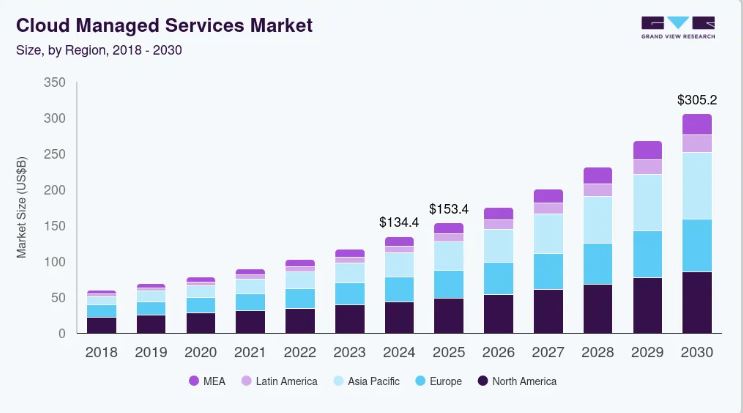
This isn’t just about following trends it’s about survival. Organizations that cling to self-managed cloud infrastructure increasingly find themselves outpaced by competitors who’ve embraced the expertise, efficiency, and innovation that public cloud managed services provide. Let’s explore the six major trends driving this unstoppable movement.
The Perfect Storm: Why Now?
The convergence of several factors has created what experts call a “perfect storm” for managed services adoption. Public cloud deployment currently holds approximately 54.8% of the global managed cloud services market, but the real story lies in why businesses are making this transition now rather than later.
The complexity of modern cloud environments has reached a tipping point. Companies are no longer managing simple workloads on a single platform. Instead, organizations increasingly adopt hybrid cloud architectures that integrate public and private clouds, creating management challenges that overwhelm even experienced IT teams.
Trend #1: AI-Powered Cloud Optimization Changes Everything
Artificial intelligence has transformed cloud management from a reactive practice into a predictive science. Today’s managed service providers leverage AI and machine learning to optimize cloud environments in ways that would be impossible for most in-house teams.
The impact is dramatic. AI-driven platforms now predict resource needs before bottlenecks occur, automatically adjust capacity based on usage patterns, and identify cost-saving opportunities that human analysts might miss. Organizations are increasingly outsourcing cloud operations not just for cost optimization, but to enable business resilience, faster innovation, and regulatory alignment.
Consider what this means in practice: A managed service provider’s AI tools can analyze millions of data points across your cloud infrastructure, detecting anomalies that signal security threats, identifying underutilized resources that drain budgets, and recommending architectural improvements that boost performance. This level of sophisticated analysis requires specialized expertise and expensive tools that few companies can justify maintaining in-house.
The competitive advantage is clear. Companies using AI-optimized managed services report faster deployment times, reduced downtime, and significant cost savings compared to traditional management approaches.
Trend #2: The FinOps Revolution-Taking Control of Cloud Costs
Cloud spending has spiraled out of control for many organizations, creating what industry insiders call “cloud cost chaos.” A HashiCorp survey found that 91% of IT professionals identified avoidable cloud spending as a challenge, with the largest waste factors being overprovisioning of resources (40%) and idle or underused resources (35%).
The financial operations (FinOps) movement has emerged as a critical discipline within cloud management. This approach combines financial accountability with technical operations, ensuring every dollar spent on cloud resources delivers measurable business value.
Managed service providers excel at FinOps because they:
- Monitor costs continuously across multiple cloud platforms
- Implement automated policies that prevent budget overruns
- Provide detailed cost attribution to individual business units or projects
- Recommend architectural changes that reduce expenses without sacrificing performance
- Negotiate better rates with cloud providers based on aggregated volume
The results speak volumes. Organizations that implement comprehensive FinOps practices through managed services typically reduce their cloud spending by 30-40% within the first year, while simultaneously improving application performance and reliability.
Trend #3: Security Threats Demand 24/7 Expert Protection
The security landscape has never been more threatening. 83% of organizations have expressed concerns about data sovereignty, and cloud security statistics indicate that 89% of businesses impacted by cloud misconfigurations were startups. Even more alarming, 80% of companies experienced security incidents related to public cloud usage in the past year.
The sophistication and frequency of attacks continue to escalate. Organizations saw nearly five times as many daily cloud-based alerts at the end of 2024 compared to the start of the year, indicating that attackers have significantly intensified their focus on cloud infrastructure.
Human error remains the leading cause of security breaches. 88% of all data breaches result from human error, with Gartner predicting that by 2025, 99% of cloud security failures will be the customer’s fault, primarily due to misconfigurations.
The financial stakes couldn’t be higher. Public cloud security incidents averaged $5.17 million per data breach in 2024 – 13.1% higher than the year before.
Managed service providers offer a comprehensive security solution that few organizations can replicate internally:
- Round-the-clock monitoring by certified security specialists
- Immediate threat response and remediation
- Regular security audits and compliance assessments
- Automated patch management and vulnerability scanning
- Advanced threat intelligence from monitoring thousands of client environments
This collective defense approach means that when a threat emerges in one client’s environment, the provider can immediately apply protective measures across all customers something individual companies managing their own security cannot achieve.
Trend #4: Multi-Cloud Complexity Requires Specialized Expertise
The multi-cloud era has arrived with full force. 76% of enterprises use at least two cloud providers, and 69% of organizations leverage three or more cloud service providers. This complexity has made effective cloud management exponentially more challenging.
Each major cloud platform AWS, Azure, Google Cloud operates differently, with unique pricing models, security frameworks, and operational requirements. Managing workloads across multiple platforms requires deep expertise in each environment, a breadth of knowledge that’s increasingly rare and expensive to maintain in-house.
Hybrid cloud deployment is expected to record the fastest growth at a 16.1% CAGR, fueled by growing enterprise needs for workload portability, data sovereignty, and security customization.
Managed service providers solve the multi-cloud challenge by:
- Maintaining certified experts across all major cloud platforms
- Providing unified management interfaces that abstract away platform differences
- Optimizing workload placement based on cost, performance, and compliance requirements
- Ensuring seamless integration and data flow between different cloud environments
- Managing complex migrations without disrupting business operations
The strategic advantage extends beyond operational efficiency. With vendor-agnostic expertise, managed service providers can objectively recommend the best platform for each workload, eliminating the bias that often leads to suboptimal architecture decisions.
Trend #5: The Critical Shift to Core Business Focus
The most successful companies in 2025 share a common trait: they’ve stopped trying to be everything to everyone. Instead, they’ve ruthlessly focused on their core competencies while partnering with specialists for everything else.
This philosophy extends to IT infrastructure. Progressive executives increasingly ask themselves: “Is managing cloud infrastructure a core competency that differentiates our business in the marketplace?” For the vast majority of companies, the answer is no.
Consider the opportunity cost. Every hour your IT team spends troubleshooting infrastructure issues, optimizing configurations, or managing security patches is an hour they’re not spending on initiatives that directly drive revenue and competitive advantage developing new features, improving customer experiences, or enabling innovative business models.
By partnering with managed service providers, organizations redirect their technical talent toward activities that matter:
- Building and refining products that delight customers
- Developing data analytics capabilities that inform strategic decisions
- Creating digital experiences that differentiate the brand
- Implementing emerging technologies that open new revenue streams
The velocity advantage compounds over time. Companies that offload operational burden to managed service providers consistently report faster time-to-market for new initiatives, greater agility in responding to market changes, and improved employee satisfaction as teams focus on creative problem-solving rather than operational firefighting.
Trend #6: The Talent Crisis Forces Strategic Decisions
The cloud skills shortage has reached crisis proportions. IDC projects that more than 90% of organizations will face IT skills shortages by 2026, which could cost them an estimated $5.5 trillion.
The problem extends beyond simple headcount. 64% of organizations report a shortage of skilled staff, and this talent gap leads to deployment delays, inefficient use of resources, and increased security vulnerabilities.
Even when companies successfully recruit cloud experts, retention remains challenging. The fierce competition for talent has driven salaries to unprecedented levels, with cloud engineers earning an average annual salary of $130,815, and total median pay reaching $148,000 per year. Smaller organizations and companies outside major tech hubs find themselves unable to compete for top talent.
The skills gap affects every aspect of cloud operations. Without proper expertise, organizations struggle with:
- Implementing security best practices and maintaining compliance
- Optimizing architectures for performance and cost-efficiency
- Troubleshooting complex issues that span multiple cloud services
- Keeping pace with the constant evolution of cloud platforms and services
- Managing the specialized skills required for emerging technologies like containers, serverless computing, and edge computing
Managed service providers offer an immediate solution to this crisis. Rather than competing for scarce talent, organizations gain instant access to teams of certified experts across all cloud platforms. These providers maintain ongoing training programs to ensure their staff stays current with the latest technologies and best practices an investment that few individual companies can match.
The economic argument is compelling. The total cost of maintaining an in-house cloud team including salaries, benefits, training, tools, and overhead typically exceeds the cost of managed services, while delivering inferior results due to the breadth and depth advantages that specialized providers enjoy.
Real-World Success: Companies Making the Leap
The theoretical advantages of managed services become concrete when we examine real-world implementations. Across industries, organizations are achieving remarkable results:
1. Mid-Market Manufacturing Company:
A regional manufacturer with 500 employees reduced cloud costs by 42% within six months of engaging a managed service provider. More importantly, they eliminated the two-week deployment time for new applications, accelerating their digital transformation initiatives and enabling rapid response to customer needs.
2. Healthcare Organization:
A multi-facility healthcare system improved their security posture dramatically after transitioning to managed services. Within 90 days, the provider identified and remediated 127 security vulnerabilities that had gone undetected by the internal team. The organization achieved HIPAA compliance for the first time, avoiding potential penalties while protecting sensitive patient data.
3. High-Growth Technology Startup:
A SaaS startup scaling from 50 to 500 employees leveraged managed services to maintain operational stability during explosive growth. Rather than building an extensive internal infrastructure team, they maintained a lean IT organization focused on product development while their managed service provider handled all cloud operations, security, and compliance requirements.
Common themes emerge across these success stories:
- Significant cost reductions combined with improved service levels
- Enhanced security posture and compliance capabilities
- Greater agility and faster time-to-market for new initiatives
- Improved employee satisfaction as teams focus on strategic work
- Access to expertise and technologies that would be cost-prohibitive to maintain internally
Choosing the Right Managed Service Provider

Not all managed service providers deliver equal value. As this market matures, organizations must evaluate potential partners carefully to ensure successful outcomes.
1. Essential Selection Criteria:
- Multi-cloud expertise stands paramount. Your provider must demonstrate proven capabilities across AWS, Azure, Google Cloud, and other platforms relevant to your business. Look for extensive certifications, customer references, and case studies that document successful implementations similar to your requirements.
- Security and compliance credentials deserve intense scrutiny. Verify that providers maintain relevant certifications (SOC 2, ISO 27001, industry-specific standards) and can demonstrate comprehensive security practices. Request details about their security operations center, incident response procedures, and how they stay current with emerging threats.
- Transparent pricing models protect against unpleasant surprises. Ensure you understand exactly what’s included in base fees versus what incurs additional charges. The best providers offer predictable monthly costs with clear mechanisms for handling growth or changes in requirements.
- Service level agreements (SLAs) define expectations for response times, uptime, and issue resolution. Review these carefully to ensure they align with your business requirements. Pay particular attention to how providers handle emergencies and after-hours support.
- Cultural fit matters more than many organizations realize. Your managed service provider becomes an extension of your team. Evaluate their communication style, responsiveness during the sales process, and whether their values align with your organization’s culture.
2. Red Flags to Avoid:
Vendor lock-in: Be cautious of providers that rely on proprietary tools or processes, making it hard to switch later. The best partners prioritize portability, ensuring you can move or adjust without obstacles.
Hidden fees: Some providers lure clients with low base rates but charge extra for routine tasks like configuration changes, reporting, or support requests. Always insist on full transparency regarding all potential costs.
Limited scalability: A provider shows a lack of scalability when they cannot clearly explain how they will support your growth or handle sudden spikes in workload. Their infrastructure, processes, and team should expand seamlessly alongside your needs.
Getting Started: Your Transition Strategy
Successful transitions to managed services follow a structured approach that minimizes risk while accelerating benefits.
Step 1: Comprehensive Assessment.
Document your current cloud infrastructure, including all platforms, services, applications, and integration points. Identify pain points, inefficiencies, and areas where you lack internal expertise. Quantify current costs both direct expenses and hidden costs like staff time and opportunity costs.
Step 2: Define Clear Objectives.
Establish specific, measurable goals for the managed services engagement. These might include cost reduction targets, security improvements, compliance requirements, or performance metrics. Prioritize objectives to ensure the provider focuses on what matters most to your business.
Step 3: Provider Selection and Due Diligence.
Develop a shortlist of candidates based on your requirements. Conduct thorough evaluations including reference checks, proof-of-concept projects, and detailed discussions about how they’ll address your specific challenges. Don’t rush this phase the right partner will significantly impact your success.
Step 4: Structured Migration and Onboarding.
Work with your chosen provider to develop a phased migration plan that minimizes business disruption. Start with non-critical workloads to build confidence and refine processes before transitioning mission-critical systems. Ensure clear communication across all stakeholders throughout the transition.
Step 5: Continuous Optimization.
Managed services relationships succeed through ongoing collaboration and refinement. Establish regular review meetings to assess performance against objectives, identify new opportunities for improvement, and adjust the engagement as your business evolves.
Looking Beyond 2025: The Future of Cloud Management
The managed services evolution continues accelerating as new technologies and approaches emerge.
- Quantum computing, though still in early stages, will eventually require entirely new approaches to cloud management and optimization. Forward-thinking managed service providers are already investing in quantum expertise to position themselves for this transition.
- Edge computing integration represents a more immediate frontier. As organizations deploy more workloads at the edge to reduce latency and improve performance, managed services will expand to encompass edge infrastructure alongside traditional cloud platforms.
- Sustainability has emerged as a critical concern for cloud operations. Providers are increasingly offering sustainability services to help organizations reduce their carbon footprint and meet environmental goals. Future managed services will routinely include carbon accounting, recommendations for reducing environmental impact, and reporting capabilities that support ESG initiatives.
- Autonomous cloud management powered by advanced AI may eventually reduce the need for human intervention in routine operations. However, this will amplify rather than diminish the value of managed service providers, as they’ll maintain the expertise needed to train, monitor, and refine these autonomous systems.
Conclusion:
The evidence is clear: public cloud managed services have shifted from being optional to a strategic necessity. AI-driven optimization, FinOps discipline, evolving security threats, multi-cloud complexity, a focus on core business, and talent shortages all underline the urgency for businesses to act.
Delaying this transition can lead to rising operational costs, security vulnerabilities, talent shortages, slower innovation, and missed opportunities as resources remain tied to day-to-day operations.
The good news is that the managed services market is mature today, with experienced providers, proven best practices, and tailored solutions ready to help organizations of all sizes optimize their cloud environments. Partnering with the right provider can turn these challenges into opportunities, freeing teams to focus on strategic initiatives and growth.
FAQs About Public Cloud Managed Services
1. What are public cloud managed services?
Public cloud managed services are third-party providers that handle management, monitoring, optimization, and security of cloud infrastructure on platforms like AWS, Azure, or Google Cloud, giving your team more time to focus on core business tasks.
2. How much can I save with public cloud managed services?
Organizations typically cut cloud spending by 30-40% in the first year through better resource use, automated cost monitoring, and expert guidance, while also saving on hiring and training specialized cloud staff.
3. Are managed services only for large enterprises?
No. Managed services benefit organizations of all sizes SMBs gain enterprise-level expertise without high costs, and large enterprises achieve scalability and efficiency beyond what internal teams can handle.
4. Will I lose control of my cloud infrastructure?
No. You retain full control. Managed service providers act as an extension of your team, following your strategies while providing expert support.
5. Do managed service providers support multi-cloud environments?
Yes. Leading providers manage workloads across AWS, Azure, Google Cloud, and others, optimizing placement for cost, performance, and compliance.
6. Is my data secure with a managed service provider?
Yes. Managed services often provide stronger security than self-managed setups, with SOC 2/ISO 27001 certifications, dedicated security teams, and 24/7 threat monitoring.