
 Services
 Solutions
 Main platform
 Technology
 White Label
  Offshore
 Hire developers



The Managed Application Services Market & Trend is reshaping how enterprises handle their application environments. Today, companies are no longer focused only on maintaining legacy systems, they’re managing a mix of cloud-based applications, hybrid platforms, and increasingly automated tools. As these systems grow in scale and complexity, traditional approaches to application management often struggle to keep pace.
Within this landscape, Managed Application Services (AMS) has moved beyond a support-focused model to become a strategic capability. Rather than addressing isolated issues, AMS helps organizations bring structure, consistency, and control to increasingly fragmented application portfolios. For enterprises aiming to stay competitive in 2026 and beyond, understanding the Managed Application Services Market & Trend including key adoption drivers, emerging trends, and real-world usage patterns is essential.
This article provides a clear, structured look at the Managed Application Services Market & Trend, examines the forces driving its evolution, and explores the opportunities and challenges organizations face when deciding how to manage their applications in a rapidly changing environment.
What Are Managed Application Services (MAS)?
Managed Application Services (MAS) represents a structured approach to managing enterprise applications across their full operational lifecycle. Rather than focusing on isolated systems or reactive support, MAS is designed to provide consistent control, visibility, and continuous improvement across complex application environments.
As organizations operate across cloud, hybrid, and legacy platforms simultaneously, MAS has become a way to manage applications as a portfolio, not just as individual technical assets.
Definition of Managed Application Services
Managed Application Services (MAS) is a service model in which an organization delegates the end-to-end operational responsibility of its applications including run, support, maintenance, and ongoing optimization to a specialized provider, with the goal of ensuring stability while enabling continuous change.
What defines MAS is not simply outsourcing execution, but establishing a scalable operating model for application management. In mature MAS engagements, success is measured not only by uptime or ticket resolution, but by how effectively the application environment supports evolving business needs.
MAS vs. AMS vs. Application Support (Quick Comparison)
| Dimension | Application Support | Application Management Services (AMS) | Managed Application Services (MAS) |
|---|---|---|---|
| Primary Focus | Incident resolution and user support | Stable and efficient application operations | Long-term control and evolution of the application portfolio |
| Scope of Responsibility | Individual issues and requests | Defined applications and services | End-to-end application lifecycle across environments |
| Operating Approach | Reactive | Structured and SLA-driven | Proactive, continuous, and portfolio-based |
| View of Applications | Isolated systems | Managed systems | Interconnected ecosystem |
| Key Success Metrics | Response time, ticket closure | Availability, SLAs, MTTR | Resilience, adaptability, and operational outcomes |
| Role in Change & Optimization | Limited or ad hoc | Planned changes and maintenance | Continuous optimization and improvement |
| Strategic Impact | Operational support function | Service delivery capability | Strategic operating model for applications |
Although the terms MAS, AMS, and Application Support are often used interchangeably, they reflect different levels of scope and strategic intent.
- Application Support typically focuses on day-to-day incident handling and user issues. It is reactive by nature, with success measured through response times and ticket closure.
- Application Management Services (AMS) expands this scope to include structured maintenance, change management, and service-level accountability. AMS introduces governance and standardized processes, but often remains centered on operational continuity.
- Managed Application Services (MAS) goes a step further by treating application management as a continuous capability. MAS emphasizes portfolio-level visibility, proactive optimization, and long-term alignment with business and technology strategy.
What Services Are Typically Included in MAS?
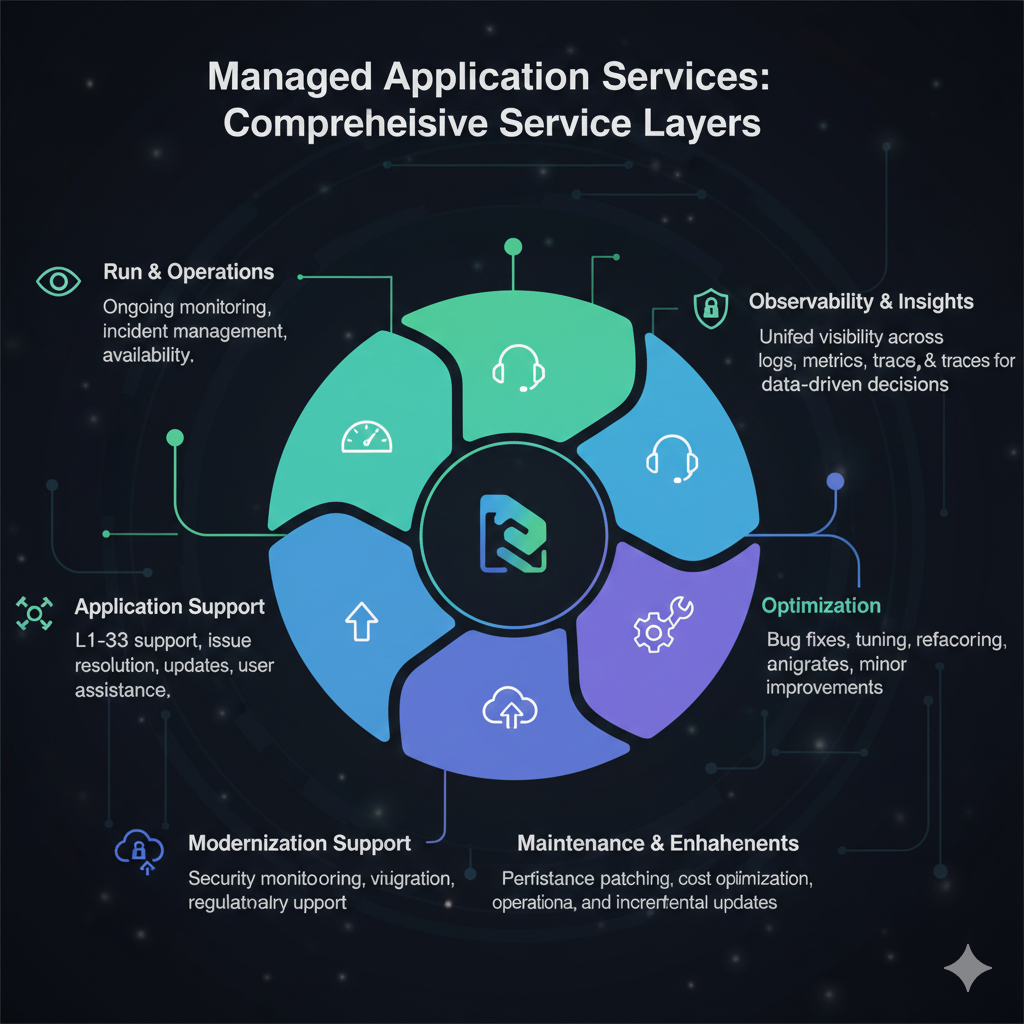
While the exact scope of MAS varies by organization, most mature MAS models include a combination of the following service layers:
- Run & Operations
Ongoing monitoring, incident management, and availability management to ensure applications remain stable and responsive.
- Application Support
L1–L3 support services, including issue resolution, user assistance, and service request handling, delivered through standardized workflows.
- Maintenance & Enhancements
Bug fixes, minor improvements, patching, and version updates to keep applications secure and functional over time.
- Optimization
Performance tuning, cost optimization (particularly in cloud environments), and operational improvements based on usage and telemetry data.
- Modernization Support
Assistance with refactoring, migration, or incremental modernization efforts, often delivered alongside ongoing operations rather than as standalone projects.
- Security & Compliance
Security monitoring, vulnerability management, access controls, and support for regulatory and compliance requirements embedded into daily operations.
- Observability & Insights
Unified visibility across logs, metrics, and traces to move beyond basic monitoring and enable proactive, data-driven decision-making.
Together, these services allow MAS to function not just as a support mechanism, but as a foundation for resilient, adaptable application environments.
Managed Application Services Market Overview (2024–2026)

Global Market Size & Growth Outlook
From 2024 to 2026, the Managed Application Services (MAS) market continues to show steady, sustained growth, reflecting a structural shift rather than a short-term surge. Enterprises are not adopting MAS because of a single technology trend, but because the operational reality of modern application environments has fundamentally changed.
Application portfolios are expanding in both size and diversity. Legacy systems remain in place longer than expected, cloud-native applications proliferate, and SaaS platforms are embedded across business functions. Managing this mix at scale has become increasingly difficult using traditional, internally fragmented models. MAS growth mirrors this pressure: it rises as organizations seek predictability, control, and resilience in environments that are otherwise difficult to govern.
Rather than peaking quickly, the market shows signs of durable demand. Once adopted, MAS is rarely rolled back. Instead, engagements tend to expand in scope over time, moving from limited support to broader lifecycle responsibility as organizations mature their operating models.
CAGR and Key Growth Assumptions
Market growth projections for MAS are typically expressed through moderate-to-strong compound annual growth rates. These projections are based on a set of underlying assumptions that go beyond headline technology adoption.
Key assumptions include:
- Continued expansion of hybrid and multi-cloud environments
- Persistent skills gaps in application operations and platform management
- Increasing expectations for availability, security, and compliance
- Growing reliance on automation, observability, and data-driven operations
Importantly, MAS growth assumptions do not rely on aggressive digital transformation scenarios. Instead, they reflect a more conservative reality: complexity is accumulating faster than organizations can simplify it. MAS adoption is therefore less about accelerating change and more about making continuous change manageable.
This explains why MAS growth remains resilient even during periods of economic uncertainty. Organizations may delay large transformation initiatives, but they rarely reduce investment in keeping critical applications stable and adaptable.
Why Market Size Numbers Differ Across Reports?
One of the most common points of confusion in the MAS market is the wide variation in reported market size and growth figures across research firms. These differences are not necessarily contradictions; they are the result of how the market is defined and measured.
Several factors consistently drive variation:
- Scope definition
Some reports define MAS narrowly, focusing on application support and maintenance. Others include optimization, modernization support, and cloud operations, resulting in significantly larger market estimates.
- Service bundling
In many cases, MAS is bundled with adjacent services such as infrastructure management, platform operations, or DevOps services. Whether these are counted as part of the MAS market materially affects reported figures.
- Regional coverage
Market maturity varies widely by region. Reports that emphasize North America and Western Europe often show different growth patterns compared to those that include emerging markets where MAS adoption is still developing.
- Definition gaps
The distinction between Application Support, AMS, and MAS is not consistently applied across studies. Some research uses these terms interchangeably, while others treat them as separate segments.
For decision-makers, the implication is clear: market size numbers should be read as directional signals, not precise benchmarks. The more reliable insight lies in the consistency of the trend itself, sustained demand for scalable, structured application management models in increasingly complex enterprise environments.
Top Managed Application Services Trends Shaping 2026
The evolution of the Managed Application Services (MAS) market is being shaped less by individual technologies and more by how enterprises are redefining the role of application operations. By 2026, the most significant MAS trends are not about adding new tools, but about changing the operating assumptions behind application management.
These trends reflect a broader shift: MAS is moving from a service layer to an organizational capability, one that absorbs complexity, enables continuous change, and aligns application operations with business priorities.
Trend 1 – AIOps Moves from Experimentation to Operational Baseline
Artificial Intelligence for IT Operations (AIOps) is transitioning from pilot projects to a foundational element of modern MAS engagements. As application environments generate growing volumes of logs, metrics, and events, manual correlation and reactive monitoring no longer scale.
By 2026, AIOps is expected to underpin how MAS providers detect anomalies, prioritize incidents, and reduce mean time to resolution. The strategic impact lies not in automation itself, but in shifting operations from reactive response to anticipatory control. Organizations adopting MAS increasingly expect intelligence to be embedded into daily operations, not layered on as an optional enhancement.
Trend 2- Observability Becomes Central to Application Management
Traditional monitoring focuses on whether systems are up or down. Observability, by contrast, focuses on understanding why systems behave the way they do. This distinction is becoming critical as applications span distributed services, cloud platforms, and third-party integrations.
In 2026, observability is no longer a specialist concern. It is becoming a core requirement of MAS operating models, providing unified visibility across application behavior, performance, and dependencies. This shift enables MAS teams to move beyond symptom management and toward systemic understanding and prevention.
Trend 3- Outcome-Oriented Service Models Gain Traction
MAS contracts have historically been defined by technical SLAs such as uptime and response time. While these metrics remain necessary, they are increasingly seen as insufficient.
A growing trend is the move toward outcome-oriented service models, where success is measured in terms of stability, resilience, and operational effectiveness rather than isolated technical indicators. This reflects a maturing buyer perspective: organizations are less interested in how services are delivered and more interested in what operational outcomes they enable.
Trend 4- Security and Compliance Are Embedded into MAS, Not Added Later
As regulatory and security pressures increase, MAS can no longer treat security as a separate domain. By 2026, security monitoring, vulnerability management, and compliance support are increasingly embedded directly into application operations.
This integration reduces friction between security and delivery teams and aligns MAS more closely with enterprise risk management. The trend signals a shift from reactive security responses to continuous, operationally integrated risk control.
Trend 5- MAS Expands Beyond “Run” into Continuous Optimization
Perhaps the most significant trend shaping MAS is the expansion of scope beyond basic “run” services. Organizations increasingly expect MAS providers to contribute to performance tuning, cost optimization, and incremental modernization alongside daily operations.
This does not mean MAS replaces transformation initiatives. Rather, it reflects a recognition that change is continuous, and operational models must support ongoing improvement without destabilizing core systems.
Why These Trends Matter
Taken together, these trends point to a clear conclusion: Managed Application Services in 2026 is less about managing applications and more about managing change at scale. Organizations that treat MAS as a static outsourcing decision risk falling behind. Those that align MAS with their broader operating model are better positioned to absorb complexity and adapt over time.
How to Choose a Managed Application Services Provider?
Choosing a Managed Application Services (MAS) provider is less about selecting a vendor and more about designing an operating relationship. Organizations that approach this decision strategically focus first on structure, intent, and governance, then evaluate providers against those criteria. The following steps reflect how experienced buyers reduce risk and extract long-term value from MAS engagements.
Step 1 – Define Your MAS Scope Correctly
Before engaging providers, organizations must clearly define what MAS is expected to cover. Ambiguity at this stage is one of the most common causes of misalignment later.
A practical way to frame scope is to distinguish between Run, Change, and Optimize:
- Run includes day-to-day operations such as monitoring, incident response, availability management, and routine support.
- Change covers planned updates, releases, and controlled enhancements that keep applications aligned with evolving requirements.
- Optimize focuses on performance tuning, cost efficiency, and incremental improvements based on operational data.
Not every application needs the same level of coverage. Some systems benefit from full lifecycle management, while others require only limited operational support.
Equally important is identifying which applications should not be managed. Highly experimental systems, tightly coupled product differentiation, or applications undergoing imminent replacement may be better retained under direct internal control. Effective MAS adoption is selective, not indiscriminate.
Step 2 – Key Evaluation Criteria Beyond Cost
While cost remains a consideration, it is rarely the primary determinant of success in MAS engagements. Experienced buyers evaluate providers across a broader set of criteria.
The delivery model determines how work is structured across onshore, nearshore, and offshore teams, and how effectively these teams integrate with internal stakeholders.
Tooling maturity reflects a provider’s ability to operate at scale. Standardized monitoring, automation, observability, and service management platforms are essential to consistent performance.
Industry experience matters not because of domain knowledge alone, but because regulatory expectations, integration patterns, and risk tolerance vary widely across sectors.
Finally, transition methodology often separates capable providers from underprepared ones. A well-defined approach to onboarding, stabilization, and knowledge transfer is critical to minimizing disruption.
Step 3 – Managed Application Services Pricing Models Explained
Pricing models shape behavior as much as they reflect cost. Understanding their implications helps organizations avoid unintended incentives.
- Per-application pricing offers clarity and predictability but may lack flexibility as portfolios change.
- Per-ticket pricing aligns cost with activity but can encourage volume over prevention.
- FTE-based models provide staffing transparency but risk recreating internal inefficiencies externally.
- Outcome-based pricing aligns incentives with results, though it requires mature metrics and trust.
In practice, hybrid pricing models are the most common and the most realistic. They combine baseline stability with performance-oriented components, balancing predictability and accountability.
Step 4 – Critical SLAs & KPIs You Should Demand
Traditional SLAs remain necessary, but they should not dominate how success is defined.
Availability measures whether systems are accessible, while reliability reflects their ability to perform consistently under change. Both matter, but reliability often provides a more accurate picture of operational health.
Metrics such as mean time to resolution (MTTR) and change failure rate reveal how effectively issues are handled and prevented.
Leading organizations also introduce business-aligned KPIs, connecting application performance to user experience, process efficiency, or operational continuity. These metrics ensure MAS performance is evaluated in context, not isolation.
Step 5 – Transition & Governance Best Practices
Transition is not a one-time event; it sets the tone for the entire engagement. Effective transitions typically follow a 30–60–90 day framework: stabilization, knowledge consolidation, and optimization planning.
One of the most common risks during transition is incomplete or informal knowledge transfer. Documentation alone is insufficient; shared understanding must be validated through joint operations and shadowing.
Long-term success depends on establishing a continuous improvement cadence. Regular reviews, data-driven insights, and clear escalation paths help ensure MAS evolves alongside organizational needs rather than becoming static.
When approached thoughtfully, selecting a Managed Application Services provider becomes less about delegation and more about building a resilient, adaptable operating model, one capable of supporting continuous change without sacrificing control.
Common Mistakes Buyers Make When Outsourcing MAS
Even well-prepared organizations can undermine the value of Managed Application Services (MAS) through a small number of recurring mistakes. These issues rarely stem from poor intentions; they usually arise from misaligned assumptions about what MAS is meant to achieve. Understanding these pitfalls is critical to avoiding structural problems that are difficult to correct once contracts are in place.
Over-Customized Contracts That Limit Adaptability
One of the most common mistakes is over-customizing MAS contracts in an attempt to anticipate every possible scenario. While detailed specifications can provide short-term clarity, excessive customization often reduces flexibility and increases operational friction.
As application environments evolve, overly rigid contracts make it difficult to adjust scope, tooling, or service models without renegotiation. Instead of enabling control, they can lock organizations into outdated assumptions. Effective MAS contracts strike a balance: clear accountability combined with room to adapt as complexity changes.
Ignoring Observability and Tooling Ownership
Another frequent oversight is treating observability and operational tooling as secondary concerns. In many MAS engagements, monitoring platforms, automation tools, and service management systems are assumed rather than explicitly addressed.
This creates two risks. First, limited visibility reduces the organization’s ability to independently assess performance and risk. Second, unclear tooling ownership can create long-term dependency, making transitions or provider changes costly and disruptive.
Organizations that succeed with MAS treat observability and tooling as strategic assets, not implementation details. Clear agreements around data access, platform ownership, and integration are essential to maintaining control.
Treating MAS as “Pure Cost Cutting”
Perhaps the most consequential mistake is framing MAS primarily as a cost-reduction initiative. While efficiency gains are real, focusing exclusively on savings often leads to decisions that undermine long-term value.
When MAS is optimized only for cost, organizations tend to underinvest in automation, governance, and continuous improvement. This can stabilize expenses in the short term while increasing operational risk over time.
The organizations that extract the most value from MAS view it as a way to manage complexity, reduce risk, and support continuous change. Cost efficiency becomes a byproduct of better operations, not the sole objective.
Avoiding these mistakes does not require perfect foresight, but it does require intentional design. When MAS is treated as an operating model rather than a transactional service, these pitfalls become easier to recognize and easier to avoid.
Managed Application Services Market Outlook Beyond 2026
Looking beyond 2026, the evolution of Managed Application Services (MAS) is defined less by market size and more by how organizations conceptualize application operations. The direction of the market suggests a shift away from transactional service models toward integrated operating platforms that support continuous change.
Rather than asking how MAS will grow, the more relevant question becomes how MAS will be embedded into enterprise operating models over the next phase of digital maturity.
MAS as a Platform, Not a Contract
One of the most significant shifts ahead is the redefinition of MAS as a platform capability rather than a contractual arrangement. In this model, MAS is no longer measured by service scope alone, but by how effectively it integrates processes, tooling, data, and governance into a coherent operational system.
As application environments continue to evolve, static contracts become increasingly misaligned with reality. Platform-oriented MAS models allow organizations to adapt service coverage, automation, and metrics without renegotiating the foundation of the engagement. This shift emphasizes enablement and extensibility over rigid service definitions.
Over time, this perspective changes how organizations think about provider relationships, moving from service delivery oversight to operational partnership grounded in shared data and outcomes.
Convergence of DevOps, SecOps, FinOps, and AIOps
Beyond 2026, the boundaries between operational disciplines continue to blur. DevOps, SecOps, FinOps, and AIOps are converging into a unified approach to application lifecycle management.
This convergence reflects a practical reality: application performance, security, cost, and reliability are deeply interconnected. Treating them as separate domains creates friction and delays decision-making. MAS operating models increasingly serve as the integration layer where these disciplines intersect.
AIOps plays a critical role in this convergence by enabling correlation across signals, while observability provides the shared visibility required for coordinated action. Together, they support a shift from siloed optimization to system-level decision-making.
What Buyers Should Prepare for in the Next 3 Years
For buyers, the implications of this outlook are significant. MAS decisions made today will shape operational flexibility for years to come.
Organizations should prepare for:
- Greater emphasis on data ownership and interoperability across tools
- Increased expectations for automation as a baseline, not a differentiator
- More dynamic service models that evolve alongside application portfolios
Just as importantly, buyers will need to strengthen internal capabilities in governance and architectural oversight. As MAS becomes more embedded in enterprise operations, clarity of intent and decision rights will matter as much as provider capability.
Looking ahead, the organizations best positioned for success will be those that treat Managed Application Services not as an outsourced function, but as a foundational layer for managing complexity and enabling continuous change.
Managed Application Services – Frequently Asked Questions
What is the difference between Managed Application Services and AMS?
Managed Application Services (MAS) manages applications as a portfolio, focusing on continuous optimization and long-term adaptability.
Application Management Services (AMS) focuses on operational support and stability for defined applications.
MAS is strategic; AMS is primarily operational.
How much does Managed Application Services cost?
There is no fixed price for MAS. Cost depends on application scope, complexity, and service coverage.
Most organizations use hybrid pricing models combining baseline fees with usage or outcome-based components.
Is MAS suitable for SMEs?
Yes, but usually selectively.
SMEs benefit most from MAS when applied to business-critical or high-complexity applications, rather than their entire portfolio.
What industries benefit most from MAS?
Industries with complex, regulated, or integration-heavy environments benefit most, including financial services, healthcare, manufacturing, logistics, and retail.
Can MAS support cloud-native and legacy apps together?
Yes, MAS is specifically designed to operate across hybrid environments, managing cloud-native, legacy, and SaaS applications within a unified operating model.
Conclusion
Navigating the Managed Application Services market is not just about following trends, it’s about making informed decisions that align with your enterprise’s long-term goals. From optimizing operational efficiency to ensuring robust security and scalability, a structured AMS strategy can transform the way your organization manages applications.
Enterprises that invest in a carefully planned AMS approach gain more than just technical support, they gain a partner in innovation. Choosing the right partner can help you implement best practices, adopt the latest automation and monitoring technologies, and realize measurable ROI.
For organizations ready to explore a strategic AMS solution, ONEXT DIGITAL provides tailored services designed to simplify application management, reduce risk, and accelerate digital transformation. Learn how our expertise can help your enterprise navigate this complex landscape and stay ahead in the rapidly evolving digital economy.