
 Services
 Solutions
 Main platform
 Technology
 White Label
  Offshore
 Hire developers



In 2025, the line between traditional IT and cloud computing is disappearing. Businesses are no longer asking whether to move to the cloud, but how to integrate both worlds effectively. This shift fuels the rise of Hybrid IT solutions a seamless blend of on-premise systems, private clouds, and public services working together as one.
As digital transformation accelerates, organizations seek agility, cost efficiency, and control. Hybrid IT bridges these goals, enabling smarter scaling, faster innovation, and stronger data governance all without sacrificing performance or security.
In this guide, we’ll explore what Hybrid IT solutions are, why they matter in 2025, and how forward-thinking companies are using them to build a more resilient digital future.
What Are Hybrid IT Solutions?
Hybrid IT Solutions refer to a technology strategy that combines traditional on-premises infrastructure with modern cloud-based services. Instead of fully migrating everything to the cloud or maintaining all systems in-house, businesses using Hybrid IT strategically choose where each workload or application should reside based on performance, security, and cost considerations.
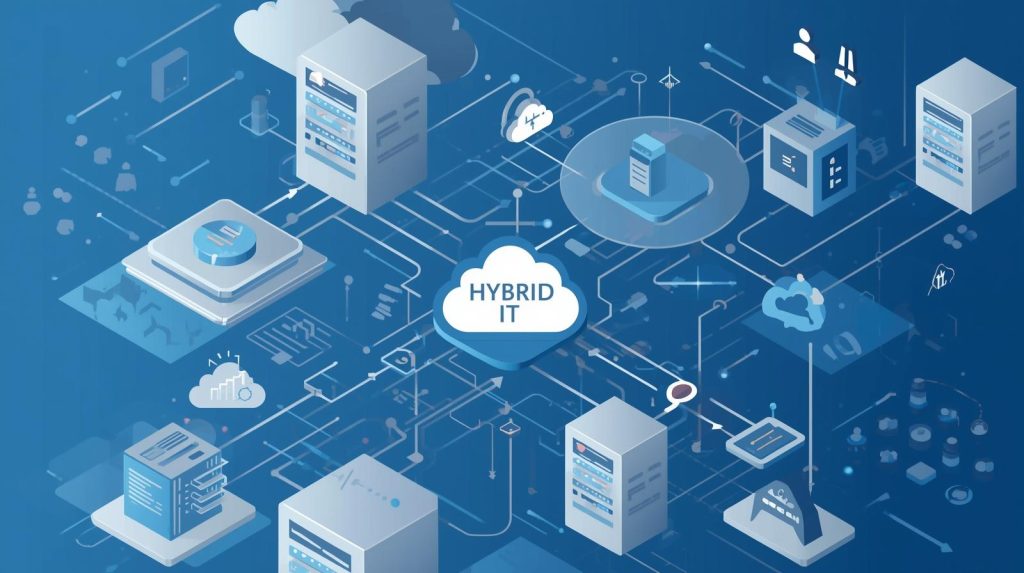
In simpler terms, Hybrid IT offers the best of both worlds the control and reliability of on-premises systems together with the scalability and flexibility of the cloud. This balance allows organizations to modernize their IT operations without disrupting existing critical systems.
Let’s see how it differs from the two traditional approaches:
- Traditional IT (On-premises):
In this model, all servers, storage, and networking hardware are owned, maintained, and operated within the company’s facilities. It offers maximum control and data security but often requires high upfront investment, continuous maintenance, and limited scalability.
- Cloud-based IT (Fully Cloud):
This model runs applications and stores data entirely in the cloud, using third-party providers such as AWS, Azure, or Google Cloud. It delivers flexibility, faster deployment, and reduced hardware costs but can raise concerns about data privacy, regulatory compliance, and vendor dependency.
Hybrid IT bridges the gap between these two extremes. It enables businesses to run mission-critical or sensitive systems on-premises while moving scalable or customer-facing services to the cloud. This approach gives organizations the freedom to choose the optimal environment for each workload optimizing both performance and cost.
For example:
A manufacturing company might keep its ERP system (which handles production and finance) running on-premises for tighter control and data protection. Meanwhile, it could host its customer relationship management (CRM) and data analytics platforms on the cloud to benefit from scalability and easier access for remote teams. Together, this setup creates a seamless, hybrid ecosystem that enhances agility, efficiency, and business continuity.
Why Businesses Are Adopting Hybrid IT in 2025?
In 2025, businesses are under increasing pressure to modernize their IT systems while staying efficient, secure, and cost-conscious. Many organizations are discovering that fully moving to the cloud or remaining entirely on-premises no longer fits their needs. That is why Hybrid IT has become the preferred path forward. It offers a balanced, adaptable, and future-ready approach that aligns with how companies operate today.
Below are the main reasons why more enterprises are embracing Hybrid IT this year:
1. Flexibility and Scalability
Hybrid IT gives organizations the ability to expand quickly when needed while keeping full control of their core systems.
During periods of high demand for example, a seasonal sales surge or a sudden project expansion extra capacity can be added through cloud resources within minutes. Meanwhile, essential systems and sensitive data continue running in the company’s own infrastructure, ensuring consistency and reliability.
This flexibility allows businesses to respond to changes smoothly without risking downtime or performance issues.
2. Cost Optimization
Hybrid IT helps companies use their resources more efficiently by combining existing infrastructure with cloud-based capacity on demand.
Instead of spending large budgets on new servers or equipment that may not be fully used, businesses can rely on the cloud for temporary or unpredictable workloads. This approach ensures they only pay for what they actually consume.
By balancing local and cloud environments, organizations can significantly lower operating costs while maintaining performance and stability.
3. Enhanced Security and Compliance
With data privacy laws and cybersecurity regulations such as GDPR and NIS2 becoming more stringent, Hybrid IT provides a way to stay compliant without sacrificing flexibility.
Sensitive information and critical systems can remain securely stored on-premises, while less confidential data and applications operate in the cloud.
This structure helps reduce security risks, ensures regulatory compliance, and gives businesses greater confidence in how their data is managed and protected.
4. Business Continuity and Disaster Recovery
System failures or unexpected outages can disrupt operations and cause major losses. Hybrid IT strengthens business resilience by enabling data backup and recovery across multiple platforms.
If one environment fails, workloads can automatically switch to another without interrupting business operations.
This level of redundancy ensures higher uptime, faster recovery, and greater protection against cyber incidents or hardware breakdowns.
5. Innovation Enablement
Hybrid IT creates an ideal foundation for innovation. By integrating cloud technologies, businesses can easily adopt and scale advanced tools such as artificial intelligence, automation, and big data analytics.
These modern capabilities can be implemented without disrupting the systems that are already running smoothly on-premises.
As a result, companies can experiment, innovate, and evolve faster turning technology into a driving force for growth and competitiveness.
In essence, Hybrid IT is no longer just an infrastructure strategy. It is a catalyst for agility, resilience, and long-term innovation, helping organizations confidently navigate the digital landscape of 2025 and beyond.
Hybrid IT vs. Hybrid Cloud: What’s the Difference?
In the fast-evolving world of enterprise technology, the terms Hybrid IT and Hybrid Cloud are often mentioned together and sometimes confused. While they are related, they represent two distinct layers of IT strategy. Understanding how they differ helps organizations design systems that are both future-ready and fully aligned with their operational goals.
1. Hybrid Cloud: A Bridge Between Public and Private Clouds
Hybrid Cloud refers specifically to the combination of public cloud and private cloud environments. It allows data, applications, and workloads to move seamlessly between these two spaces.

For example, a company might use a public cloud (such as AWS, Azure, or Google Cloud) for scalable web applications, while maintaining a private cloud for storing sensitive customer or financial data.
The purpose of Hybrid Cloud is to achieve optimal flexibility and efficiency within cloud ecosystems. Businesses can dynamically choose where to run each application depending on security, performance, and cost needs.
However, it is still focused solely on cloud technologies it does not account for the broader IT ecosystem that includes on-premises servers, networks, and external IT services.
2. Hybrid IT: The Broader Enterprise Strategy
Hybrid IT extends beyond the cloud. It combines traditional IT infrastructure, cloud services, and external IT providers into a unified, managed environment.
This approach gives businesses complete freedom to choose the best platform for each workload whether that’s a physical server in the company’s data center, a virtual machine on a private cloud, or an analytics application running on a public cloud.
Hybrid IT encompasses every component that powers an organization’s technology ecosystem:
- On-premises systems: core business applications, databases, and legacy software.
- Cloud environments: private and public clouds working together.
- Network infrastructure: secure connectivity that links all systems.
- IT services: monitoring, security management, and support from internal or external teams.
In essence, Hybrid IT acts as the orchestrator that ensures consistency, security, and performance across all these layers. It provides centralized visibility and control, enabling IT leaders to manage costs, maintain compliance, and accelerate digital transformation.
Key Challenges in Managing Hybrid IT Environments
While Hybrid IT brings undeniable advantages in agility, scalability, and cost efficiency, managing such an environment is far from easy. The combination of on-premises systems, multiple cloud platforms, and third-party services introduces new layers of complexity. Organizations must carefully balance performance, security, and cost while keeping operations running smoothly.
Below are the main challenges businesses often face when managing Hybrid IT in 2025.
1. Complexity in Integration
A Hybrid IT ecosystem connects many different components from traditional servers and databases to modern cloud platforms and software services. Each system may use different technologies, data formats, and communication protocols, which makes integration a difficult and time-consuming process.
Without a clear integration framework, businesses can easily fall into the trap of data silos and fragmented workflows. Information may not move seamlessly between environments, leading to delays and inefficiencies. For example, linking an older ERP platform with a cloud-based CRM system can require extensive customization and ongoing maintenance.
To overcome this challenge, organizations need well-defined integration strategies, reliable middleware, and standardized APIs that ensure all systems communicate smoothly and consistently.
2. Visibility and Monitoring Issues
When IT resources are spread across multiple locations and platforms, it becomes harder to maintain a complete view of performance and health. Many traditional monitoring tools were designed for single environments, so they often cannot track what is happening across the entire hybrid landscape.
This lack of visibility can delay the detection of problems and make it harder to respond quickly to outages or security incidents. To manage a hybrid environment effectively, businesses need centralized monitoring systems that provide real-time insights into application performance, network traffic, and resource usage across all environments.
Having this unified view allows IT teams to make faster decisions, identify risks early, and ensure a consistent user experience.
3. Security and Data Governance
Security is one of the most critical and complex aspects of Hybrid IT management. Each environment on-premises, private cloud, and public cloud has its own security settings and policies. Coordinating them to create a unified defense framework can be challenging.
Organizations must manage user access, enforce encryption, and ensure compliance with data protection regulations such as GDPR, HIPAA, or NIS2. Inconsistent policies between platforms can easily create vulnerabilities.
Strong data governance is also essential. Companies must define where data is stored, who can access it, and how it is protected. A well-structured security and governance model ensures that sensitive information remains safe while maintaining compliance across all environments.
4. Skill Gaps and Workforce Limitations
Operating a Hybrid IT environment requires a combination of traditional IT expertise and modern cloud knowledge. However, finding professionals who are skilled in both areas is becoming increasingly difficult.
Many businesses face a shortage of qualified engineers who can manage hybrid architectures, automate processes, and secure multi-environment systems. This talent gap often slows down transformation projects and increases dependence on external service providers.
To address this, organizations should invest in training programs, upskill existing staff, and adopt automation tools that simplify day-to-day management tasks.
5. Cost Tracking and Optimization
One of the promises of Hybrid IT is cost efficiency, but without proper oversight, expenses can quickly spiral out of control. As workloads move between environments, tracking consumption and allocating budgets accurately becomes complicated.
Hidden costs often come from unused cloud instances, redundant services, or underutilized on-premises equipment. Over time, these inefficiencies can significantly impact the IT budget.
Businesses need clear cost visibility tools and automated optimization solutions that track resource usage in real time. Regular cost reviews and governance policies help ensure spending remains aligned with business priorities and that every investment delivers tangible value.
How to Build an Effective Hybrid IT Strategy?
A successful Hybrid IT strategy helps businesses combine the flexibility of the cloud with the stability and control of on-premises systems. To achieve that balance, organizations need a clear plan built around business goals, not just technology choices. Below is a step-by-step guide to creating an effective Hybrid IT strategy that enhances performance, security, and innovation.
Step 1: Assess Your Existing Infrastructure
The first step is to understand your current IT environment. Evaluate all applications, data, and workloads to determine which ones are suitable for the cloud and which should remain on-premises due to security, latency, or compliance requirements.
This assessment should include performance analysis, interdependencies, and cost efficiency. For example, core financial systems may stay on-premises for better control, while analytics or customer-facing applications can move to the cloud for scalability.
A detailed evaluation helps businesses design a transition plan that minimizes disruption and ensures seamless integration between different environments.
Step 2: Define Clear Business Objectives
Every Hybrid IT plan should start with a clear understanding of what the organization wants to achieve. The goal might be improving performance, cutting costs, enhancing data protection, or increasing flexibility.
Defining objectives early allows IT leaders to align infrastructure decisions with measurable business outcomes. For example, if the main goal is to reduce operational expenses, focus on automation and optimized cloud usage. If the goal is faster innovation, prioritize cloud-native tools that accelerate development and deployment.
With well-defined objectives, every investment in technology will directly support the company’s long-term vision.
Step 3: Select the Right Technologies and Providers
Choosing the right platforms and partners is one of the most critical parts of a Hybrid IT strategy. Leading providers such as AWS, Microsoft Azure, Google Cloud, VMware, and HPE GreenLake each bring unique strengths in terms of scalability, pricing, and integration.
When making a decision, consider interoperability, workload mobility, compliance requirements, and data residency. The goal is to ensure that your hybrid environment operates smoothly, no matter which vendor or system is involved.
Organizations should also choose tools that support automation, container orchestration, and API integration to simplify management and future scalability.
Step 4: Implement Management and Monitoring Tools
Once the infrastructure is in place, ongoing management and monitoring are crucial. Without consistent oversight, hybrid systems can quickly become complex and inefficient.
Unified dashboards and automation tools can provide better visibility and control. Platforms such as Terraform, Ansible, or Puppet enable teams to manage infrastructure through code, improving deployment accuracy and reducing manual errors.
A centralized monitoring solution helps track system health, detect performance issues, and respond to potential failures before they affect users. This ensures that both cloud and on-premises environments run smoothly and securely.
Step 5: Prioritize Security and Compliance
Security should be built into the foundation of every Hybrid IT environment. Protect data at every stage through encryption, strict identity and access management, and continuous monitoring. Adopting a Zero Trust security framework helps prevent unauthorized access and strengthens overall protection.
Compliance is equally important. Depending on your industry and region, follow standards such as GDPR, ISO 27001, or HIPAA to ensure data integrity and legal compliance.
Additionally, establish multi-layer backup and disaster recovery systems to maintain business continuity in case of disruptions or cyber incidents.
Step 6: Continuous Optimization
Hybrid IT is not a one-time project; it requires continuous evaluation and refinement. Regularly review system performance, usage patterns, and costs to identify opportunities for improvement.
Leverage analytics and automation to adjust workloads dynamically based on demand. Retire underused resources, fine-tune performance, and reallocate budgets to areas that drive the most value.
By maintaining an ongoing optimization process, businesses can keep their hybrid environments agile, efficient, and aligned with evolving goals.
Future Trends Shaping Hybrid IT in 2025 and Beyond
As businesses continue to balance the need for flexibility, control, and security, Hybrid IT is evolving into a more intelligent, sustainable, and localized model. Several key trends are shaping how organizations will design and manage their hybrid ecosystems in the coming years.
1. AI-Driven IT Operations (AIOps)

Artificial intelligence is transforming IT management. AIOps uses machine learning and advanced analytics to automatically detect, analyze, and resolve infrastructure issues before they impact business operations.
Instead of relying on manual monitoring, AIOps continuously studies system behavior, identifies patterns, and predicts potential disruptions such as performance degradation or security risks. This allows IT teams to respond proactively, improve system reliability, and reduce downtime.
In the Hybrid IT landscape, AIOps acts as an intelligent assistant, simplifying management across multiple environments and enabling faster, data-driven decision-making.
2. Zero Trust Security Models
As hybrid environments become more distributed, traditional perimeter-based security models are no longer enough. The Zero Trust approach assumes that no user or device should be trusted by default, even if they are inside the corporate network.
In this model, every access request is verified, authenticated, and continuously monitored. Combining Zero Trust principles with advanced identity management, encryption, and behavioral analytics helps organizations strengthen their defenses and minimize risks from both internal and external threats.
By adopting Zero Trust, businesses can maintain strong protection across all cloud and on-premises components, ensuring data integrity in an increasingly complex IT landscape.
3. Green IT and Sustainability
Sustainability is now a top priority for many organizations, and Hybrid IT plays a central role in achieving it. Companies are optimizing energy use, consolidating data centers, and shifting workloads to more efficient cloud regions to reduce their carbon footprint.
Hybrid environments allow businesses to balance performance and energy efficiency by moving workloads to the most eco-friendly or cost-effective platforms. Moreover, many cloud providers now offer sustainability dashboards and carbon tracking tools that give organizations better visibility into their environmental impact.
In 2025 and beyond, Hybrid IT strategies that incorporate sustainability principles will not only help the planet but also improve long-term cost efficiency and brand reputation.
4. Edge-Hybrid Integration
Edge computing is rapidly becoming an essential part of the hybrid model. By processing data closer to where it is generated in factories, retail stores, or IoT devices organizations can achieve lower latency, faster insights, and improved reliability.
The integration of edge computing with Hybrid IT allows data to flow seamlessly between local devices, on-premises servers, and cloud platforms. This is particularly valuable in industries such as manufacturing, logistics, and healthcare, where real-time decision-making is crucial.
In the near future, edge-hybrid architectures will become the backbone of intelligent, decentralized digital operations.
5. Cloud Sovereignty and Local Compliance
As governments strengthen data protection laws, cloud sovereignty has become a defining trend in Hybrid IT strategy. Cloud sovereignty ensures that data is stored, processed, and managed within a specific geographic or legal jurisdiction, in compliance with local regulations such as GDPR, NIS2, or national cybersecurity laws.
This approach allows organizations to use the scalability of global cloud platforms while maintaining full control over sensitive information. It also builds trust with customers who expect transparency about where their data resides.
In 2025 and beyond, Hybrid IT environments will increasingly emphasize sovereignty, giving businesses more options to stay compliant and secure while expanding across borders.
How to Choose the Right Partner for Your Hybrid IT Journey?
Building and managing a Hybrid IT environment goes beyond adopting new technologies it requires collaboration with a reliable and skilled partner. The right partner can help you design a strategy that balances performance, security, and scalability while ensuring your infrastructure aligns with business goals.

When selecting a Hybrid IT partner, consider the following key factors that determine long-term success:
1. Expertise and Experience
Choose a partner with proven experience in implementing Hybrid IT solutions across multiple industries. They should understand both on-premises and cloud infrastructures and know how to integrate them seamlessly.
An experienced provider can anticipate technical challenges, recommend suitable architectures, and tailor solutions that match your specific business requirements.
2. Integration Capability
A successful Hybrid IT environment depends on smooth connectivity between different systems and platforms. Your partner should have strong integration capabilities, including expertise in APIs, automation, and orchestration tools.
They should ensure that data and workloads move securely and efficiently across environments while maintaining performance and consistency.
3. Security and Compliance Excellence
Security is the foundation of any Hybrid IT strategy. The ideal partner must be able to implement robust data protection measures, including encryption, identity management, and continuous monitoring.
They should also have a deep understanding of compliance frameworks such as GDPR, NIS2, or HIPAA, ensuring that your organization meets all regulatory requirements while maintaining operational efficiency.
4. Reliable Technical Support
Hybrid IT requires ongoing support to maintain uptime and performance. Choose a partner that offers 24/7 technical assistance, proactive system monitoring, and continuous optimization services.
Beyond troubleshooting, your partner should act as a long-term advisor helping you adapt to evolving technologies, scale effectively, and optimize your hybrid ecosystem for future needs.
5. Partnering with Onext Digital
At Onext Digital, we help organizations design, deploy, and optimize Hybrid IT environments that deliver flexibility, reliability, and compliance. Our experts bring years of experience in integrating on-premises systems with cloud technologies, ensuring a seamless and secure transformation.
We provide end-to-end solutions from strategy development and migration to automation, monitoring, and long-term management. Every project we deliver is tailored to align with your goals, reduce complexity, and unlock the full potential of your IT infrastructure.
Whether you are modernizing legacy systems or scaling to meet new demands, Onext Digital is your trusted partner for a smooth and sustainable Hybrid IT journey.
Final Thoughts
Hybrid IT is not just a temporary technology trend it is a strategic foundation that helps businesses thrive in a world where agility, security, and performance must coexist. By blending on-premises control with cloud innovation, organizations can create an IT ecosystem that adapts quickly to change while maintaining stability and compliance.
At ONEXT DIGITAL, we specialize in designing and managing Hybrid IT environments that empower businesses to scale confidently and operate efficiently in today’s complex digital landscape. With extensive experience across cloud migration, infrastructure optimization, and automation, our team ensures your hybrid transformation is seamless, secure, and sustainable.
If you are ready to modernize your infrastructure and build a smarter, more resilient IT foundation, Contact us immediately for consulting or more detailed information!
FAQs About Hybrid IT Solutions
Below are some of the most common questions businesses have when exploring Hybrid IT. These insights will help you understand how this approach works, its benefits, and how to implement it effectively.
1. What are examples of Hybrid IT solutions?
Hybrid IT can include any combination of on-premises and cloud technologies working together. Common examples are running an ERP system on local servers while storing customer data in the cloud, or using cloud-based collaboration tools integrated with on-premises databases. This blend allows organizations to maintain control where needed while benefiting from cloud scalability.
2. Is Hybrid IT more secure than a cloud-only setup?
Hybrid IT is not automatically more secure, but it provides greater control over sensitive data. By keeping critical workloads on-premises and placing non-sensitive services in the cloud, businesses can apply customized security policies to each environment. With strong encryption, identity management, and a zero-trust framework, Hybrid IT can be as secure or even more so than cloud-only systems.
3. How does Hybrid IT improve cost efficiency?
Hybrid IT allows companies to optimize spending by using cloud resources on demand while maintaining existing infrastructure investments. Businesses can scale up cloud capacity during peak usage and scale down when demand decreases, avoiding unnecessary costs. This flexible model ensures that every workload runs in the most cost-effective environment.
4. Can small businesses adopt Hybrid IT?
Yes. Hybrid IT is not limited to large enterprises. Small and mid-sized businesses can start small by moving selected workloads to the cloud such as backup, email, or customer management while keeping critical systems in-house. Modern tools and managed services make hybrid adoption affordable and easier to implement, even for smaller teams.
5. What tools help manage hybrid environments?
Effective Hybrid IT management requires visibility and automation across all platforms. Tools such as VMware vRealize, Microsoft Azure Arc, Terraform, Ansible, and Datadog help organizations monitor, automate, and secure both on-premises and cloud systems from a single dashboard. These tools simplify operations and reduce the risk of configuration errors.