
 Services
 Solutions
 Main platform
 Technology
 White Label
  Offshore
 Hire developers


Is outdated software the reason your factory keeps falling behind?
You have invested in new machines, trained your team, improved your processes but delays, disconnected systems, and surprise issues keep showing up.
Maybe the real problem is not your people or your equipment.
Maybe it is the software.
Or more specifically, not having the right software partner who truly understands how factories operate.
You might be asking:
“Do they actually understand my industry?”
“Will their system work with what I already have?”
“Is this going to be worth the cost?”
This guide is for you.
We will walk you through how to choose the right manufacturing software development company so you can stop wasting time, money, and energy.
What makes a great manufacturing software company in 2026?
Not every software company is built for the factory floor.
In 2026, the best ones do more than write code they understand how real factories operate. They know the pressure to meet production deadlines, the difficulty of tracking materials across departments, and the constant need to reduce downtime without cutting corners.
These companies don’t just deliver software. They build systems that connect machines, people, and data helping manufacturers run faster, smoother, and smarter.
So, what separates great partners from the rest?
Seven things manufacturers expect from a true expert
- Custom ERP systems designed to match how your operations really work
- MES platforms that track production in real time, down to every machine
- Industrial IoT solutions that link sensors, devices, and dashboards
- PLM tools that manage product designs, versions, and updates
- Automation software that integrates with robots and shop floor equipment
- AI tools for maintenance that detect problems before they cause delays
- Compliance and traceability features for audits, safety, and reporting
These aren’t just nice to have they’re what forward-thinking manufacturers demand.
How modern technology is changing the game?
The factory of 2026 runs on more than machines and people it runs on data.
With the right software, manufacturers can act on that data instantly. Whether it’s spotting a weak point in production or adjusting to a supply chain change, fast decisions lead to real advantages.
Modern factories depend on cloud-based systems, smart sensors, and AI-powered insights. If your software provider can’t support those tools, you risk falling behind competitors who can.
What core systems should a vendor offer?
Here’s a simple breakdown of the most essential software tools and what they bring to your factory:
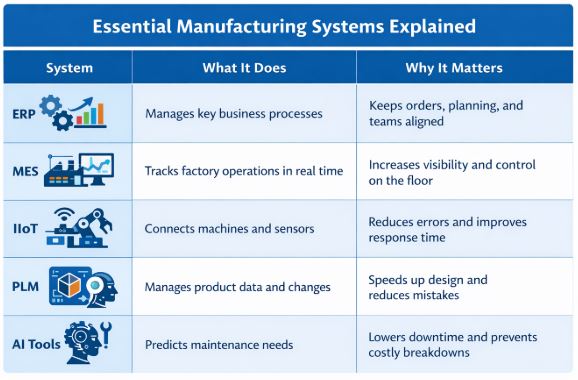
Together, these systems form the foundation of a modern smart factory and a reliable vendor should be able to deliver all of them in a way that fits your needs.
How do you evaluate a manufacturing software development company?
You should choose a company that has real manufacturing experience, strong technical capabilities, proven results, and reliable long-term support.
Selecting the right software partner can drive real efficiency or lead to costly setbacks. The best companies know how factories operate, understand your daily challenges, and build systems that fit your operations, not the other way around.
What should you look for in a top vendor?
You should look for a company that has completed real factory projects, earned strong client reviews, and offers expertise in ERP, MES, and IIoT systems with reliable support.
Here are ten essential qualities to look for:
- The company has completed at least 50 manufacturing-related projects.
- The team has over 10 years of experience in ERP or MES development.
- The vendor maintains a Clutch rating of 4.8 or higher from verified clients.
- Their case studies clearly show time savings, cost reductions, or improved production.
- The company understands compliance standards like ISO 9001 or FDA 21 CFR.
- Their tech stack includes modern tools such as C#, Python, AWS, or Azure.
- They have experience with both cloud-based and on-premise deployments.
- The company offers structured post-launch support with service-level agreements (SLAs).
- Their solutions include real-time IIoT data integration from machines and sensors.
- They respond to client issues within 24 hours or less.
Why do Clutch reviews matter so much?
Clutch reviews matter because they show what real clients have experienced beyond marketing claims.
When clients describe real outcomes like reduced downtime or faster reporting you get insight into what the vendor actually delivers. A strong Clutch profile with detailed, honest feedback often tells you more than any sales brochure can.
How can you compare vendors fairly?
You can compare vendors fairly by creating a scorecard that measures what matters to your factory from technical skill to industry experience.
Each factory has different priorities, so your comparison should focus on your actual needs. Some companies are strong in automotive MES, while others lead in IIoT for electronics. A simple table helps you weigh the most relevant factors:

This type of comparison lets you make an informed decision based on facts, not assumptions.
What are the real costs and timelines for custom ERP or MES development?
Most custom ERP or MES projects cost between $50,000 and $500,000 and take 3 to 12 months to complete, depending on the complexity and scale.
Custom software is not cheap, but it pays off when it solves the right problems. The price and timeline can vary widely based on the factory size, number of users, system integration needs, and required features.
How much does a custom ERP or MES system cost in 2026?
A small to mid-sized factory can expect to invest between $50,000 and $300,000, while larger or more complex projects can reach $500,000 or more.
Here is a typical price range by project size:
- Small factories (1-2 production lines): $50,000 – $120,000
- Mid-sized factories (multi-line, 100+ users): $150,000 – $300,000
- Large or multi-site factories: $400,000 – $500,000+
Tip: Ask for a modular pricing model so you can scale features based on budget and needs.
Which pricing model is best: fixed or hourly?
A fixed-price model is better for projects with clear requirements, while hourly pricing is more suitable for agile development or evolving needs.
Fixed-price contracts are common for factories with defined scopes and tight budgets especially in cost-sensitive markets like Vietnam.
Hourly contracts offer more flexibility but can lead to budget overruns if not managed closely.
In Vietnam, most factories prefer fixed pricing for predictability, but hybrid models are also emerging.
How long does it take to develop and launch a system?
Most ERP or MES systems take between 3 and 12 months to build and deploy, depending on their size and complexity.
Here’s a typical timeline breakdown:
- MVP or pilot version: 6–8 weeks
- Standard MES or ERP system: 6–9 months
- Full platform with ERP + MES + IIoT: 9–12 months
Delays often happen when requirements change mid-project or when data migration is underestimated. Having a clear scope and committed team helps avoid that.
What ROI can manufacturers expect from custom software?
Many factories report a 20% to 30% reduction in downtime and 15% to 25% improvement in operational efficiency within the first year.
Return on investment comes from faster production, fewer errors, better reporting, and smarter use of resources. With features like predictive maintenance and real-time dashboards, factories can shift from reactive to proactive management.
Which industries benefit most from custom manufacturing software?
Industries with complex operations, strict regulations, or high-volume production such as automotive, food, electronics, pharmaceuticals, and textiles benefit the most from custom solutions.
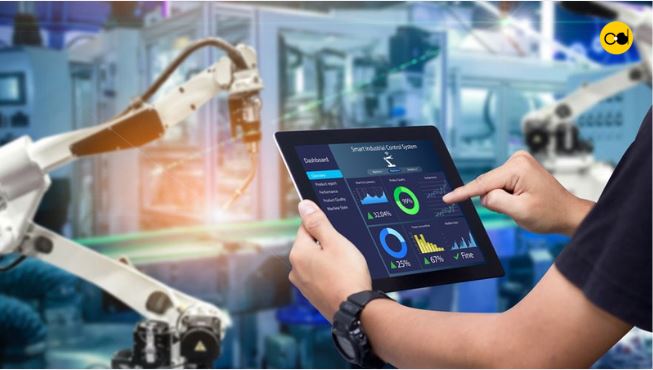
These industries often face challenges like real-time tracking, quality control, traceability, and the need to adapt quickly to market demands. Off-the-shelf software rarely fits their unique processes, which is why tailored systems offer a clear advantage.
How do automotive, food, and electronics manufacturers benefit from custom software?
These industries use software to reduce downtime, improve process visibility, and meet strict production standards.
- Automotive factories need MES systems that monitor assembly lines in real time, reduce bottlenecks, and ensure quality across multiple stages.
Example: A Tier 1 supplier reduced downtime by 30% using a custom MES with IIoT integration. - Food manufacturers rely on ERP systems that include inventory management, batch tracking, and HACCP compliance.
Example: A mid-sized frozen food plant improved traceability and reduced waste by 20%. - Electronics producers benefit from PLM and IIoT platforms that handle short product lifecycles, version control, and precise machine monitoring.
Example: A PCB manufacturer used predictive maintenance tools to cut equipment failure by 40%.
Why do pharma and aerospace need fully traceable systems?
These industries operate under strict compliance rules, where every process must be documented, controlled, and easily auditable.
Custom software helps these companies:
- Implement full traceability from raw material to final product
- Generate audit-ready reports
- Comply with FDA, ISO 13485, and other international standards
- Maintain electronic signatures and access logs for quality assurance
Without this level of control, even a small mistake can lead to fines, recalls, or reputational damage.
What are some real results from factories in Vietnam?
Vietnamese manufacturers have seen ROI up to 40% through offshore custom development especially in textiles, food, and electronics.
One example is a textile factory in Hanoi that partnered with a local development firm to build a smart production system. The solution included:
- Barcode-based tracking on the shop floor
- Real-time dashboards for supervisors
- Automated shift planning and quality checks
Within 9 months, the factory reduced lead times by 35% and saw a 40% improvement in overall production efficiency.
Why Vietnam Is Becoming a Top Choice for Manufacturing Software in 2026?
Vietnam isn’t just a cheap outsourcing option anymore it’s becoming one of the best places to build manufacturing software that actually works in the real world.
In 2026, more and more factories are choosing to work with software teams in Vietnam because they offer the right mix of technical skills, affordable pricing, and hands-on experience with real production problems.
Here’s what makes Vietnam stand out.
Engineers who understand how factories actually work
Vietnam is a major production base for industries like electronics, cars, textiles, and food. That means many software developers here don’t just sit in offices they’ve been on factory floors.
They’ve seen how machines break down, how operators work under pressure, and how messy data from old systems causes delays.
That real-world exposure helps them build software that fits how factories truly run not just how things look on paper.
Reasonable pricing with experienced teams
Yes, Vietnam is affordable. But it’s not about cutting corners it’s about getting more for your money.
Many teams here offer:
- Senior developers with years of experience in ERP, MES, and factory systems
- Low staff turnover, so you don’t have to start over every few months
- Fair pricing that lets you build solid software without rushing or skipping steps
Instead of saving money now and paying for fixes later, you get it done right the first time.
A good fit for long-term projects
Factory software is never “done” after the first release. It needs updates, improvements, and expansions as your operations grow.
That’s why you need a partner, not just a vendor. Vietnamese teams are known for being:
- Easy to work with over time
- Willing to adapt to the way your team works
- Careful with documentation and clear with communication
This makes them a great choice if you plan to roll out your system in stages or across multiple factories.
How Vietnam compares to India and Eastern Europe
If you’re still weighing your options, here’s a simple breakdown that focuses on what really matters for factory software:
| What matters most | Vietnam | India | Eastern Europe |
|---|---|---|---|
| Knows how factories work | Yes — real factory experience | Depends on the team | Moderate |
| Cost for full projects | Low — great value | Very low | Medium to high |
| ERP and MES experience | Growing fast | Strong in ERP, less MES | Strong, but more expensive |
| Machine and sensor integration | Strong in key industries | Mixed | Strong in automation |
| Time zone and communication | Great for Europe and Asia | Good | Excellent for Europe |
| Team stays long-term | Yes | Can vary | Usually yes |
| Good for multi-year projects | Definitely | Depends on vendor | Often yes, but pricier |
How do top vendors ensure scalability, integration, and security?
Top vendors build systems that scale with your operations, integrate seamlessly with machines and software you already use, and follow strict security protocols to protect your data and ensure compliance.
When choosing a software partner, it’s not just about features it’s about how well the system grows, connects, and protects. A weak architecture today could lead to bottlenecks, data breaches, or expensive rebuilds in the future.
How do leading vendors handle system scalability?
They design software that supports hundreds or even thousands of users, runs smoothly across multiple locations, and adapts as your production needs grow.
A scalable system allows your business to:
- Add new users, plants, or production lines without rebuilding the platform
- Handle growing data volumes from machines, sensors, and ERP transactions
- Operate globally while maintaining centralized control
How do they ensure smooth integration with machines and software?
They build API-ready systems and use standard protocols like OPC UA and MQTT to connect with both legacy equipment and modern platforms.
Factories often use machines from different generations, ERP systems from different vendors, and third-party apps for reporting or logistics. A good vendor ensures all systems work together without manual transfers or duplicate entry.
Key integration features include:
- IIoT gateways to connect shop floor machines
- Real-time syncing with existing ERP or WMS platforms
- Modular architecture to plug into third-party solutions
What security measures do top vendors follow?
They follow enterprise-grade security standards, using encryption, access control, and zero-trust frameworks to protect sensitive data.
Modern manufacturing software needs to defend against both external threats (like ransomware) and internal risks (like unauthorized access). Vendors must demonstrate:
- Data encryption at rest and in transit
- Role-based access control to limit user permissions
- Audit logs for traceability and compliance
- Zero-trust architecture to prevent lateral movement within the system
- Secure cloud hosting with SLA-backed uptime (e.g. AWS, Azure)
How do vendors future-proof your system?
They include technologies like AI, predictive analytics, and cloud-native design so your factory stays competitive long-term.
Scalable vendors think beyond today’s features. They build platforms that:
- Support AI-driven insights (e.g. predictive maintenance, demand forecasting)
- Work in hybrid cloud environments (on-prem + cloud)
- Allow continuous deployment and modular updates
What mistakes should you avoid when choosing a manufacturing software partner?
The most common mistakes are choosing based on price alone, over-customizing features, ignoring integration needs, and failing to ask the right questions upfront.
Choosing the wrong vendor can lead to delays, budget overruns, and software that no one wants to use. Here are four critical mistakes to avoid:
Focusing Only on Price Instead of Long-Term Value
Choosing a vendor based purely on the lowest price is one of the fastest ways to fail.
A significantly cheaper quote often means:
- Weak system architecture that cannot scale
- Limited testing and poor documentation
- No real post-launch support or slow response times
- Inexperienced teams working on critical factory systems
In manufacturing, software downtime directly impacts production output and revenue. What looks cheap at the beginning often becomes expensive when you factor in system rework, performance issues, and lost productivity.
What to do instead:
Evaluate total cost of ownership, not just development cost. This includes maintenance, scalability, integration effort, and long-term support.
Over-Customizing Every Feature Without Clear Business Value
Many factories fall into the trap of building highly customized systems that try to handle every possible scenario from day one.
Over-customization leads to:
- Complex systems that are difficult to maintain
- Slower development timelines
- Higher costs for future upgrades
- Strong dependence on the original vendor
Just because a feature is technically possible does not mean it delivers real operational value. Software should simplify processes, not mirror every manual step in digital form.
What to do instead:
Start with core workflows that directly reduce downtime, errors, or manual work. Build modular systems that can evolve over time instead of overloading the first release.
Ignoring Integration with Existing Systems and Machines
Manufacturing software never works in isolation.
A common mistake is choosing a vendor without fully assessing how the new system will integrate with:
- Existing ERP or accounting systems
- Legacy machines and PLCs
- Warehouse Management Systems (WMS)
- Third-party logistics or reporting tools
Poor integration results in manual data entry, duplicated work, inconsistent reports, and frustrated operators.
What to do instead:
Choose a vendor with proven experience in IIoT integration, API-based architecture, and industrial communication protocols such as OPC UA or MQTT. Integration capability should be validated with real examples, not promises.
Not Asking Strategic Questions During Vendor Evaluation
Many manufacturers only ask surface-level questions such as:
- “Can you build an ERP or MES system?”
- “Have you worked with factories before?”
These questions are not enough.
Failing to ask deeper, strategic questions can hide major risks related to scalability, security, and long-term support.
What to ask instead:
- How do you handle system performance when data volume doubles?
- What happens if we add new production lines or plants?
- How do you manage post-launch support and incident response?
- How do you ensure operator adoption on the shop floor?
- Can you show a similar factory system that is still running after 3–5 years?
The quality of a vendor’s answers often reveals more than their sales presentation.
15 key questions to ask any software vendor before signing a deal
Use this list to compare vendors and protect your investment:
- How many manufacturing software projects have you completed in the past 3 years?
- Can you share case studies from factories similar to ours (industry, size, region)?
- What standards do you follow for machine integration (e.g. OPC UA, MQTT)?
- Do you offer predictive maintenance, AI tools, or smart alerts?
- How fast do you respond to critical system issues?
- What cybersecurity standards do you follow (e.g. ISO 27001, Zero Trust)?
- What platforms do you use for cloud hosting and hybrid deployments?
- Can the system scale across multiple sites and 1000+ users?
- How do you support compliance with ISO 9001, FDA 21 CFR Part 11, etc.?
- Do you offer SLA-backed post-launch support and maintenance?
- What does your onboarding and training program include?
- How do you ensure seamless integration with our current ERP or WMS?
- Can we test a demo with live factory data or dashboards?
- Who owns the source code and IP after the project ends?
- Do you provide modular pricing and flexible upgrade paths?
Frequently Asked Questions (FAQ)
Q1. Should I build ERP and MES systems together or separately?
You should build them together if your goal is end-to-end visibility, but for smaller factories, starting with MES first may be more cost-effective.
Q2. How much does a custom ERP system cost in Vietnam in 2026?
A typical project ranges from 1.2 to 7 billion VND depending on scope, with modular systems starting at 50,000 USD.
Q3. Can Vietnamese offshore teams guarantee 99.9% uptime?
Yes, top vendors hosting on AWS or Azure with SLA-backed plans can deliver 99.9% system availability.
Q4. What ROI can I expect from AI-driven predictive maintenance?
Most factories see a 20–30% drop in unplanned downtime and a 15–25% cut in maintenance costs.
Q5. Is custom manufacturing software too complex for small factories?
Not at all. With modular design and phased rollout, even small teams can benefit without overwhelming their operations.
Q6. How long does it take to get the system live?
Most projects take 3–9 months. MVPs or pilot programs can launch in 6–8 weeks.
Final thoughts:
Running a factory means dealing with constant pressure. Deadlines. Unexpected slowdowns. Systems that don’t speak the same language. When that happens, it’s not just productivity that takes a hit it’s people, too.
That’s why the choice of a software partner isn’t just a technical decision. It’s a practical one. A human one.
You need someone who listens first. Someone who understands that every line of code needs to fit the way your factory actually works. Someone who doesn’t just deliver a product but sticks around to make sure it keeps working, long after launch.
- That’s the approach we take at Onext Digital.
- We don’t try to be everywhere. But where we are, we aim to do things right with focus, care, and results that speak for themselves.
Because at the end of the day, the best software? It’s the one your team trusts. The one that lets you sleep easier, not worry more. And it always starts with the right people behind it.