
 Services
 Solutions
 Main platform
 Technology
 White Label
  Offshore
 Hire developers



The healthcare industry stands at a turning point. A single data breach now costs medical organizations an average of $10.93 million, nearly three times higher than the global average across all industries. At the same time, global healthcare data is projected to surge to 10,800 exabytes by 2025, fueled by the growth of electronic health records, medical imaging, and connected devices.
As the volume and complexity of information continue to rise, managing it effectively has become more than an IT challenge. It is now a strategic imperative. Data management in healthcare defines how well organizations can protect patient privacy, maintain compliance, and deliver high-quality care in a digital first world.
This guide will walk you through the essential systems, best practices, and security strategies to transform your healthcare data from a growing liability into a trusted and valuable asset.
What Is Healthcare Data Management?
Healthcare data management refers to the comprehensive process of acquiring, validating, storing, protecting, and processing health-related information to ensure its accessibility, reliability, and timeliness. Unlike traditional data management, healthcare systems must handle uniquely sensitive information while navigating complex regulatory requirements.
The Healthcare Data Ecosystem:
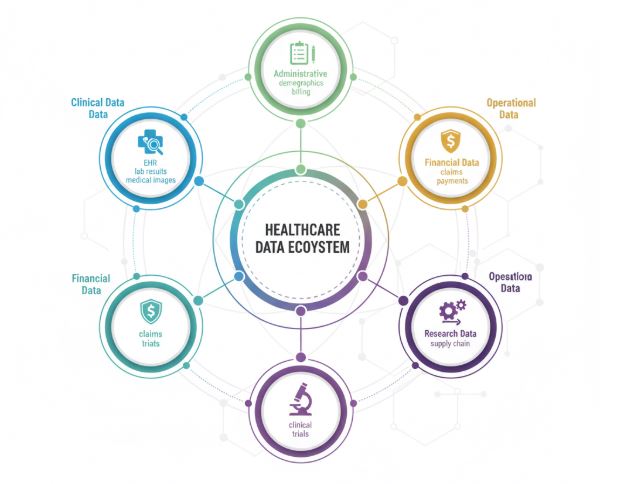
Modern healthcare organizations manage multiple categories of data, each with distinct characteristics and requirements:
- Clinical Data forms the core of patient care, including electronic health records (EHRs), physician notes, laboratory results, diagnostic images, medication histories, and treatment plans. This data directly impacts clinical decision-making and must be available in real-time to support patient care.
- Administrative Data encompasses patient demographics, insurance information, billing records, appointment schedules, and facility management information. While less clinically critical, this data drives operational efficiency and revenue cycle management.
- Financial Data includes claims processing, accounts receivable, payment transactions, and cost accounting information that enables healthcare organizations to maintain financial viability.
- Research Data supports clinical trials, outcomes studies, population health analysis, and medical research initiatives that advance healthcare knowledge and treatment protocols.
- Operational Data covers supply chain management, equipment maintenance, staffing schedules, and facility utilization metrics that keep healthcare operations running smoothly.
Healthcare information flows through distinct lifecycle phases from creation and capture, through storage and maintenance, to use and disclosure, sharing and exchange, and finally archival or secure destruction. Each phase requires specific controls to maintain data integrity, security, and compliance.
Why Data Management Matters in Healthcare?
Effective data management directly impacts every aspect of healthcare delivery, from individual patient outcomes to population health strategies.
1. Enhancing Patient Care Quality
Comprehensive data management empowers clinicians with a complete view of each patient’s medical history. It enables them to identify potential drug interactions, monitor treatment effectiveness, and make timely, evidence-based decisions. In critical situations, when a patient arrives at the emergency department, immediate access to accurate medical records including allergies, current medications, and chronic conditions can literally mean the difference between life and death.
Healthcare organizations that implement robust data management systems have reported 15-20% reductions in medical errors and significant improvements in care coordination. A 2024 study also found that facilities equipped with advanced data analytics capabilities achieved 23% better patient outcomes in chronic disease management compared to those operating with fragmented systems.
2. Reducing Healthcare Costs
3. Meeting Regulatory Compliance
Healthcare organizations operate under strict data regulations. HIPAA mandates comprehensive safeguards for protected health information, with violations costing between $100 and $50,000 per incident. Organizations must also comply with state-specific regulations, GDPR for European patients, and industry requirements. Robust data management systems provide the audit trails, access controls, and security measures necessary to demonstrate compliance.
4. Accelerating Medical Research
Well-organized healthcare data fuels breakthrough discoveries in disease treatment and personalized medicine. Researchers analyzing de-identified patient data across large populations can identify patterns that individual clinicians would never observe, leading to new understanding of disease progression and treatment effectiveness.
Key Challenges in Healthcare Data Management
Despite significant technological advances, healthcare organizations continue to struggle with fundamental data management challenges that compromise security, efficiency, and care quality.
1. Data Silos and Interoperability Issues
Healthcare data often remains trapped in isolated systems that cannot communicate effectively. A patient’s EHR at their primary care clinic may not connect with hospital systems, laboratory databases, or pharmacy records. This fragmentation forces patients to repeatedly provide the same information and prevents clinicians from seeing complete medical histories.
2. Security and Privacy Concerns
Healthcare organizations face relentless cyberattacks, with ransomware incidents increasing 94% between 2022 and 2024. The average healthcare data breach now exposes records of 50,000+ patients and costs organizations $408 per stolen record. Beyond external threats, organizations must manage internal risks from inadvertent disclosures, unauthorized access, and lost or stolen devices.
3. Data Quality Problems
Studies indicate that 20-30% of healthcare data contains errors or inconsistencies, ranging from simple typos to critical mistakes in medication dosing or allergy information. Data quality issues arise from manual entry errors, inconsistent naming conventions, missing fields, and duplicate patient records.
4. Volume and Complexity
Healthcare data volumes are growing exponentially, with medical imaging alone accounting for 90% of all healthcare data. A single MRI scan can generate gigabytes of data, and genomic sequencing produces terabytes per patient. The complexity extends beyond size healthcare includes structured data, semi-structured clinical notes, and unstructured medical images.
5. Legacy System Integration
Many healthcare organizations rely on systems implemented 20-30 years ago that cannot easily integrate with modern cloud platforms or analytics tools. Replacing legacy systems involves massive costs and significant disruption, yet maintaining outdated technology increases security vulnerabilities and prevents leveraging modern capabilities like artificial intelligence.
Essential Components of Healthcare Data Management

A comprehensive healthcare data management system requires multiple integrated components working together to ensure data remains secure, accurate, accessible, and compliant throughout its lifecycle.
1. Data Governance Framework
Data governance establishes the policies, procedures, and accountability structures that guide how organizations manage health information. A strong governance framework defines data access authority, establishes quality standards, and creates clear escalation paths. Organizations with mature governance frameworks experience 50-60% fewer data quality issues than those without formal structures.
2. Data Security and Privacy Controls
Healthcare organizations must implement multiple security layers. Physical controls include restricted server access and secure hardware disposal. Technical measures encompass encryption, multi-factor authentication, intrusion detection, and role-based access controls. Administrative safeguards include security policies, workforce training, business associate agreements, and incident response procedures.
3. Data Quality Management
High-quality healthcare data is accurate, complete, consistent, timely, and valid. Organizations need validation rules that check information as it enters the system, regular audits to identify error patterns, and duplicate record detection processes. Master data management ensures key entities maintain consistent identities across all systems.
4. Data Integration and Interoperability
Healthcare information must flow seamlessly between systems. Standards like HL7 FHIR enable different systems to exchange data in standardized formats. Integration engines translate data between systems using different formats. Healthcare information exchanges (HIEs) provide infrastructure for sharing patient information across organizational boundaries.
5. Analytics and Reporting
Modern healthcare organizations need sophisticated analytics to extract insights. Descriptive analytics provide historical views, diagnostic analytics identify root causes, predictive analytics forecast future outcomes, and prescriptive analytics recommend specific actions. Business intelligence platforms should deliver role-specific views to executives, managers, and clinicians.
6. Data Storage Infrastructure
Healthcare organizations need storage balancing performance, scalability, security, and cost. Options include on-premises data centers (maximum control), cloud platforms (scalability and reduced management), or hybrid approaches. Modern storage must support structured databases, medical images, and genomic data, with robust backup and disaster recovery capabilities.
How to Implement Best Practices in Healthcare Data Management
Implementing these proven practices helps healthcare organizations maximize the value of their data while minimizing risks and ensuring compliance with regulatory requirements.
1. Establish Comprehensive Data Governance
Create a data governance council with executive sponsorship and representation from clinical, IT, compliance, and operational leaders. Document clear roles and responsibilities, assign data stewards for major domains, and create a data catalog documenting what data exists, where it resides, and who has access.
2. Implement Defense-in-Depth Security
Security requires multiple overlapping controls. Use network segmentation, zero-trust architecture, endpoint detection, and security information and event management (SIEM) systems. Conduct regular penetration testing, maintain an incident response plan, and practice through tabletop exercises at least annually.
3. Prioritize Data Quality Through Validation
Implement real-time validation rules at the point of data entry, use standardized terminologies, and establish quality metrics and monitoring dashboards. Conduct regular audits and create feedback loops that alert staff to questionable data. Recognize departments demonstrating exceptional data quality.
4. Adopt Interoperability Standards
Embrace HL7 FHIR for data exchange and implement standard code sets including LOINC, RxNorm, SNOMED-CT, and ICD-10. Participate in health information exchanges and support patient data access through secure portals and APIs. Prioritize vendors supporting open standards over proprietary solutions.
5. Invest in Continuous Workforce Training
Implement mandatory training on HIPAA, acceptable use policies, and data handling responsibilities. Use real-world examples relevant to your organization and test comprehension. Conduct refresher training annually and create a culture where staff can report issues without fear of punishment.
6. Conduct Regular Audits and Monitoring
Implement automated monitoring that flags unusual access patterns. Review audit logs regularly and conduct formal audits at least annually. Perform disaster recovery tests simulating different failure scenarios and update procedures based on lessons learned.
7. Leverage Automation and AI
Natural language processing can extract structured information from physician notes. Predictive models can identify data quality issues, flag security anomalies, and suggest duplicate records for merging. Robotic process automation can handle repetitive tasks, freeing staff for higher-value activities.
Technologies and Solutions for Healthcare Data Management

Selecting the right technology stack is critical for building an effective, scalable data management infrastructure that meets healthcare’s unique requirements.
1. Electronic Health Record Systems
Enterprise EHR platforms like Epic, Oracle Cerner, and Meditech provide comprehensive functionality for clinical documentation, computerized physician order entry, medication administration, and clinical decision support. Modern systems support interoperability through standard interfaces and increasingly offer mobile access and patient engagement tools.
2. Cloud Healthcare Solutions
Major cloud providers offer healthcare-specific platforms with HIPAA-eligible services. Microsoft Azure for Healthcare provides FHIR server capabilities and healthcare-specific AI models. Google Cloud Healthcare API offers strong analytics for medical imaging and genomics. AWS healthcare solutions emphasize scalability and security with a vast partner ecosystem.
3. AI and Machine Learning Tools
AI technologies are transforming healthcare. Computer vision algorithms analyze medical images, natural language processing extracts insights from clinical notes, and predictive models identify patients at high risk for adverse outcomes. Healthcare-specific AI platforms include IBM Watson Health, Google Healthcare AI, and specialized solutions for radiology and pathology.
Comparison of Leading Healthcare Data Management Platforms
| Platform | Best For | Key Strengths | Considerations | Typical Pricing |
|---|---|---|---|---|
| Epic | Large health systems | Comprehensive functionality, strong interoperability | High cost, complex implementation | Enterprise: $5M-$100M+ |
| Oracle Cerner | Mid-large hospitals | Scalability, global presence | Legacy integration challenges | Enterprise: $3M-$50M+ |
| AWS HealthLake | Cloud-first organizations | FHIR-native, ML integration | Requires cloud expertise | Usage-based: $0.20-$5/GB |
| Microsoft Cloud for Healthcare | Microsoft-ecosystem orgs | Integration with Microsoft 365 | Limited standalone use | $50-$200/user/month |
| Health Catalyst | Analytics-focused | Purpose-built for healthcare analytics | Requires data warehouse | License: $500K-$5M+ |
Compliance and Regulatory Requirements in Healthcare Data Management
Healthcare organizations must navigate a complex web of federal, state, and international regulations governing how they collect, store, use, and share health information.
1. HIPAA Privacy and Security Rules
HIPAA establishes national standards for protecting protected health information (PHI). The Privacy Rule governs use and disclosure, requiring patient authorization for most disclosures beyond treatment, payment, and operations. The Security Rule requires administrative, physical, and technical safeguards for electronic PHI. Violations result in penalties ranging from $100 to $50,000 per incident.
2. State and International Requirements
Beyond federal requirements, healthcare organizations must comply with state-specific privacy laws that may impose stricter standards. Organizations treating European patients must comply with GDPR, which provides stronger privacy rights including data portability and the right to be forgotten.
Essential Compliance Checklist for Healthcare Data Management
To maintain full compliance with healthcare data protection standards, organizations should ensure the following key practices are in place:
- Implement role-based access controls and review them regularly to ensure only authorized personnel can access sensitive data. Encrypt all electronic protected health information (ePHI) both at rest and in transit to prevent unauthorized disclosure. Conduct comprehensive security risk assessments at least once a year and address any identified vulnerabilities promptly.
- Maintain signed business associate agreements with all vendors who handle PHI. Develop, document, and routinely test incident response procedures to ensure rapid action in case of a breach. Keep tamper-resistant audit logs for a minimum of six years to meet regulatory requirements.
- Provide privacy and security training for all employees during onboarding and on an annual basis. Restrict physical access to any facilities or systems containing PHI, and test data backup and recovery processes each year to verify system resilience. Finally, establish clear procedures for handling patient access requests to ensure timely and compliant responses.
ROI and Success Metrics for Healthcare Data Management
Healthcare data management initiatives typically show measurable returns within 2-3 years. Key performance indicators include:
- Data Quality Metrics: Completeness rates for critical fields (target: 95%+), accuracy percentages, and duplicate record rates (target: <2%)
- Security Metrics: Incident detection and resolution time (target: <24 hours), training completion rates (target: 100%), and audit findings
- Operational Efficiency: Time spent documenting versus direct patient care, duplicate test ordering rates, and medication error rates (target: 20-30% reduction)
- Clinical Outcomes: Readmission rates, medication reconciliation accuracy, and patient safety incidents (target: 10-25% improvement)
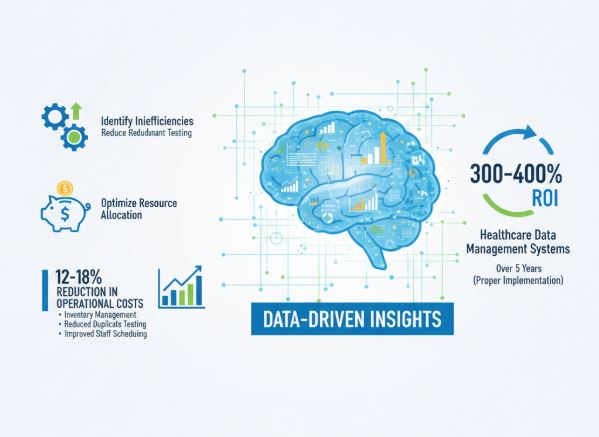
A mid-size hospital system investing $5 million in comprehensive data management typically realizes $15-20 million in benefits over five years, yielding ROI of 300-400%.
Conclusion
Effective healthcare data management is no longer just a technical requirement it’s a strategic advantage that enhances patient safety, operational efficiency, and clinical outcomes. Organizations that invest in modern data infrastructure, strong governance, and secure analytics will lead the digital transformation of healthcare.
To accelerate this journey, partnering with an experienced technology provider like ONEXT DIGITAL can make a difference. With expertise in data-driven healthcare solutions, cloud architecture, and system integration, ONEXT DIGITAL helps healthcare organizations unlock the full potential of their data and deliver better patient outcomes.
Talk to our experts today to discover how ONEXT DIGITAL can help you build smarter, more secure, and future-ready healthcare data systems.
Frequently Asked Questions
1. What is healthcare data management?
Healthcare data management involves collecting, storing, protecting, and analyzing patient information such as EHRs, lab results, and medical images to improve care quality while ensuring privacy and compliance.
2. Why is data security critical in healthcare?
Because healthcare breaches expose sensitive patient data and cost millions per incident. Strong security protects both patient privacy and an organization’s reputation.
3. What are the biggest challenges in healthcare data management?
The main challenges include data silos, poor data quality, cybersecurity risks, legacy system integration, and complex compliance requirements.
4. How much does healthcare data management cost?
Costs vary by scale mid-size hospitals invest around $3–10 million, while large systems may spend $10–100 million. Cloud-based options can start from $0.20 per GB.
5. What regulations govern healthcare data management?
Key regulations include HIPAA, HITECH, GDPR, and state privacy laws. Compliance requires encryption, access control, audit logs, and breach notifications.
6. How can healthcare organizations improve data management?
Start with a data governance framework, perform risk assessments, improve data quality, and adopt secure, interoperable cloud and analytics technologies.