
 Services
 Solutions
 Main platform
 Technology
 White Label
  Offshore
 Hire developers



If you are evaluating BigCommerce for your Australian ecommerce operation in 2026, you need more than a feature checklist.
You need to understand where this platform actually fits in the local market, who it serves well, and what the real costs look like when you factor in Australian business realities: GST, USD billing, payment providers, BNPL, marketplace competition, ERP integration and operational complexity.
This is not a sales pitch. It is a practical review of how BigCommerce fits into the Australian ecommerce landscape in 2026, where it delivers value, and where it may create more complexity than some businesses need.
For teams also planning implementation, migration or customisation, experienced BigCommerce development services can help turn that platform decision into a more realistic ecommerce roadmap. But before choosing any platform, the first step is understanding whether BigCommerce matches the way your business actually sells.
Australia Ecommerce Market in 2026: Still Growing, But More Competitive
The Australian ecommerce market is still growing, but it is not the same easy-growth environment many retailers saw during the pandemic years.
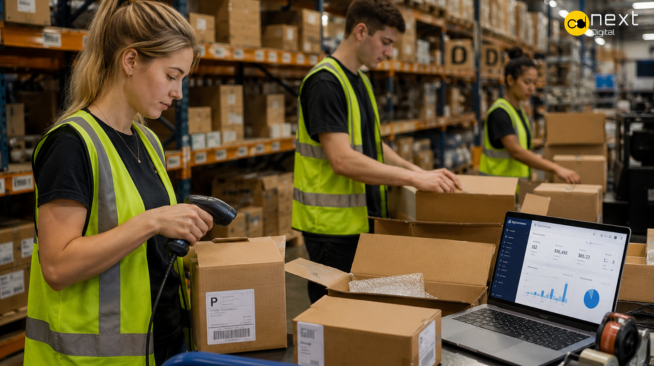
According to Australia Post’s 2026 eCommerce Report, Australians spent $82.6 billion online in 2025, up 14% year on year. Online retail now accounts for 24% of total retail spend, and 82% of Australian households shopped online in 2025, equal to around 9.8 million households.
That sounds positive, and it is. But the details matter.
Shoppers are buying more frequently, but baskets are smaller. Australia Post reported that average basket size dropped to $96, with shoppers becoming more value-conscious and spreading purchases across more brands.
For ecommerce businesses, this means revenue growth is harder to win. You cannot rely only on larger basket sizes. You need better repeat purchase strategy, sharper pricing, stronger fulfilment and a more efficient operating model.
There are three important market shifts Australian retailers should consider when choosing an ecommerce platform.
First, shoppers are more selective. Cost-of-living pressure has changed buying behaviour. Customers compare prices more often, wait for promotions and expect value to be clear before they check out.
Second, marketplaces are stronger. Australia Post reported that online marketplaces generated $18.9 billion in spend in 2025, up 13% year on year. For many customers, Amazon AU, eBay, Catch and category-specific marketplaces are no longer secondary options. They are part of the normal buying journey.
Third, fulfilment and checkout are now conversion factors. Australia Post found that 69% of shoppers want a range of delivery options at checkout, while 26% expect same-day or next-day delivery when purchases are urgent.
The implication for platform selection is clear: in 2026, an ecommerce platform needs to support more than a good-looking storefront. It needs to handle inventory, pricing, fulfilment, payment choice, product data, customer groups and integrations without turning daily operations into manual work.
This is where BigCommerce becomes relevant, especially for businesses with large catalogues, trade customers, ERP requirements or multi-channel sales.
BigCommerce Market Share in Australia
Let’s be clear about where BigCommerce sits in the Australian market. By store count, it’s not the leader. Shopify dominates in pure numbers, WooCommerce has the open-source and WordPress crowd, and there’s a long tail of custom builds and legacy systems. If you measure by how many Australian stores are live on each platform, BigCommerce is firmly in third or fourth place.
But store count doesn’t tell the whole story.
BigCommerce’s Australian footprint is concentrated in a specific segment: mid-market retailers, B2B wholesalers, and businesses with complex catalogue requirements. These aren’t lifestyle brands selling 50 SKUs through Instagram. They’re businesses doing real operational volume, hundreds or thousands of products, multiple customer segments with different pricing tiers, integration requirements with existing inventory or accounting systems, and fulfilment workflows that go beyond “pack and ship”.
Examples of where BigCommerce tends to show up in Australia:
Wholesalers and distributors moving their trade customer ordering online. These businesses need customer-specific pricing, quote systems, bulk ordering workflows, and integration with their existing ERP. BigCommerce’s B2B Edition handles this natively.
Multi-brand retailers with large catalogues. Fashion retailers with thousands of SKUs across multiple brands, homewares businesses with complex product variants, automotive parts suppliers, businesses where product data management is a real operational challenge, not just a content exercise.
Brick-and-mortar retailers expanding online. Businesses that already have POS systems, inventory management processes, and customer databases. They need an ecommerce platform that integrates with what they already run, not one that forces them to rebuild everything from scratch.
The Australian market data suggests that BigCommerce should not be positioned as a mass-market ecommerce builder. Its store count is smaller than Shopify or WooCommerce, but its value is stronger in businesses where ecommerce is tied to backend operations: B2B ordering, complex catalogues, trade pricing, ERP integration, multi-channel retail, and scalable fulfilment.
For small DTC brands, BigCommerce may feel heavier than necessary. For mid-market Australian retailers, wholesalers, and distributors, it can be a serious long-term platform candidate.
Why BigCommerce Appeals to Australian B2B and Mid-Market Brands?
When Australian businesses choose BigCommerce over other platforms, it is usually because they have operational requirements that simpler platforms may handle only through apps, plugins or custom development.
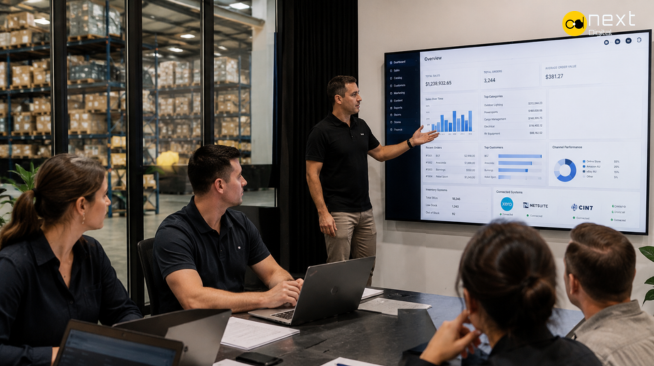
Here is where BigCommerce tends to be strongest:
1. B2B and Trade Selling
If you sell to trade customers, you may need customer-specific pricing, account management, company profiles, quote-style workflows and purchase order support.
On simpler ecommerce setups, these requirements often rely on third-party apps or custom work. On WooCommerce, they may require multiple plugins. On Shopify, the right setup may involve Shopify Plus, custom apps or workarounds depending on the use case.
BigCommerce is often more attractive when B2B selling is central to the business model rather than a side feature.
That said, businesses should still review exactly which B2B features are included in their plan or edition. “B2B-ready” does not automatically mean every workflow is available out of the box.
2. Larger and More Complex Catalogues
BigCommerce is generally a stronger fit for larger catalogues than many basic ecommerce builders. It can support businesses with thousands of products, variants, custom fields and structured categories.
However, it is still important not to overstate this. Catalogue performance depends on implementation quality, theme structure, product data, search setup, filtering, apps and integrations.
A poorly built BigCommerce store can still feel slow or hard to manage. A well-built Shopify, WooCommerce or Magento setup can also handle large catalogues when implemented properly.
The practical point is this: BigCommerce is worth considering when catalogue complexity is part of the business model, not just a temporary growth problem.
3. Integration-Friendly Architecture
Many Australian mid-market businesses already use systems they cannot easily replace: Xero, MYOB, NetSuite, Microsoft Dynamics, Cin7, a warehouse management system, a POS platform or a custom ERP.
In these cases, ecommerce cannot sit separately from the rest of the business. Orders, inventory, customer data, fulfilment and accounting need to move between systems accurately.
BigCommerce’s API and integration ecosystem make it a reasonable candidate for these situations. But again, the value depends on execution. The platform can support integration, but a clean integration still requires proper planning, data mapping, testing and maintenance.
4. Multi-Storefront and Multi-Channel Use Cases
Some businesses operate multiple brands, retail and wholesale storefronts, or regional ecommerce experiences. BigCommerce can be useful when one backend needs to support several sales experiences.
This can reduce operational duplication, especially when products, inventory or customer data need to be managed centrally.
But multi-storefront should not be treated as a reason to choose BigCommerce by default. For smaller teams, managing multiple storefronts can add complexity. It only makes sense if the business genuinely needs that structure.
5. Headless Commerce Readiness
BigCommerce can also work for businesses that want a custom frontend while using BigCommerce as the commerce backend.
This can be useful for brands that need more control over the customer experience, frontend performance, content architecture or app-like interfaces.
However, headless commerce is not automatically better. It usually increases development cost, technical responsibility and ongoing maintenance. For many Australian retailers, a well-implemented traditional storefront is still the more practical choice.
The common thread is simple: BigCommerce appeals most to businesses where ecommerce is an operating system, not just a sales page.
If your business has workflows, integrations, trade rules and catalogue complexity, BigCommerce may be a strong fit. If you mainly need to launch quickly with a simple product range, it may be more platform than you need.
BigCommerce Pricing in Australia: The 2026 Reality
Pricing is one of the most important parts of any BigCommerce Australia review because the headline monthly price does not tell the full story.
For Australian businesses, there are several cost factors to consider: USD billing, GST, plan thresholds, Open Payment Provider Fees, payment gateway costs, apps, development, integration and support.
BigCommerce’s Australian pricing page states that prices are in US dollars and exclude taxes such as GST and VAT. That means Australian businesses need to convert subscription costs into AUD and add GST when comparing platforms.
From June 1, 2026, BigCommerce is also moving to a new plan structure. Standard becomes Core, Plus becomes Growth, Pro becomes Scale, and Enterprise becomes Performance.
Here is the updated pricing structure:
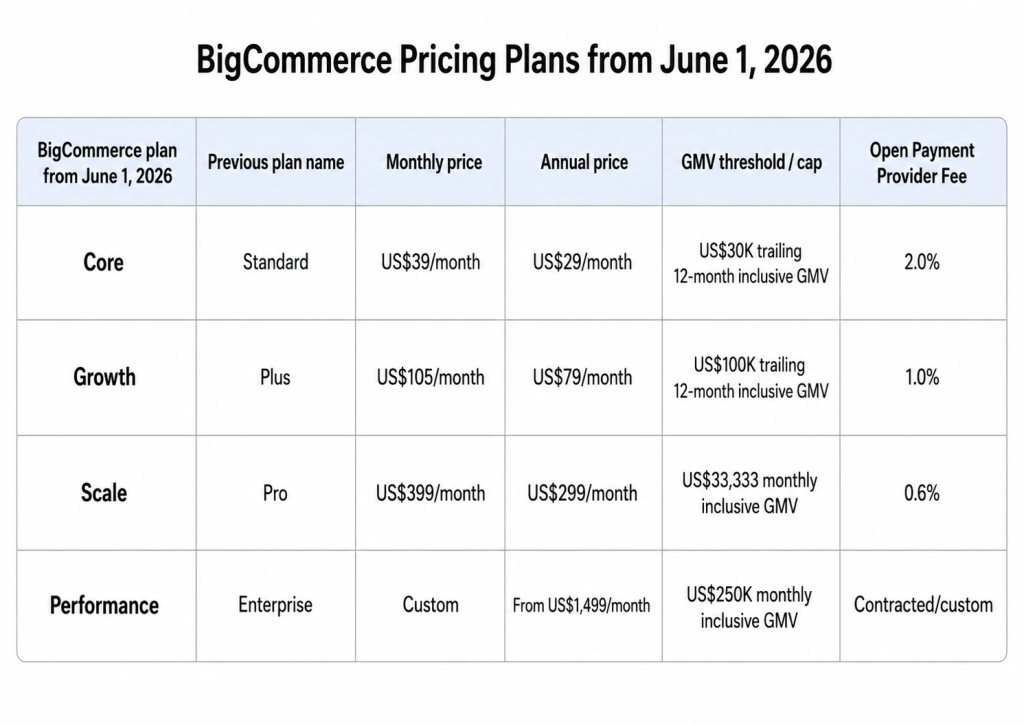
BigCommerce also states that Scale uses a 0.9% overage rate on inclusive GMV above US$33,333 per month, replacing the older Pro plan’s fixed block-based overage model. Performance has a US$250K monthly inclusive GMV cap with 0.6% overage above that cap.
There are a few practical implications here:
First, the Core plan may look affordable at US$39/month, but its US$30K trailing 12-month GMV cap is low. A business doing meaningful online volume may outgrow it quickly.
Second, Growth is likely to be more realistic for small but serious ecommerce businesses, especially if they need customer groups, abandoned cart recovery or stronger checkout features.
Third, Scale is where BigCommerce starts to look more clearly mid-market. At US$399/month monthly billing, plus possible overage and payment-related fees, it only makes sense if the business has enough operational complexity to justify the cost.
Fourth, the Open Payment Provider Fee needs to be reviewed carefully. BigCommerce says the fee applies to self-serve plans when orders are processed through Open Payment Providers. It does not apply to Embedded Payment Providers listed by BigCommerce, which include providers such as Afterpay, BigCommerce Payments, PayPal Braintree, PayPal Complete Payments, Stripe and Zip Money.
This is important because older comparisons often describe BigCommerce as having no transaction fees. In 2026, that statement needs more context. Depending on the payment provider setup, some merchants may pay no Open Payment Provider Fee, while others may see an additional platform-level cost.
A simple example:
If an Australian merchant processes the equivalent of US$80,000 per year through an Open Payment Provider on the Growth plan, the 1.0% Open Payment Provider Fee could add around US$800 per year before gateway fees, GST, apps or development costs.
If the same business uses only Embedded Payment Providers, that specific Open Payment Provider Fee may not apply. But standard payment processing fees from the gateway still apply.
So the right question is not only “How much is BigCommerce per month?”
The better question is:
What will the total cost of ownership look like over 12 to 24 months after subscription, GST, FX movement, payment processing, Open Payment Provider Fees, apps, integration, development and support?
For small businesses doing low online revenue, BigCommerce can become expensive quickly. For a mid-market retailer, wholesaler or distributor, the cost may be reasonable if the platform reduces manual admin, supports B2B workflows and integrates cleanly with backend systems.
Payment and BNPL Trends in Australia
Payment flexibility remains important in the Australian market, but payment choice now needs to be reviewed alongside platform economics.
Australian consumers expect familiar payment options. Depending on the category, that may include card payments, PayPal, Apple Pay, Google Pay, Afterpay, Zip or other BNPL options.
BNPL is still relevant, especially in consumer categories such as fashion, beauty, homewares, pet products and electronics. But it is no longer a simple growth hack. Merchant fees, regulation, refund handling and customer behaviour all need to be considered.
For BigCommerce merchants, the key issue is not only whether a payment method is available. The key issue is how that payment method affects the total cost structure.
BigCommerce’s 2026 pricing update makes gateway planning more important. Some payment providers are listed as Embedded Payment Providers and do not attract the Open Payment Provider Fee. Others may be treated as Open Payment Providers and may add extra cost on top of normal gateway fees.
That means payment planning should happen before a migration or launch, not after the store is live.
A DTC retailer may prioritise Afterpay, Apple Pay and fast mobile checkout.
A B2B distributor may care more about account-based payment terms, purchase orders, bank transfer, invoice workflows and credit limits.
A multi-channel retailer may need online payments, POS transactions, refunds and accounting reconciliation to work cleanly together.
BigCommerce can support a serious payment setup, but merchants should compare providers carefully. The review should include:
- Gateway transaction fees
- BNPL merchant fees
- Whether the provider is Embedded or Open under BigCommerce’s model
- Checkout experience
- Refund handling
- Multi-currency requirements
- ERP, accounting or POS integration
- Reporting and reconciliation
The practical takeaway: payment choice in Australia is not just a conversion issue. In 2026, it is also a platform cost issue.
Real BigCommerce Project Example
A useful way to understand BigCommerce is to look at how it works in a real ecommerce project, not just through a feature list.
One example is Ezydog, a pet accessory brand in Singapore. The brand worked with ONEXT DIGITAL to build a modern pet products shopping website on BigCommerce.

The goal was not only to create a good-looking storefront. The project also needed to support practical ecommerce operations such as product browsing, secure checkout, inventory management, order tracking, site performance and SEO.
This example is relevant for Australian retailers because it shows where BigCommerce can be useful beyond a basic online store. For businesses selling physical products with growing operational requirements, the platform can provide a stronger foundation for catalogue management, checkout, inventory visibility and scalable ecommerce workflows.
That does not mean every retailer needs BigCommerce. A simple store may not need this level of structure. But for businesses with product complexity, backend requirements and plans to grow across channels, a real implementation can help show what the platform is actually good at.
Before making a platform decision, it is worth reviewing similar projects and asking practical questions:
- How complex is the product catalogue?
- Are there wholesale or trade customers?
- Does the store need ERP, POS or warehouse integration?
- How many payment methods are required?
- Will the business sell across multiple channels?
- What internal team will manage the platform after launch?
These questions are often more useful than comparing feature checklists.
Final Verdict
BigCommerce is not the right platform for every Australian ecommerce business. It’s not trying to be.
If you’re launching a small DTC brand, testing a product idea, or running a lifestyle business with a simple catalogue and straightforward fulfilment, BigCommerce will feel like overkill. You’ll pay more than you need to, deal with features you don’t use, and spend time managing complexity that doesn’t add value to your business. In that case, Shopify development services or a simple WooCommerce setup may serve you better.
But if your ecommerce operation has real operational depth, large catalogues, B2B customer segments, ERP or POS integration requirements, multi-channel inventory management, or complex pricing and fulfilment workflows, BigCommerce becomes a strong candidate.
The platform is built for businesses where ecommerce is a system, not just a storefront. Where the backend matters as much as the frontend. Where you need infrastructure that can handle operational complexity without breaking or requiring constant custom development.
For Australian wholesalers, distributors, multi-brand retailers, and mid-market businesses with established operations, BigCommerce delivers value that justifies its cost structure. The B2B functionality, catalogue management, integration capabilities, and scalability are genuinely strong. The pricing model, while not cheap, is predictable and aligns with business growth.
The decision ultimately comes down to fit. Don’t choose BigCommerce because a feature comparison chart says it has more checkboxes than competitors. Choose it because your business has specific operational requirements that BigCommerce handles better than alternatives. If those requirements exist, the platform is worth serious consideration. If they don’t, look elsewhere.
The Australian ecommerce market in 2026 is competitive, operationally complex, and increasingly demanding. If your business matches that profile, BigCommerce is built for you. If it doesn’t, it probably isn’t.
Not sure whether BigCommerce is the right platform for your business? The ONEXT DIGITAL ecommerce development team can help you review your requirements, compare platform options, and build a scalable ecommerce solution for your next stage of growth.
FAQs
Is BigCommerce good for Australian businesses?
Yes. BigCommerce can be a good platform for Australian businesses, especially those that need flexible payments, scalable ecommerce features, larger catalogue support, or B2B capabilities. It is better suited to growing businesses than very small stores with simple needs.
How much does BigCommerce cost in Australia in 2026?
As of 2026, BigCommerce lists Standard at US$39/month, Plus at US$105/month, and Pro at US$399/month. Annual billing lowers the monthly equivalent to US$29, US$79, and US$299 respectively. Prices are in US dollars and exclude taxes.
What changes are happening to BigCommerce pricing in 2026?
From June 1, 2026, BigCommerce is renaming Standard to Core, Plus to Growth, Pro to Scale, and Enterprise to Performance. The update also introduces new GMV thresholds and Open Payment Provider Fees for self serve plans.
What is the BigCommerce Open Payment Provider Fee?
The Open Payment Provider Fee is a monthly fee charged by BigCommerce on eligible order GMV processed through Open Payment Providers. From June 1, 2026, the fee is 2.0% on Core, 1.0% on Growth, and 0.6% on Scale. It is separate from payment gateway processing fees.
Which payment gateways does BigCommerce support in Australia?
BigCommerce supports many payment gateways in Australia, including Adyen, Afterpay, Checkout.com, CommBank MIGS, eWAY Rapid, Humm, Klarna, PayPal, Square, Stripe, Windcave, Zip, and others.
Do I need a developer for BigCommerce?
You can set up a basic BigCommerce store without a developer. However, if you need migration, custom design, B2B features, payment setup, integrations, SEO, or performance optimisation, working with a developer or ecommerce agency is recommended.