
 Services
 Solutions
 Main platform
 Technology
 White Label
  Offshore
 Hire developers



Many tradies in Australia are still losing hours every week on non-revenue tasks such as manually writing quotes, tracking appointments via messages, entering invoices into accounting systems, or chasing customers for payments. As businesses grow and add more staff and jobs, managing everything through paper, spreadsheets, or scattered chat messages often leads to mistakes, missed jobs, and slower cash flow.
That’s why job management apps for tradies are becoming increasingly important in Australia. Platforms like ServiceM8, Tradify, Fergus, and simPRO help automate workflows from quoting, scheduling, and time tracking to invoicing and payments. When combined with Xero and Stripe, many tradie businesses can run almost their entire operation from a phone, significantly reducing admin time and focusing more on revenue-generating work.
This article compares the most popular job management apps for tradies in Australia in 2026, including their pros, cons, costs, integration capabilities, and the types of businesses each platform suits best.
1. Australian Tradie Industry Overview (2026)
Australia’s tradie and field service sector is made up mostly of small businesses, typically with 1–20 staff. This includes trades like electrical, plumbing, HVAC, cleaning, and general maintenance. Most of the work is done on-site, which makes day-to-day operations very different from office-based industries.

Data from the Australian Bureau of Statistics (ABS) shows that small businesses make up more than 90% of firms in construction-related services, which is the core part of the tradie economy. The market is therefore highly fragmented, with most operators running independently and with limited standardisation across tools and processes.
Over the past decade, the industry has gradually moved away from manual workflows such as paper job sheets, spreadsheets, and phone-based scheduling. This shift has accelerated in recent years due to rising labour costs, ongoing skills shortages, and higher customer expectations around response time, instant quoting, and faster payment.
Today, most tradie businesses in Australia operate using a connected software stack rather than a single tool. Common setups include job management platforms like ServiceM8 or Tradify for scheduling and quoting, accounting systems such as Xero for bookkeeping, and payment tools like Stripe for online payments. Together, these systems help reduce admin work, improve accuracy, and shorten the time from job completion to payment, improving overall cash flow.
2. Why Tradies in Australia Need Job Management Apps?
Time saving:
Specialized software automates quoting, invoicing, and payment reminders, helping tradies save around 5–10 hours per week compared to manual admin. At ~$100/hour job value, that’s roughly 250 hours saved per year through automation alone.
Fewer errors and missed jobs:
Job schedules, customer details, and material costs stored in messages or handwritten notes are easily lost. Apps like ServiceM8, Tradify, etc. centralize all data in one system, accessible directly from the field.
Higher revenue:
Invoices sent immediately after job completion (instead of days later) improve cash flow. Integrated online payments (Stripe) allow instant payment instead of waiting weeks for bank transfers.
Scalability:
When a business grows to more staff or larger contracts, spreadsheets and paper systems break down quickly. Dedicated software scales from 1–5 users to hundreds of employees.
For example, most tradies now use three core systems: job management software (ServiceM8, Tradify, Fergus, etc.), accounting software (Xero), and online payments (Stripe). When integrated, completing a job on a phone automatically creates an invoice in Xero with a Stripe payment link. The customer pays instantly, and reconciliation happens automatically. This removes most manual admin work and significantly speeds up cash collection.
3. Quick Comparison: Best Tradie Apps in Australia (2026)
The table below provides a side-by-side comparison of the leading tradie software platforms used across Australia in 2026.
| App | Best for | Typical size | Key feature | Starting price |
|---|---|---|---|---|
| M8 | Small field service teams | 1–20 staff | Scheduling and dispatching | From $29/mo |
| Tradify | Electricians and plumbers | 1–20 staff | Quoting and job tracking | From $35/user/mo |
| simPRO | Large trade businesses | 10–200+ staff | Project management and inventory | Custom pricing |
| Fergus | Plumbing and electrical | 1–50 staff | Job costing and margins | From $55/user/mo |
| AroFlo | Field service and facilities | 10–200+ staff | Asset and compliance management | Custom pricing |
| MechanicDesk | Automotive workshops | 1–30 staff | Parts ordering and job cards | From $59/mo |
| Xero | All trades (accounting) | Any | Invoicing, GST, BAS and reporting | From $29/mo |
| Stripe | All trades (payments) | Any | Online card payments | 1.7% + 30c per transaction |
3. Best Tradie Apps in Australia (2026)
ServiceM8
ServiceM8 is a popular field service management app in Australia. It supports quoting, scheduling, job tracking, invoicing, and payments in a user-friendly, mobile-first interface (iOS/Android apps).
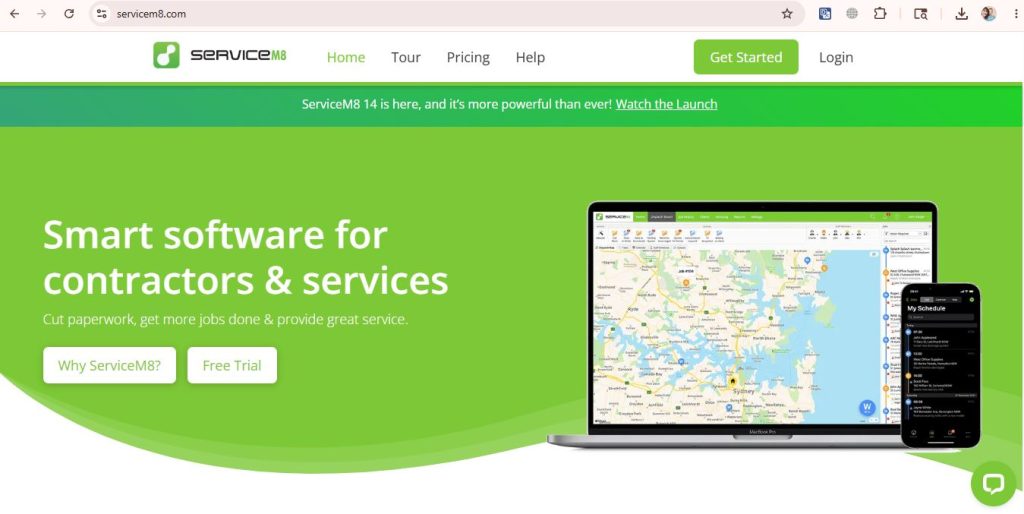
ServiceM8 integrates with Xero to automatically create accounting invoices, and can embed Stripe payment links so customers can pay immediately by card. It is widely used by electricians, plumbers, cleaners, and pest control technicians because it is quick to set up, easy to learn, and works offline. The entry plan is free for up to 30 jobs per month, with the Starter plan starting at $29/month for unlimited users.
Tradify
Tradify is job management software designed for small teams in Australia and New Zealand. It focuses on quoting, job tracking, timesheets, invoicing, and customer management. It integrates with Xero and Stripe for online payments. The interface is simple, making it suitable for solo tradies or small teams of 1–20 people working in residential construction trades.
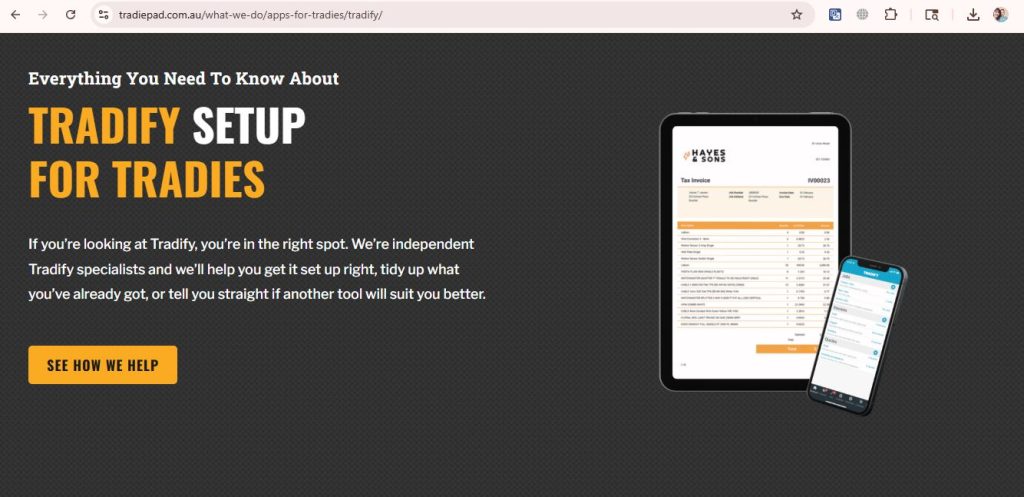
Tradify is used by tens of thousands of electricians, plumbers, HVAC technicians, and others due to its strong workflow organisation. The company positions itself as a “best for tradies” solution, offering tools that digitise the entire process from quoting through to payment.
Fergus
Fergus started as a “tool built by tradies for tradies,” which is why many of its features are well suited to electrical and plumbing work. It places strong emphasis on job costing and tracking profitability at a project level. The system includes quoting, job tracking, timesheets, invoicing, and profit reporting.
Fergus integrates with Xero so invoices are automatically synced into accounting. It is a good fit for small to mid-sized teams (1–50 people), helping businesses clearly see labour, materials, and overall project costs. According to its website, around 20,000 Australian tradies use Fergus. Pricing starts from $48/month (Essentials plan) and $72/month (Pro plan), plus $22 per timesheet user.
simPRO
simPRO is a job management platform built for larger businesses. It includes end-to-end functionality from quoting, scheduling, purchase order processing, inventory management, workforce allocation, to invoicing and payments. It is designed for large commercial projects (electrical, HVAC, fire protection, etc.) and includes detailed reporting, compliance requirements, and project scheduling tools such as Gantt charts.
For businesses with more than 10 staff or those needing inventory control, simPRO is a common choice. It integrates with Xero and typically uses custom pricing based on company size. According to comparison sources, entry-level pricing in Australia is not publicly listed and is generally several hundred dollars per month or more.
AroFlo
AroFlo is an Australian job management software designed for large companies, maintenance contractors, and building services providers. It handles asset management, scheduled maintenance planning, safety compliance, and multi-site workforce deployment. AroFlo also supports inventory and stock control.
The AroFlo Premium plan starts at around $235/month for 3 users and includes document storage and accounting integrations. It integrates well with Xero and is suited to businesses with more than 10 staff, especially those managing long-term maintenance contracts.
MechanicDesk
MechanicDesk is designed specifically for automotive garages and workshops. It manages job cards, parts ordering, vehicle history, invoicing, and customer relationship management. MechanicDesk integrates with Xero and supports payments via Stripe.
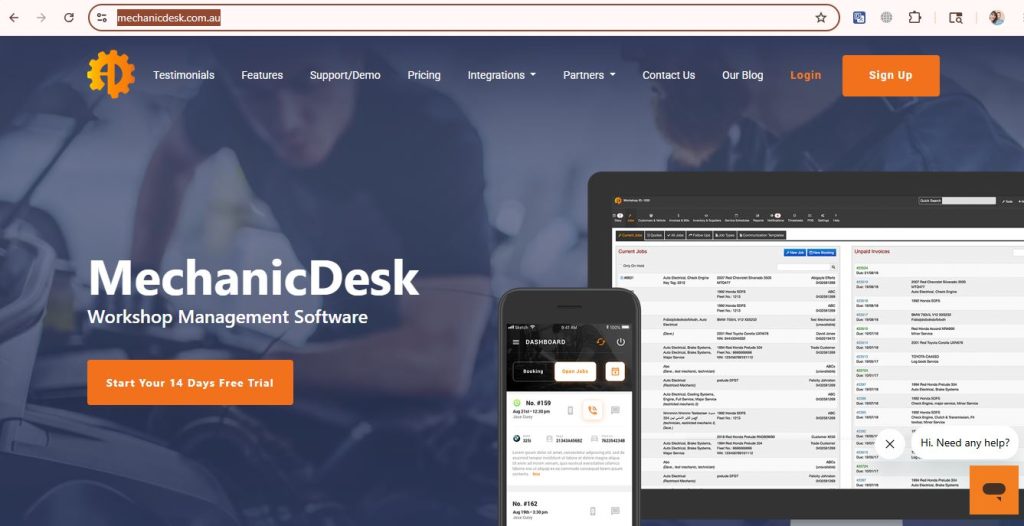
Pricing starts from $85/month for the Starter plan (1 user), $115 for Small (3 users), $150 for Team (6 users), and $250 for Large (15 users), with an additional $15 per extra user. It is a complete solution for mechanics, tyre shops, and small repair centres, replacing manual logbooks and paper-based tracking systems.
Xero (Accounting)
Xero is the most widely used cloud accounting software in Australia. Nearly all tradie businesses use Xero for invoicing, expense tracking, bank reconciliation, and tax reporting. Xero has around 3 million users globally.
In Australia, Xero offers several plans: Ignite ($35), Grow ($75), Comprehensive ($100), and Ultimate 10 ($130) per month (GST included). It also integrates tools like Hubdoc for automated invoice capture, and supports budgeting and job-based reporting.
Stripe (Payments)
Stripe is a popular online payment platform in Australia. It processes credit and debit card payments, provides payment links, and integrates smoothly with Xero and job management apps.
In Australia, domestic card transaction fees are currently 1.70% + 30¢ per transaction, which is considered relatively competitive in the market. When customers pay through a Stripe link attached to a Xero invoice, the system automatically matches the payment and reconciles the accounts, helping businesses get paid faster.
Note: Australian regulations will prohibit businesses from separately surcharging card fees starting in October 2026. However, Stripe processing fees will still apply, so businesses typically factor them into pricing or include them as part of general service costs.
4. How to Choose the Best Tradie App for Your Business Size
Choosing the right app depends on the type of work, team size, and project complexity:
Small teams (1–5 staff):
ServiceM8 or Tradify are usually the best options. They are quick to set up, affordable, and cover the essentials (quoting, scheduling, invoicing, and payments) for day-to-day residential service work. Pair with Xero for accounting.
Growing teams (5–20 staff):
Tradify or Fergus are better choices as they add job costing and profitability tracking. These tools are slightly more complex but still manageable. Combine with Stripe for faster payments and automation tools to connect with Xero.
Large companies (>20 staff):
simPRO or AroFlo are more suitable because they support multi-team coordination, inventory management, multi-stage project scheduling, and compliance requirements. They require more time and investment to implement, but are better suited for complex commercial operations.
Auto workshops / garages:
Industry-specific software like MechanicDesk is the clear choice. It handles core workshop needs such as parts ordering and vehicle repair history. Regardless of business size, MechanicDesk includes specialised features that general-purpose apps don’t provide.
How to choose correctly:
Evaluate your current needs and your expected growth over the next two years. Small teams should avoid overpaying for enterprise systems, while larger companies should avoid cheap tools that lack critical functionality. Always check integration quality with Xero (automatic invoice syncing and reconciliation) and payment support via Stripe before making a decision. Some providers only sync invoices but don’t reconcile payments automatically, which leads to manual work, errors, and wasted time.
Also, don’t choose based on price alone. A more expensive system that saves several hours of admin work per week is often more cost-effective than a cheaper tool that creates operational friction.
5. Integrations and Automation for Tradie Workflow Efficiency
The key to a smooth workflow is proper integration between systems. Typically, when a job is marked as completed in ServiceM8, Tradify, or Fergus, the system automatically generates an invoice in Xero along with a Stripe payment link. The customer pays through that link, and Stripe automatically reconciles the payment in Xero without any manual input.
Other remaining tasks are usually handled with supporting tools—for example, Hubdoc to scan supplier invoices and send them directly into Xero, or Zapier/Make to automate processes such as sending payment reminders, saving new customer details, or triggering follow-up emails. For businesses that require a more advanced setup across these systems, custom software development for tradie automation systems can help unify the entire workflow into a single connected structure.
This setup removes the need to manually copy data between systems, reduces errors, and speeds up cash collection. Without integration, a tradie might lose days due to delayed invoicing and spend time chasing payments. With automation, invoices are created immediately after job completion, and automated reminders help ensure payments are made on time.
6. Common Mistakes When Choosing Tradie Software
Choosing overly complex systems:
Many small tradies end up buying “enterprise plans” (simPRO, AroFlo) when they only need basic features. This leads to high costs, confusion for staff, and unused functionality. For example, a solo electrician doesn’t need inventory management for 3,000 stock items.
Ignoring Xero integration quality:
Not all apps fully sync payments properly. Some only push invoices to Xero, while payments still need to be reconciled manually, which removes much of the benefit. Always test the trial version to confirm whether invoices are automatically pushed to Xero and whether Stripe payments are properly reconciled.
Not planning ahead:
Some people choose based only on current needs and later outgrow the system, while others overpay for features they don’t use. The right approach is to pick a tool that fits your current stage but can scale with upgrades later.
Lack of automation setup:
Even with good software, if systems are not connected, manual data entry still takes time. After setup, it’s important to configure automation tools like Zapier or Make (or services like Tradie Flow) to automate tasks such as creating Xero invoices, attaching Stripe payment links, and sending payment reminders.
Focusing only on price:
The cheapest option is not always the best value. A $30/month tool that saves many hours of admin work can be far more cost-effective than a cheaper tool that creates inefficiencies. Always compare workflows and features, not just subscription cost.
7. Best Tradie Apps by Trade Type
Electricians:
The most commonly used apps are ServiceM8, Tradify, and Fergus. ServiceM8 and Tradify are well suited for residential work (fast quoting, offline support). For larger or commercial electrical projects, Fergus or simPRO are preferred due to stronger job costing and project control. In short: residential electrical work uses ServiceM8/Tradify + Xero; commercial electrical work uses Fergus/simPRO + Xero.
Plumbers:
Typically use Fergus, Tradify, or ServiceM8. Fergus stands out for job profitability tracking and materials management. Many Australian plumbing businesses start with Tradify and later move to Fergus or simPRO as they scale. Plumbing apps need to support emergency scheduling (24/7 jobs), material tracking, and GST-compliant invoicing via Xero.
HVAC technicians:
AroFlo and simPRO are commonly used because they support asset management (air conditioning units, boilers), preventive maintenance scheduling, and safety compliance requirements. Smaller teams often start with ServiceM8 and upgrade to AroFlo or simPRO as maintenance contracts increase.
Auto garages (mechanics):
Require specialised features such as parts ordering, vehicle history tracking, and job cards. MechanicDesk is one of the leading solutions in Australia because it is built specifically for workshops. It integrates with Xero and Stripe to manage the full workflow from vehicle intake to repair and payment.
Builders / large contractors:
These projects involve multiple work stages and require progress tracking, variation management, and staged approvals. simPRO or AroFlo are commonly used due to their advanced project management capabilities. Smaller residential contractors often start with Tradify or Fergus before moving to more specialised systems as they grow.
8. Conclusion
Choosing the right job management app can make a significant difference for a tradie business in Australia. For small teams handling day-to-day service work, platforms like ServiceM8 or Tradify are usually enough to manage quoting, scheduling, and invoicing efficiently. As the business grows and needs better control over costs, profitability, or multiple teams, Fergus, simPRO, or AroFlo become more suitable due to their more advanced project and operations management capabilities.
However, the real value is not just in the software itself, but in how the systems are connected. When job management apps are integrated with Xero, Stripe, and automation tools, businesses can reduce manual admin work and improve cash flow. Instead of spending hours each week on paperwork and reconciliation, businesses can focus more on customers, jobs, and growth.
There is no single “best app for everyone.” The right solution depends on the current size of the business, its workflow, and its growth direction over the next few years.
If you want to build a fully automated workflow for a tradie business from quoting and job management to invoicing and payments via Xero & Stripe – ONEXT DIGITAL can help design and implement a system that fits your current scale and is ready to grow with your business. Get in touch with us today for a consultation.
FAQs
What is the best tradie app in Australia?
The best tradie app in Australia depends on business size and workflow. ServiceM8 is often the best choice for small teams due to its simplicity and mobile-first design, while Tradify is popular for electricians and plumbers. Larger businesses typically prefer simPRO or AroFlo for advanced job and project management.
Which tradie app is best for small businesses?
For small tradie businesses (1–5 staff), ServiceM8 and Tradify are the most suitable options. They cover essential features like quoting, scheduling, invoicing, and payments without being overly complex or expensive.
Do tradie apps integrate with Xero and Stripe?
Yes, most major tradie apps in Australia such as ServiceM8, Tradify, Fergus, and simPRO integrate with Xero for accounting and Stripe for online payments. These integrations help automate invoicing, payment tracking, and bank reconciliation.
How much do tradie apps cost in Australia?
Pricing varies depending on the platform. Basic tools like ServiceM8 start from around $29/month, while Tradify starts at approximately $35 per user/month. More advanced systems like simPRO or AroFlo typically use custom or higher-tier pricing based on business size and requirements.
What is the difference between ServiceM8 and Tradify?
ServiceM8 is known for its simplicity, fast setup, and mobile-first experience, making it ideal for small field service teams. Tradify offers more structured job tracking, quoting, and timesheets, making it better suited for growing teams that need more control over workflows and reporting.
Which tradie software is best for growing businesses?
For growing tradie businesses (5–20 staff), Fergus is often the best choice because it includes strong job costing and profitability tracking. It helps business owners understand margins while still managing scheduling, quoting, and invoicing in one system.