
 Services
 Solutions
 Main platform
 Technology
 White Label
  Offshore
 Hire developers



Artificial intelligence (AI) and automation are rapidly transforming the IT industry. Beyond streamlining internal operations, these technologies are redefining how businesses approach IT outsourcing from automating repetitive tasks to enhancing infrastructure management and technical support. According to McKinsey, over 50% of global tech companies are now integrating AI into their outsourcing processes to reduce costs, boost efficiency, and improve operational accuracy.
But what exactly are the benefits of AI and automation in IT outsourcing? What challenges should organizations prepare for? And which trends are shaping the future of this evolving landscape? Let’s dive in and explore.
1. AI and Automation in IT Outsourcing Landscape
In the context of IT outsourcing, artificial intelligence (AI) and automation refer to the use of intelligent algorithms and automated workflows to optimize and streamline tasks that were traditionally performed by human teams. These technologies are transforming outsourced services from software development and quality assurance to infrastructure management and customer support.

AI technologies simulate human cognition to make decisions, learn from data, and adapt over time. Automation, particularly in the form of Robotic Process Automation (RPA), handles high-volume, rule-based tasks with precision and speed. When combined, AI and automation enable IT service providers to deliver faster, more reliable, and cost-effective solutions.
Some key technologies driving this transformation include:
- Machine Learning (ML): Enables systems to learn from historical data and improve over time without being explicitly programmed.
- Robotic Process Automation (RPA): Automates routine, rule-based processes such as data entry, system monitoring, and report generation.
- Natural Language Processing (NLP): Powers chatbots and virtual assistants to handle customer support queries and internal service requests.
- AI Ops (Artificial Intelligence for IT Operations): Uses AI to analyze large volumes of operational data, detect anomalies, and automate incident response.
Case Study: A mid-sized IT outsourcing firm specializing in managed support services adopted a machine learning based AI system to handle incoming Level 1 support tickets. Previously, human agents responded to tickets manually, resulting in an average resolution time of 24 hours. After integrating a combination of NLP and RPA tools, the system could automatically classify, prioritize, and resolve repetitive tickets such as password resets or access requests within 2 hours. This not only reduced SLA breaches but also allowed human agents to focus on more complex tasks, improving overall service quality and client satisfaction.
2. Key Benefits of Integrating AI and Automation in IT Outsourcing
The convergence of AI and automation technologies with IT outsourcing has redefined the value proposition of external service delivery. No longer focused solely on cost-cutting, organizations now pursue outsourcing partners that deliver intelligence, agility, and measurable outcomes. Here’s how AI-powered outsourcing is transforming the IT landscape:
2.1 Boosted Operational Efficiency
AI-driven automation enhances the speed, accuracy, and reliability of IT operations.
- According to McKinsey’s 2024 Global Survey, automation powered by AI has increased IT productivity by up to 35%, particularly in areas such as infrastructure monitoring, log analysis, and incident remediation.
- Gartner (Q1 2025) reports that AI Ops platforms can autonomously resolve up to 70% of Tier-1 IT tickets, minimizing the need for human intervention.
Case in point: Deloitte’s 2024 research reveals that companies leveraging AI-based service desks experienced a 62% reduction in resolution time and a 28% improvement in SLA compliance.
2.2 Scalable Cost Reduction
AI automates high-volume, repetitive tasks, unlocking long-term cost savings.
- Capgemini’s 2024 Automation Survey shows that companies using AI in outsourcing reduce IT, finance, and customer service costs by 30 – 45%.
- IBM estimates that virtual assistants now manage over 88% of routine L1 support tickets, reducing ticket volumes and allowing for leaner support teams.
These savings can be redirected toward strategic initiatives such as cloud transformation, product innovation, and hiring for critical engineering roles.
2.3 Greater Accuracy and Predictability
Machine learning minimizes human error and delivers consistent service quality.
- ML-powered QA tools detect bugs with up to 97% accuracy, cutting regression testing time by 40% (Accenture AI Labs, 2024).
- PwC’s 2025 Digital Trust report indicates that AI-driven predictive maintenance can reduce unplanned IT outages by up to 52%.
This reliability reduces SLA violations and fosters trust between clients and outsourcing partners.
2.4 Smarter, Data-Driven Decisions
AI equips teams with real-time insights and predictive analytics to guide IT strategies.
- According to Gartner’s 2025 CIO Survey, 71% of enterprises now rely on AI-driven analytics for IT decision-making.
- AI dashboards help monitor systems continuously, detect anomalies, and analyze sentiment often identifying risks hours before human analysts can.
Modern AI systems also recommend optimal staffing, resource allocation, and resolution paths based on historical and real-time data dramatically increasing agility and responsiveness.
2.5 Agile Scalability
AI enables flexible, demand-driven scaling of outsourced services.
- IDC’s 2024 Global Sourcing Index shows that vendors using AI and RPA scaled workloads 2.7 times faster during peak demand periods.
- Cloud-native AI bots can automatically adjust resource allocation, maintaining cost efficiency even as user traffic surges by 200% or more.
This elasticity empowers businesses to grow rapidly without proportionally increasing infrastructure costs or headcount.
3. Challenges of Adopting AI in IT Outsourcing
While AI offers clear advantages in IT outsourcing, its adoption is not without challenges. Organizations looking to integrate AI into their outsourced services must navigate a range of technical, operational, and strategic hurdles.
3.1 Integration Complexity
One of the biggest barriers is the complexity of integrating AI into existing systems or client applications. Many legacy environments lack the flexibility or infrastructure required to support modern AI frameworks, leading to costly and time-consuming integration efforts.
3.2 Data Privacy and Security Risks
Using AI to process sensitive information introduces risks around data privacy and security. Organizations must ensure that AI systems comply with strict data protection regulations such as GDPR and CCPA, particularly when handling customer or financial data.
3.3 Skill Gaps and Talent Shortage
There’s a growing shortage of professionals who are both fluent in AI technologies and familiar with the outsourced systems they must work with. This talent gap creates a bottleneck in scaling AI adoption, especially in highly specialized industries.
3.4 Cost of Initial AI Implementation
Initial implementation costs can be prohibitively high, especially for startups or smaller outsourcing firms. Expenses tied to infrastructure setup, model training, and team upskilling can make AI adoption feel risky, even if the long-term returns are substantial.
4. How Startups and SMEs Can Leverage AI in Outsourcing
For startups and small to medium-sized enterprises (SMEs), adopting artificial intelligence can be challenging due to limited budgets, lack of expertise, and the high cost of building in-house AI infrastructure. Outsourcing provides a strategic path to harness AI-driven solutions without incurring heavy upfront investments.
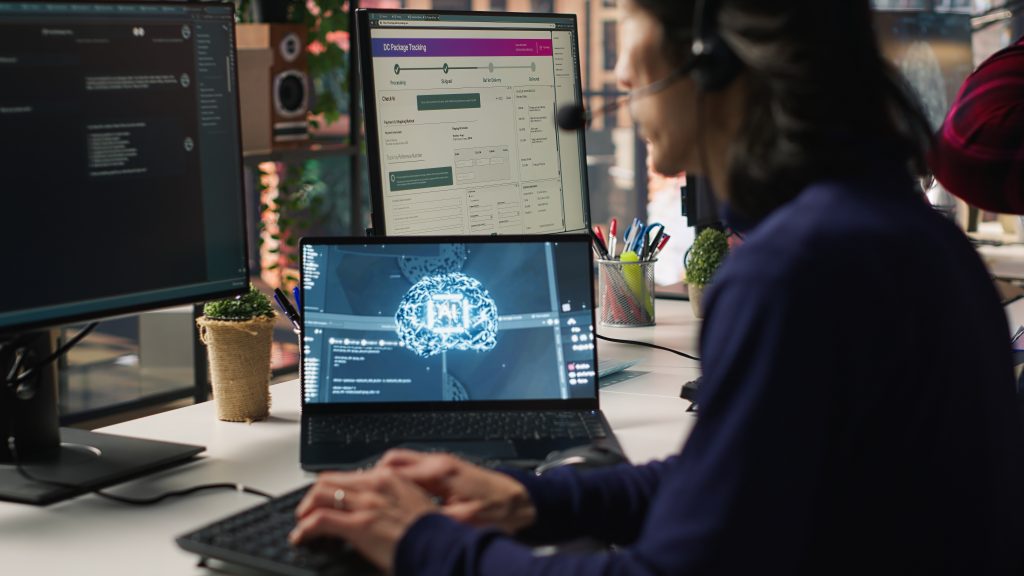
By partnering with outsourcing vendors that have AI-enabled workflows and pre-built infrastructure, startups can gain access to advanced technologies at a fraction of the cost. These third-party providers often bring years of experience in deploying AI tools across development, testing, and monitoring environments. This allows smaller companies to compete more effectively, accelerating product development and improving service quality without overextending internal resources.
In practice, many outsourcing teams already integrate AI-powered tools to streamline their processes. For example:
- GitHub Copilot assists developers by auto-completing code and suggesting functions based on context.
- Testim.io enhances software quality by automating test generation and execution using machine learning.
- DataDog AI helps monitor performance, predict issues, and optimize infrastructure in real-time.
Leveraging these AI capabilities through outsourcing enables startups and SMEs to move faster, deliver better software, and remain agile in a competitive market all while keeping operational costs under control.
5. Future Trends in AI-Driven IT Outsourcing

As artificial intelligence continues to evolve, its role in software outsourcing is expanding rapidly. AI is no longer just a supportive tool, it is beginning to reshape the entire process of software development and project management. Below are some of the key trends expected to define the future of this industry.
5.1 Autonomous Software Development
Artificial intelligence is increasingly taking over repetitive development tasks. In the near future, AI will be capable of writing code, running tests, and even deploying software with minimal human input. This evolution will significantly speed up the software development lifecycle and reduce the need for manual intervention.
5.2 Smarter Project Management with AI
AI-powered project management tools are becoming more advanced, helping teams plan more effectively, allocate resources intelligently, and manage backlogs with greater efficiency. These tools not only improve transparency but also support data-driven decision-making across the project lifecycle.
5.3 AI-as-a-Service Becoming Mainstream in Outsourcing
Outsourcing vendors are beginning to offer full AI tool suites as part of their service packages. This trend allows clients to benefit from advanced technologies such as predictive analytics, intelligent automation, and AI-powered monitoring without needing to invest in building or maintaining their own AI infrastructure.
5.4 Enhanced Collaboration Between Humans and AI
Rather than replacing human teams, AI is becoming a collaborative partner. Organizations are finding ways to combine human intuition and creativity with the speed and accuracy of AI tools. This synergy leads to higher productivity, fewer errors, and faster innovation.
5.5. Generative AI in Coding and Support:
GenAI tools like GitHub Copilot, ChatGPT, and Tabnine are increasingly being used in coding assistants, documentation generation, and even customer support. These tools reduce time-to-market and boost developer productivity while making AI capabilities accessible across technical skill levels.
6. Conclusion
AI and automation are no longer optional in IT outsourcing, they are becoming essential drivers of productivity, cost efficiency, and innovation. From streamlining workflows to enhancing decision-making, their impact spans across every phase of the software development lifecycle. Businesses that adopt these technologies early will not only optimize their operations but also gain a significant edge over the competition.
Looking to integrate AI into your outsourced development process? Our team of AI-enabled developers at ONEXT DIGITAL is here to help you get started and stay ahead.
7. FAQs: AI and Automation in IT Outsourcing
1. What is AI and automation in IT outsourcing?
It refers to using artificial intelligence and automated tools to improve outsourced IT services like support, monitoring, and development.
2. How does AI improve IT outsourcing?
AI boosts speed, reduces errors, lowers costs, and enables 24/7 intelligent automation in tasks like ticket handling and infrastructure monitoring.
3. What are the top benefits of AI in IT outsourcing?
Key benefits include cost savings, faster response times, improved SLA compliance, and smarter decision-making through analytics.
4. Is AI outsourcing suitable for small businesses?
Yes. SMEs can access advanced AI tools affordably through outsourcing vendors without building in-house infrastructure.
5. What are the risks of using AI in outsourced IT services?
Main risks include data security, integration complexity, and the need for skilled teams to manage and monitor AI systems effectively.