
 Services
 Solutions
 Main platform
 Technology
 White Label
  Offshore
 Hire developers



In the heart of Southeast Asia, a technological revolution is brewing. While the West remains fixated on Silicon Valley, a hidden dragon stirs: – Offshore software development in Vietnam. Here, a vibrant pool of young, programmers hunger to unleash their skills on your project. But the real fire-breathing advantage? Development costs that will leave your competitors in the dust. Forget sky-high rates – Vietnam offers exceptional talent at a fraction of the price. Intrigued by the prospect of a skilled team tackling your project for a fraction of the usual cost? Dive deeper and discover why Vietnam should be your next offshore software development powerhouse.
What is Offshore Software Development Center ( ODC)?
Offshore software development involves partnering with a software development company in a foreign country to handle various stages of your software project. This can include tasks like design, development, testing, and even maintenance. Here’s a breakdown of the key aspects:
- Location: The development team is located in a different country from your own.
- Partnership: You collaborate with the offshore company to achieve your project goals.
- Project Stages: The offshore team can handle various project phases, from the initial concept to final product.
- Benefits: This approach offers advantages like cost savings, access to a wider talent pool, and a focus on your core business.
Here’s an analogy: Imagine building a house. Offshore software development is like hiring skilled construction workers from another country to collaborate on building your dream home. You provide the blueprint and materials, while the offshore team brings their expertise and labor to bring your vision to life.
Vietnam has cemented its position as a global leader in offshore software development, leveraging a skilled workforce, competitive costs, and supportive government policies. As we analyze the data from 2020 to 2024, it becomes evident that Vietnam’s IT sector is poised for further growth in 2025. Below is a detailed analysis of the current state and future predictions for offshore software development in Vietnam.
Offshore Software Development Statistics (2020-2024)
1.Growth in the IT Workforce
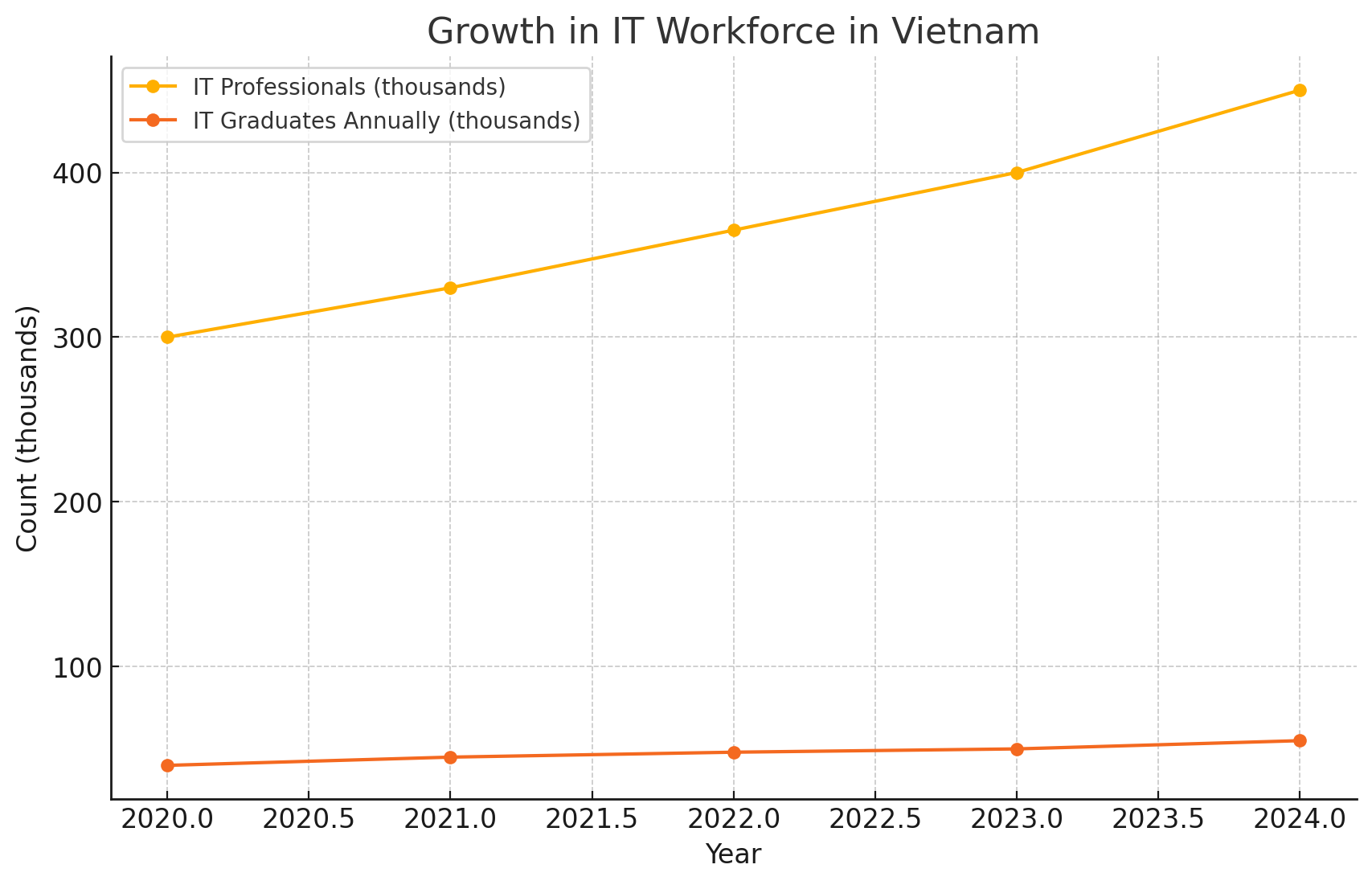
Skilled Professionals: The number of IT professionals in Vietnam has grown significantly, from 300,000 in 2020 to 450,000 in 2024, representing a compound annual growth rate (CAGR) of approximately 10%.
Annual IT Graduates: Universities across Vietnam produce 50,000 IT graduates annually (2024), up from 40,000 in 2020. These graduates are well-versed in programming languages such as Python, Java, and C++, and increasingly proficient in emerging technologies like AI and blockchain.
2. Foreign Direct Investment (FDI)
FDI Inflows: FDI in Vietnam’s IT sector has steadily increased, from $2.5 billion in 2020 to $5.2 billion in 2024, driven by investments from tech giants like Samsung, Intel, and Foxconn. These investments reflect global confidence in Vietnam’s cost-effective and high-quality tech capabilities.
3. Competitive Cost Structure
While the fastest-growing country in Southeast Asia, Vietnam is categorized as having a lower-middle-income economy, this enables businesses to access globally competitive talent at cost-effective rates. Businesses outsourcing to Vietnam have achieved cost savings of up to 80% compared to Western markets. Lower labor costs and a strong emphasis on quality output support this competitive edge.
4. Service Diversification
Vietnamese software development firms are expanding their service portfolios to include:
- Custom software development
- Mobile and web application development
- AI and machine learning integration
- Blockchain solutions
- Cloud computing
What’s Next For 2025?

Looking ahead to 2025, the trajectory of Southeast Asia’s economy, particularly in the Offshore Development Center (ODC) sector in Vietnam, will depend on its ability to address ongoing challenges such as talent retention and cybersecurity while capitalizing on emerging opportunities like AI-driven development and sustainable practices.
1. Workforce Expansion
The IT workforce is expected to grow to 500,000 professionals, with over 60,000 graduates annually joining the talent pool. This growth is driven by Vietnam’s robust educational system and increasing demand for skilled developers globally.
2. Increase in FDI
Vietnam is projected to attract over $6 billion in FDI in its IT sector by 2025. Companies from the U.S., Japan, and South Korea are expected to expand their operations in Vietnam, drawn by its competitive costs and growing expertise in emerging technologies.
3. Shift to High-Value Services
Vietnamese firms are likely to focus more on high-value services, including:
- AI and machine learning solutions: Demand for AI integration in software development is growing, with the potential to reduce project timelines by 25%.
- Cybersecurity solutions: With rising global concerns over data breaches, Vietnam is investing in training and tools to provide advanced cybersecurity services.
- Cloud-native development: The shift to cloud-based infrastructure will drive demand for cloud computing expertise.
4. Sustainable Practices
- As global clients prioritize sustainability, Vietnamese IT firms will adopt green IT solutions, including energy-efficient data centers and eco-friendly development practices, to align with international standards.
5. Rise of Tier-2 Cities
- Secondary cities such as Da Nang, Hai Phong, and Can Tho are expected to emerge as major outsourcing hubs. These cities offer cost advantages and a growing pool of skilled developers, contributing significantly to Vietnam’s offshore software development revenue.
Understanding The Landscape of Offshore Software Development in Vietnam

The concept of offshore software development involves partnering with a software development company in a foreign country to handle various stages, from design and development to testing and maintenance, of your software application. Now, let’s delve into the reasons behind Vietnam’s meteoric rise as a prominent player in this dynamic field:
1. Thriving Tech Talent Pool:
Vietnam ranks 29th globally in the programming skills chart of the Skill Value Report 2019. Many companies have achieved CMMI Level 3 and 5 certifications, demonstrating professional software development capabilities.
Vietnam boasts a young and energetic population with a strong emphasis on STEM education. Universities churn out graduates well-versed in programming languages, frameworks, and methodologies like Agile development. This translates to a readily available pool of skilled developers eager to contribute to innovative projects. Beyond technical expertise, Vietnam’s young workforce is known for its strong work ethic, cultural adaptability, and eagerness to learn.
2. Government as a Catalyst
The Vietnamese government has actively championed the growth of the IT industry. This translates to a supportive ecosystem for software development companies to flourish. Government initiatives include tax breaks for IT companies, investments in infrastructure development, and programs encouraging IT education and training. These policies not only attract foreign investment but also empower local companies to compete on the global stage.
3. Cost Advantage with High Quality
The average salary in Vietnam is $284/month, lower than many other outsourcing countries such as the Philippines ($1,620/month) and China ($1,161/month). Compared to established outsourcing destinations like India or China, Vietnam offers highly competitive development rates without compromising on quality. This significant cost advantage can allow businesses to stretch their project budgets further and potentially unlock greater value. However, Vietnam’s value proposition goes beyond just cost. The focus on education ensures a highly skilled workforce that delivers projects that meet international quality standards.
4. Building the Future Workforce
Vietnam has over 400 universities and educational centers focused on programming and software development. Annually, approximately 57,000 students graduate in the field of information technology.
Vietnam’s educational system prioritizes not just technical skills but also English language proficiency. This ensures a steady stream of graduates equipped with the necessary foundation to excel in the software development field and collaborate effectively with international clients. Many universities also collaborate with IT companies, offering practical training programs that bridge the gap between theoretical knowledge and real-world application. This forward-thinking approach ensures a continuous pipeline of talent prepared to meet the evolving needs of the software development industry.
By combining a skilled workforce, proactive government support, and a commitment to quality at competitive rates, Vietnam has carved a unique niche in the global offshore software development landscape. Its potential as a reliable and cost-effective development partner is undeniable, making it a compelling choice for businesses seeking a competitive edge in the digital age.
Advantages of Choosing Vietnam for Offshore Software Development
Having explored Vietnam’s thriving software development scene, let’s delve deeper into the specific advantages it offers businesses seeking a reliable and cost-effective offshore development partner:
1. Unbeatable Cost Efficiency
Vietnam boasts some of the most competitive development rates globally. Compared to Western countries, development costs can be significantly lower, often leading to savings of up to 90%. This substantial cost advantage allows you to stretch your project budget further, potentially freeing up resources for other crucial areas of your business.
2. Skilled Workforce and Cultural Fit
Vietnam is home to a young and vibrant pool of tech talent with strong technical skills and a hunger to learn. Universities produce graduates well-versed in popular programming languages, frameworks, and methodologies. Beyond technical expertise, Vietnamese developers are known for their strong work ethic, cultural adaptability, and excellent English proficiency. This strong communication foundation facilitates smooth collaboration and a clear understanding of project requirements.
3. Thriving Tech Ecosystem
Vietnam’s technology ecosystem is rapidly expanding, fueled by a growing network of technology parks, innovation hubs, and startup incubators. Cities such as Ho Chi Minh City and Hanoi have emerged as vibrant centers for technology, drawing both domestic and international tech talent. This dynamic environment encourages innovation and fosters collaboration, making Vietnam a prime destination for offshore software development.
4. Cultural Alignment and Dedication
Vietnamese professionals are highly regarded for their strong work ethic, attention to detail, and commitment to excellence. The cultural values of respect, teamwork, and dedication align seamlessly with the expectations of global clients. These qualities have proven instrumental in building successful and lasting international partnerships.
5. Government Support and Robust Infrastructure
The Vietnamese government actively supports the IT sector through tax breaks for IT companies, investments in infrastructure development, and programs promoting IT education and training. This supportive ecosystem fosters innovation and ensures that Vietnamese development companies have access to the latest technologies and resources. Additionally, Vietnam boasts a robust IT infrastructure with reliable internet connectivity, making remote collaboration seamless.
6. Enhanced Intellectual Property Protection
Vietnam has made notable progress in strengthening its intellectual property protection laws and enforcement mechanisms. These advancements provide foreign businesses with confidence that their proprietary information and software code are well-protected throughout offshore collaborations.
7. Flexibility and Scalability
Vietnamese development companies offer a variety of engagement models, such as fixed-cost, time and material, or dedicated team models. This allows you to choose an approach that best suits your project needs and budget. Additionally, the large talent pool enables development teams to scale up or down easily to accommodate project requirements throughout its lifecycle.
Finding the Perfect Offshore Development Partner in Vietnam

Unearthed the potential of Vietnam’s software development scene? Now, let’s navigate the process of finding the perfect offshore development partner to propel your project forward. Here’s a roadmap to guide your selection:
1. Understanding Your Project Needs
Before embarking on your search, take a step back and meticulously define your project requirements. This includes outlining the functionalities, technologies involved, target timeline, and budget. A clear understanding of your project goals will empower you to select a development partner with the relevant expertise and experience to deliver success.
2. Choosing the Right Engagement Model
As mentioned earlier, Vietnamese development companies offer various engagement models. Here’s a breakdown of the most common ones:
- Fixed-Cost Model: This model is ideal for projects with well-defined requirements and a fixed scope. The development company provides a fixed price quote upfront based on the agreed-upon functionalities and timeline. This approach offers budget predictability but might have limited flexibility for changes during development.
- Time and Material Model: This model provides greater flexibility for projects with evolving requirements or ongoing development needs. You essentially pay for the development team’s time and materials used. This approach allows for adjustments along the way but requires close project management to monitor costs.
- Dedicated Team Model: Here, you essentially gain access to a team of developers who work exclusively on your project. This model fosters strong collaboration, in-depth knowledge of your project, and increased control over the development process. However, it typically comes at a higher cost compared to other models.
3. Evaluating Potential Partners
With a clear understanding of your project needs and preferred engagement model, you can start researching potential development partners. Here are some important factors to consider during your evaluation:
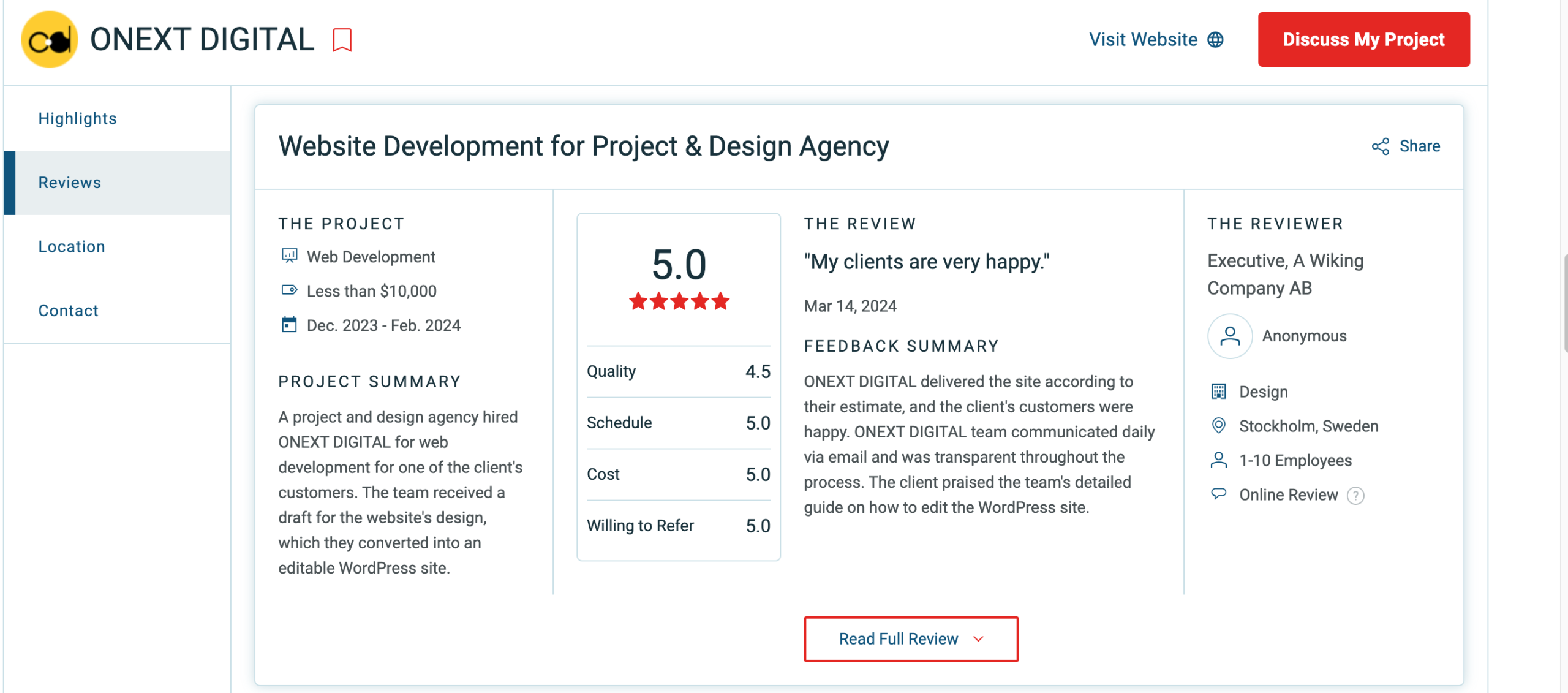
Read more about Onext’s Review on Clutch
- Client Testimonials and Reviews: Read client testimonials and reviews to gauge the company’s reputation and past performance. Satisfied clients are a strong indicator of a reliable development partner.
- Expertise and Experience: Look for companies with a proven track record in your specific industry or technology stack. Analyze their portfolio to assess their experience with projects similar to yours.
- Communication Style and Cultural Fit: Effective communication is paramount for a successful offshore partnership. Choose a company that demonstrates clear and transparent communication practices. Additionally, consider the cultural fit – look for a partner that understands your business practices and management style.
- Security and Quality Assurance Practices: Ensure the development company prioritizes data security and employs robust quality assurance practices to deliver high-quality and bug-free software.
4. Engaging in a Trial Project
Consider starting with a small, well-defined trial project before committing to a larger engagement. This allows you to assess the development team’s skills, communication style, and overall fit for your project.
By following these steps and conducting a thorough evaluation, you’ll be well-equipped to select the ideal Vietnamese development partner to translate your vision into a successful software product.
Conclusion
Vietnam’s offshore software development sector is entering a new phase of maturity and growth. With its combination of a skilled workforce, cost efficiency, and robust government support, the country is well-positioned to expand its role as a global IT outsourcing leader. By 2025, Vietnam will likely shift from being a cost-effective outsourcing destination to a hub for high-value, sustainable, and innovative tech services, further solidifying its place in the global technology landscape. Looking to enhance your Offshore Development Center (ODC) operations with top-tier talent and innovative solutions? Onext Digital is your trusted partner. Reach out to us today and discover how our global development teams and industry expertise can propel your business to new heights.