
 Services
 Solutions
 Main platform
 Technology
 White Label
  Offshore
 Hire developers



If you’re comparing ClickFunnels vs Shopify, you probably don’t need another feature by feature comparison. You already know both platforms can help you sell online. The real question is which one will make more sense once your business is actually up and running.
That’s where the difference becomes more important. Shopify is built around the store, while ClickFunnels is built around the funnel.
Shopify makes sense when customers need to browse products, compare options, add items to a cart, and come back to buy again. ClickFunnels takes a different approach. It’s a better fit when you already have a clear next step in mind, whether that’s getting someone to opt in, buy an offer, take an upsell, book a call, or enter a follow up sequence.
Neither approach is automatically better. The mistake is choosing one simply because it has more features, costs less each month, or has better reviews. Those things can matter, but they don’t tell you whether the platform fits the way your business actually operates.
A much better question is: How does your business actually make money?
Once you answer that, the choice between ClickFunnels and Shopify usually becomes a lot clearer. And that tells you much more than a feature comparison ever will.
ClickFunnels vs Shopify: What’s the Difference?
At first glance, ClickFunnels and Shopify can look pretty similar. Both let you sell online, take payments, build pages, and connect marketing tools. The difference becomes clearer when you look at how businesses actually use them.
Shopify is built more for running an ecommerce business from end to end. ClickFunnels puts more emphasis on the sales process, especially when you have a specific offer and want to guide visitors toward a particular action.
That doesn’t mean Shopify can’t build sales funnels or ClickFunnels can’t handle products. Both platforms have expanded well beyond what they were originally known for. The difference becomes more noticeable as your business starts putting more demands on the platform.
A Shopify store might start with ten products and eventually grow into hundreds or thousands of SKUs, multiple markets and sales channels, more complex inventory and shipping, customer accounts, subscriptions, B2B pricing, and a growing content operation.
ClickFunnels can become more complex too, but in a different direction. One offer might expand into several funnels, landing pages, upsells, email sequences, courses, memberships, appointments, and campaigns running at the same time.
Both platforms can grow with a business. The more important question is which direction your business is likely to grow in.
Quick comparison
| ClickFunnels | Shopify | |
|---|---|---|
| Built primarily for | Sales funnels | Ecommerce |
| Best suited to | Offers, campaigns and lead generation | Product based businesses |
| Product catalog | Good for simpler catalogs | Strong |
| Inventory | Available, but not the main focus | Strong |
| Sales funnels | Core strength | Possible with apps and customization |
| Landing pages | Core strength | Good |
| Upsells | Strong | Available |
| Ecommerce operations | Good | Strong |
| SEO | Suitable for landing pages and content | Strong ecommerce foundation |
| Marketing automation | Strong | Strong through native tools and apps |
| App ecosystem | Growing | Very large |
| Multichannel commerce | Available | Strong |
| Courses and digital products | Strong | Usually requires additional tools |
| Best fit | Funnel driven business | Commerce driven business |
The table gives you the quick overview. But if you’re trying to decide between the two, it helps to forget the feature list for a moment and look at the business itself.
The real difference
Take a business selling 300 skincare products. Customers might find it through Google, Instagram, email, or marketplaces. They browse categories, compare products, add several items to their cart, and may come back later to buy again.
The website has to handle much more than the sale itself. Products, inventory, orders, shipping, customers, and returns all need to work together. That’s the kind of operation Shopify is designed to support.
Now consider a business selling a $1,500 coaching program. Most customers come from Facebook ads. They land on a sales page, learn about the offer, watch a video, make a purchase, and may then see an upsell or receive a follow up if they don’t buy.
There may be only a few products, but the sales journey is much more important. The business wants control over what visitors see, what they’re offered next, and how leads are followed up. That’s where ClickFunnels fits more naturally.
Both businesses sell online, but they’re dealing with very different challenges. Saying that both platforms can sell products doesn’t tell you which one is the better fit.
If your business revolves around products, inventory, orders, and the day to day operation of a store, Shopify is usually the stronger foundation. If it revolves around a smaller number of offers, paid traffic, landing pages, upsells, and lead generation, ClickFunnels is likely to suit you better.
The real question is simple: what do you need the platform to handle most of the time?
ClickFunnels vs Shopify: Feature-by-Feature Comparison
Feature comparisons are useful, but they can also be a bit misleading. A platform may have a feature on paper and still be a poor fit for the way you actually run the business. So rather than going through a long checklist, it’s worth looking at what these features mean once you’re dealing with real customers, real traffic, and real operations.
Sales funnels
This is probably the area where ClickFunnels has the biggest advantage. The platform is designed around getting someone from the first click to a specific action, rather than sending them to a homepage and letting them decide where to go from there.
A typical funnel might look something like:
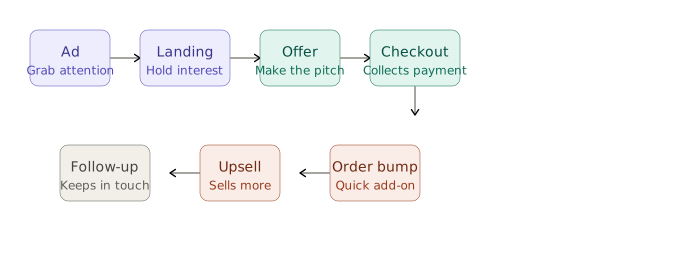
That’s a very different experience from a normal ecommerce store. Someone landing on a Shopify homepage might browse a category, look at several products, add a few things to the cart, leave, and come back later. With a funnel, the path is much more deliberate.
That’s useful when you have one main offer or a small number of offers and know roughly how you want people to move through the buying process. It’s common in coaching, courses, webinars, lead generation, high ticket products, digital products, and direct response campaigns. Agencies can also use this approach when they’re building dedicated campaigns for different clients or offers. We go into that use case in our guide to ClickFunnels for digital agencies.
Shopify can do funnel based selling as well. Landing pages, upsells, personalization, and marketing automation are all possible through Shopify’s own features, apps, and custom development. The difference is that creating a highly focused funnel can take more tools and more setup.
Verdict: ClickFunnels has the edge when the funnel is a major part of how you sell.
Ecommerce & product management
This is where Shopify becomes the more obvious choice.
Selling a product online isn’t particularly difficult. Managing a store with hundreds or thousands of products is a completely different problem.
As the catalog grows, you have to think about variants, inventory, collections, shipping, returns, discounts, customer accounts, warehouses, multiple sales channels, international markets, B2B customers, and possibly retail and POS. None of these things are especially exciting, but they become a big part of running an ecommerce business.
Shopify is designed to deal with that operational side of ecommerce. That’s one of its biggest strengths.
ClickFunnels can handle physical products, and there’s nothing wrong with using it for a small catalog, particularly if most of your sales come through funnels. Five products with a clear offer structure is a very different situation from 5,000 products with complex inventory and fulfillment requirements.
Once the store itself becomes complicated, Shopify tends to make more sense because product and order management are at the heart of the platform.
So the useful question isn’t whether ClickFunnels can sell products. It can. The question is how much of your day to day business is actually about running an ecommerce operation.
If that’s most of the business, Shopify is usually the better foundation.
Checkout & conversion
This is one of those areas where comparing the platforms by asking “which converts better?” doesn’t really get you anywhere.
ClickFunnels gives you more control over the buying journey. You can build a page around one offer, take the customer to checkout, add an order bump, show an upsell, and decide what happens next. If you have a specific journey in mind, that’s a useful level of control.
Shopify is designed for a different kind of shopping experience. Customers can browse products, compare options, add several items to their cart, use discounts, choose shipping, and come back to the store later. For a large ecommerce business, that flexibility is often more important than forcing everyone through the same path.
Think about the difference between buying a $1,000 coaching program and buying a pair of running shoes. The first customer may need a carefully structured sales process before they’re ready to buy. The second may want to look at ten different products, compare prices and reviews, and decide for themselves.
Neither approach is inherently better. It depends on how people buy what you’re selling.
If your business depends on a specific offer and a controlled sales journey, ClickFunnels is likely to suit you better. If customers need to browse a catalog and make their own choices, Shopify is usually the better fit.
Marketing automation
ClickFunnels is well suited to businesses where marketing follows a fairly direct path from traffic to conversion:
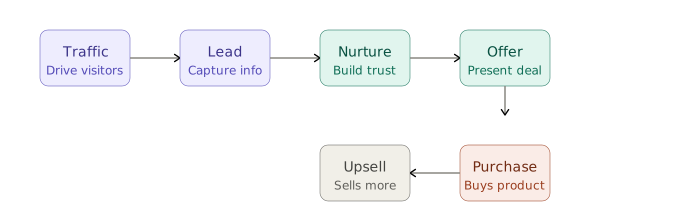
You can build the landing pages, create the funnel, run email campaigns, and automate follow ups in the same environment. For a business that is mainly trying to turn paid traffic or leads into sales, having those pieces close together can be convenient.
Shopify approaches marketing from the ecommerce side. Your marketing activity sits alongside products, customer data, orders, purchases, and retention. You can add apps for email marketing, automation, loyalty, subscriptions, analytics, and other needs as the business grows.
That difference matters more as the business gets bigger.
A coach sending Facebook traffic to one main offer may find ClickFunnels easier to work with. An ecommerce brand managing hundreds of products, repeat customers, several acquisition channels, and ongoing retention campaigns will probably benefit more from Shopify’s wider ecosystem.
So this isn’t really about which platform has “better automation.” It’s about what you need the automation to connect to.
SEO
For a typical ecommerce business, Shopify is generally the safer option.
It gives you control over the usual SEO basics, including title tags, meta descriptions, URLs, and image alt text, along with technical elements such as canonical tags, XML sitemaps, robots.txt, and SSL. Shopify’s SEO documentation
The bigger advantage is the way Shopify handles the structure of an ecommerce website. You can organize content around categories, products, buying guides, blog posts, and internal links, which gives you a solid foundation for building organic traffic over time.
ClickFunnels can certainly rank in search. A well built landing page targeting a specific search term can perform perfectly well. The difference becomes more noticeable when you start trying to build a large site with hundreds of products, multiple categories, and a substantial content library.
If organic search is a major acquisition channel, Shopify will generally be easier to work with.
But don’t choose a platform based on SEO alone. If most of your customers come from paid ads, email, referrals, or social media, the difference may not matter much to your business.
Integrations
Shopify’s large app ecosystem becomes particularly useful once an ecommerce business starts adding more systems. A growing store may need to connect with a CRM, ERP, accounting software, shipping and fulfillment tools, inventory management, customer support, email marketing, analytics, marketplaces, loyalty programs, subscriptions, or business intelligence.
Shopify gives you a lot of options for connecting these systems as the operation grows.
ClickFunnels supports integrations too, but its setup tends to stay closer to the funnel and marketing side of the business. For a relatively simple funnel, that’s not necessarily a limitation. In fact, keeping more of the process in one place can mean fewer tools to pay for and maintain.
That’s something worth keeping in mind when comparing the two. A longer list of integrations doesn’t automatically make a platform better. Every extra system adds another subscription, another connection to maintain, and another thing that can potentially go wrong.
For a complex ecommerce operation, Shopify will generally give you more flexibility. For a focused funnel where you don’t need a large technology stack, ClickFunnels may actually be the simpler setup.
ClickFunnels vs Shopify Pricing: Which Gives You Better Value?
Pricing is easy to oversimplify. Put two monthly prices side by side, see that one is cheaper, and it can seem like the obvious choice. But the subscription is only part of the cost. What you actually spend depends on what you need the platform to do and how many other tools you need alongside it.
ClickFunnels vs Shopify Pricing at a Glance
| ClickFunnels | Shopify | |
|---|---|---|
| Entry plan | $97/month | $39/month |
| Mid tier | $197/month | $105/month |
| Higher tier | $297/month | $399/month |
| Annual pricing | From $970/year | From $29/month, billed annually |
| Primary focus | Sales funnels and conversion | Ecommerce and online stores |
| Best for | Funnel driven businesses | Product based businesses |
Prices can change by region, billing cycle, and plan configuration, so check the official pricing pages before making a purchasing decision.
Looking only at the starting plans, Shopify is clearly cheaper. For a small business with a straightforward store, that lower price can be a real advantage. But costs can increase as the store becomes more complex.
Depending on the setup, you may need:
- Paid apps
- Premium themes
- Custom development
- Email and marketing tools
- Subscription software
- Advanced integrations
- Funnel and conversion tools
Not every store needs all of these, but the technology stack can grow as requirements become more specialized.
ClickFunnels costs more upfront, but more of its features are built around funnels and conversion, including landing pages, offers, upsells, email marketing, and related workflows. If those activities drive a large part of your revenue, having them in one platform can reduce the need for additional marketing tools.
It doesn’t replace every ecommerce system, though. Businesses with large catalogs, complex inventory, or fulfillment requirements may still need separate tools.
That’s why the monthly subscription doesn’t tell the whole story. A Shopify store may start at $39 but require additional apps and development over time. ClickFunnels may cost more but make sense if it replaces several funnel and marketing tools you would otherwise pay for.
For a straightforward ecommerce business, Shopify’s lower entry price and stronger store management make it a practical choice. For a funnel driven business built around paid traffic, specific offers, upsells, and conversion optimization, ClickFunnels may justify the higher cost.
The better comparison is the total cost of the setup your business actually needs, not just the platform’s monthly fee.
Which Is Better for Ecommerce?
Shopify is generally the better choice for ecommerce. Not because it has a longer list of ecommerce features, but because running an online store is what Shopify is built to handle.
That becomes more obvious as the business grows. You may start with a small catalog, but over time you’re likely to deal with product variants, inventory, shipping, multiple sales channels, international customers, B2B orders, SEO, and integrations with other systems. Shopify is designed to bring those pieces together.
ClickFunnels can still work for selling products, especially when you don’t really need a traditional online store. If you have a small number of offers and most of your sales come from a specific marketing campaign or sales journey, a funnel may be a better fit.
Take two businesses as an example.
Example 1: A fashion brand sells 800 products. Customers need to browse categories, filter by size and color, compare products, and decide what to put in their cart. Shopify is the more natural choice because the store itself is a big part of the customer experience.
Example 2: A business sells a $997 online course and gets most of its customers through YouTube ads and webinars. There isn’t much to browse. The goal is to take someone from the landing page to the offer, purchase, and possibly an upsell. In this case, ClickFunnels may be a better fit.
So the choice isn’t really about whether you’re selling physical or digital products. It’s about how people need to move from interest to purchase.
If customers need to browse and compare, Shopify usually makes more sense. If you already have a specific offer and want to guide people through a defined sales process, ClickFunnels is worth considering.
Which Is Better for Conversion?
If conversion is the main thing you’re trying to improve, ClickFunnels has a clear advantage. Its setup is designed to give visitors a defined path from the first click to the purchase and what happens next.
A typical funnel might look like:
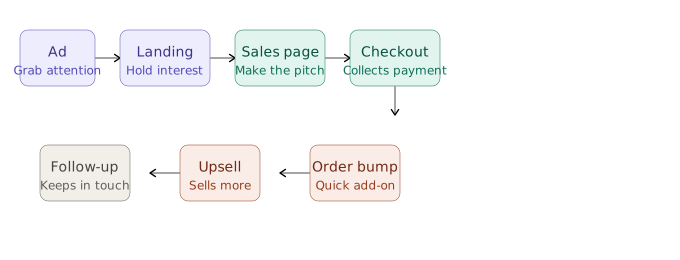
This can work particularly well for high margin offers, where improving conversion or average order value can have a direct impact on revenue.
But more funnel control doesn’t automatically mean more sales. It depends on how customers prefer to buy.
Take running shoes. A customer may want to compare brands, sizes, colors, reviews, and shipping options before deciding. A tightly controlled funnel could make that experience more frustrating.
A business coaching program is different. If you’re selling one $1,000 offer, customers don’t need to browse hundreds of products. They need to understand the offer, decide whether they trust it, and work out whether it’s worth the price. A focused funnel can make much more sense.
ClickFunnels tends to work better when you want to guide customers through a specific journey. Shopify is usually better when customers need the freedom to browse and compare.
The right choice isn’t about which platform has better conversion features. It’s about whether the buying experience fits the way your customers actually make decisions.
Which Is Better for SEO?
For long term ecommerce SEO, Shopify is generally the stronger choice. Its ecommerce structure gives you more ways to attract search traffic through different types of pages, including:
- Product pages
- Collection pages
- Blog posts and buying guides
- Comparison and educational content
That gives you more opportunities to target different search intents as the site grows. But Shopify won’t make your store rank on its own. You still need useful content, well optimized product pages, internal links, technical SEO, backlinks, and a site structure that makes sense.
ClickFunnels can work perfectly well for businesses that don’t rely heavily on organic search. If you’re a consultant spending $10,000 a month on paid advertising, for example, your funnel doesn’t need to rank for thousands of keywords. Its job is to turn the traffic you’re already paying for into leads and customers.
So saying Shopify is better for SEO doesn’t mean it’s the better platform for every business. It simply means that if organic search is an important long term acquisition channel, Shopify gives an ecommerce business a stronger foundation to build on.
Can You Use ClickFunnels and Shopify Together?
Yes. For some businesses, using ClickFunnels and Shopify together can be more practical than trying to make one platform handle everything. The idea is to let each platform do the job it’s better suited for.
For example:
Paid traffic → ClickFunnels landing page → Specific offer → Shopify → Store / Customer account / Repeat purchase
You could also keep Shopify as the main store and use ClickFunnels only for specific campaigns, such as a product launch, seasonal promotion, or high value offer.
In this setup, Shopify takes care of the broader ecommerce operation while ClickFunnels handles more focused campaigns and sales funnels. This can work well when each platform has a clear role.
The downside is that you’re also adding another system to manage. Depending on the setup, that may mean dealing with:
- Customer data
- Tracking and analytics
- Payments
- Integrations
- Domains
- Marketing automation
- Ongoing maintenance
For a simple business, that extra complexity may not be worth it. Running two platforms doesn’t automatically give you the best of both. It only makes sense when each one is solving a problem the other isn’t particularly good at handling.
Verdict: A hybrid setup can work well when Shopify is your core ecommerce platform and ClickFunnels is reserved for specific conversion focused campaigns.
ClickFunnels vs Shopify: Which One Should You Choose?
By this point, the choice should be fairly straightforward. You don’t need the platform with the longest feature list. You need the one that fits the way your business sells and the way your customers prefer to buy.
Choose Shopify if…
Shopify is probably the better fit if ecommerce is at the center of your business and you need a platform that can handle more than just the transaction. It’s a strong choice when you have:
- A large or growing product catalog
- Inventory, shipping, and fulfillment requirements
- Customers who need to browse and compare products
- Multiple sales channels or retail operations
- SEO as an important acquisition channel
- A need for POS or B2B functionality
- A growing need for integrations
In short, choose Shopify when running the store is the main challenge you’re trying to solve.
Choose ClickFunnels if…
ClickFunnels is worth considering when the business is built around a smaller number of offers and a more defined sales process. It can be a better fit if you:
- Sell high ticket products, courses, coaching, or digital products
- Rely heavily on paid traffic or lead generation
- Use webinars, launches, or campaign based selling
- Have upsells as an important part of your revenue
- Want to guide customers through a specific buying journey
In this case, ClickFunnels makes more sense when the focus is turning traffic and leads into customers.
Consider both if…
Using both platforms can make sense when Shopify already handles your store well, but you also run campaigns that benefit from dedicated funnels. This might include businesses with significant paid traffic, high value offers, or campaigns where you want to test a different buying experience without changing the main store.
Just keep in mind that a hybrid setup also means more systems to connect and maintain. If one platform can handle everything you actually need, keeping the setup simple is usually the better option.
The goal isn’t to use more software. It’s to have the right platform handling the right job.
What If You’re Already on Shopify?
If your Shopify store is already working, don’t migrate just because ClickFunnels has stronger funnel features. Moving platforms takes time and money, and it may not fix the problem you’re actually dealing with.
Start by identifying what’s not working:
- Conversion is low? Look at the customer journey, offer, and funnel.
- Landing pages underperform? Test the page and messaging before changing platforms.
- Checkout abandonment is high? Review pricing, shipping, payment options, and checkout.
- Organic traffic is declining? Check your SEO, content, and site structure.
- Campaigns are hard to manage? Review your marketing tools and automation.
The platform may not be the problem. A weak funnel won’t become effective simply by moving to ClickFunnels, just as rebuilding your store won’t make an unwanted product sell.
Migration can make sense when the business itself has changed. For example, a store that started with 50 products may eventually generate most of its revenue from one flagship offer through paid traffic. If the business now revolves around that offer rather than managing a traditional catalog, it’s worth reconsidering whether Shopify is still the right fit.
Make that decision based on how the business operates today, not on platform marketing claims.
Fix the business problem first. Choose the platform second.
The Real Cost of Switching Platforms
This is the part many ClickFunnels vs Shopify comparisons overlook. Migrating to another platform isn’t just a matter of rebuilding the homepage and moving your products across.
A proper Shopify migration means accounting for your existing data, URLs, SEO, integrations, and functionality before the new store goes live. Depending on the business, you may need to migrate or rebuild:
- Products, variants, customers, and orders
- Images, URLs, metadata, and blog content
- Redirects, analytics, and tracking
- Payment and email automation
- Third party integrations and custom functionality
SEO is one of the biggest risks. An established store may have hundreds or thousands of URLs with existing rankings, backlinks, and search history. Change those URLs without a proper migration plan, and you can launch a much better looking store while quietly losing organic traffic.
A proper migration should usually cover:
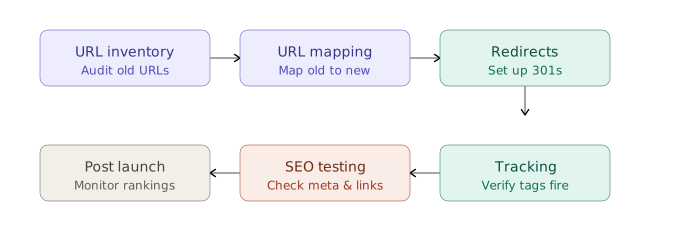
The same planning applies to customer and business data. You need to know what happens to existing orders, customer accounts, subscriptions, email sequences, tracking, and integrations that don’t have a direct replacement.
That’s why a platform migration is a technology project, not simply a design project. There’s also the risk of having to do it all again if the new platform turns out to be a poor fit.
The cheapest migration isn’t necessarily the one with the lowest development quote. It’s the one that gets you onto the right platform without creating an expensive second migration later.
Conclusion
Choosing between ClickFunnels and Shopify isn’t about picking the platform with the most features. It’s about finding the one that fits how your business actually sells.
Shopify is generally the stronger choice for running and growing an ecommerce store, while ClickFunnels makes more sense for businesses built around focused sales funnels and conversion. In some cases, using both can be a practical option.
If you’re still unsure, start with the business rather than the platform. Look at your products, customer journey, traffic sources, sales process, and where you’re currently losing revenue. The right technology should make those things easier to manage, not add another layer of complexity.
If you need help deciding between ClickFunnels, Shopify, or a combination of both, ONEXT DIGITAL can review your current setup and recommend the most practical approach, whether that means improving what you already have or moving to a different platform. Talk to our ecommerce experts to discuss your project.
FAQs
Is ClickFunnels better than Shopify?
Neither is universally better. ClickFunnels is stronger for funnel driven businesses, while Shopify is generally better for ecommerce with larger catalogs, inventory, SEO and broader commerce operations.
Can ClickFunnels replace Shopify?
Yes, for businesses with a small number of products, digital products, courses, coaching or high value offers. For large catalogs, complex inventory and broader ecommerce operations, Shopify is usually the better foundation.
Can you use ClickFunnels with Shopify?
Yes. Shopify can handle your main store while ClickFunnels runs specific sales funnels or campaigns. This works best when each platform has a clear role, although it adds integration and maintenance complexity.
Which is better for ecommerce and SEO?
Shopify is generally better for both ecommerce and ecommerce SEO. Its structure is designed for product catalogs, collections, content, inventory and broader store operations. ClickFunnels is more suitable when paid traffic and funnel conversion are the priority.
Is ClickFunnels good for selling physical products?
Yes, especially for a small product range where sales depend on paid traffic, offers, upsells or other funnel tactics. As catalog and operational complexity grow, Shopify usually becomes a better fit.
Should I migrate from Shopify to ClickFunnels?
Not necessarily. If the problem is conversion, landing pages or marketing automation, improve those areas first. Consider migration only when your business model has changed enough that your current ecommerce architecture no longer fits.