
 Services
 Solutions
 Main platform
 Technology
 White Label
  Offshore
 Hire developers




Ask any Australian CTO who has tried outsourcing software development and they will usually say the same thing: it is not code quality or technical skill that slows things down. It is communication. Messages sent in the afternoon get answered the next morning. Code reviews happen late at night because that is the only time both sides are online. Small issues sit for hours because the offshore team is simply offline.
Sound familiar. That is not really an outsourcing problem in general. It is a timezone problem. And in most cases, it comes down to one thing: the Australia Vietnam Timezone Overlap and whether your teams actually share enough working hours to get real work done together.
This is where Vietnam changes the experience for Australian teams. Most people focus on cost or talent, but in day to day delivery, it is the overlap that shapes everything. It decides whether work moves in real time or gets stretched across days.
The point of this article is simple. Break down the actual numbers, compare Vietnam with other common offshore locations, and show what a normal working setup looks like when the overlap is used properly.
The Australia Vietnam Timezone Gap: Numbers That Actually Matter
First, you need to understand where both sides sit on the clock.
Vietnam runs on Indochina Time (ICT): UTC+7. The important detail here is that Vietnam does not observe daylight saving time, this timezone is fixed year round and never changes.
Australia is different. The east coast of Australia (Sydney, Melbourne, Brisbane) operates on two different timezones depending on the season:
- AEST at UTC+10: applies from April to October (Australian winter)
- AEDT at UTC+11: applies from October to April (Australian summer, when daylight saving is active)
This means the daily overlap between working hours on both sides is:
- Australian winter (April to October): 4 hours of overlap, 9am to 1pm AEST lines up with 12pm to 5pm in Vietnam
- Australian summer (October to April): 3 hours of overlap, 9am to 12pm AEST lines up with 12pm to 3pm in Vietnam
In plain terms: when the Australian side starts their day at 9am, the Vietnam team is already in the middle of their afternoon with 3 to 4 hours of working day still ahead of them. Nobody stays up late. Nobody shifts their schedule.
Why Vietnam Stands Apart From Every Other Destination?
If you strip everything back and just look at how the working day actually lines up between Australia and each offshore location, the difference becomes pretty easy to see.
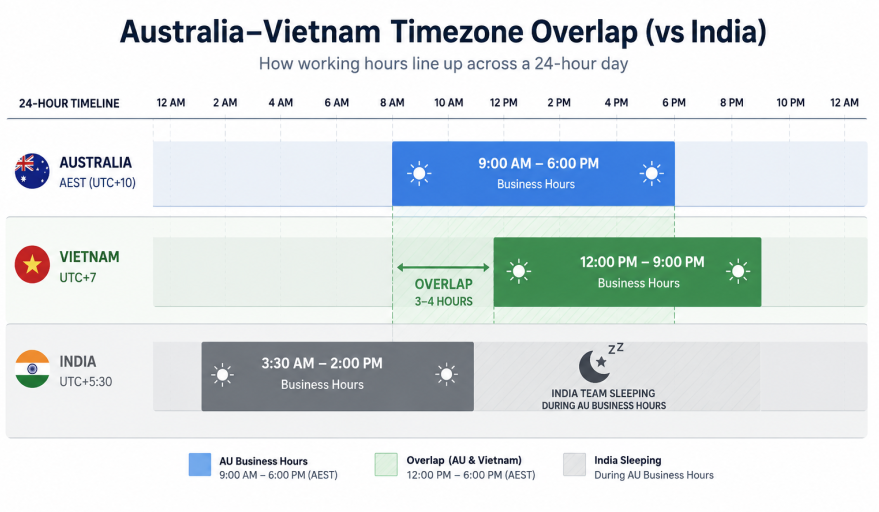
Here is a simple breakdown:
| Location | Timedifference | 9amAEST= | Meaning |
| Vietnam | UTC+7 | 12pm | 3 to 4 hours overlap |
| Philippines | UTC+8 | 11am | Around 3 hours overlap |
| India (Bangalore) | UTC+5:30 | 3:30am | Very little overlap |
| Eastern Europe | UTC+2 to +3 | 12am to 2am | No real overlap |
- India is still the most common offshore choice, but for Australian teams the problem shows up immediately in daily work. When it is 9am in Sydney, it is still very early in Bangalore. So real time conversation rarely happens. Most questions go one day out and come back the next. Over time, that slows everything down, even if the team is technically strong.
- Eastern Europe is worse for Australia because the working hours barely touch at all. When Australia starts the day, those teams are usually not online. So everything becomes async by default.
- The Philippines is closer to Vietnam and often put in the same bucket. It does give a usable overlap with Australia, usually a few hours in the middle of the day. That is enough for standups and quick checks, but still not enough if you need constant back and forth while building features.
- Vietnam is different in a practical way. The overlap sits right in the middle of the Australian workday, late morning into early afternoon. That is when teams actually need each other most, standups, blockers, reviews, quick decisions. Instead of waiting overnight, most issues get handled the same day.
So the real point is not just how many hours overlap. It is whether those hours fall at the time work actually happens.
That is why Vietnam tends to feel smoother for Australian teams once they start working in it.
What the 9am to 12pm AEST Overlap Is Actually Worth?
Knowing the numbers is one thing. But what are those 3 to 4 shared hours actually worth inside a working day?
The answer is: a lot, because these are not just any 3 to 4 hours. This is the start of the Australian working day, and it is precisely when the most important decisions happen:
- The morning standup is when the whole team gets aligned: who is working on what, who is stuck, what the priorities are for the day. Without real time overlap, you find out about yesterday’s problems tomorrow morning.
- Resolving blockers as they come up matters because in software development, blockers are often small but become expensive if they sit for hours. A developer waiting to clarify a requirement for eight hours has effectively lost an entire working day.
- Design decisions that need input from both sides cannot always be left as async messages. Some things require back and forth, follow up questions, and quick clarification. With real overlap, these conversations happen in the morning instead of dragging across two or three days of email threads.
- Code review that finishes the same day becomes realistic. Submit a pull request at 11:30am, the Vietnam team picks it up at 2:30pm their time, and feedback comes back before you close your laptop for the day.
All of these things without timezone alignment become bottlenecks. And with timezone alignment, they feel as natural as working with a team in the same building.
What a Real Working Day Actually Looks Like?
Here is a concrete example of an ordinary day when an Australian team is working alongside a Vietnam team:
- 9:00am AEST / 12:00pm Vietnam
The Vietnam team joins the Zoom call at the start of their afternoon. They are alert, mid workday, not dragged out of bed at midnight. Everyone gives a quick progress update, raises any blockers, and confirms their tasks for the day. The meeting wraps in 15 minutes.
- 10:00am AEST / 1:00pm Vietnam
A developer on the Australian side is building a feature and runs into uncertainty about how a specific API is supposed to behave. They send a message in Slack. The senior developer in Vietnam currently in their afternoon work session replies within 8 minutes with a clarifying question and a proposed approach. The issue is resolved before it ever becomes a blocker.
- 11:30am AEST / 2:30pm Vietnam
A feature needs to be reviewed and pushed to staging before end of day. The pull request is submitted at 11:30am. The QA lead in Vietnam picks it up immediately, they are in the middle of their afternoon, which tends to be their most focused stretch of the day. The review is done within an hour.
- 1:00pm AEST / 4:00pm Vietnam
The Australian side moves into their afternoon meetings. The Vietnam team continues development until end of their working day at 6pm Vietnam time, which is 3pm AEST. No further coordination needed. Both sides do deep focused work for the rest of their respective days.
- 4:00pm AEST
When the Australian team comes out of their afternoon meetings, the feature review is done. Two minor issues have been noted with suggested fixes already attached. Ready to merge. Work has moved forward.
- 5:30pm AEST
You log off. The Vietnam team finished their shift at 6pm their time. Nobody worked overtime. Nobody stayed up late.
This is not an idealised scenario. This is the workflow Australian clients describe after two to four weeks of working together.
A Practical Sprint Schedule for Australian and Vietnam Teams
The structure below is designed to make the most of the overlap window while protecting enough uninterrupted time for both teams to do deep work without constant interruption.
- Monday: Sprint Planning
The start of the week is when the most alignment is needed. Use the full morning overlap for planning:
| AEST | VietnamTime | What happens |
| 9:00am | 12:00pm | Sprint planning full team, 45 minutes. Confirm scope, priorities, and who owns what. |
| 9:45am | 12:45pm | Sprint board updated, everyone clear on what they are building this week. |
| From 10am | Afternoon | Both teams work independently for the rest of the day. |
After the planning session, both teams know exactly what they are doing for the week. No need for back and forth questions throughout the day.
- Tuesday to Thursday: Development Days
The middle three days are for building. Standups are short, everything else is focused work time:
| AEST | VietnamTime | What happens |
| 9:00am | 12:00pm | Daily standup 15 minutes. Progress, blockers, today’s tasks. |
| 9:15am | 12:15pm | Australian side processes any async messages sent overnight by Vietnam. |
| All day | Afternoon | Both teams work independently. |
| 2:00pm | 5:00pm | Last real time window for quick questions before Vietnam end of day. |
One important note: a 15 minute standup is enough for a normal day. If something bigger needs discussion, schedule a separate call rather than letting the standup expand. A standup that regularly runs long becomes a drag on everyone’s morning.
- Friday: Sprint Review and Retrospective
The end of the sprint is for looking back and setting up the next one:
| AEST | VietnamTime | What happens |
| 9:00am | 12:00pm | Sprint review and demo 30 minutes. Vietnam team walks through what shipped. |
| 9:30am | 12:30pm | Retrospective 20 minutes. What worked, what needs to change. |
| Rest of day | Afternoon | Documentation, small cleanups, preparation for the next sprint. |
The whole week has no meeting longer than 45 minutes and no meeting outside the overlap window. That is what makes this schedule sustainable in the long run, not just for the first few weeks.
A Note for Teams Based in Perth
Perth operates on AWST at UTC+8, which puts it only one hour ahead of Vietnam rather than three or four hours like Sydney and Melbourne. That means less overlap:
- Australian summer: roughly 1 to 2 hours of shared working time per day
- Australian winter: roughly 2 to 3 hours of shared working time per day
Less than Sydney, but still significantly better than India. When Perth is at 9am, Bangalore is at 6:30am barely more overlap than no overlap at all.
For Perth based teams, the recommendation is to build the day around one real time touchpoint at 9am to 10am AWST, which lands at 12pm to 1pm in Vietnam. Just a short standup, but enough to sync up and clear any blockers. The rest of the day runs asynchronously, which works fine as long as both sides develop the habit of leaving clear written context in every message rather than assuming the other side will chase them for details.
Why Most Australian Founders Are Surprised?
The most common expectation going in is: “offshore means async, delays are just part of the deal.” That expectation comes from real experience. With India or Eastern Europe, timezone lag is a genuine problem with no fix. Working that way feels like a slow game of tennis where you hit the ball across overnight and wait until morning to see where it lands.
Vietnam feels completely different. Not because Vietnamese engineers are technically superior to those in India or Eastern Europe, but simply because they are working during the same part of the day as you are.
That difference becomes obvious within the first five to ten working days. And when it does, the most common reaction is: “Why did nobody tell me this before I tried the other options?”
The Bottom Line: Timezone Is No Longer a Reason to Hesitate
If you are considering offshore development and timezone differences are on your list of concerns, that hesitation is understandable. It usually comes from real experience working with teams where communication delays are unavoidable and progress feels out of sync.
But that experience is not universal.
With the right setup, timezone stops being a barrier and becomes a coordination advantage. Instead of waiting an entire day for updates, teams can overlap working hours, resolve issues faster, and keep development moving continuously rather than in isolated blocks. The difference is not just speed, but how predictable the workflow becomes.
What matters more than geography is how the team is structured, how communication is handled, and whether there is enough overlap to keep momentum during critical hours.
If you are exploring offshore development and want to see how a properly structured team can reduce delay, improve delivery speed, and keep communication consistent, it is worth having a direct conversation before making assumptions based on past experiences.
If you want, you can reach out to ONEXT DIGITAL and we can walk through what a realistic setup would look like for your team and workflow.
FAQs
What is the Australia Vietnam Timezone Overlap?
The Australia Vietnam Timezone Overlap refers to the shared working hours between Australia (AEST/AEDT) and Vietnam (UTC+7), typically ranging from 3 to 4 hours per day depending on daylight saving time.
How many hours do Australia and Vietnam actually overlap for work?
Australia and Vietnam share around 3 to 4 hours of overlap daily. During Australian winter (AEST), the overlap is about 4 hours, and during Australian summer (AEDT), it is about 3 hours.
Why is timezone overlap important in offshore software development?
Timezone overlap is important because it enables real-time communication, faster decision-making, quicker code reviews, and immediate blocker resolution instead of waiting overnight for responses.
How is Vietnam different from India or Eastern Europe for outsourcing?
Vietnam offers a practical daytime overlap with Australian working hours, while India and Eastern Europe have minimal or no meaningful overlap, making real-time collaboration much slower.
What does a typical working day look like between Australia and Vietnam teams?
A typical day includes a shared morning standup, real-time problem solving during overlap hours, same-day code reviews, and independent work outside overlap periods, allowing continuous progress.
Can offshore development work effectively without full-day overlap?
Yes, but productivity improves significantly when there is meaningful overlap. Even 3–4 shared hours can remove communication delays and make offshore collaboration feel more like in-house teamwork.