
 Services
 Solutions
 Main platform
 Technology
 White Label
  Offshore
 Hire developers



E-commerce businesses are dealing with more products, more customer data, and higher customer expectations than ever. Customers want to find what they need quickly, get answers without waiting, and see recommendations that are actually relevant to them.
This is where AI is starting to play a bigger role. Businesses are using it for product recommendations, search, customer service, content, demand forecasting, inventory, pricing, fraud detection, and more. Generative AI and AI agents are also being used across sales, marketing, and daily operations.
But not every AI use case makes sense for every e-commerce business. The real challenge is knowing where AI can make a useful difference. In this article, we look at 15 practical AI use cases in e-commerce and how businesses are using them.
What is AI in e-commerce?

AI in e-commerce is the use of AI to help businesses understand customers, products, and business data, then use that information to make better decisions or automate tasks.
Unlike traditional e-commerce systems that mainly follow predefined rules, AI can identify patterns in customer behaviour, product data, and past transactions. It can use these patterns to recommend products, predict demand, understand search queries, or generate content.
For example, an online store might recommend products based on what a customer has viewed or purchased. A B2B seller with thousands of products could use AI to forecast demand or help customers find products that meet specific technical requirements.
AI can be applied across many areas of e-commerce, including search, recommendations, customer service, marketing, pricing, and inventory.
How is AI being used in e-commerce?
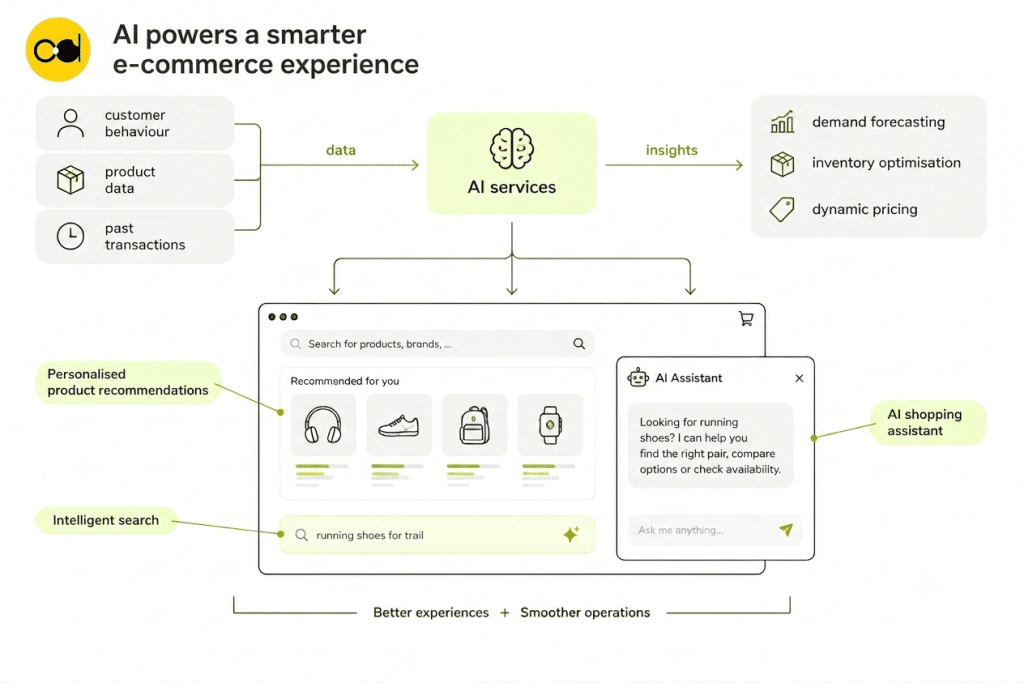
AI is used in e-commerce to personalise customer experiences, improve product discovery, automate routine tasks, and support better sales and operational decisions. Common applications include product recommendations, intelligent search, AI shopping assistants, customer service, demand forecasting, inventory management, pricing, fraud detection, and marketing.
These use cases cover both customer-facing experiences and behind-the-scenes operations. For example, AI can help shoppers find relevant products faster while helping e-commerce teams forecast demand or create product content at scale.
Some of the most common AI use cases in e-commerce include:
- Personalised product recommendations
- Intelligent search and product discovery
- AI shopping assistants
- Product content creation
- AI-powered customer service
- Demand forecasting
- Inventory optimisation
- Dynamic pricing
- Customer segmentation
- Marketing personalisation
- Fraud detection
- Visual search
- Automated product categorisation
- Customer churn prediction
- AI agents for e-commerce operations
Businesses do not need to use all of these. A practical starting point is usually one specific problem, such as improving product discovery, reducing manual work, or forecasting demand.
15 AI Use Cases in E-commerce
1. Personalised product recommendations
AI-powered product recommendations use customer and product data to suggest products that are more relevant to each shopper. The system can consider signals such as browsing behaviour, previous purchases, product attributes, and items viewed to decide what to recommend.
For a fashion retailer, AI might suggest products based on what a customer has bought or recently viewed. In B2B e-commerce, recommendations can be more specific, such as suggesting compatible parts, accessories, replacement items, or products that are often bought together.
This can help customers discover products they may not have found on their own, while giving businesses more opportunities to cross-sell and upsell. Because recommendations can be adjusted automatically based on new customer and product data, the same approach can also be used across a large catalogue and customer base.
2. Intelligent search and product discovery
AI-powered search helps shoppers find relevant products by understanding the meaning and intent behind their search, rather than relying only on exact keyword matches.
This becomes more useful as an e-commerce catalogue grows. A customer may know what they need without knowing the exact product name or terminology used by the seller.
For example, someone might search for:
“lightweight waterproof jacket for winter hiking”
Instead of matching these words individually, an AI-powered search system can interpret the query as a combination of product type, use case, weight, and weather resistance. It can then return relevant products even if the product titles do not contain the exact wording used in the search.
This is particularly useful for businesses with large or technical catalogues. Customers can describe what they need in their own words, while the search system works out which products are the closest match.
3. AI shopping assistants
AI shopping assistants help customers find and compare products by letting them ask questions in natural language. Instead of browsing through filters and categories, shoppers can describe what they need and ask follow-up questions as they go.
For example:
“I need a laptop for software development, preferably with at least 32GB of RAM and a budget of $2,000.”
The assistant can use product data to suggest suitable options, explain the differences, and help the customer narrow down the choices.
For B2B e-commerce, the questions can be more specific. Buyers may need to check technical specifications, product compatibility, stock availability, documentation, or account-specific pricing before placing an order.
The quality of the answers depends heavily on the data behind the assistant. It needs reliable information from sources such as the product catalogue, inventory, pricing, or CRM. In many cases, connecting the assistant to these sources is more important than simply using a more powerful language model.
4. Automated product content creation
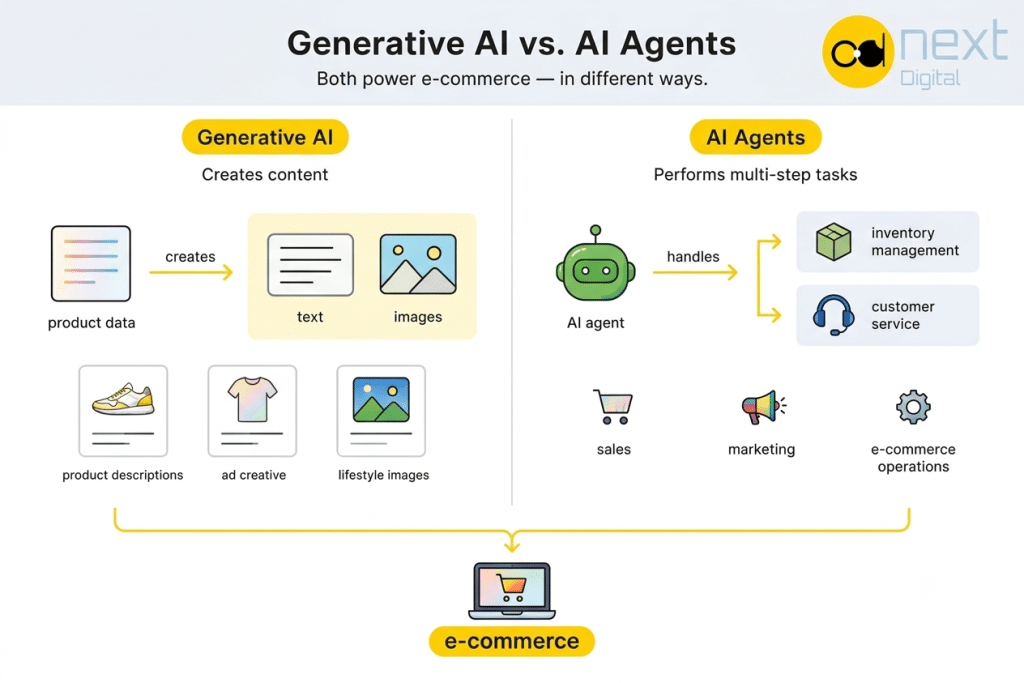
Generative AI can help e-commerce businesses create and update product content at scale using information from their product catalogue. This is particularly useful when a business has thousands of products and needs to manage descriptions, specifications, metadata, or content for different markets.
Common uses include:
- Product descriptions
- Product summaries
- Category descriptions
- SEO metadata
- Email copy
- Advertising variations
- Product translations
- Internal product documentation
For example, a business can provide structured product data and content guidelines, then use AI to create a first draft for each product. The same information can also be adapted for different formats, languages, or markets.
AI-generated content still needs human review, especially when it includes technical specifications, compatibility, pricing, safety information, or other factual details. In practice, AI is often most useful for handling the repetitive drafting work, while people check the information and approve the final content.
5. AI-powered customer service
AI can handle routine customer service questions, such as order status, product availability, returns, and basic product enquiries. This can reduce the amount of repetitive work handled manually by support teams.
An AI assistant can respond immediately and, when connected to systems such as order management, CRM, and product data, give customers more specific answers than a basic chatbot with a fixed set of responses.
For example, instead of simply telling a customer that an order is “being processed”, the assistant could check the order system and explain its current status.
AI does not have to replace human support agents. A common approach is to let it handle straightforward enquiries and pass more complex cases to a human, along with the conversation history and relevant customer information.
6. Demand forecasting
AI can use historical sales, seasonality, promotions, customer behaviour, and other data to estimate future product demand. This helps e-commerce businesses make better decisions about purchasing, inventory, and stock levels.
For example, an online retailer could analyse previous sales to identify products that are likely to become more popular during a particular period. The business can then adjust purchasing and inventory plans before demand increases.
More accurate forecasts can help reduce stockouts and excess inventory. They can also support production planning, warehouse management, and purchasing.
But forecasting is not a crystal ball. Unexpected market changes, supply disruptions, major promotions, or changes in customer behaviour can still affect the results. The quality of the data also has a direct impact on how useful the forecast is.
7. Inventory optimisation
AI can help e-commerce businesses decide how much stock to keep, when to reorder, and where inventory should be allocated. It can analyse sales velocity, current stock levels, supplier lead times, historical demand, and other operational data to identify potential inventory problems.
For example, if a product is selling faster than expected and the next shipment is still several weeks away, AI can flag the risk of a stockout early. The business can then review its replenishment plan before the product runs out.
Depending on the operation, AI can also support decisions around reorder points, safety stock, inventory allocation, slow-moving products, and warehouse planning.
For businesses managing thousands of SKUs, this can reduce the amount of manual analysis required from inventory and operations teams.
8. Dynamic pricing
AI can help e-commerce businesses adjust or recommend prices based on factors such as demand, inventory, competitor prices, sales performance, and customer behaviour.
This can be useful when a business manages a large catalogue across different markets, customer segments, or sales channels. In B2B e-commerce, pricing can be more complicated because it may also depend on order volume, contract terms, negotiated discounts, account type, or location.
For example, if demand for a product is rising while available stock is falling, an AI system could flag the change and recommend a price adjustment based on the business’s pricing rules.
AI does not have to control pricing on its own. Many businesses use it to make recommendations while keeping pricing rules, approval limits, and human review in place.
9. Customer segmentation
AI can analyse customer data to identify groups of shoppers with similar purchasing behaviour, preferences, or engagement patterns. It can look at signals such as purchase history, browsing activity, order frequency, product preferences, and changes in buying behaviour.
For example, a business might identify a group of high-value repeat customers, another that mainly shops during promotions, and another whose purchasing activity has recently declined.
These segments can then be used to improve marketing campaigns, product recommendations, promotions, and customer retention efforts.
Unlike fixed segments created manually, AI can update these groups as customer behaviour changes. This can help businesses spot new patterns without having to review the data and redefine every segment themselves.
10. Marketing personalisation
AI can help e-commerce businesses personalise marketing by choosing products, content, offers, or messages that are more relevant to individual customers. It can use signals such as browsing behaviour, purchase history, product preferences, and engagement to decide what to show or send.
This can be used across email campaigns, website content, promotions, audience targeting, and customer journeys.
For example, someone who repeatedly views products in one category but has never purchased may need a different message from a long-term customer who regularly buys from that category.
The goal is not simply to send more messages. It is to make the messages and offers customers receive more relevant to what they are actually interested in.
11. Fraud detection and payment risk
AI can help e-commerce businesses detect potentially fraudulent transactions by analysing transaction patterns and looking for unusual behaviour. Signals can include unusually large orders, sudden changes in buying behaviour, repeated transactions, or other patterns associated with suspicious activity.
Machine learning is useful for this because it can analyse large numbers of transactions and identify patterns that would be difficult to spot manually.
For example, a transaction may look unusual because its value is much higher than a customer’s normal orders or because several purchases are made in a short period. The system can flag the transaction for further checks rather than automatically treating it as fraud.
False positives are an important part of the problem. Blocking a legitimate customer can be just as frustrating as missing a fraudulent transaction, so fraud models need to be monitored and adjusted as customer and transaction patterns change.
12. Visual search
AI-powered visual search lets customers find products by uploading an image instead of typing a search query. This can be useful when shoppers know what a product looks like but do not know its name or the right keywords to describe it.
Computer vision can analyse characteristics such as shape, colour, pattern, style, and other visual features to find similar products in the catalogue.
For example, a customer could upload a photo of a chair they like and receive similar products available from the retailer. The same approach can work for fashion, furniture, homeware, automotive parts, and other product categories where appearance matters.
This gives customers another way to find products, especially when describing what they want in words would be difficult.
13. Automated product categorisation and tagging
AI can automatically classify products and extract product attributes from information such as names, descriptions, specifications, and images. This is useful when catalogue data comes from different suppliers or has been collected over many years and is not consistent.
For example, one supplier might call a product a “running shoe”, another might use “athletic footwear”, while the internal catalogue follows a different naming convention. AI can help map these products into a consistent structure, such as:
Electronics → Computers → Laptops
It can also extract details such as screen size, processor, RAM, storage, and operating system from the available product information.
This can reduce manual catalogue work and improve search, filtering, and product discovery. For products where incorrect information could affect a purchase decision, human review should still be part of the process.
14. Customer churn prediction
AI can help e-commerce businesses identify customers who may be becoming less engaged by analysing changes in their purchasing and online behaviour. This can include purchase frequency, order value, website activity, product interests, and customer interactions.
For example, a customer who used to place an order every month but has not purchased anything for several months may be showing a change in behaviour. An AI model can flag the change so the business can decide whether a retention action is worth taking.
The goal is not to predict exactly which customers will stop buying. It is to spot changes early enough for the business to decide whether it should take action.
15. AI agents for e-commerce operations
AI agents can handle a sequence of e-commerce tasks by retrieving information, analysing it, and taking actions across connected systems. Unlike a traditional chatbot that mainly answers questions, an agent can work through several steps to complete a task.
For example, an operations manager might ask:
“Check our top-selling products in this category, identify anything at risk of running out of stock, and prepare a replenishment report.”
An AI agent could retrieve data from inventory and sales systems, analyse the results, and prepare the report without requiring someone to perform each step manually.
Depending on the systems it can access, an agent could also support product research, customer service, order management, inventory monitoring, marketing tasks, catalogue management, sales assistance, and internal reporting.
The more access an agent has, the more carefully it needs to be controlled. Before connecting an agent to production systems, businesses should consider authentication, permissions, data validation, logging, monitoring, and when human approval is required.
How do you implement AI in an existing e-commerce platform?
In many cases, businesses can add AI to an existing e-commerce platform without rebuilding the website from scratch. The existing frontend, backend, APIs, databases, CRM, ERP, and commerce platform can stay in place, with an additional AI layer connecting the relevant data and services.
A simplified setup might look like:
Existing e-commerce platform → Data and integration layer → AI services → AI application → Customer or employee interface
For example, an AI recommendation feature could use product data and customer behaviour to generate recommendations, then display them through the existing website.
An AI customer service assistant could connect to product data, order information, and CRM records to answer customer questions while leaving the underlying commerce platform unchanged.
The exact architecture depends on the use case and existing technology stack. In most projects, the practical approach is to add AI where it solves a specific problem rather than rebuild the entire platform around it.
How should a business start implementing AI in e-commerce?
A good way to start implementing AI in e-commerce is to begin with a specific business problem, check whether the right data is available, then test a focused use case before scaling it further. This helps the business avoid investing in AI before it is clear what the technology is supposed to improve.
1. Define the problem first
Start with the problem, rather than the AI technology. Look at the parts of the business that are taking too much time, costing too much money, or creating a poor customer experience. Customers might be struggling to find the right products, support teams may be answering the same questions every day, or inventory forecasts may be unreliable. Product content may also take too much manual work to create and update.
Once the problem is clear, it becomes easier to decide whether AI is actually useful and what type of solution would fit the situation.
2. Check the available data
Next, look at the data needed for the use case. Depending on the project, this might include product information, customer profiles, order history, browsing behaviour, inventory, pricing, CRM records, or internal documents.
The goal is not to collect as much data as possible. What matters is whether the relevant data is accurate, accessible, consistent, and up to date. If important information is spread across different systems or contains a lot of errors, those issues may need to be addressed before the AI system can produce reliable results.
3. Choose the right AI approach
Different problems call for different types of AI. A recommendation engine may be suitable for product personalisation, while a predictive model could be a better fit for demand forecasting. Semantic search can help with product discovery, while generative AI combined with retrieval can support a product knowledge assistant.
There is no need to use generative AI simply because it is widely available. The technology should fit the problem, the available data, and the way the business already operates.
4. Start with a focused pilot
Rather than trying to introduce AI across the whole business at once, start with one use case that can be tested and measured. A retailer, for example, could test AI recommendations for one product category before expanding them across the catalogue. A B2B e-commerce business might start an AI assistant with a limited set of product documentation and common customer questions.
A smaller pilot makes it easier to identify problems with data, integrations, accuracy, user experience, and cost before investing in a wider rollout. It also gives the team a clearer idea of whether the use case is worth expanding.
5. Measure the results
Decide how you will measure the pilot before launching it. The right metrics depend on the use case and could include conversion rate, average order value, search success rate, customer service resolution time, customer satisfaction, stockout rate, inventory turnover, content production time, or operational cost.
AI also needs ongoing monitoring after launch because products, customer behaviour, and business requirements change over time. Regular testing and review can help identify when the system needs to be updated, retrained, or adjusted.
The goal is not to add AI for its own sake. It is to solve a specific business problem, measure whether the solution actually helps, and expand it when the results justify doing so.
What data does AI need for e-commerce?
The data AI needs in e-commerce depends on the use case, but it commonly includes product, customer, transaction, behavioural, inventory, pricing, and operational data. A recommendation system, for example, needs different information from a fraud detection model or an AI shopping assistant.
The table below shows some of the most common data requirements for different e-commerce AI use cases:
| AI use case | Typical data requirements |
|---|---|
| Product recommendations | Purchase history, browsing behaviour, product attributes |
| Intelligent search | Product catalogue, search queries, product attributes |
| Demand forecasting | Historical sales, seasonality, promotions, inventory |
| Dynamic pricing | Pricing history, demand, inventory, sales |
| Customer service | Product data, orders, policies, CRM information |
| Fraud detection | Transaction history, payment and account activity |
| Churn prediction | Purchase history, engagement, customer activity |
| Visual search | Product images and product metadata |
| AI shopping assistant | Product catalogue, documentation, pricing, availability |
| AI agents | Business data, APIs, system permissions, workflow information |
Having more data does not automatically make an AI system better. What matters is whether the relevant data is accurate, consistent, accessible, and available when the system needs it. For example, an AI shopping assistant may give unreliable answers if product information or pricing is out of date, even if the business has a large amount of customer data.
The way the data is stored also matters. E-commerce businesses often have information spread across the website, ERP, CRM, inventory system, product information management system, and other tools. Connecting these sources properly can be just as important as choosing the AI model itself.
What are the risks of using AI in e-commerce?
The main risks of using AI in e-commerce include inaccurate information, data privacy issues, security vulnerabilities, poor recommendations, and making decisions too dependent on automation. The level of risk depends on what the AI system does and how closely it is connected to customer, product, payment, or business systems.
Inaccurate information
Generative AI can produce answers that sound convincing even when the information is wrong. This can become a serious problem when an AI system provides product specifications, pricing, compatibility information, return policies, or other details that customers rely on when making a purchase.
Connecting the AI system to trusted business data can reduce the chance of outdated or incorrect answers. Important outputs should also be validated, particularly when the information could affect a customer’s purchase or a business decision.
Data privacy
E-commerce systems often contain customer profiles, purchase histories, contact details, and other information that needs to be protected. Businesses therefore need to consider what data the AI system can access, where that data is stored, how long it is retained, and who can use it.
Data should only be made available to the AI system when it is needed for the specific use case. Clear access controls and appropriate data handling practices are important, particularly when AI is connected to customer or internal business systems.
Security
An AI application connected to business systems creates additional security considerations. This is especially important when an AI assistant or agent can access customer data, internal documents, APIs, or production systems.
Authentication, permissions, input validation, logging, monitoring, and protections against threats such as prompt injection should be considered as part of the architecture from the beginning. The more actions an AI system can take, the more carefully those permissions need to be controlled.
Poor recommendations and predictions
AI systems depend heavily on the quality of the data they use. If product information is incomplete, customer behaviour is poorly recorded, or historical data does not reflect current buying patterns, the system may produce irrelevant recommendations or unreliable predictions.
This is why testing and ongoing evaluation matter. A model that worked well when it was first deployed may need to be adjusted as products, customers, and market conditions change.
Too much automation
Not every e-commerce decision should be handed over to AI. Pricing changes, refunds, financial decisions, account actions, and other high-impact decisions may require approval rules or human review.
AI can handle many routine tasks, but businesses still need clear boundaries around what the system can decide and what requires a person to step in. In practice, controlled automation is often more useful than giving an AI system unrestricted control.
AI in B2B vs B2C e-commerce: What’s the difference?
The main difference is that B2C AI often focuses on helping individual shoppers discover products and make faster purchases, while B2B AI usually needs to support more complex buying processes, pricing, products, and business systems. The same AI technologies can be used in both models, but the data, integrations, and business rules behind them can be quite different.
| Area | B2C e-commerce | B2B e-commerce |
|---|---|---|
| Buying process | Often shorter | Often longer and more complex |
| Pricing | Generally more standardised | May vary by account, contract, or volume |
| Products | Usually consumer-oriented | Often technical or specialised |
| Customer data | Individual shoppers | Companies, accounts, and buying groups |
| Orders | Often smaller | Often larger and recurring |
| Common AI applications | Recommendations, search, personalisation | Forecasting, pricing, product discovery, sales assistance |
| Key integrations | Commerce, marketing, payment | Commerce, CRM, ERP, inventory, procurement |
In B2C e-commerce, AI is often used directly in the customer journey. Recommendations can help shoppers discover products, intelligent search can make it easier to find what they need, and personalisation can tailor the experience based on browsing and purchase behaviour.
B2B use cases often involve more business data and more complicated rules. A buyer may need to check technical specifications, account-specific pricing, stock availability, previous orders, product compatibility, or contract terms before placing an order. AI therefore needs to work with information beyond the storefront.
For example, a B2B AI assistant may need to connect the e-commerce platform with product information, CRM records, ERP data, inventory, pricing rules, and procurement workflows before it can give a useful answer.
This makes integration particularly important in B2B e-commerce. The AI model is only one part of the system; the quality and accessibility of the business data behind it can have just as much impact on the result.
How much does AI in e-commerce cost?
The cost of implementing AI in e-commerce can range from a relatively small integration using an existing AI API to a much larger custom system connected to multiple business platforms. There is no single price that applies to every project because the cost depends on what the AI needs to do, what data it needs to access, and how closely it needs to integrate with the existing e-commerce infrastructure.
For example, adding an AI-powered product assistant using an existing AI service and a limited product catalogue is generally a simpler project than building a custom system that connects to an ERP, CRM, inventory platform, product database, and multiple customer channels.
The main factors that affect the cost include:
- Use case complexity: A simple content-generation feature is different from an AI agent that can take actions across business systems.
- Data preparation: Cleaning, structuring, and connecting product, customer, or operational data can require significant development work.
- Existing architecture: The technology stack and condition of the current e-commerce platform can affect how easily AI can be added.
- Integrations: Connecting AI to APIs, CRM, ERP, inventory, payment, or other systems adds development and testing work.
- AI model or service: Costs can vary depending on whether the project uses an existing API, an open-source model, or a more customised approach.
- Custom development: Features built specifically for a business usually require more development than using an off-the-shelf AI service.
- Security and access controls: Systems handling customer or business data may need additional authentication, permissions, and security measures.
- Testing and monitoring: AI systems need testing for accuracy, reliability, and unexpected behaviour, both before and after launch.
- Infrastructure and ongoing usage: Hosting, API calls, storage, monitoring, and model usage can create ongoing costs after the initial implementation.
Because of these differences, it is usually more useful to estimate the cost after defining the use case, data requirements, integrations, and technical architecture. A generic price for “AI development” can be misleading if the scope has not been defined yet.
Final thoughts
AI can be useful in e-commerce, but adding an AI chatbot or generating more content does not automatically make a business better. It needs to do something useful, whether that is helping customers find products, reducing repetitive support work, improving demand forecasts, or making a large catalogue easier to manage.
There is also no need to rebuild an entire e-commerce platform just to add AI. Existing websites, databases, CRM, ERP, and other systems can often stay in place. AI can be added to the parts of the business where it can make a real difference, such as search, recommendations, customer service, forecasting, or content management.
The best place to start is usually one problem rather than a long list of AI features. Look at the data available, choose an approach that fits the problem, test it on a smaller scale, and see what actually changes. If the results are useful, the same approach can then be expanded to other parts of the business.
If you need help connecting AI with an existing e-commerce platform or building new AI-powered features, ONEXT DIGITAL works with businesses on e-commerce development, system integration, and custom AI development.
FAQs
What are the most common AI use cases in e-commerce?
Common AI use cases in e-commerce include product recommendations, smarter search, AI shopping assistants, customer service, demand forecasting, inventory management, dynamic pricing, fraud detection, visual search, and product content creation. Businesses can also use AI for customer segmentation, marketing personalisation, churn prediction, and automating tasks with AI agents.
How does AI improve product discovery in e-commerce?
AI helps shoppers find relevant products by understanding search intent, customer preferences, and product information. Semantic search, personalised recommendations, and visual search can make it easier to find products even when shoppers do not know the exact product name.
Can small e-commerce businesses use AI?
Yes. Small e-commerce businesses can start with practical features such as AI customer service, product content creation, search, recommendations, or marketing personalisation. They can use existing AI services rather than building a custom AI system from scratch.
Can AI replace human customer service in e-commerce?
AI can handle many routine questions, such as order status, product information, availability, and simple returns. Human agents are still useful for complex, sensitive, or unusual cases, so a combination of AI and human support is often more practical.
How do you choose the right AI use case for an e-commerce business?
Start with a specific business problem rather than the technology. Check whether the necessary data is available and whether the results can be measured. A small pilot can then show whether the use case is worth expanding.
How long does it take to implement AI in e-commerce?
It depends on the use case and technical requirements. A simple AI feature using an existing service may take a few weeks, while a custom solution connected to systems such as ERP, CRM, or inventory platforms can take several months.