
 Services
 Solutions
 Main platform
 Technology
 White Label
  Offshore
 Hire developers



Launching a Shopify store used to take days, sometimes even weeks. You had to choose a theme, design layouts, write product descriptions, and set everything up step by step. Today, AI tools are changing that process. With the right AI Shopify store builder, you can create a basic store structure, generate product pages, and even draft marketing copy in a much shorter time.
However, not every AI tool delivers the same results, and not all of them will help you build a store that actually converts.
Some tools focus on creating a full store quickly, while others are better suited for landing pages, product descriptions, or visual content. Shopify itself now includes built in AI features such as Shopify Magic and Sidekick, while many third party apps offer more advanced automation and conversion focused templates. This variety gives you more flexibility, but it also makes the decision more complex.
In this guide, you will learn what an AI Shopify store builder really does, how different options compare, and how to choose the right solution based on your goals, whether you are launching a new store, testing products, or scaling an existing business.
What Is an AI Shopify Store Builder?
An AI Shopify store builder is a tool that helps you create and set up a Shopify store faster by using artificial intelligence to generate layouts, content, and basic structure. Instead of building everything manually, you provide a few inputs such as your niche, product type, or brand direction, and the tool assists in creating key parts of your store.
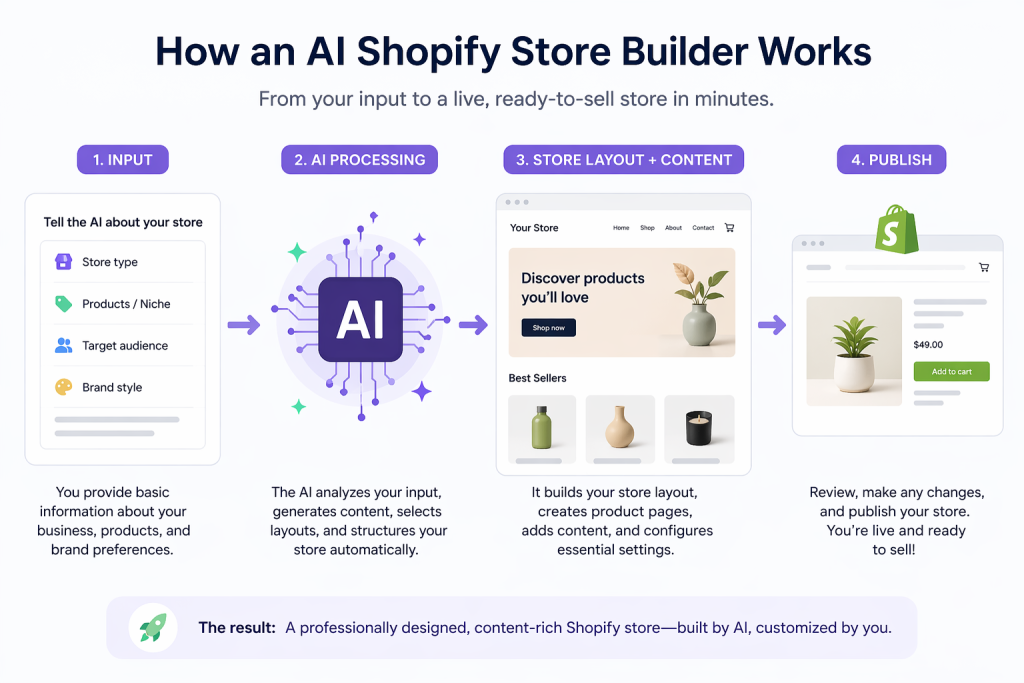
Depending on the tool, this can include:
- Store layout and homepage structure
- Product page content and descriptions
- Basic branding elements such as headlines and messaging
- Images or visual suggestions
- Navigation and page sections
It is important to understand that not all AI Shopify store builders work in the same way. In practice, they fall into three main categories.
1. Native Shopify AI tools
Shopify has introduced its own AI capabilities, including features like Shopify Magic and Sidekick. These tools focus on helping you generate content, automate tasks, and speed up workflows directly inside your Shopify admin. They are useful for writing product descriptions, editing copy, and managing operations, but they do not fully replace the process of designing and structuring a store from scratch.
2. AI store builder apps
These are third party tools designed to generate a more complete store setup. Some can create a starter store with products, collections, and basic design elements already in place. They are often used by beginners or dropshippers who want to launch quickly without spending too much time on setup.
3. AI page builders and CRO tools
These tools focus on building high performing pages with a stronger emphasis on results. This is closely related to conversion rate optimization for Shopify, where layout, messaging, and structure are designed specifically to improve conversions.
Understanding these differences is key. Choosing the wrong type of tool can lead to unnecessary work later, especially if your goal is not aligned with what the tool is designed to do.
Does Shopify Have an AI Store Builder?
Yes, Shopify does offer AI powered features that support the process of building and managing a store. However, it is important to set the right expectations about what these features can and cannot do.
Shopify provides an AI Store Builder experience that helps users get started quickly. You can explore it directly through the official Shopify AI Store Builder.
In practical terms, this means you can:
- Generate product descriptions and marketing copy
- Get suggestions for store content and structure
- Speed up routine tasks inside the admin dashboard
What Shopify does well is making the setup process more accessible, especially for beginners. You can move from idea to a working store much faster than before, without needing technical skills.
That said, the native AI features are designed to assist rather than fully automate everything. You will still need to:
- Refine your design to match your brand
- Adjust layouts for better user experience
- Optimize pages for conversion and SEO
For many users, Shopify’s built in AI is a strong starting point. But if your goal is to create highly optimized landing pages, test multiple variations, or scale performance driven campaigns, you may need to combine it with specialized AI apps.
Types of AI Shopify Store Builders
To choose the right solution, you need to understand how different types of AI tools fit into the Shopify ecosystem. Each type serves a different purpose, and selecting the right one depends on your specific goals.
1. Native Shopify AI tools
These tools are built directly into Shopify and are designed to improve efficiency within the platform. They are best suited for users who want a streamlined workflow without relying heavily on external apps.
Key strengths:
- Seamless integration with Shopify
- Easy to use for beginners
- Helpful for content generation and task automation
Limitations:
- Limited control over advanced design and layout
- Not focused on conversion optimization
- Still requires manual refinement
This option works well if you are just starting out and want a simple, guided setup process.
2. AI store builder apps
These tools aim to generate a more complete store setup, often including products, collections, and basic design elements. They are popular among users who want to launch quickly and test ideas without spending too much time on configuration.
Key strengths:
- Faster initial setup
- Can generate a full store structure
- Useful for rapid product testing
Limitations:
- Output can feel generic
- Limited flexibility for branding
- May require significant editing afterward
This type is ideal for dropshippers or anyone focused on speed over customization in the early stages.
3. AI page builders and CRO focused tools
These tools focus on building high performing pages rather than the entire store. They are designed with marketing and conversion in mind, making them a strong choice for performance driven users.
Key strengths:
- Better control over layout and design
- Optimized for conversions
- Suitable for landing pages and product pages
Limitations:
- Do not build a full store from scratch
- Often require integration with other tools
- Can have a learning curve for beginners
This category is best for marketers, agencies, or brands that already have a store and want to improve performance.
Best AI Shopify Store Builder Options
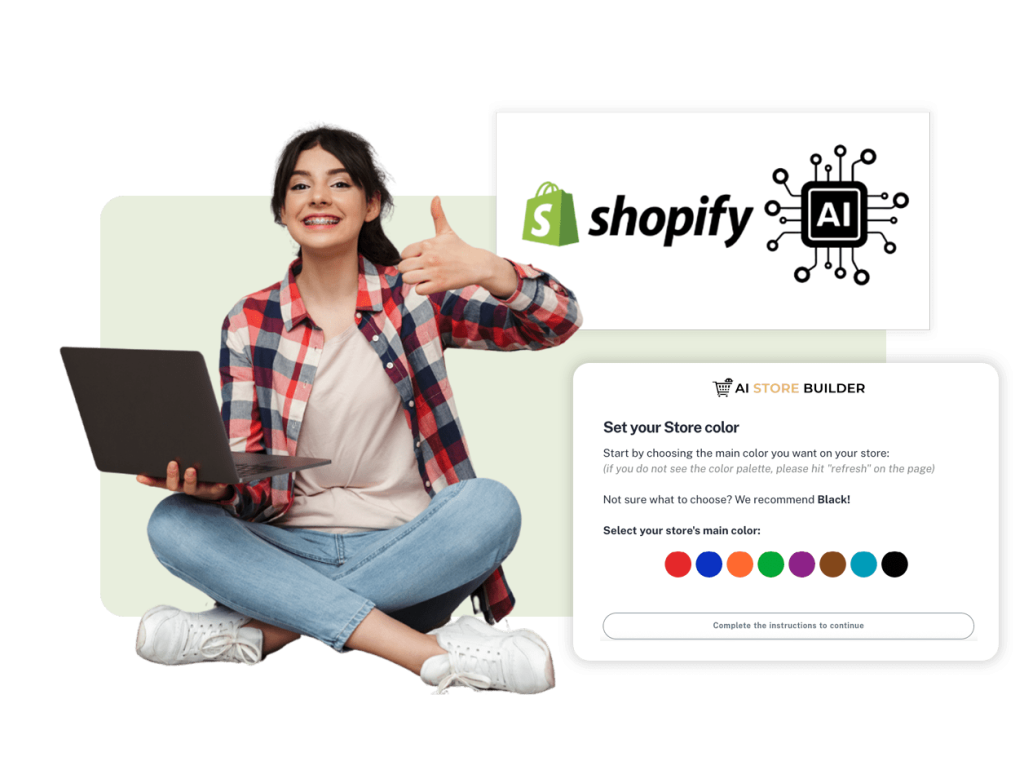
Not all AI Shopify store builders serve the same purpose. Some are designed to help you launch a basic store as quickly as possible, while others are better for creating high converting landing pages or refining the shopping experience after the store is already live. That is why the best option depends less on which tool is the most popular and more on what you are actually trying to achieve.
1. Shopify AI Store Builder
Shopify’s own AI features are the most natural starting point for many users, especially beginners. Because they are built directly into the Shopify ecosystem, they reduce friction and make it easier to move from idea to setup without relying too heavily on third party tools.
Shopify Magic helps with content generation, including product descriptions and marketing copy. More details are available through Shopify Magic. Together, these tools can save time during the early stages of building a store and make day to day operations more efficient.
The main advantage of Shopify’s native AI is convenience. Everything works within the platform, which means fewer integrations, fewer setup issues, and a smoother learning curve for new merchants. For someone launching a store for the first time, this can be a major benefit.
However, Shopify’s built in AI is best understood as an assistant rather than a complete replacement for strategy, design, or optimization. It can help you create a starting point, but it will not automatically produce a polished storefront with strong branding, conversion focused structure, and fully optimized SEO.
Best for: beginners, small businesses, and merchants who want a simple starting point
Main strength: convenience and native integration
Main limitation: limited depth for advanced design and conversion work
2. AI store builder apps
AI store builder apps are usually better suited for users who want speed above all else. Many of these tools are built to generate a starter storefront quickly, often with products, collections, descriptions, and basic design already in place. For early product testing, this can be extremely useful.
This category is especially attractive to dropshippers and product testers because it reduces setup time. Instead of spending hours building pages manually, users can create a functional draft store much faster and then focus on traffic and testing.
The downside is that speed often comes at the expense of originality. AI generated stores can look generic if the output is not edited carefully. Messaging may feel repetitive, page structure may be too templated, and branding often needs significant refinement before the store feels credible.
That does not make these tools ineffective. It simply means their real value lies in acceleration, not perfection. They are best used to create a working foundation that you later improve through manual edits, design adjustments, and stronger positioning.
Best for: dropshippers, quick launches, and early stage product testing
Main strength: fast setup
Main limitation: generic output without human refinement
3. AI page builders and conversion focused tools
The third category includes AI tools that focus less on generating an entire store and more on creating individual pages that are designed to perform better. These are often used for landing pages, product pages, campaign pages, and other high impact sections of the store.
This type of tool is especially useful for marketers, brands, and agencies that care about conversion rate optimization. Instead of asking AI to build everything, they use it to speed up page creation while keeping control over structure, messaging, and visual hierarchy.
In many cases, this is the more strategic option. A store does not necessarily need to be built entirely by AI to benefit from AI. If the main goal is to create better pages for paid traffic, product launches, seasonal promotions, or A B testing, then page focused tools are often more valuable than full store generators.
Their limitation is that they do not replace the full store setup process. You may still need a theme, navigation structure, collection architecture, and backend configuration in Shopify before these tools become truly effective.
Best for: marketers, agencies, scaling brands, and paid traffic campaigns
Main strength: stronger focus on conversions
Main limitation: not a full store setup solution
Shopify AI Store Builder vs AI Page Builder
One of the most common sources of confusion is the difference between an AI store builder and an AI page builder. Although the names sound similar, they are designed for very different stages of your Shopify journey.
An AI store builder focuses on creating the foundation of your store. It helps you set up the overall structure, including homepage layout, product listings, collections, and basic content. This is most useful when you are starting from scratch and need to get a store live as quickly as possible.
An AI page builder, on the other hand, focuses on improving specific pages within your store. Instead of building everything, it helps you design and optimize landing pages, product pages, and promotional sections with a stronger emphasis on conversion.
In simple terms, a store builder helps you launch, while a page builder helps you sell.
Key differences at a glance:
| Criteria | AI Shopify Store Builder | AI Page Builder |
|---|---|---|
| Main purpose | Build the full store foundation | Optimize individual pages |
| Best use case | Launching a new store | Improving conversions on existing store |
| Scope | Entire store (homepage, products, collections) | Specific pages (landing, product, campaign pages) |
| Speed | Very fast initial setup | Fast page creation and iteration |
| Customization level | Limited, often template based | Higher control over layout and design |
| Conversion focus | Basic | Strong focus on CRO and performance |
| SEO control | Basic structure only | Better control for on page optimization |
| Ideal users | Beginners, dropshippers | Marketers, brands, agencies |
When should you use each one?
If you are starting with no store at all, an AI store builder is usually the best first step. It helps you go from idea to a working storefront quickly, which is critical in the early stage.
If you already have a store and want to improve results, an AI page builder becomes more valuable. It allows you to refine key pages, test different layouts, and increase conversion rates without rebuilding everything.
In many cases, the most effective approach is to combine both. You can use an AI store builder to create the initial setup, then use a page builder to optimize the pages that directly impact revenue, such as product pages and landing pages.
Benefits of Using an AI Shopify Store Builder
Using an AI Shopify store builder is not just about convenience. It directly impacts how fast you can launch, how easily you can operate, and how effectively you can test and improve your store. Below are the key benefits broken down clearly.
1. Faster time to launch
The most obvious advantage is speed. Tasks that used to take days, such as setting up pages, writing content, and structuring a store, can now be done much faster.
This is especially important if you:
- Want to launch a store quickly
- Need to test a product idea
- Are running time sensitive campaigns
Instead of getting stuck in setup, you can move to execution much sooner.
2. Lower barrier to entry
AI makes Shopify more accessible for people without technical or creative experience.
You do not need to:
- Know how to design layouts
- Write professional level copy
- Understand complex development
You start with a generated structure and improve it, rather than building everything from zero. This reduces overwhelm and makes it easier to take action.
3. Faster content creation
Creating content is one of the most time consuming parts of building a store. This includes product descriptions, homepage sections, headlines, and promotional copy.
AI helps by:
- Generating first drafts instantly
- Providing multiple variations to choose from
- Reducing the time spent staring at a blank page
You still need to refine the content, but the heavy lifting is already done.
4. Easier testing and iteration
In ecommerce, speed of testing often matters more than getting everything perfect the first time.
With AI, you can:
- Create multiple versions of a store or page
- Test different layouts and messaging
- Launch campaigns faster
This allows you to learn what works and adjust quickly, which is critical for growth.
5. Better use of time and resources
Instead of spending hours on repetitive setup tasks, you can focus on higher value work such as:
- Positioning your brand
- Improving user experience
- Optimizing conversions
- Planning marketing strategies
AI shifts your effort from building to improving.
6. Strong starting point for optimization
AI does not usually deliver a perfect final result, but it gives you a solid first version to work from.
This means:
- You are not starting from scratch
- You can identify gaps more quickly
- You can move into optimization faster
The real value comes from combining AI generated output with human refinement.
Overall, the biggest benefit of an AI Shopify store builder is not that it replaces human work, but that it accelerates the entire process. It helps you reach a usable version of your store faster, so you can spend more time improving what actually drives results.
Limitations You Should Know Before Using AI
AI Shopify store builders can save a significant amount of time, but they are not a complete solution. To use them effectively, you need to understand where they fall short and what still requires human input.
1. Output can feel generic
AI is trained on existing patterns, so the results it generates often follow common structures and phrasing. While this is useful for creating a quick draft, it can make your store feel similar to many others.
Without editing, you may end up with:
- Repetitive messaging
- Predictable layouts
- Weak brand identity
To stand out, you will need to refine the content and tailor it to your specific audience and positioning.
2. Limited understanding of your audience
AI can generate headlines, sections, and product descriptions, but it does not truly understand your customers, their motivations, or their objections.
This often leads to:
- Messaging that sounds correct but not persuasive
- Lack of emotional connection
- Missing key selling points that drive conversions
A store that looks complete is not necessarily a store that performs well. Strong conversion usually requires deeper insight and strategic thinking.
3. SEO quality still depends on human review
AI can produce content quickly, but that does not guarantee it is optimized for search engines. In practice, building a store that can rank well often requires a more structured approach, similar to Shopify SEO services, where keyword targeting, site structure, and content quality are handled more deliberately.
Common issues include:
- Repetitive or thin product descriptions
- Headings that do not match search intent
- Poor keyword targeting
- Weak internal structure
If you publish content without reviewing it, you risk hurting both visibility and credibility. Proper SEO still requires manual optimization.
4. Risk of similar looking stores
When many users rely on the same tools, templates, and prompts, the results start to look alike. This creates a problem in competitive markets where differentiation is critical.
Customers may:
- Feel less trust in generic designs
- Struggle to remember your brand
- Compare you directly with similar competitors
To avoid this, you need to customize both design and messaging beyond what AI generates.
5. Not a complete replacement for strategy
AI can help execute tasks faster, but it does not replace:
- Brand positioning
- Customer research
- Conversion strategy
- Long term growth planning
These elements are what turn a basic store into a successful business. AI supports the process, but it does not define it.
In practice, AI works best as a starting point. It helps you move from zero to a usable draft quickly. The real results come from what you do next, refining the content, improving the experience, and building a store that is tailored to your audience rather than generated for everyone.
How to Choose the Right AI Shopify Store Builder?
Choosing the right AI Shopify store builder depends less on which tool has the most features and more on what you need it to do for your business. Some tools are better for launching quickly, while others are better for improving conversions, testing offers, or building stronger landing pages.
The key is to choose based on your stage, your goals, and the type of store you are building.
1. Choose based on your current stage
If you are starting from scratch, your priority is usually speed and simplicity. In that case, a tool that helps you generate a basic store structure, product pages, and starter content will make the most sense.
If you already have a live store, your needs are different. You are less concerned with setup and more focused on improving performance. In that situation, a page builder or conversion focused AI tool is often the better option.
A simple way to think about it is this:
- If you need to launch, look for a store builder
- If you need to improve results, look for a page builder
2. Define what you want AI to help with
Not every AI tool does the same job. Before choosing one, be clear about the main outcome you want.
For example, you may need help with:
- Building a full starter store
- Creating product descriptions faster
- Designing better landing pages
- Testing different page layouts
- Generating content for campaigns
The clearer your objective is, the easier it becomes to avoid paying for features you do not actually need.
3. Look at the level of control you need
Some AI Shopify tools prioritize automation. They help you move fast, but they give you less control over branding, layout, and messaging. Others offer more flexibility, which is valuable if you want your store to look more polished and distinct.
If brand identity matters to your business, choose a tool that still allows you to:
- Edit structure easily
- Adjust design elements
- Rewrite content without friction
- Customize key pages in detail
The best tool is not always the one that automates the most. It is the one that gives you the right balance between speed and control.
4. Consider your business model
Different store types benefit from different tools.
- If you are running a one product or dropshipping store, speed and testing may matter most. A simple AI store builder can help you get online quickly and validate demand.
- If you manage a branded ecommerce business, you will likely need better design flexibility, stronger storytelling, and more control over product and category pages.
- If you are an agency or marketer, your focus may be on efficiency, repeatability, and campaign performance. In that case, tools that support landing page creation, quick edits, and testing workflows will usually provide more value.
5. Evaluate the quality of the output, not just the feature list
A long feature list can sound impressive, but what matters more is the actual quality of what the tool produces.
Ask questions like:
- Does the content sound natural?
- Do the layouts feel modern and credible?
- Can the design be adapted to your brand?
- Will the result still need heavy rework?
A tool that saves you ten minutes but creates mediocre output may cost you more time in revision later.
6. Think beyond launch
Many merchants choose a tool based only on how quickly it can create a store. That matters, but it should not be the only consideration.
You should also think about:
- How easy it is to optimize later
- Whether it supports growth
- Whether it works well with your existing Shopify setup
- How practical it is for ongoing updates
The right AI Shopify store builder should help you now without creating more limitations later.
Quick decision guide:
| If your priority is… | Best type of tool |
|---|---|
| Launching a new store quickly | AI store builder |
| Building a basic store with less manual work | Shopify native AI tools |
| Improving landing pages and product pages | AI page builder |
| Increasing conversions on key pages | Conversion focused page builder |
| Testing offers and campaigns quickly | AI page builder |
| Creating a strong branded experience | Flexible builder with customization control |
In the end, the right choice comes down to fit. The best AI Shopify store builder is not necessarily the most advanced or the most popular. It is the one that matches your workflow, supports your goals, and helps you build a store that is not only faster to launch, but also easier to improve over time.
How to Get Better Results From Any AI Shopify Store Builder?
Using AI can speed up the process, but better results still depend on how you guide the tool and what you improve afterward. Even the best AI Shopify store builder will only give you a strong result if you combine automation with clear direction and careful refinement.
1. Start with clear inputs
AI performs better when your inputs are specific. If you provide vague information, you are more likely to get generic output.
Before using the tool, prepare:
- Your brand name
- Product category
- Target audience
- Main value proposition
- Tone of voice
- Key competitors or reference brands
The more context you provide, the more relevant the result will be.
2. Refine the copy manually
AI generated content is useful for first drafts, but it should not be published without review. You need to make sure the copy reflects your brand, speaks to your audience, and supports conversions.
Pay close attention to:
- Homepage headlines
- Product descriptions
- Call to action text
- Trust building sections
- Promotional messaging
In most cases, a few strong edits can make the content feel far more human and persuasive.
3. Improve the pages that matter most
Not every page needs the same level of attention. Focus your effort on the pages that influence revenue directly.
These usually include:
- Homepage
- Product pages
- Collection pages
- Landing pages
- Cart or offer related sections
This helps you get the most value from AI while still improving the areas that have the biggest business impact.
4. Make the design feel less generic
One of the most common weaknesses of AI generated stores is sameness. To avoid this, you should go beyond default templates and adjust the visual identity. In many cases, a more refined approach similar to Shopify design services can help create a store that feels more distinctive and aligned with your brand.
You can improve this by updating:
- Fonts and spacing
- Color usage
- Image selection
- Section order
- Icon style and trust elements
Even small changes can make the store look more original and credible.
5. Review the SEO basics before publishing
AI can help draft content, but SEO still needs human review. Before publishing, check whether the important on page elements are properly optimized.
Review:
- Page titles
- Meta descriptions
- Heading structure
- Internal links
- Image alt text
- Keyword placement
This step helps make sure your store is not only fast to build, but also better positioned to attract search traffic.
6. Test and improve over time
AI should help you launch faster, not stop you from optimizing later. Once the store is live, look at how users interact with it and keep improving based on real data.
Track things like:
- Bounce rate
- Product page engagement
- Add to cart rate
- Conversion rate
- Performance of different page layouts
The best results come when AI is used to accelerate the first version, and human decisions shape every improvement after that.
An AI Shopify store builder can save time, reduce friction, and speed up execution. But the stores that perform best are rarely the ones left exactly as AI generated them. The strongest approach is to treat AI as a starting point, then refine the store with better strategy, better messaging, and better optimization.
Conclusion
An AI Shopify store builder helps you launch faster and reduce setup time, but real results come from what you do after. Strong positioning, clear messaging, and continuous optimization are still what drive performance.
The most effective approach is to use AI as a starting point, then refine and scale with the right strategy. In practice, combining AI with experienced execution is what turns a basic store into a high performing one, which is also how teams like ONEXT DIGITAL approach Shopify growth.
If you’re ready to take your store further, improve conversions, or build a more optimized Shopify experience, feel free to contact us today and explore what a more structured approach can do for your business.
FAQs
Is there a free AI Shopify store builder?
Some AI Shopify tools offer free trials or limited free plans, but most full features require a paid subscription. Shopify itself provides AI features within its platform, but you still need a Shopify plan to use them.
Is Shopify Magic enough on its own?
Shopify Magic is useful for generating content and speeding up tasks, but it is not a complete solution for design, conversion optimization, or advanced customization.
Are AI-built Shopify stores good for SEO?
They can be a good starting point, but AI-generated content often needs editing. Proper SEO still requires keyword targeting, structure optimization, and manual improvements.
Do I still need a designer or developer?
For a basic store, you may not need one immediately. For better design, performance, and scalability, professional support is still valuable.
Can AI build a complete Shopify store?
AI can generate a basic store structure with pages and content, but it does not create a fully optimized or branded store. You will need to refine design, content, and strategy manually.