
 Services
 Solutions
 Main platform
 Technology
 White Label
  Offshore
 Hire developers


If you are considering Vietnam for AI development, the short answer is yes, it can be a practical option. Vietnam-based teams are already working on AI applications, workflow automation, machine learning, and AI features built into existing software. What matters is whether the company you choose has the right skills and experience for your project.
Price matters, but it should not be the only factor. You also need to look at how the team handles your data, who owns the code and AI assets, how they communicate, and what support they provide after launch. This guide covers what to look for in an AI development company in Vietnam before you sign a contract.
Is Vietnam a Real Option for AI Development?
Yes. Vietnam is a practical option for businesses looking to build AI applications, automate workflows, or add AI features to existing software.
The country’s technology sector has grown significantly in recent years. According to Vietnam’s Ministry of Science and Technology, there were more than 80,000 digital technology companies in 2025, employing over 1.9 million people. More than 2,100 Vietnamese technology companies had also expanded into overseas markets, giving the local engineering sector considerable experience working with international clients.
Vietnam’s growing AI ecosystem builds on this wider software engineering base. A production AI project rarely needs AI expertise alone. Depending on the project, you may also need backend developers, data engineers, cloud and DevOps specialists, QA engineers, and project managers. Having these skills within the same team can make it easier to take an AI product from an early prototype to something that can actually run in production.
Vietnam is also investing more heavily in AI skills and infrastructure. In 2026, the government approved a national programme targeting at least 10,000 highly qualified AI professionals by 2030, alongside broader AI skills training. Investment in AI infrastructure, including GPU capacity, is growing as well.
That said, these numbers are useful context, not a guarantee of a vendor’s capabilities. Not every company that lists AI development as a service will have the right experience for your project.
If you are evaluating an AI development company in Vietnam, look closely at the team behind the proposal. What have they built? Which AI technologies do they work with? Can they handle the data, integrations, security and infrastructure your project will need?
What Types of AI Work Are Well Suited to Vietnam?
Vietnam can be a good fit for many applied AI projects, especially those that combine AI with conventional software development.
Common examples include:
- Generative AI applications and RAG-based assistants
- AI chatbots and virtual assistants
- AI agents and workflow automation
- Document processing and data extraction
- Machine learning and predictive systems
- Computer vision
- AI integration with existing software and business systems
Many of these projects do not require building a foundation model from scratch. The work is often about choosing the right model, connecting it to business data, building the application around it, and making sure the system works reliably in production.
What About Communication and Time Zones?
Technical skills are only part of the picture when you work with an overseas team. Day-to-day communication and project management matter too.
Vietnam can be convenient for Australian businesses because the time difference still allows several hours of overlap during the working day. That gives teams time for meetings, technical discussions, reviews, and resolving issues without requiring everyone to work the same hours.
Still, a small time difference does not automatically mean good communication. Before signing with a vendor, find out who will manage the project, who your main technical contact will be, how often you will meet, and how requirements and technical decisions will be documented.
When Might Another Option Make More Sense?
Vietnam will not be the right fit for every AI project. Fundamental AI research, foundation-model development, or work requiring highly specialised scientific expertise may call for a different type of team and research environment.
You may also need another delivery model if regulations require data or development work to remain in a specific jurisdiction, if the project depends heavily on onsite collaboration, or if an offshore team cannot securely access the infrastructure involved.
For most businesses, what matters is whether the specific vendor and team can deliver what the project requires. Their relevant experience, technical approach, security practices, team structure, and delivery model are worth checking before you make a decision.
What Do AI Development Companies in Vietnam Actually Build?

AI development companies in Vietnam work on a wide range of projects, from AI-powered business tools and automation to machine learning and AI features added to existing software.
The right approach depends on the business problem, the data available and how much the AI needs to connect with existing systems. Some common types of AI development include:
Generative AI & RAG
Generative AI applications use large language models (LLMs) to generate, analyse or work with content such as text and code. RAG (retrieval-augmented generation) takes this a step further by allowing an application to work with a company’s own documents and knowledge.
Common use cases include internal knowledge assistants, customer support, technical documentation, enterprise search and content generation.
If you are evaluating a vendor, ask how they handle your data, document retrieval, user permissions and response quality.
AI Agents & Workflow Automation
AI agents can handle a series of tasks instead of simply answering a prompt. They can retrieve information, work with APIs, make decisions based on defined rules and trigger actions in other systems.
For example, an agent could qualify leads, respond to customer enquiries, update a CRM or handle routine internal tasks.
The challenge is making the agent work reliably within the business process. A good demo is not enough. The vendor should be able to explain what happens when the AI gets something wrong or encounters an unexpected case.
AI-Powered Document Processing
AI can be used to extract, classify and summarise information from invoices, contracts, forms, reports and other documents.
For example, a system could read incoming invoices, extract key fields and send the data to an accounting or ERP system. This can reduce manual data entry when a business is dealing with large volumes of documents.
Depending on the project, the work may involve OCR, data extraction, classification, validation and integration with existing software.
Machine Learning & Predictive Systems
Machine learning is useful when a business has enough historical data to identify patterns and make predictions.
Common applications include demand forecasting, customer churn prediction, fraud detection, recommendation systems, lead scoring and risk analysis.
The model itself is only part of the work. Data quality, preparation and testing can have a major impact on whether the system is useful in practice.
Computer Vision
Computer vision allows software to analyse images or video and identify objects, patterns or specific conditions.
Businesses use it for tasks such as quality inspection, object detection, image classification, document analysis and visual monitoring.
A typical project may involve collecting and labelling image data, developing the model, connecting it to an application and deploying it in a cloud or edge environment.
AI Integration With Existing Software
Many businesses do not need a completely new AI product. They want to add AI to software they already use.
That might mean connecting an AI feature to a CRM, ERP, ecommerce platform, customer portal or internal database. Examples include AI-powered search, product recommendations, automated replies and intelligent reporting.
This type of work requires solid software engineering as well as AI knowledge. The new feature needs to work with existing APIs, data, user permissions and business processes without creating problems elsewhere in the system.
How Much Does AI Development Cost in Vietnam?
There is no fixed price for AI development in Vietnam. The budget depends on the people involved, the type of AI being built, the amount of data to work with, and how much software needs to be developed around it.
That makes hourly or monthly developer rates a poor way to compare vendors on their own. What matters more is what you are actually getting for the price and what is included in the scope.
What Actually Drives AI Development Costs?
The biggest cost differences usually come from five areas.
1. Project complexity
A simple AI feature can be relatively quick to build. A system that needs complex workflows, high accuracy, real-time processing or more extensive testing will take considerably more work.
2. Data preparation and quality
Good data can make development much easier. If data needs to be collected, cleaned, labelled or reorganised before it can be used, that work becomes part of the project.
3. Model, API and infrastructure costs
Using an existing model through an API is usually very different from running or fine-tuning a model yourself. Model choice, usage volume, cloud resources and GPU requirements can all affect the ongoing cost.
4. Integrations and security
An AI feature may need to connect with a CRM, ERP, ecommerce platform or internal database. Authentication, access controls and other security requirements can add further development and testing work.
5. Monitoring and maintenance
The work does not necessarily stop when the AI goes live. Depending on the system, you may need monitoring, performance checks, model updates, bug fixes and ongoing technical support.
Why Can Two AI Projects Have Very Different Prices?
Take two projects that are both described as an “AI chatbot”.
Project A: Website chatbot
A business wants a chatbot that answers common customer questions using an existing AI API. It has a small knowledge base, few integrations and a fairly simple workflow.
Project B: Internal AI assistant
A company wants an assistant that searches internal documents, follows different access permissions, connects with business systems and gives reliable answers based on company data.
Both use AI, but the amount of work behind them is very different. The second project may involve more data preparation, integrations, security, testing and ongoing monitoring.
This is why a lower developer rate does not necessarily mean a lower project cost. When comparing quotes, look at the team, scope, technology, delivery timeline and what happens after launch.
Build vs Buy vs Customize: Which Approach Makes Sense?
Building everything from scratch is not always the best option. An existing AI product may already cover most of what you need. For other projects, an API-based solution or a customised application may be a better fit.
| Approach | When it may make sense |
|---|---|
| Existing AI SaaS | An existing product already covers most of your requirements |
| API-based AI | You need AI capabilities inside your own application |
| Custom AI application | Your workflows, data or integrations require something tailored |
| Custom model | You have a specific reason to train or fine-tune a model |
The better starting point is often not “How much will it cost to build?”
It is:
What is the simplest approach that can solve the problem reliably?
A good AI development company should be able to walk you through these options and explain the trade-offs before recommending a particular build.
How Are IP, Data and Contracts Handled?
IP and data are worth sorting out before an AI project starts. An AI system can involve much more than source code, including prompts, RAG workflows, embeddings, datasets and custom models, while the development team may also need access to internal documents or customer data.
Source Code, AI Assets and Ownership
Start by making sure the contract says exactly what you will own once the work is completed.
That may include:
- Source code and application architecture
- Custom prompts and AI workflows
- RAG pipelines and configurations
- Embeddings and vector databases
- Fine-tuned or custom models
- Technical documentation
There is one detail that is easy to miss. A vendor may use third-party AI models, open-source software or tools they developed before your project. Those are not necessarily yours just because they are part of the final system.
Ask the vendor to clearly separate project-specific work from third-party or pre-existing components, and explain what rights you have to each.
Data Access and Confidentiality
AI projects often involve sensitive business information, from internal documents and customer records to product or operational data. Before giving a development team access, be clear about what they can access, why they need it and how that access will be managed.
Your agreement should cover confidentiality, subcontractors, data retention and deletion. It should also state whether your data can be used to train or improve any model outside your project.
An NDA can help protect confidential information, but it is only one part of the picture. The main development agreement should also explain how data is handled during the project and what happens to it when the work ends.
What Should the Contract Cover?
At a minimum, make sure you have clear terms covering:
| Area | What to clarify |
|---|---|
| IP ownership | Who owns the source code, AI assets and project-specific work |
| Third-party technology | Which AI models, APIs, open-source libraries or vendor-owned components are being used |
| Data protection | How business and customer data can be accessed, stored and processed |
| Confidentiality | Requirements for the vendor, employees and subcontractors |
| Data retention | How long project data is kept and when it will be deleted |
| Security | Who is responsible for access controls, credentials and security |
| Handover | What happens to code, data, accounts and documentation when the project ends |
Before signing, it is also worth asking:
- Who owns the prompts, workflows, RAG setup and other AI assets created for the project?
- Will our data be used to train or improve models outside our project?
- Which third-party AI models, APIs or open-source components will the system rely on?
- What happens to our data, code and AI assets if we stop working together?
Getting these points clear at the beginning can save a lot of trouble later, especially when the AI system becomes part of a business-critical workflow.
How to Check an AI Development Company Before Signing
A company may list every AI service imaginable on its website. That does not tell you whether its team is right for your project.
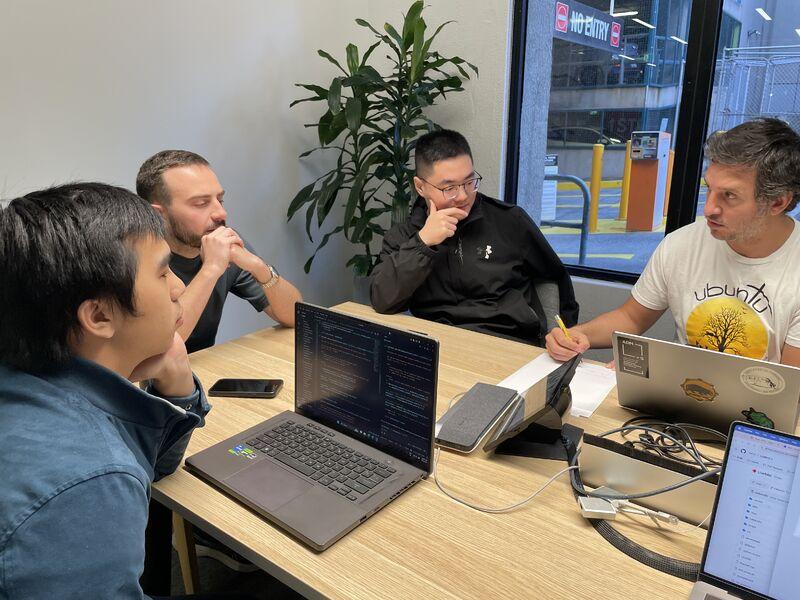
Before you sign, try to get past the sales presentation. Look at what the company has actually built, who will work on your project, how they plan to deal with the difficult parts, and who will support the system once it is live.
1. Check Their Actual AI Experience
Start with their previous work.
Ask for examples that are relevant to what you are trying to build. If you need a RAG application, for example, ask how they handled document ingestion, retrieval and user permissions. If you need an AI agent, ask what systems it connected to and how they dealt with failed or unexpected actions.
You do not need confidential client details. A good vendor should be able to give you enough technical detail to show that the experience is real.
2. Ask Who Will Actually Work on Your Project
The people you speak to during the sales process may not be the people who build your product.
Ask who will be on the team, what each person will handle and how much of their time will be dedicated to your project. Depending on the scope, you may need AI or ML engineers alongside backend developers, data engineers, DevOps, QA and a project manager.
It is also worth asking who your main contact will be and how technical questions or urgent issues will be handled.
3. Ask for a Technical Walkthrough
Once the vendor understands your requirements, ask them to show you how they would build it.
They should be able to talk through the architecture, model or API choices, data flow, integrations and the main technical risks. You should not need to be an AI engineer to follow the explanation.
Be cautious if the answer is simply “we can build it” without much detail. You are not looking for the most complicated architecture either. If an existing model and a relatively simple setup can do the job, that may be the better choice.
4. Test the Risky Parts With a PoC
If there is something you are not sure will work, test that part before paying for the full build.
A proof of concept (PoC) can help you find out whether your data is suitable, whether the model can reach the required level of accuracy, whether a RAG system retrieves the right information, or whether a key integration actually works.
Keep the PoC focused. There is little value in spending weeks building a small version of the whole product just to answer one technical question.
5. Verify Security, IP and Data Handling
Before giving a vendor access to business or customer data, make sure you understand how that data will be handled.
Ask where it will be stored, who can access it, whether subcontractors are involved and when it will be deleted. For AI projects, also ask whether your data will be used to train or improve models outside your project.
The same applies to ownership. Make sure the contract covers source code, prompts, AI workflows and other project-specific assets, as well as any third-party models or software used in the system.
6. Understand Delivery and Post-Launch Support
A demo that works in a meeting is not the same as a system that works reliably for real users.
Before signing, find out what happens after launch. Who fixes bugs? Who monitors the system? Who handles model or API changes? What happens if the infrastructure has a problem?
You should also be clear about the delivery model, milestones, communication, reporting and handover. Whether you work with a project team, dedicated developers or a hybrid setup, everyone should know what they are responsible for.
Looking for an AI Development Company in Vietnam?
If you are considering Vietnam for your AI project, ONEXT DIGITAL can help you assess the technical scope, team structure and delivery model before development starts. We can discuss your requirements, the type of AI solution you need and the engineering resources involved, so you have a clearer view of the work involved before development begins.
Whether you are building a new AI application, adding AI features to an existing product, or looking for an experienced engineering team to support your development work, we can help you explore the practical options.
FAQs
Can a Vietnam-based AI development team work with businesses in Australia?
Yes. Vietnam-based AI teams can work with Australian businesses through remote or dedicated development models. The main factors to check are working-hour overlap, English communication, project management, security requirements and how responsibilities are handled across both teams.
What skills should an AI development team have?
A capable AI team should cover more than model development. Depending on the project, you may need experience in machine learning, generative AI, data engineering, backend development, cloud infrastructure, API integration and testing. The team should also understand how to deploy, monitor and maintain AI features in a production environment.
Should I hire an AI development company or build an in-house team?
It depends on your project, budget and internal capabilities. An in-house team can make sense when AI development is a long-term core capability. An external AI development company can be more practical when you need specialist skills, want to start sooner or do not have enough AI engineers internally.
Can an AI development company work with existing software and systems?
Yes. Many AI projects involve adding AI capabilities to software a business already uses rather than building a completely new platform. This may include connecting AI to CRM systems, websites, mobile apps, internal databases, business tools or existing APIs.
What should I prepare before starting an AI development project?
Start with a clear business problem rather than a specific AI model. Define what you want to improve, what data is available, which systems need to be connected and how success will be measured. It also helps to identify users, security requirements and any technical constraints before discussing the development approach.