
 Services
 Solutions
 Main platform
 Technology
 White Label
  Offshore
 Hire developers



Hire virtual reality developers is not quite the same as hiring a software developer and adding “VR experience” to the job description.
VR development brings together software engineering, 3D graphics, real-time rendering and spatial interaction. Someone can have years of experience with Unity or Unreal Engine and still not have the practical experience needed to build a good VR application. Working in VR means thinking about how the software performs when someone is actually wearing a headset, moving around and interacting with the environment.
That is what makes VR hiring a little more complicated. Performance, latency, hardware limitations and user comfort all affect the experience, and these are things you cannot always judge from a CV or a list of technologies.
This guide looks at what a VR developer actually does, how much it can cost to hire one, which skills to look for, where to find candidates and how to tell whether someone has real hands-on VR experience.
What Does a Virtual Reality Developer Do?
A virtual reality developer builds interactive 3D applications that run on VR headsets and respond to users’ movement, controllers, hand tracking or other spatial inputs.
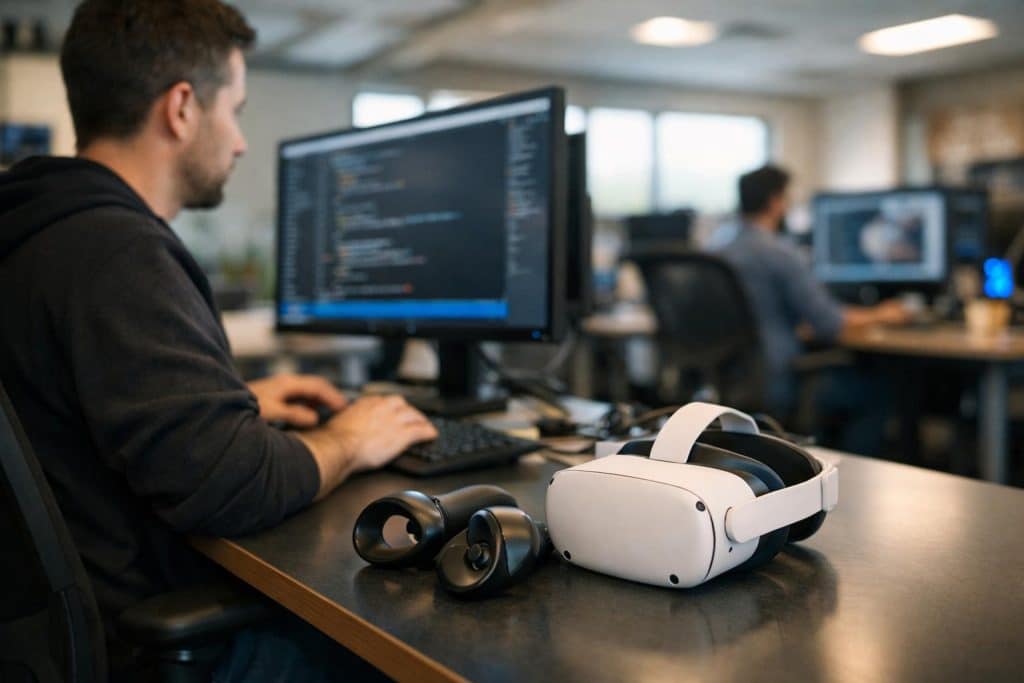
What they work on depends on the product. They might build interactions, handle movement and physics, add spatial audio, optimise graphics, connect the app to backend services or prepare builds for different headsets. They may also work closely with 3D artists, UX designers, product managers and other developers.
VR Developer vs. Game Developer
There is a fair amount of overlap between the two roles, especially when both involve Unity or Unreal Engine. But a game developer can have years of experience building 3D games without having dealt with things like headset optimisation, hand tracking, VR locomotion or motion comfort.
That does not mean game developers are a poor fit for VR. Someone with strong Unity or Unreal experience can transition well into a VR role. Just make sure they have some hands-on experience with the parts of VR that matter to your project, rather than relying on the job title or technology list on their CV.
How Much Does It Cost to Hire a VR Developer?
There is no standard salary benchmark for VR developers in Australia, so putting a single figure on the role can be misleading. VR developers also come from different backgrounds, including software engineering, game development and 3D graphics.
For a rough starting point, it makes more sense to look at software engineering salaries and then consider the experience and technical skills your project actually needs.
Software Developer Salary Benchmarks in Australia
According to Re:Sourced’s 2026 Sydney salary data, software engineers earn a base salary of around A$90,000-A$120,000 for junior roles, A$120,000-A$160,000 for mid-level roles, A$160,000-A$190,000 for senior roles, and A$190,000-A$210,000 for tech lead roles.
These ranges represent the middle 50% of accepted offers recorded by Re:Sourced, based on the 25th to 75th percentile. They provide a useful reference for the Australian software engineering market, although they are not specific to VR developers.
| Experience level | Sydney software engineering benchmark |
|---|---|
| Junior (0–2 years) | A$90,000-A$120,000 |
| Mid-level (2–5 years) | A$120,000-A$160,000 |
| Senior (5+ years) | A$160,000-A$190,000 |
| Tech Lead | A$190,000-A$210,000 |
These are software engineering figures, not VR-specific salary bands. They are useful as a starting point, but the actual cost of hiring a VR developer will depend on what you need them to do.
Someone who has already shipped VR products may sit toward the higher end of the market, particularly if they have experience with Meta Quest, Unreal Engine and C++, real-time rendering or more complex XR interactions.
And remember that base salary is only part of the cost of an Australian employee. Superannuation, bonuses and other employment costs can add to the final figure.
Hiring VR Developers in Vietnam
Vietnam is another option for Australian companies that need VR development capacity. There is not much public salary data specifically for VR developers, so game development is a useful reference because the two areas share many of the same technologies, including Unity, Unreal Engine, C++, C# and real-time 3D.
ITviec’s 2025-2026 Vietnam IT Salary & Recruitment Market Report puts the median monthly salary for Game Developers at VND 33.35 million. The median is around VND 40.4 million for developers with 3-4 years of experience and VND 57.85 million for those with 5-8 years of experience.
These numbers are for game developers rather than VR developers, so they should not be treated as direct VR salary rates. What you actually pay will depend on the developer’s engine experience, graphics skills, XR experience, English and level of responsibility.
For an Australian company, there are also costs beyond salary to think about. Recruitment, employment arrangements, equipment, onboarding, communication and timezone overlap can all affect the total cost of working with a remote developer or team.
What Determines the Cost of Hiring a VR Developer?
A few things can make a noticeable difference to the budget:
- Experience: Someone who has shipped several VR products will usually cost more than a developer whose experience is mainly prototypes or personal projects.
- Engine: Unity developers are relatively common. Strong Unreal Engine and C++ experience can be harder to find.
- Target hardware: Experience with the specific headset you are building for can save a lot of time, especially when performance is tight.
- Technical specialisation: Graphics programming, rendering optimisation, multiplayer networking, computer vision and advanced hand tracking all require more specialised skills.
- Product complexity: A simple training application is a very different job from a multiplayer VR game or a graphics-heavy simulation.
- Hiring model: In-house hiring, remote employees, staff augmentation and outsourcing all come with different costs and responsibilities.
The easiest way to set a realistic budget is to define the project first. Once you know the headset, engine, technical scope and level of ownership you need, it becomes much easier to work out what kind of developer you can afford.
What Skills Should You Look for When Hiring a VR Developer?

A good VR developer needs more than experience with Unity or Unreal Engine. They also need to understand 3D programming, performance, VR hardware and how people actually interact with a virtual environment.
The exact skills you need will depend on the project, but the areas below are a good place to start when reviewing candidates.
Unity or Unreal Engine
Most VR applications are built with Unity or Unreal Engine, so hands-on experience with at least one of them is usually essential.
That said, seeing Unity or Unreal on a CV does not tell you much on its own. Try to find out what the developer has actually built and what they were responsible for.
You could ask:
- What VR projects have you built with Unity or Unreal
- Which parts of the project did you work on?
- Have you worked with OpenXR or platform-specific SDKs?
- How did you handle input, movement and interaction?
Someone who has followed a few VR tutorials is very different from someone who has built and shipped a complete VR application.
3D Programming and Mathematics
VR developers do not need to be mathematicians, but they should be comfortable working with 3D space, vectors, rotations, transforms, physics and coordinate systems.
These concepts come up all the time in VR development. For example, a developer might need to work out where an object should appear based on the user’s hand position, or how it should move when the user picks it up and throws it.
You do not need to give candidates a difficult maths test. Instead, give them a simple 3D interaction problem and ask how they would approach it. You will learn more from how they think through the problem than from whether they can remember a particular formula.
Performance Optimisation
Performance matters a lot in VR. Low frame rates, high latency or unstable rendering can quickly make an application uncomfortable to use.
A VR developer should have a good understanding of things like:
- Frame rate and frame time
- Draw calls and rendering overhead
- Polygon and texture budgets
- Lighting and shader performance
- CPU and GPU bottlenecks
- Memory usage
- Profiling and performance testing
Rather than simply asking whether someone knows how to optimise a VR application, ask about a real problem they have worked on.
For example:
“The application runs well on a desktop but starts dropping frames on the target headset. How would you investigate it?”
A good answer should go beyond “optimise the graphics”. The developer should be able to explain how they would profile the application, find out whether the CPU or GPU is the bottleneck, check what is costing the most and then test possible fixes.
This kind of question can tell you much more than simply seeing “performance optimisation” listed on a CV.
VR Hardware and Platforms
VR development is closely tied to the hardware. Experience with a high-end PC VR setup does not necessarily mean someone knows how to optimise an application for a standalone headset.
Depending on the project, you may need experience with platforms such as Meta Quest, HTC Vive, PlayStation VR2 or other OpenXR-compatible devices.
Ask candidates which devices they have actually worked with and what limitations they had to deal with.
For example:
- Have you developed for standalone and PC-connected headsets?
- How did you work around hardware limitations?
- Have you used hand tracking, controllers or eye tracking?
- How did you test the application on the target device?
You do not need someone who has used every headset on the market. What matters is whether their experience matches the hardware your project will use.
VR Interaction and UX
VR interaction is quite different from using a website or mobile app. Users interact with objects in three-dimensional space through controllers, hand tracking, head movement, voice or other forms of input.
A developer should be comfortable working with things such as:
- Object grabbing and manipulation
- Teleportation and other movement systems
- Spatial interaction
- Hand and controller input
- Collision and physics
- User comfort
- Visual and audio feedback
The developer does not need to be a UX designer. But they should understand that technical decisions can have a direct effect on how comfortable and intuitive the experience feels.
For example, a movement system might work perfectly from a technical point of view but still make users uncomfortable if the movement feels unnatural.
Soft Skills That Matter for VR Developers
VR projects often involve developers working with 3D artists, designers, product managers and other engineers, so communication is important.
There are three areas worth paying attention to:
- Problem-solving: Can they investigate an issue and work out what is actually causing it?
- Communication: Can they explain a technical problem clearly to someone who does not work with VR every day?
- Technical judgement: Can they explain why they chose a particular approach and what trade-offs they considered?
You can usually get a good sense of this during the interview. Ask candidates to walk you through a real problem they faced on a previous project and explain what they did.
Where to Find VR Developers?
There are several ways to find VR developers, and the right option depends on the type of hire you need. If you are looking for a permanent team member, job boards may make sense. If you need someone for a prototype or a specific feature, freelance platforms can be more practical.
| Channel | Best for | Watch out for |
|---|---|---|
| VR communities | Specialists and developers with strong portfolios | Smaller candidate pool |
| LinkedIn and job boards | Full-time and long-term hiring | Many applications may be keyword-driven |
| Freelance platforms | Prototypes, short-term work and specific tasks | Experience levels vary |
| Staff augmentation | Adding VR developers to an existing team | Vendor and developer quality can vary |
VR communities are worth exploring if you want to find developers who are genuinely interested in the field. You may come across people sharing VR projects, contributing to Unity or Unreal communities, or discussing problems they have worked on. The pool is smaller, but you can sometimes find strong specialists who are not actively looking through traditional job boards.
LinkedIn and job boards are a practical option for full-time roles. They can give you a wider pool, but a CV that matches your keywords does not necessarily mean the person has real VR experience. Ask about previous projects and look at their portfolio before moving them further through the process.
Freelance platforms work well for prototypes, short-term projects or a specific piece of development. They can also be a useful way to work with someone before committing to a longer engagement. The main challenge is that experience varies widely, so check relevant VR work rather than relying on platform ratings alone.
Staff augmentation can make sense when you already have a development team and need extra VR skills for a period of time. You avoid a full recruitment process, but you are also relying on the provider to supply the right developer. Make sure you understand who will actually work on your project and what experience they have with your target platform.
Whichever channel you use, look at the actual VR work behind the profile. “Unity”, “Unreal” or “VR” on a CV tells you very little without some evidence of what the developer has built.
How to Evaluate a VR Developer?
A CV can tell you that someone has worked with Unity, Unreal or OpenXR, but it does not tell you how much of the work they actually did. For a VR role, you need to look at the projects they have built, how they solve technical problems and whether they can explain the decisions behind their work.
1. Review the Portfolio
Start by asking candidates to show you specific VR projects they have worked on. Do not just look at the final result. Ask which engine and SDK they used, which headset they built for, what they were responsible for and what problems they had to solve.
This can quickly separate someone who has actually worked on VR products from someone who has mainly followed tutorials or contributed to a project without much technical ownership.
2. Run a VR-Specific Technical Interview
Generic coding questions do not always tell you much about a VR developer. It is more useful to give them a problem they might realistically face on the job.
For example:
“The application runs well on a desktop but starts dropping frames on the target headset. How would you investigate it?”
Pay attention to how they approach the problem. Do they start by profiling the application? Can they work out whether the CPU or GPU is the bottleneck? Do they know how to identify what is actually causing the slowdown before suggesting a fix?
You are not looking for one perfect answer. You want to see whether they have a practical way of diagnosing and solving VR performance problems.
3. Give a Short Practical Task
A small practical task can be useful when you need more evidence of a candidate’s ability. Depending on the role, you could ask them to build a simple VR interaction, implement teleportation, add hand interaction, optimise a scene or investigate a performance issue.
Keep the task short and close to the work they would actually be doing. There is little point asking someone to spend an entire weekend building a prototype just to get through an interview. The goal is to see how they work, not to get free development work.
4. Ask Them to Explain Their Decisions
After the interview or practical task, ask the candidate to walk you through what they did and why.
Why did they choose that approach? What alternatives did they consider? What would they change if they had more time?
This is especially useful when hiring mid-level or senior developers. Someone with real experience should be able to explain their technical decisions, including the trade-offs they made, rather than simply saying that something worked.
It also matters when the developer will work remotely with designers, product managers and other engineers. Good VR development involves a lot of technical decisions, and being able to explain those decisions clearly makes collaboration much easier.
Top Interview Questions for VR Developers
The following questions are useful because they focus on real development situations rather than asking candidates to recite technologies.
1. What’s the most technically difficult VR feature you’ve built?
Ask for a specific example and then dig into the candidate’s personal contribution. What went wrong? How did they approach it? What did they learn from the process?
2. How would you investigate frame-rate drops in a VR application?
Look for a structured debugging process. Strong candidates should be able to talk about profiling, identifying whether the problem is CPU- or GPU-related and deciding which optimisation to test first.
3. How would you design movement for users who experience motion sickness?
This question helps you understand whether the candidate considers comfort as part of development. Listen for discussion around locomotion options, snap turning, user settings and platform guidelines.
4. How have you optimised a VR application for a standalone headset?
The answer should reflect practical experience with hardware constraints rather than generic statements about making code faster.
5. Tell me about a VR project where you disagreed with a design decision.
This gives you a useful look at how the developer handles technical trade-offs, user experience and collaboration with people who may have different priorities.
Common Mistakes When Hiring VR Developers
One of the easiest mistakes is to treat VR as ordinary software development with a 3D layer added on top. Strong programming fundamentals matter, but VR introduces problems around spatial interaction, real-time rendering, hardware limitations and user comfort that a general software background does not automatically cover.
Another common mistake is hiring based on keywords. A CV containing Unity, Unreal, C#, VR and OpenXR may look perfect, but none of those terms prove that the candidate has shipped a VR product. Asking detailed questions about previous projects is a much better way to establish the depth of their experience.
The target headset is also easy to overlook. A developer experienced with PC VR may not know how to optimise for a standalone device, while someone with extensive Quest experience may not have worked with the rendering requirements of a high-end PC VR application. Define the hardware before you start screening.
Finally, don’t make formal education do the job of technical evaluation. Unless the role genuinely requires a specific qualification, a strong portfolio and demonstrated VR skills can tell you much more about a developer’s ability to do the work.
Should You Hire a VR Developer In-House, Remotely or Through Outsourcing?
The right hiring model depends on what your existing team can already handle.
| Hiring model | Best suited for | Main consideration |
|---|---|---|
| In-house | Long-term VR product teams | Higher fixed employment cost |
| Remote employee | Companies wanting dedicated talent outside their local market | Requires strong remote collaboration |
| Staff augmentation | Existing engineering teams that need additional VR capacity | Internal team keeps technical ownership |
| Outsourced project | Companies without internal VR expertise | Requires careful vendor selection |
For an Australian company with an established engineering team, staff augmentation can be useful when you need additional VR capacity without creating an entirely new local team. The external developer can work within the existing development process while your team continues to own the product and technical direction.
If your team has little or no VR experience, a development partner may make more sense because you may need more than additional hands. In that case, look for a partner that can demonstrate actual VR experience, not simply general software outsourcing credentials.
How to Hire a VR Developer: A Practical Process
A good VR hiring process starts before you publish the job.
First, define the product and technical requirements. Be clear about the type of VR experience you are building, the target headset, engine, programming language and the parts of the development process the new hire will own. This also makes it easier to decide whether you need a junior developer who can work under supervision or a senior engineer who can make architectural decisions.
Once the role is clear, source candidates through the channels that make sense for your market. Review portfolios before spending too much time on interviews, then use a technical discussion to explore the candidate’s actual contribution to previous projects. A short practical assessment can follow if you need stronger evidence of their ability.
Before making an offer, check references where appropriate and ask specifically about technical ownership, communication, reliability and teamwork. If the candidate is a good fit, keep the final stage moving. Specialised VR developers are a relatively small talent pool, and a slow hiring process can cost you strong candidates.
Final Thoughts
Hiring a VR developer is about more than finding someone who knows Unity or Unreal Engine. Look for hands-on VR experience, relevant hardware knowledge and the ability to solve real performance and interaction challenges.
For Australian companies, local hiring is not the only option. A dedicated remote team can provide access to experienced VR developers in Vietnam while your team keeps ownership of the product and technical direction.
If you need additional VR development capacity, ONEXT DIGITAL can help you build a dedicated team around your project requirements.
FAQs
What is the best way to hire a virtual reality developer?
The best way to hire a virtual reality developer is to define your target platform, VR engine, required technical skills, and project scope before evaluating candidates. This makes it easier to find developers with relevant hands-on experience rather than relying on general software development experience.
How long does it take to hire a VR developer?
Hiring a VR developer can take several weeks, depending on the level of experience, technical requirements, and availability of suitable candidates. Roles requiring experience with specific hardware, Unreal Engine, C++, or advanced VR optimisation may take longer to fill.
What should I include in a VR developer job description?
A VR developer job description should specify the target headset or platform, game engine, programming language, type of VR experience, required experience, and main responsibilities. Including these details helps candidates understand the role and reduces applications from developers without relevant VR experience.
Can a software developer become a VR developer?
Yes, a software developer can move into VR development by building skills in 3D programming, a VR engine such as Unity or Unreal Engine, spatial interaction, and real-time performance optimisation. Experience with software engineering provides a useful foundation, but practical VR experience is still important.
Is VR development different from game development?
VR development overlaps with game development but has additional technical requirements related to head tracking, spatial interaction, motion input, performance, and user comfort. A game developer may have relevant skills, but VR experience is valuable when the project depends on these platform-specific requirements.