
 Services
 Solutions
 Main platform
 Technology
 White Label
  Offshore
 Hire developers



Building a ClickFunnels funnel isn’t particularly difficult anymore. The harder part is knowing what to build, why it should work, and what happens once someone enters the funnel.
You can have a polished landing page and thousands of visitors, yet still struggle to turn that traffic into customers. The offer might be weak, leads may not get proper follow up, or your CRM and tracking may not be working as they should. Customers can also drop off during checkout, while you have little idea where or why they’re leaving.
That’s where a ClickFunnels agency in Australia can be useful. The value isn’t simply having someone who knows ClickFunnels. It’s having a team that can look at the whole funnel, find what’s getting in the way, and make the strategy, technology and sales process work together.
The Real Difference Between Building a Funnel and Building a Business Funnel
Imagine you’re running a coaching business. Your landing page gets 10,000 visitors, but only 1% turn into leads. The page looks good, the form works, and the traffic is there. So why aren’t more people taking the next step?
It might not be a ClickFunnels problem at all. The offer may not be strong enough. The messaging might not speak to what people actually care about, or the traffic could be bringing in the wrong audience. And even when someone does submit a form, poor follow up can mean those leads go nowhere.
This is where the difference between building a funnel and building a funnel around the business starts to matter.
A basic setup might be:
Page → Form → Checkout
For a simple campaign, that can work perfectly well. But a funnel that’s responsible for bringing in and converting customers usually involves much more:
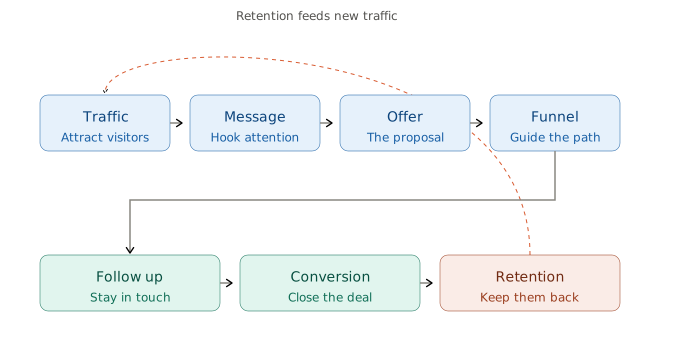
These pieces are connected. The quality of the traffic affects who lands on the page. The message and offer determine whether they have a reason to stay. The funnel needs to make the next step clear, while the follow up keeps things moving when someone isn’t ready to buy straight away.
That’s also where you see the difference between someone who knows ClickFunnels and an agency that understands funnels. A ClickFunnels specialist can build the pages, connect the forms and set up the checkout. But if conversion is poor, the real problem may sit somewhere else.
A good agency should be willing to challenge the funnel itself. If the offer is wrong, the traffic is poor or the CRM setup is broken, rebuilding the landing page isn’t going to solve much.
Our view is simple: don’t hire an agency to rebuild what you haven’t diagnosed.
What Does a ClickFunnels Agency Actually Handle?
A ClickFunnels agency isn’t just there to build pages. The work usually comes down to understanding what the funnel needs to achieve, building it, connecting it to the rest of the business, and improving it once real people start using it.

Funnel Strategy: Start With the Business Goal
Before anyone starts building, there needs to be a clear reason for the funnel. Are you trying to generate leads, sell a product, book calls, fill a webinar or move existing customers toward another offer? The answer affects the customer journey, the offer, the messaging and how the funnel should be structured.
This part is easy to skip when the focus is on getting something live quickly. But a funnel can work perfectly from a technical perspective and still do very little for the business.
Design & Development: Build Around the Customer
Once the structure is clear, the actual pages can be built. Depending on the business, that could mean a landing page, sales funnel, lead generation flow, webinar funnel, checkout or upsell.
The point isn’t to add more pages or make everything look impressive. Each step should help the visitor understand the offer and know what to do next. Good design helps with that, but it can’t fix unclear messaging or an offer that people don’t want.
Integrations: Make Everything Work Together
A funnel rarely lives inside ClickFunnels alone. New leads may need to go into a CRM, trigger an email sequence or be passed to a sales team. Payments need to work properly, analytics need to capture the right data, and different tools may need to communicate through integrations or APIs.
This is where seemingly small technical problems can become expensive business problems. A funnel can look fine on the front end while leads are failing to reach the CRM, an automation isn’t firing or conversion data isn’t being recorded correctly.
Optimisation: Launch Is Only the Start
Once the funnel is live, you finally have something real to measure. You can see where people are dropping off, which pages are converting and whether the tracking is giving you a reliable picture of what’s happening.
Changes might be as simple as rewriting a section of copy or changing a form. They might also involve the offer, checkout, mobile experience or follow up process. A/B testing can help when there are multiple reasonable options, while good tracking tells you where to look in the first place.
Launching a funnel is not proof that the funnel works. It is the point where you can finally start finding out.
Why Some ClickFunnels Projects Don’t Work
A funnel can be built exactly as planned and still bring in disappointing results. The problem isn’t always the funnel itself. Sometimes the real issue is the offer, the traffic, the page messaging or what happens after someone fills out a form.
The Funnel Was Built Before the Offer Was Clear
It’s tempting to start with the thing you can actually build. You open ClickFunnels, choose a template and start putting the pages together. But if the offer isn’t clear, there is only so much the funnel can do.
You can rewrite the headline and move the buttons around, but if people don’t see a good reason to buy, the page won’t suddenly start converting. The funnel should make a good offer easier to understand. It shouldn’t be doing the heavy lifting for a weak one.
The Page Looks Good but Doesn’t Answer the Customer’s Questions
A page can look great and still leave visitors unsure about what they’re getting, who it’s for or what happens next. People don’t convert because a page looks polished. They convert when the offer makes sense, their concerns are addressed and taking the next step feels straightforward.
Traffic Was Treated as the Solution to a Conversion Problem
More traffic won’t rescue a funnel that doesn’t convert. If 99% of your visitors leave without taking action, buying twice as much traffic simply doubles the waste.
The traffic may genuinely be the problem. But before spending more on acquisition, it’s worth finding out what happens once people actually land on the page.
Integrations Were Added as an Afterthought
CRM, email, payment and analytics are often left until the end because they aren’t as visible as the pages. That’s when small technical issues can turn into bigger business problems.
A lead that doesn’t reach the CRM, an email that never triggers or tracking that misses a conversion can make the funnel look healthier or weaker than it really is.
Nobody Owns Optimisation After Launch
The funnel goes live, the project gets marked as complete and everyone moves on. A few months later, the same funnel is still running even though the numbers have been telling you something isn’t quite right.
Someone needs to be responsible for looking at the data, spotting where people are dropping off and deciding what is worth testing.
A funnel shouldn’t be treated as finished just because the build is finished.
Do You Actually Need a ClickFunnels Agency?
Not every business needs an agency to manage its ClickFunnels funnel. If you’re running a small campaign, have an in house marketer or developer, or only need a few pages changed, doing it yourself or hiring a specialist can make more sense.
An agency becomes more useful when the funnel is a significant part of how you generate revenue. If you’re spending heavily on paid traffic, running multiple funnels, dealing with complex CRM and automation, or getting traffic without the conversions you expected, finding the problem can require more time and expertise than you have internally.
If your funnel is bringing in serious revenue, the cost of a bad funnel can be much higher than the agency fee. That’s the calculation worth making.
Hiring an agency for a simple landing page is overkill. Hiring a freelancer to manage a revenue critical funnel can create a different problem.
ClickFunnels Expert vs Agency: You’re Not Buying the Same Thing
A ClickFunnels expert and an agency can both build a funnel. The difference is usually the scope of responsibility.
If you already know what you want and just need someone to get it done, an expert can be a good fit. An agency makes more sense when the project involves strategy, multiple systems, complex integrations or ongoing optimisation.
| Requirement | ClickFunnels Expert | ClickFunnels Agency |
|---|---|---|
| One off task | ✓ | ✓ |
| Simple funnel | ✓ | ✓ |
| Funnel strategy | Depends | Usually |
| Complex integrations | Depends | Usually |
| Multiple funnels | Depends | More likely |
| Ongoing optimisation | Depends | More likely |
| Broader technical support | Limited | More likely |
The important point is that an agency isn’t automatically better. If you need a landing page built, hiring a full team may simply add unnecessary cost. But if your ClickFunnels funnel connects marketing, sales, CRM, payments and automation, having several areas of expertise under one project can reduce the gaps between them.
If you need someone to fix a funnel, hire for the task. If the funnel is an important part of how your business acquires customers, hire for the system.
What Should You Actually Look for in a ClickFunnels Agency in Australia?
Don’t start by asking only, “How much do you charge?” Start by asking what you’re actually getting for the money.
For Australian businesses, there are a few practical issues worth checking beyond ClickFunnels experience. This includes working hour overlap, project ownership, documentation, account access and what happens when the funnel needs changes after launch.
Can They Explain Why the Funnel Should Work?
A portfolio can show you what an agency has built. It doesn’t necessarily tell you whether they understood why it worked.
Ask them to explain the funnel structure, the offer, the customer journey and the reasoning behind their recommendations. If the answer is mostly about templates and design, that’s worth paying attention to.
Do They Understand Conversion, Not Just ClickFunnels?
Knowing how to use ClickFunnels is one thing. Knowing why people buy is another.
The agency should be comfortable talking about offers, messaging, landing page structure, calls to action, drop off points and conversion rates. You don’t need someone who treats every problem as a ClickFunnels problem.
Can They Handle the Technical Side?
The more important the funnel becomes, the more likely it is to touch other systems.
Ask what CRM, email, payment, analytics and API integrations they have handled before. You don’t want to discover halfway through the project that the agency can build the pages but can’t connect the systems your business already relies on.
Can They Work With What You Already Have?
Not every funnel needs to be rebuilt from scratch. You may already have pages that convert well, a CRM that’s working fine or a follow up sequence that only needs a few changes.
A good agency should look at what exists before recommending a rebuild.
Sometimes fixing three things is a better answer than replacing thirty.
What Happens After Launch?
Find out who checks the funnel once real traffic starts coming in, who looks at the conversion data and who deals with broken integrations or underperforming pages.
For Australian businesses, also clarify how handover and support work during Australian business hours. If your sales or marketing team needs an issue resolved the same day, knowing who is available and how quickly they respond matters more than simply knowing where the agency is based.
Can They Work With Your Australian Team?
This is more useful than simply asking whether an agency is based in Australia.
If you’re working with an offshore team, ask about working hour overlap, project management, response times, documentation and who owns communication. Also confirm that your business retains access to the ClickFunnels account, analytics, CRM and other connected systems rather than leaving everything under the agency’s control.
For Sydney and Melbourne businesses, Vietnam is generally three hours behind during Australian standard time and four hours behind when daylight saving is in effect. Brisbane is three hours ahead of Vietnam year round.
That can create useful overlap during the Australian working day, but only if the agency actually structures its working hours around the client.
Timezone is rarely the real problem. Poor communication is.
How Much Does a ClickFunnels Agency Cost in Australia?
There isn’t one standard ClickFunnels agency price in Australia.
As a practical 2026 benchmark, Australian funnel and CRO providers commonly quote around A$2,000 to A$10,000 for project based work, while ongoing funnel optimisation can range from roughly A$2,000 to A$8,000 or more per month, depending on scope. These are indicative market benchmarks rather than fixed ClickFunnels agency rates.
The ClickFunnels subscription is separate from the agency fee. As of 2026, ClickFunnels lists its monthly plans at US$97 for Launch, US$197 for Scale and US$297 for Optimize. Annual billing offers lower effective monthly rates.
The agency cost usually depends on the scope of work.
Fixed Project
A fixed project fee works well when you know what needs to be built. You might have a defined funnel structure, a set number of pages and clear requirements for design, integrations and delivery.
Hourly Support
Hourly work can make sense for smaller jobs such as fixing an existing funnel, troubleshooting an integration or making occasional changes.
Monthly Retainer
A retainer is more useful when the funnel needs attention after launch. This could include conversion testing, tracking checks, troubleshooting, new pages, integrations and ongoing optimisation.
Dedicated Team
For larger projects, you may need strategy, design, development and technical support rather than one person doing everything.
The important thing is not to compare quotes based only on the final number. One agency may be quoting for five pages, while another includes strategy, CRM integration, tracking, testing and post launch support. Those are not equivalent projects.
ClickFunnels Agency Australia vs Offshore: Does Location Actually Matter?
Where your ClickFunnels agency is based does matter, but it shouldn’t be the first thing you look at. The better question is whether the team can understand your business, work within your operating hours and take responsibility for the outcome.
Australian Agencies: The Local Advantage
A local Australian agency gives you easier timezone alignment and usually simpler communication. It can also be useful when your funnel depends heavily on Australian market knowledge, local campaigns or a team that needs frequent face to face interaction.
The tradeoff is usually cost. Australian delivery costs are higher, particularly when you need ongoing development and technical support.
Offshore Agencies: What You Actually Need to Check
Offshore teams can give you access to a wider technical talent pool and, depending on the team and scope, lower delivery costs. But the cost advantage only matters if the work is managed properly.
A two hour or three hour timezone difference isn’t what usually breaks a project. Missed updates, unclear ownership, slow decisions and having to explain the same thing several times are much more likely to cause trouble.
Before choosing an offshore agency, ask how much working hour overlap you will have, who manages the project, who is responsible for technical decisions, how quickly issues are normally acknowledged, where project documentation is kept, who owns the ClickFunnels account and what happens when the project needs support after launch.
Those questions tell you much more than whether the agency’s office is in Sydney, Melbourne, Brisbane or Vietnam.
Why Vietnam Can Work for Australian Businesses
Vietnam can be a practical option for Australian businesses that want access to technical talent while maintaining useful overlap with the Australian working day. Sydney and Melbourne are three hours ahead of Vietnam during standard time and four hours ahead during daylight saving, while Brisbane remains three hours ahead.
But timezone overlap alone isn’t a reason to hire a team.
ONEXT DIGITAL has worked with Australian businesses across ecommerce and software development, including Australian homewares, gift and fitness retail projects. Its public case studies include an Australian home and bedding retailer, an Australian gift box store and an Australian owned online fitness retailer.
That experience is relevant when evaluating an offshore technical partner because it demonstrates experience working with Australian businesses and requirements. It does not mean every offshore project will be a good fit. The same standards still apply: clear communication, accountable project management, proper documentation and reliable post launch support.
The best offshore partner should feel operationally close even when it isn’t geographically close.
The Questions You Should Ask Before Signing With a ClickFunnels Agency
Before you sign anything, don’t just ask about price and delivery time. Ask questions that show you how the agency thinks, who will actually do the work and what happens when the funnel is live.
1. Will You Work With Our Existing Funnel or Rebuild It?
Don’t assume a rebuild is the answer. Ask the agency to show you what they would keep, what they would change and why. If the immediate recommendation is to rebuild everything before they’ve properly reviewed your existing funnel, that’s worth questioning.
2. Who Will Actually Work on the Project?
The person selling the project isn’t always the person delivering it. Ask who will handle strategy, design, development and integrations, and who you’ll be speaking with once the project starts.
3. How Will You Measure Success?
“Making the funnel look better” isn’t a business outcome. Depending on your funnel, success might mean more qualified leads, a higher conversion rate, fewer checkout drop offs or more completed purchases. Agree on the numbers that matter before the project starts.
4. What Happens After Launch?
Find out whether the agency provides technical support, monitors performance, helps with testing and handles integration problems after launch. A funnel can behave very differently once real traffic starts coming through.
5. What Integrations Have You Worked With?
Tell the agency exactly what your funnel needs to connect to, whether that’s a CRM, email platform, payment provider, analytics tool or custom API. You don’t need an agency that has worked with every platform. You need one that understands the systems your business actually depends on.
Conclusion
A ClickFunnels funnel can be technically well built and still fail to deliver results. The right agency should not simply build the pages you ask for. It should help identify what is actually stopping the funnel from converting, work with the systems around it and measure what happens after launch.
For Australian businesses, that means choosing on capability and accountability rather than location alone. A local agency may be the right fit. An offshore team may be equally effective if the working process is clear and reliable.
ONEXT DIGITAL works with Australian businesses on ecommerce and software development from Vietnam, with public case studies covering Australian retail businesses.
If your ClickFunnels funnel isn’t performing, find the bottleneck first. Then decide what actually needs to change.
FAQs
How do I choose the right ClickFunnels agency?
Choose a ClickFunnels agency based on its experience, conversion strategy, technical capabilities, integration experience, communication process and ongoing support. A good agency should be able to explain why a funnel is structured a certain way and identify problems with the offer, messaging or customer journey rather than automatically recommending a rebuild.
How much does a ClickFunnels agency cost in Australia?
The cost depends on the funnel’s complexity, number of pages, design and copy requirements, integrations, automation and ongoing support. A simple funnel will generally cost less than a complex sales funnel connected to CRM, payment and marketing systems. Ask for a detailed scope so you can compare what each agency actually includes.
Should I hire a ClickFunnels expert or an agency?
A ClickFunnels expert is usually suitable for straightforward work such as building a landing page, fixing an existing funnel or making specific changes. An agency is generally a better fit when the project involves funnel strategy, multiple systems, complex integrations, ongoing optimisation or a funnel that plays an important role in generating revenue.
Can a ClickFunnels agency work with an existing funnel?
Yes. A ClickFunnels agency can audit and improve an existing funnel without rebuilding everything from scratch. This may involve improving specific pages, fixing integrations, changing messaging, reducing drop offs or testing different elements. In many cases, fixing the main bottleneck is more effective than replacing the entire funnel.
What should I ask a ClickFunnels agency before hiring them?
Ask who will work on your project, how they measure success, whether they can work with your existing funnel, what integrations they have handled and what support they provide after launch. Their answers can help you determine whether they understand the wider business problem rather than simply knowing how to build ClickFunnels pages.
Can an offshore ClickFunnels agency work with Australian businesses?
Yes. An offshore ClickFunnels agency can work effectively with Australian businesses when it has clear communication processes, suitable working hour overlap, reliable project management and relevant technical experience. The agency’s location is less important than its ability to communicate clearly, meet deadlines and take responsibility for the work.