
 Services
 Solutions
 Main platform
 Technology
 White Label
  Offshore
 Hire developers



If you’re running or planning to launch an online store for the Australian market, there’s something you need to account for that has nothing to do with your product, pricing, or ad strategy.
Trust in ecommerce is getting harder to earn. Not because people have stopped buying online, but because a growing number of so called “ghost stores” websites that look like legitimate local businesses but aren’t have made shoppers more cautious across the board, including with stores that are completely legitimate.
This is not just an Australian issue, but it’s in Australia where it has been most clearly documented, backed by data from regulators and consumer protection agencies. For any business investing in a serious ecommerce setup, this matters. How your store is built from day one directly affects how quickly customers decide to trust it, and whether they buy at all.
What a Ghost Store Is in Australia and Why It’s Becoming So Common in Ecommerce
The Australian Competition and Consumer Commission (ACCC) uses the term “ghost store” to describe websites that present themselves as local Australian businesses while having no real presence behind them. In practice, these are online stores with no physical location, no genuine team operating in Australia, and a business model that typically relies on dropshipping low-cost products from overseas and reselling them at a significant markup, often framed as a limited time boutique closing down sale.
The scale of the problem is larger than most people expect. In 2025, Australians reported hundreds of millions of dollars in losses linked to online shopping scams, according to data from Scamwatch (Australian Government). Broader figures from the Australian Competition and Consumer Commission (ACCC) show that total scam losses across Australia reached multi-billion-dollar levels in 2025, continuing an upward trend compared to previous years.
In the first quarter of 2026, Scamwatch data indicates that a significant share of reported losses came through online channels, including fake websites, paid ads, and social media platforms.
So why is this happening now? It comes down to a few separate shifts that have quietly reinforced each other over time.
First, it has become extremely easy to make something look legitimate. AI tools and ready made templates mean that a convincing storefront, complete with branding, product descriptions, and even a founder story, can be put together in a very short time. What used to require design, copywriting, and production effort can now be assembled in hours.
Second, advertising platforms are highly efficient at targeting. With relatively small budgets, these stores can reach users who are already inclined to support local or boutique businesses. In other words, they are not broadcasting broadly, but focusing on the exact audience most likely to trust the message.
Finally, the most effective part is not pricing, but emotion. The same narrative keeps appearing across multiple sites: a small family run boutique forced to close, everything heavily discounted, urgency created through limited time offers. It is not random. It works because it taps into genuine empathy, and that makes it harder for people to pause and question what they are seeing.
Taken together, these factors create a kind of repeatable system. It is fast to set up, easy to target, and effective at triggering trust at the exact moment a customer is making a decision. The result is that the losses reported each year are not isolated incidents, but the output of a model that continues to scale until enforcement catches up.
ACCC Ghost Store Warning Signs: What They Are and What They Really Mean for Online Shoppers
If you are building an online store for the Australian market, it’s worth understanding that the warning signs highlighted by the Australian Competition and Consumer Commission (ACCC) are not just consumer advice. They also reveal the basic gaps that fake businesses cannot fully cover. In practice, these are the same signals Australian shoppers are increasingly using to decide whether a website feels trustworthy.
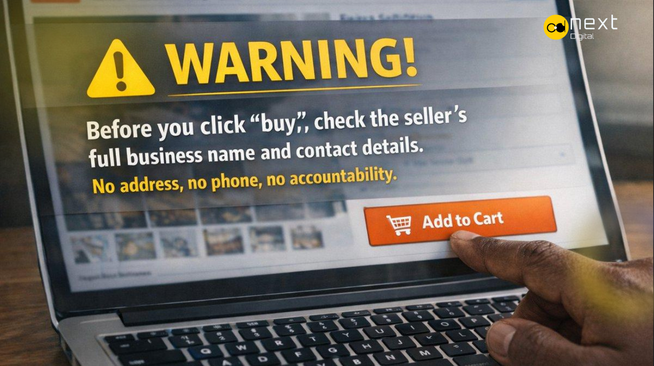
A .com domain instead of .com.au. This is not a stylistic choice. A .com.au domain requires a verified Australian Business Number (ABN), meaning the business must be properly registered in Australia. Many ghost stores operating from overseas cannot meet this requirement, which is why they often use .com domains instead.
A “closing down” story combined with countdown timers. This is a common urgency tactic in ecommerce. Messages like “only a few items left” or “sale ends tonight” are designed to push quick decisions. In many ghost store cases, these claims are not tied to real stock levels or actual business events.
AI-generated founder images or made-up brand identities. A simple check is to look at the website’s history using tools like the Internet Archive. If a business claims to have existed for years but only appears recently in archived versions, or if key visuals change completely over time, it often indicates that the brand identity is not genuine or consistent.
Reviews that don’t match across platforms. A typical pattern is that reviews on the website are very positive, while independent platforms like Google Reviews or Trustpilot show a very different picture. This is why the ACCC advises shoppers to always cross-check external sources instead of relying only on on-site testimonials.
Missing business information such as an ABN, physical address, or phone number. While some early-stage businesses may have limited details, the complete absence of verifiable contact information is still a warning sign. Legitimate businesses are usually traceable in more than one way.
Returns policies that require shipping goods overseas, along with legal terms referencing foreign laws instead of Australian Consumer Law. This often indicates that the business is not actually operating locally, even if it presents itself as an Australian store.
How Legitimate Online Stores Are Affected: The Hidden Cost of Ghost Store Confusion and Lost Trust
One angle that rarely gets enough attention is that ghost stores don’t just affect customers. They also create real problems for legitimate businesses that happen to get caught in the same naming or branding space.
A clear example is Everly Collective, an Australian fashion label that had no connection to the “Everly Melbourne” website flagged in public warnings by the Australian Competition and Consumer Commission (ACCC). Because the names were similar, the real brand ended up having to publicly clarify that it was not involved, simply to avoid confusion. That kind of cleanup takes time, resources, and attention away from actually running the business. A similar issue happened with Gorman in 2023, when copycat websites forced the brand to actively work on takedowns and brand protection.
There is also a useful precedent that shows how seriously this kind of behavior can be treated. In one case, the Federal Court of Australia fined Meg’s Flowers in Brisbane for running a large network of location-based websites and targeted ads that falsely presented the business as local in different areas. The key point here is not just the penalty itself, but the fact that regulators do take misleading geographic positioning and deceptive branding seriously when it crosses the line.
Beyond individual cases, there is a broader impact on the market. As trust in ecommerce becomes more fragile, new stores are often judged more harshly, especially those without an established track record or strong review history. That means lower conversion rates and higher acquisition costs, simply because more effort is required to convince first-time customers that a store is legitimate. This is an often overlooked cost that now sits inside customer acquisition economics in markets like Australia.
Regulators have also started looking more closely at the platforms themselves. The ACCC has raised concerns with both Meta and Shopify around merchant oversight and enforcement. Meta has acknowledged the ongoing challenge and described it as part of a wider fight against organised online fraud. While this kind of response signals stronger enforcement in the future, it also means platforms are likely to tighten onboarding requirements for all new merchants. The challenge is that these systems are not perfect at distinguishing between bad actors and first-time legitimate businesses.
As a result, the barrier to entry is gradually increasing. That makes the early decisions around platform choice, setup quality, and trust infrastructure more important than ever, because fixing those foundations later is significantly harder than getting them right from the start.
Ecommerce Trust Checklist: How to Build Trust With Australian Shoppers on First Visit
This is the most important part if you are launching or rebuilding an ecommerce store for Australian customers. In a market where trust is increasingly under pressure, small details in how your store is set up can directly affect whether someone feels comfortable buying from you.
1. Build legal transparency into the foundation, not as an afterthought
Business details such as ABN or ACN should be clearly visible in the footer, About page, and Contact page. These should be part of the site setup itself, not something added later. If you are serious about the Australian market, using a .com.au domain early is worth considering, since registration requires ABN verification and immediately adds a layer of credibility.
2. Make contact information real, visible, and consistent
A single contact form with no other details often creates doubt. A trustworthy store should have at least a business email on its own domain, a phone number that is actually answered, and clear expectations around response time. These should feel like part of the customer experience, not hidden support information.
3. Show real operational signals, not just polished design
Strong branding and clean UI matter, but they are not enough on their own. Customers also look for signs that a real operation exists behind the website, such as product photos taken in real environments, packaging, warehouse activity, or shipping processes. A fast-loading site with a secure checkout also reinforces that the business is properly set up and maintained.
4. Keep policies simple, clear, and locally relevant
Return and refund policies should reference Australian Consumer Law rather than generic templates from other markets. Shipping costs and delivery timelines should be clearly stated before checkout. If the business uses dropshipping, it is better to be transparent about it rather than leaving customers to discover it later. Clarity tends to build more trust than over-polished wording.
5. Use external, verifiable social proof
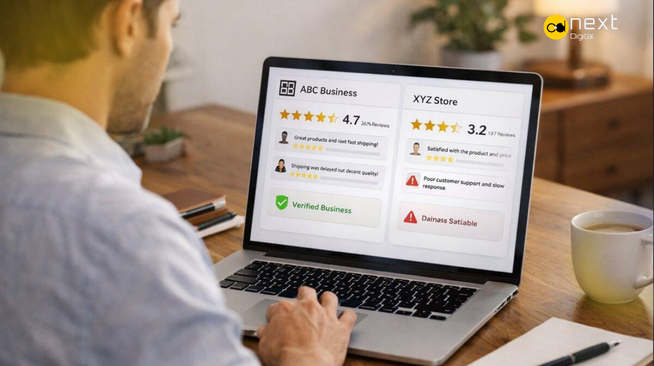
Reviews are more powerful when they can be independently verified. Encouraging feedback on platforms like Google Reviews or Trustpilot helps build credibility outside of your own website. While it may feel counterintuitive to direct customers away from your site, independent validation is often what reassures first-time buyers the most.
6. Treat transparency as a competitive advantage
Instead of only trying to avoid being mistaken for a ghost store, real businesses can actively show how they are verifiable. A simple page or section explaining how customers can check your ABN, view external reviews, or contact you directly can significantly reduce friction. In a market where skepticism is becoming the default, openness itself becomes a differentiator.
Why Ecommerce Trust Is Now Infrastructure, Not Just Marketing or Branding
Ghost stores are not going away anytime soon. The Australian Competition and Consumer Commission (ACCC), Scamwatch, and the major platforms are all actively trying to deal with the issue. In the first quarter of 2026 alone, thousands of scam websites were taken down, and hundreds of ads and social media accounts were referred to Meta for review. But the pattern is becoming familiar. One wave gets shut down, and another quickly replaces it, mainly because these operations are cheap and easy to spin up.
For anyone building a real sales channel in Australia, the takeaway is fairly simple. Trust is no longer something you add later through branding or marketing. It has to be built into the foundation of the site from day one, on the same level as performance, UX, and payment security. When an ecommerce store is set up properly from the start, with clear legal details, real ways to contact the business, and a consistent experience across the site, it does more than build confidence. It also removes friction at the point where customers decide whether to buy.
If you are planning to build or rebuild an ecommerce platform for the Australian market, the focus should be on getting those foundations right early. That means a clean site structure, secure payments, and a user experience that feels reliable from the first visit. This is also where working with an experienced ecommerce development partner can make a difference, helping you avoid small gaps in setup and trust signals that can quietly turn into lost sales over time.
FAQs
What is a ghost store?
A ghost store is an online shop that appears to be a legitimate local business but has no real physical presence or genuine operations behind it. These stores often use misleading branding and dropshipping models to sell products under the appearance of a trusted local retailer.
How do I know if an online store is legit in Australia?
You can check if an online store is legitimate by verifying its Australian Business Number (ABN), looking for a real physical address, checking independent reviews on platforms like Google or Trustpilot, and ensuring the website has transparent policies under Australian Consumer Law.
Are ghost stores scams?
Many ghost stores operate in a grey area. While not all are classified as scams, some use misleading or deceptive practices that may breach Australian Consumer Law. In more serious cases, they are investigated by regulators such as the ACCC for false or misleading conduct.
What are the warning signs of a fake online store?
Common warning signs include missing ABN details, fake urgency like “closing down sale,” heavily discounted prices that seem unrealistic, inconsistent or fake reviews, and unclear or overseas return policies.
Why am I seeing so many fake online stores on Facebook and Instagram?
Fake or misleading stores often use targeted advertising on social media platforms like Facebook and Instagram because they can reach highly specific audiences at low cost. These ads are designed to create urgency and emotional trust, making users more likely to buy quickly.
What should I do if I bought from a ghost store?
If you suspect you’ve purchased from a ghost store, contact your bank or payment provider immediately to request a chargeback. You should also report the website to Scamwatch and avoid providing additional personal or financial information.