
 Services
 Solutions
 Main platform
 Technology
 White Label
  Offshore
 Hire developers



Choose the wrong payment gateway and the impact goes far beyond a few extra percentage points in transaction fees.
What often gets overlooked is what happens at checkout. A customer reaches the payment page, doesn’t see their preferred payment method, hesitates for a second, and leaves. That lost sale never shows up as a separate cost in your reports, but it affects revenue all the same.
The way Australians pay online has changed dramatically over the past few years. According to data from the Reserve Bank of Australia, consumers made more than 520 million mobile wallet transactions worth $24.3 billion AUD in February 2025 alone. Digital wallets have become mainstream, with most Australian businesses now accepting at least one wallet-based payment option.
The same trend is visible in Buy Now Pay Later services. From June 2025, BNPL products came under Australia’s consumer credit regulations, adding another layer of legitimacy and consumer confidence to services such as Afterpay.
By 2026, most Australian shoppers expect to see options like Apple Pay, Google Pay, and Afterpay when they reach checkout. They don’t think of these as bonus features anymore. They’re simply part of a normal online shopping experience. If your store doesn’t support the payment methods customers prefer, you’re creating unnecessary friction right at the point where a sale should be completed.
In this guide, we’ll look at the major payment gateways available to Shopify merchants in Australia, compare what they actually cost, highlight their strengths and limitations, and help you decide which setup makes the most sense for your business.
Why Your Choice of Payment Gateway Matters More Than You Think?
Before comparing providers, it’s worth looking beyond the advertised processing rates and understanding where the real costs come from.
One detail many Shopify merchants overlook is the platform’s additional transaction fee when using a third-party payment gateway. Depending on your Shopify plan, that fee can range from 0.6% to 2% on top of the gateway’s own charges.
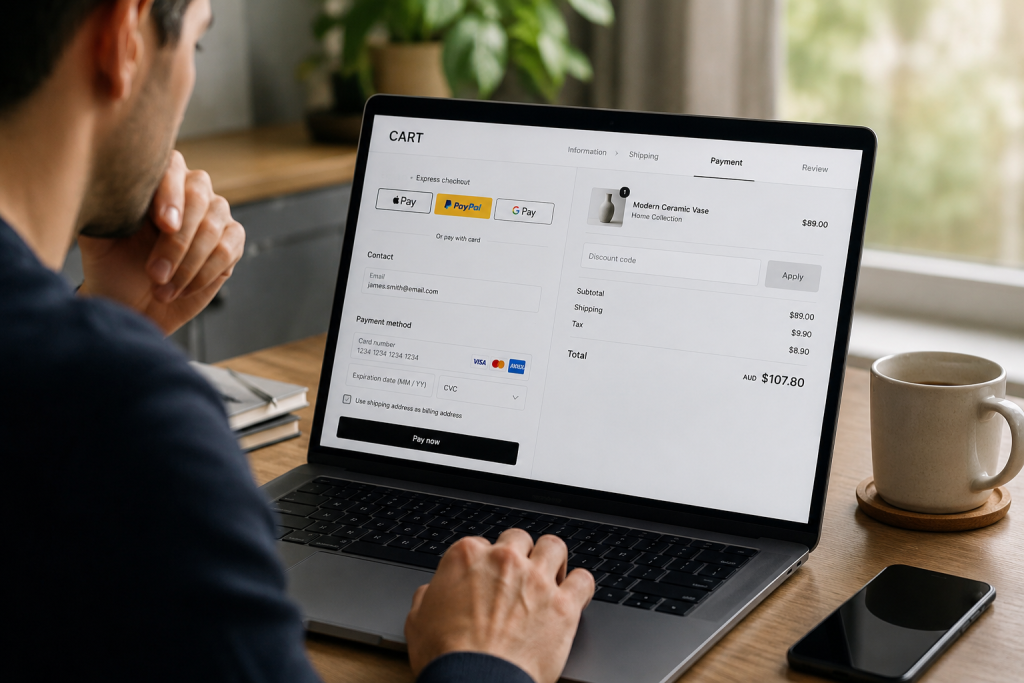
For example, if your store generates $100,000 AUD in annual revenue and you’re on the Basic plan, Shopify’s extra 2% fee alone adds up to around $2,000 AUD per year. That’s money being spent without improving your marketing, operations, or customer experience.
But fees are only part of the story. The bigger issue is what happens at checkout. Baymard Institute research found that a noticeable share of shoppers abandon their carts simply because they can’t use the payment method they prefer.
That’s particularly relevant in Australia, where services like Afterpay, Apple Pay, Google Pay, and PayPal have become part of everyday online shopping. When customers reach the final step of checkout and don’t see an option they trust or regularly use, some will complete the purchase anyway. Others won’t.
That’s why choosing a payment gateway isn’t just about reducing fees. It’s also about removing friction at the exact moment a customer is ready to buy.
1. Shopify Payments
Shopify Payments is built directly into Shopify, and for Australian merchants it is usually the most sensible starting point.
Fees by plan (AUD, 2026)
| Shopify Plan | Monthly fee | Online transaction fee | Third-party gateway fee |
| Basic | $56 AUD | 1.75% + $0.30 | 2% |
| Grow | $149 AUD | 1.60% + $0.30 | 1% |
| Advanced | $575 AUD | 1.40% + $0.30 | 0.6% |
Source: Shopify AU, GemPages (March 2026)
The third column is the one that really matters. If you are not using Shopify Payments and instead rely on something like Stripe or PayPal, Shopify adds an extra transaction fee on top of whatever your payment provider already charges.
In practice, this means you are paying twice for the same transaction flow. This is exactly why Shopify Payments becomes the default choice for most stores.
What Shopify Payments supports in Australia?
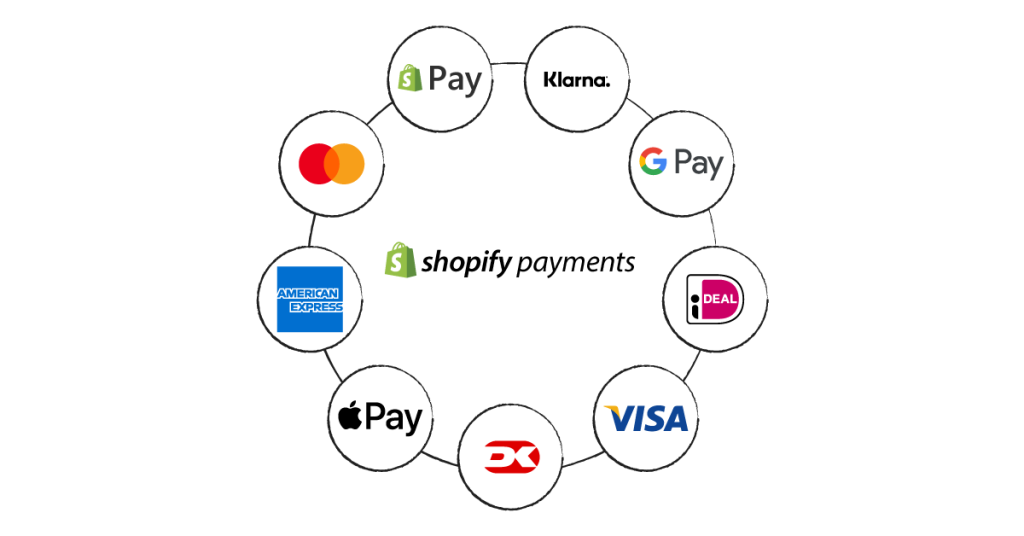
- Visa, Mastercard, American Express
- Apple Pay and Google Pay
- Shop Pay, which is Shopify’s accelerated one click checkout
- EFTPOS via Shopify POS for in person sales
- Payouts to Australian bank accounts, typically within 2 business days
Why Shopify Payments is the default for most stores?
- No third-party transaction fees
This is the main advantage. For example, a store doing around $200,000 AUD per year on the Basic plan could save roughly $4,000 annually by sticking with Shopify Payments instead of using an external gateway and paying Shopify’s extra fee on top.
- Everything in one place
Payments, refunds, chargebacks and payouts are all handled inside Shopify’s dashboard. There is no need to switch between Stripe, PayPal and your store backend just to reconcile numbers.
- Shop Pay actually moves the needle
Shop Pay is often overlooked, but it has a real impact on conversion. Returning customers can check out with just an email and a verification code, which removes a lot of friction at the final step. Shopify has reported average improvements of around 1.7% in conversion rate and up to 18% lower cart abandonment on mobile for stores using Shop Pay.
Things to watch out for:
- International cards and American Express come with higher rates (around 2.60% + $0.30 AUD), which can reduce margins if you have a high share of international customers
- Not all business models are eligible since Shopify Payments restricts certain industries
- Account reviews and payout holds can still happen, which may temporarily affect cash flow if you are not prepared
Best for:
Most Shopify stores in Australia, especially at launch and during early growth. Unless you have very specific payment requirements, Shopify Payments is usually the cleanest and most cost effective setup to start with.
2. Stripe

Stripe is the closest competitor to Shopify Payments in terms of pricing and capability, but it takes a different approach. It is more flexible, more developer focused, and generally better suited for complex or custom setups.
Fees in Australia (2026):
- Domestic AU card transactions: 1.75% + $0.30 AUD (before GST)
- International cards: 3.5% + $0.30 AUD
- Afterpay via Stripe: around 6% + $0.30 AUD (including GST), significantly more expensive
- Klarna and Zip: available, pricing by arrangement
Source: GlobalFeeCalculator.com, Stripe AU Pricing (May 2026)
On a simple example, for a $100 AUD transaction, Stripe costs around $2.05 AUD, while PayPal is closer to $2.90 AUD. That is a difference of about $0.85 per transaction.
If a business processes $100,000 AUD per year, Stripe can end up roughly $850 AUD cheaper than PayPal, before considering GST reclaim effects.
When Stripe actually makes sense over Shopify Payments
Here is the honest version. If you are running a Shopify store and you use Stripe without Shopify Payments, you will pay Stripe’s processing fees plus Shopify’s additional third-party transaction fee (between 0.6% and 2%). In most standard cases, Shopify Payments still comes out cheaper.
Stripe becomes worth it in more specific scenarios:
- You sell across multiple platforms such as Shopify, WooCommerce, or a custom-built app and want one unified payment system
- You need custom webhooks, API integrations, or more advanced checkout logic
- You run subscription or recurring billing models using Stripe Billing
- You require more advanced multi-currency handling at scale
Best for:
Technical founders, multi-platform businesses, or stores that need more control over payment logic than what Shopify Payments provides out of the box.
3. PayPal
PayPal should not be your primary payment gateway. But not offering it at all is usually a mistake.
According to PayPal’s own research, 54% of consumers are more willing to buy from an unfamiliar online store when PayPal is available at checkout. Even more striking, 59% of PayPal users have abandoned a purchase because PayPal was not an option. In Australia, PayPal accounts for around 64% of digital wallet purchases.
Fees in Australia:
- Domestic transactions: approximately 2.6% + $0.30 AUD, higher than both Shopify Payments and Stripe
- International transactions: additional currency conversion fees apply
PayPal is clearly more expensive. But the common mistake is treating this as a simple “Stripe vs PayPal” comparison. The real question is whether you should offer PayPal at all as part of your checkout mix.
The right way to use PayPal
If you have Shopify Payments enabled and add PayPal as a secondary payment option, Shopify does not charge the third-party transaction fee on PayPal orders. You only pay PayPal’s own processing fee, without double charges.
That small detail changes the economics quite a bit. In most cases, the optimal setup is: Shopify Payments as the primary gateway plus PayPal Express Checkout as a secondary option.
Best for:
Adding PayPal as a supporting checkout method alongside Shopify Payments. It is especially useful for stores selling internationally or targeting customers over 35 who still strongly prefer PayPal at checkout.
4. Afterpay & Zip
Australia is one of the most mature Buy Now Pay Later (BNPL) markets in the world on a per-capita basis. As of 2025, roughly one in three Australians uses BNPL, and new regulation introduced in June 2025 has made the category feel more structured and mainstream rather than less relevant.
4.1 Afterpay:
Afterpay is the most recognised BNPL brand in Australia and integrates smoothly with Shopify.
Merchant fee: approximately 6% + $0.30 AUD per transaction when processed through Stripe. This is around 3 to 4 times the cost of a standard card payment.
So why do merchants still use it?
The answer is simple. Afterpay often increases conversion and lifts average order value by 20%-30% because customers are not forced to pay the full amount upfront. That uplift can more than offset the higher fees, but only if your margins are healthy enough.
If your product margin is below roughly 20%, you need to be careful. In some cases, Afterpay can eat into profitability faster than it improves conversion.
Note on regulation: From June 2025, BNPL providers are regulated under the National Consumer Credit Protection Act. This adds compliance requirements for providers, but also improves consumer trust, which tends to support long-term adoption.
4.2 Zip
Zip (including Zip Pay and Zip Money) is generally better suited for higher-ticket purchases compared to Afterpay.
Zip Money supports credit limits of up to $10,000 AUD, which makes it more appropriate for categories like electronics, furniture, and fitness equipment. In these cases, Afterpay’s lower limits can become a constraint.
Best for:
Afterpay works best for fashion, accessories, and homeware, especially when average order value is above $50 AUD.
Zip is more suitable for higher-ticket categories such as electronics, premium home goods, or any product where customers need more flexible financing limits.
5. Square
Square sits in a slightly different category compared to the other payment providers. It is not just a payment gateway, it is really designed as an all-in-one system for in-person POS and online payments. And in that space, it does a solid job.
Fees in Australia:
- In-person (tap, chip, swipe): 1.6% flat with no fixed per-transaction fee
- Online: 1.9% + $0.10 AUD
The in-person rate is where Square becomes genuinely competitive. For example, on a $10 in-person transaction, Square takes $0.16. A typical online processor like Stripe would be closer to $0.53 for a similar payment flow. That difference becomes meaningful for high-volume, low-average-order businesses such as cafés, pop-up stores, or market stalls.
Shopify integration reality:
This is where Square becomes less straightforward. Square does integrate with Shopify, but it is not a native, tightly unified experience. If you run Square for physical retail and Shopify for ecommerce, you will usually end up in one of two situations:
- Managing two separate inventory systems
- Or relying on third-party sync tools to keep everything aligned
Both approaches work, but neither is completely frictionless. As the business grows, this setup can create operational overhead.
Best for:
Square is best suited for businesses that already run Square hardware in physical locations and want to add an online store on top.
It is not the strongest choice if you are purely ecommerce on Shopify. In that case, Shopify Payments or Stripe-based setups are usually simpler and more efficient.
Real Cost Comparison: What Does Each Gateway Actually Cost on $100,000 AUD/Year?
Assumptions: 100% domestic AU card transactions, Shopify Basic plan, ~1,000 transactions/year, $100 AUD average order value.
| Gateway setup | Transaction fee | Shopify add-on fee | Estimated annual cost |
| Shopify Payments only | 1.75% + $0.30 | None | ~$2,050–$2,350 AUD |
| Stripe only (no Shopify Payments) | 1.75% + $0.30 | +2% | ~$4,050–$4,350 AUD |
| PayPal only (no Shopify Payments) | 2.6% + $0.30 | +2% | ~$4,900–$5,200 AUD |
| Shopify Payments + Stripe (secondary) | 1.75% + $0.30 | None* | ~$2,050–$2,350 AUD |
Key takeaway
The biggest cost difference is not Stripe vs PayPal. It is whether Shopify Payments is active or not. Once Shopify Payments is removed, Shopify’s additional transaction fee quietly becomes the most expensive part of the entire stack. That is why the total annual cost almost doubles in some setups, even when the underlying gateway fees look similar.
Apple Pay & Google Pay Are No Longer Optional
This is no longer a question of whether you should enable them. The real question is why they are not already turned on.
In Australia, digital wallet usage has become mainstream, especially among younger buyers. Over 60% of adults aged 18 to 29 use a digital wallet at least once a week. Apple Pay alone accounts for around 25% of the digital wallet market share in Australia. Industry forecasts also project digital wallet transaction value to exceed $200 billion AUD in 2025, growing more than 20% year on year from 2024.
When you use Shopify Payments, Apple Pay and Google Pay come included by default. There are no extra processing fees beyond standard Shopify Payments rates, and no separate integration work required.
In most cases, it is literally a couple of clicks in your Shopify admin to enable them, and once activated, they quietly improve checkout speed and conversion without adding any operational overhead.
Why it matters in practice
The impact is not about novelty, it is about friction. Digital wallets remove the need to manually enter card details, which is often where mobile users drop off. That small reduction in friction tends to show up directly in higher conversion rates, especially on mobile traffic.
Bottom line
If you are already using Shopify Payments, there is almost no scenario where Apple Pay and Google Pay should be disabled.
They are low effort, zero extra cost, and consistently one of the highest ROI checkout improvements you can make.
Quick Reference: Which Gateway for Which Store?
| Your situation | Recommended setup |
| New store, want simplicity | Shopify Payments + PayPal Express |
| Scaling, want to reduce fees | Shopify Payments on a higher plan (lower % rates) |
| Products priced $50 AUD+ | Shopify Payments + Afterpay |
| High-ticket items (electronics, furniture) | Shopify Payments + Afterpay + Zip |
| Multi-platform or custom API needs | Shopify Payments + Stripe (technical setup) |
| Selling in-person and online | Square (if hardware already exists) or Shopify POS |
| International customers | Shopify Payments + PayPal + Airwallex |
| Want to build trust with new visitors | Add PayPal Express as a checkout option |
5 Common Mistakes Australian Shopify Merchants Make With Payments
1. Running only one payment method:
Shopify supports multiple gateways simultaneously. There’s no cost to offering PayPal alongside Shopify Payments when it’s set up correctly. Different customers have different habits you can’t predict which one they’ll use.
2. Not enabling Apple Pay and Google Pay:
Both can be activated in two clicks inside Shopify Payments settings. No extra fees. Given that more than half of Australian online shopping happens on mobile, there’s no justification for leaving these off.
3. Adding Afterpay without checking the margin maths:
The ~6% Afterpay fee eats into margin fast. If your product margin is under 20%, do the calculation before turning it on. Afterpay makes the most sense when high AOV or conversion uplift more than compensates for the higher fee.
4. Using a third-party gateway without Shopify Payments active:
If you activate Stripe or PayPal as your only gateway without enabling Shopify Payments, Shopify charges its additional transaction fee on top. The fix: always keep Shopify Payments active as your primary gateway, then add others as secondary options.
5. Not revisiting your setup as you grow:
The right gateway configuration at $50,000 AUD/year is not necessarily right at $500,000 AUD/year. Higher Shopify plans lower your transaction rates. New payment methods emerge PayTo (account-to-account payments) is being pushed by Australian banks and is expected to grow significantly through 2026. Review your payment setup at least once a year.
Final Thought
There’s no single “best” payment gateway for every Shopify store in Australia. But there is a configuration that works for most:
Shopify Payments as your primary gateway, PayPal Express as a secondary option, Apple Pay and Google Pay enabled from day one. Add Afterpay once your AOV and margins support it. Consider Zip if you sell high-ticket items. Bring in Stripe only if your technical requirements outgrow what Shopify Payments can handle natively.
What matters more than any individual provider is how well your overall setup is structured from fees to checkout flow to conversion impact. This is where Shopify payment and checkout optimization as part of professional Shopify development services becomes critical.
Payments aren’t a set and forget configuration. The Australian market is moving fast digital wallet adoption is accelerating, BNPL regulation is reshaping the landscape, and account to account payment infrastructure is being built out. The stores that stay on top of this aren’t necessarily the biggest ones they’re the ones actively working with Shopify development specialists to continuously optimize their store performance and checkout experience.
FAQs
What is the best payment gateway for Shopify in Australia?
For most Shopify stores in Australia, Shopify Payments is the best option. It has competitive processing fees and removes Shopify’s extra third-party transaction fee, making it the most cost-effective and simplest setup for most merchants.
Is Stripe better than Shopify Payments?
Not usually. Stripe is only better for advanced use cases such as multi-platform setups, custom checkout flows, or subscription billing. For standard Shopify stores, Shopify Payments is typically cheaper overall because it avoids additional Shopify fees.
Should I offer PayPal on my Shopify store?
Yes. PayPal should be included as a secondary payment option. It increases trust, especially for international customers, and can reduce cart abandonment even if it has higher processing fees.
Is Afterpay worth it for Shopify stores?
Afterpay can be worth it if your margins allow it. It often increases conversion rates and average order value by 20–30%, but the fees are high (around 6% + $0.30), so it works best for products with healthy profit margins.
Why is Shopify Payments important beyond just fees?
Because it also avoids Shopify’s additional transaction fee (0.6%–2%) applied when using third-party gateways. This means total transaction cost can be significantly lower, not just the gateway fee itself.