
 Services
 Solutions
 Main platform
 Technology
 White Label
  Offshore
 Hire developers



Imagine launching an online store by turning a few simple ideas into a fully functional storefront, without coding, without complex design work, and without spending weeks on setup. With the rise of Shopify AI website builder tools in 2026, this is no longer just a concept but a practical reality for many entrepreneurs.
These AI powered platforms automate much of the store building process, from selecting products with strong market potential to generating high converting product descriptions and optimizing layouts for better user experience. Instead of juggling multiple time consuming tasks, you can focus on what matters most, marketing, customer experience, and growing your revenue. As a result, the barrier to starting an eCommerce business is significantly lower than before.
In this guide, we will explore some of the most effective Shopify AI website builder tools available today, highlight their key features, and examine real world use cases. You will also learn how these tools can help you launch your store faster and optimize it for conversions from day one.
1. What is a Shopify AI Website Builder?
Shopify AI website builders are smart platforms that simplify the process of creating and launching an eCommerce store on Shopify. These tools use artificial intelligence to automate key tasks such as product selection, store design, content creation, and overall store setup.
What makes them particularly useful is the amount of time and effort they save. Instead of spending weeks building a store manually, you can create a polished, ready to sell storefront in just a few hours, or even minutes. While that may sound ambitious at first, it has become increasingly achievable thanks to advancements in AI technology.
1.1. Leading Shopify AI Website Builders in 2026
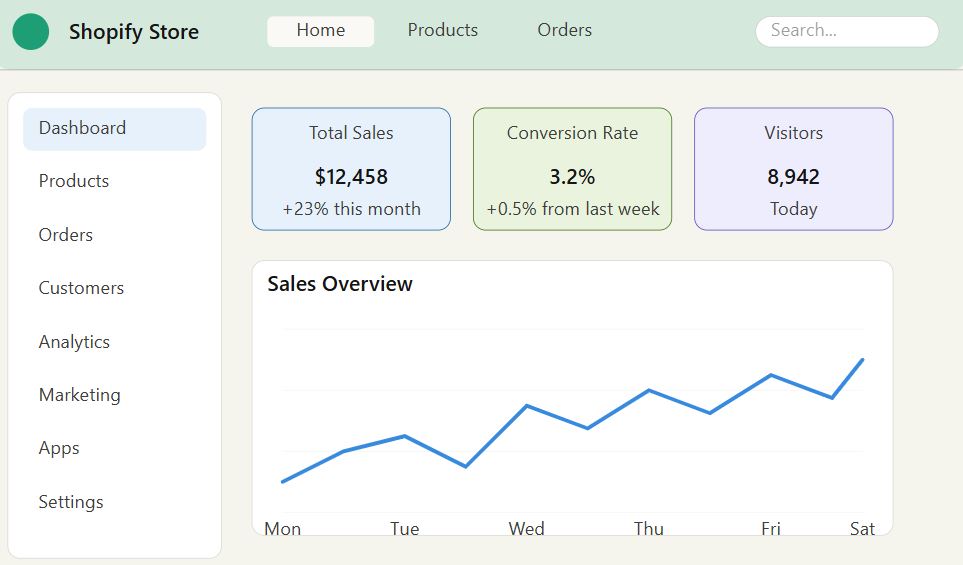
By 2026, a wide range of AI powered Shopify tools are available to help entrepreneurs not only launch their stores but also manage and grow them more efficiently. Below are some of the most widely used options:
- Instant Shopify AI Website Builder: An all in one solution that allows you to create pages or sections using simple prompts, with built in AI for generating content and improving SEO performance.
- Shopify Magic: A free set of AI features from Shopify that supports tasks such as image editing, keyword suggestions, FAQ generation, email creation, and checkout assistance.
- Shopify Sidekick: An AI assistant integrated into Shopify that guides you through setup step by step while also providing strategic recommendations and content suggestions.
- Shogun AI Tools: Focuses on AI generated copy, section building, and SEO enhancements to improve overall store performance.
- Gempages AI Page Builder: Known for its “image to layout” capability, with additional AI features expected to expand over time.
1.2. Types of Shopify AI Website Builders
1.2.1. Fully Automated Store Creation
Some tools take a fully automated approach. You provide a few basic inputs, and the system handles the entire store creation process from start to finish.
Typically, you only need to enter details such as your business idea, target audience, and design preferences. The AI then generates a complete Shopify store, including:
- Selecting products based on market demand
- Writing product titles and descriptions optimized for sales
- Designing a layout aligned with your brand direction
- Creating essential pages such as About, Contact, and policy pages
- Setting up basic payment and shipping configurations
This approach is ideal for users who want to launch quickly without getting into technical details. For example, some tools like AutoDS claim they can generate a Shopify store in just a few minutes, which is especially appealing for dropshipping models.
1.2.2. AI Powered Assisted Store Creation
Other tools follow a more collaborative approach. Instead of fully automating the process, they assist you with suggestions while you remain in control of the final decisions.
With this method, you build your store step by step, supported by AI driven insights such as:
- Recommending products with strong demand in your niche
- Generating SEO friendly product descriptions that improve conversion rates
- Suggesting pricing strategies based on competitor analysis
- Providing layout recommendations aligned with your brand identity
- Offering practical marketing insights to help increase traffic and sales
This approach is well suited for users who want guidance from AI while still maintaining flexibility and creative control over their store.
2. Three Key Benefits of Using Shopify AI Website Builders
Setting up an online store can feel overwhelming, especially if you do not have a technical background or design experience. Shopify AI website builders help reduce much of that complexity by streamlining the entire process and making store creation more accessible to a wider range of users.
2.1. Save Significant Time and Effort
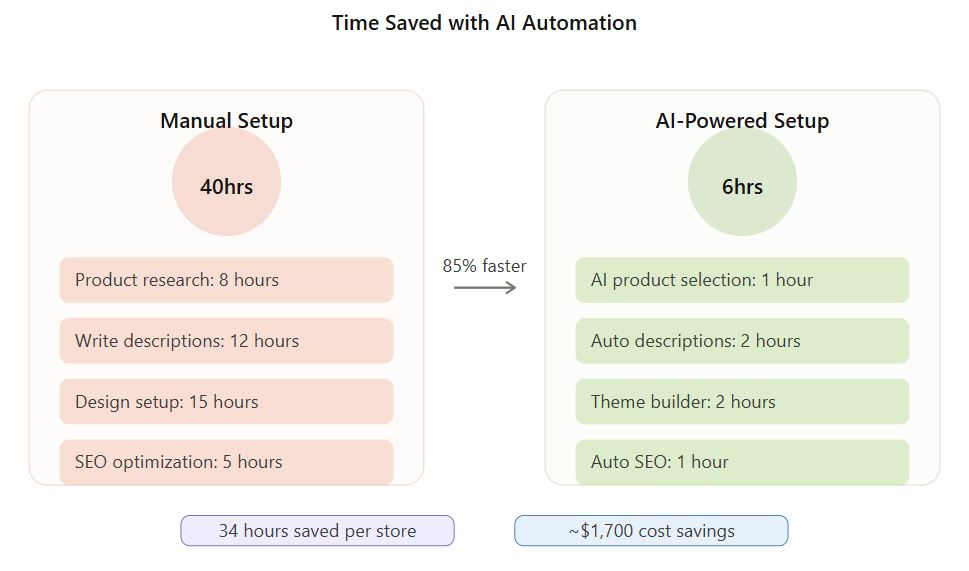
One of the biggest advantages of these tools is the amount of time they save. Instead of manually handling repetitive tasks such as writing product descriptions, optimizing pages for search engines, or editing images, AI can handle much of the workload automatically.
This enables you to move from idea to launch much faster, which is especially important in eCommerce. Being able to launch quickly can make the difference between capitalizing on a trending product and missing the opportunity. What traditionally takes weeks can now often be completed in just a few hours.
2.2. No Technical or Design Skills Required
Another key benefit is that you do not need any coding or design expertise to get started. The technical aspects, including layout structure and visual styling, are managed by the platform in the background.
Most tools provide ready made themes, pre built layouts, and design suggestions that already follow modern eCommerce standards. This makes them particularly useful for solo entrepreneurs or small teams who want to launch quickly without relying on developers or designers. As a result, the barrier to entry is significantly lower, allowing more people to start an online business with minimal setup friction.
2.3. Optimized for Sales and Conversions
Shopify AI website builders are not only designed for convenience, but also to help improve sales performance. Many platforms incorporate proven eCommerce practices to enhance conversion rates, including:
- Product pages with clear visuals and persuasive, structured descriptions
- Simplified checkout processes that reduce cart abandonment
- Built in marketing features to attract and engage visitors
- Mobile friendly designs that ensure a smooth experience across devices
In addition, some AI systems continuously learn from user behavior and store performance data. Over time, they can suggest improvements and refinements that help optimize your store’s layout, content, and overall user experience. The result is a store that is not only easier to build, but also better positioned to generate conversions from the start.
3. The Evolving Role of AI Store Builders
The role of Shopify AI website builders does not end once your store goes live. Instead, these tools continue to support your business over time by optimizing performance and improving your store based on real user behavior and data.
3.1. Continuous Learning and Improvement
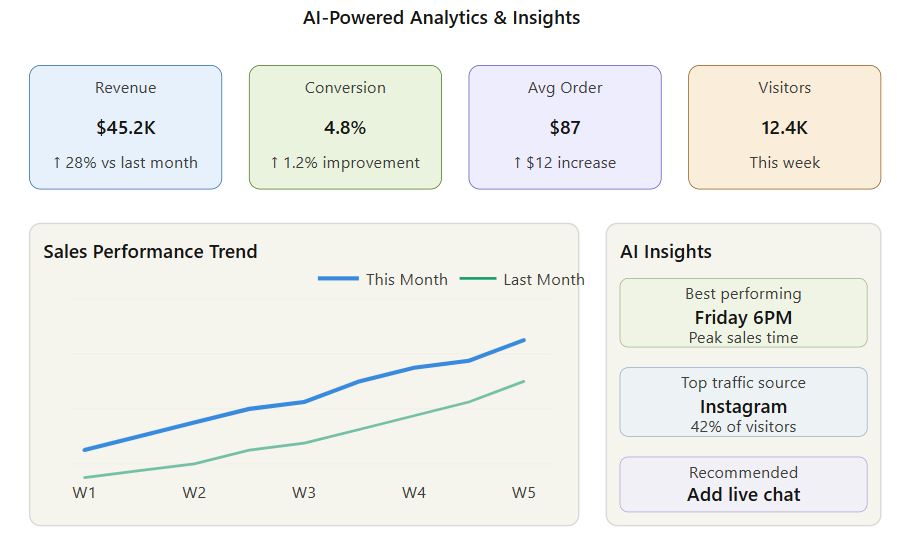
One of the key strengths of AI store builders is their ability to learn and adapt over time. As your store begins to generate traffic, sales, and customer interactions, the AI analyzes this data to identify patterns and uncover opportunities for improvement.
Based on these insights, the system may suggest adjustments to product descriptions, pricing strategies, or marketing approaches to enhance overall performance. Over time, this creates a continuous improvement cycle, where your store becomes more effective as more data is collected and analyzed.
In addition, many platforms benefit from aggregated insights across a large number of stores. This means the recommendations you receive are not based solely on your own data, but also on patterns observed from other successful stores using the same system. As the AI continues to evolve, it becomes increasingly refined, helping you optimize your store with greater accuracy.
3.2. Ongoing Support and Guidance
Beyond optimization, many Shopify AI website builders also provide ongoing support to help you manage and grow your store more effectively. This support can include step by step guidance, built in tutorials, and personalized suggestions based on your store’s performance.
Some platforms also offer access to user communities where store owners can share experiences, exchange strategies, and learn from one another. This combination of AI driven assistance and community knowledge makes it easier to overcome challenges, particularly for those who are new to eCommerce.
Instead of working in isolation, you benefit from both automated insights and practical guidance, allowing you to make more informed decisions as your business develops and scales.
4. Getting Started with Shopify AI Website Builders
Most Shopify AI website builders operate on a subscription model, especially if you want full eCommerce functionality and seamless integration with Shopify. For example, features like Shopify Magic typically require an active Shopify plan. Many platforms also offer free trials or demos, allowing you to explore the tool before making a commitment.
To get started, you typically select a plan, connect your Shopify account, and then begin customizing your store’s design and product setup.
4.1. Choosing the Right Shopify AI Website Builder Plan
When selecting a Shopify AI website builder, it is important to choose a plan that aligns with both your budget and your business needs. A practical approach is to compare the features included in each plan against the requirements of your store.
While some platforms offer free plans, they often come with limitations such as restricted features, limited product listings, or partial integration with Shopify. These constraints can become a challenge as your store begins to scale.
In most cases, a paid plan is the better option if you want full functionality. Paid tiers usually include more advanced customization options, support for a larger product catalog, and faster customer support when issues arise. This makes them more suitable for building a serious, long term eCommerce store.
4.2. Connecting Your Shopify Account
After selecting a builder and subscribing to a plan, the next step is to connect your Shopify account. This integration allows the AI platform to access and manage key store data such as products, collections, and orders, which helps streamline the setup process.
The typical steps include:
- Log in to your Shopify AI website builder account
- Navigate to the integration or settings section
- Select the option to connect with Shopify
- Enter your Shopify store URL and confirm the connection
- Log in to your Shopify account and approve access
Once the connection is established, the system will synchronize your store data. From there, you can manage products, monitor orders, and adjust settings directly within the AI platform without needing to switch between multiple tools.
4.3. Customizing Your AI Generated Shopify Store
After your store is generated, customization is where you refine it to match your brand identity. Most Shopify AI website builders provide flexible editing tools that allow you to adjust both design and content with ease.
Theme Selection and Customization
You can choose from pre built themes or modify an existing layout to better align with your brand. Elements such as colors, typography, spacing, and overall layout can be adjusted to create a consistent and professional appearance across your store.
AI Text Generation
Many platforms include AI features that assist with generating product descriptions, email content, headlines, and SEO meta descriptions. This helps speed up content creation while maintaining consistency in tone and messaging throughout your store.
Page Creation and Editing
Essential pages such as the homepage, about page, contact page, and policy pages can be easily created and edited. With drag and drop editors, arranging sections and adding content becomes straightforward, even for users without technical experience.
5. The Future of AI in Shopify: Trends to Watch
As Shopify AI website builders continue to evolve, their role is expected to go far beyond basic store setup. In the coming years, these tools will likely take on more advanced responsibilities across design, marketing, and customer experience, helping merchants operate more efficiently at every stage of their business.
- AI Generated Product Imagery: AI will be capable of creating high quality product visuals from simple text prompts or enhancing existing images. This allows merchants to produce consistent, professional looking visuals without the need for expensive photo shoots or design resources.
- Smarter Chatbots: AI powered assistants will provide 24/7 customer support with improved contextual understanding. They will be able to deliver more accurate, personalized responses tailored to individual customer needs and behavior.
- Predictive Trend Analysis: By analyzing large volumes of market and consumer data, AI can identify emerging product trends earlier. This helps store owners make more informed decisions and stay ahead of competitors.
- Advanced Marketing Automation: AI will increasingly handle marketing activities such as email campaigns, ad optimization, and audience targeting. These systems will continuously refine campaigns to improve performance and return on investment.
- Customer Behavior Analysis: AI will monitor and analyze user behavior in real time, enabling more accurate product recommendations and a more personalized shopping experience across the store.
Overall, these developments point toward a future where AI is not only used to build Shopify stores, but also plays an active role in managing, optimizing, and scaling them with minimal manual effort.
6. Important Considerations When Choosing an AI Store Builder
While Shopify AI website builders offer many advantages, not every tool will be suitable for every business. Choosing the right solution requires evaluating several practical factors that can directly impact your store’s performance and long term growth.
6.1. Customization Capabilities
A good AI store builder should provide enough flexibility to shape your store according to your brand identity. If the platform is too rigid, your store may end up looking generic or fail to reflect your unique positioning.
Look for tools that allow you to customize layouts, colors, typography, and content so you can build a store that feels consistent, professional, and aligned with your brand.
6.2. Integration and Scalability
It is important to evaluate how well the platform integrates with other Shopify apps and services you plan to use. This may include email marketing tools, analytics platforms, payment gateways, or inventory management systems.
Equally important is scalability. As your business grows, your chosen solution should be able to handle increasing product catalogs, higher traffic volumes, and more complex workflows without limiting performance or functionality.
6.3. Cost vs Value
Pricing should not be assessed on its own. Instead, consider the overall value the platform delivers. A higher priced solution may save time, reduce manual effort, and improve conversions, ultimately leading to better long term returns.
At the same time, ensure that the features included in each plan align with your actual needs. This helps avoid paying for unnecessary functionality while still getting the capabilities required to run your store effectively.
6.4. Customer Support Quality
Reliable customer support is especially important if you are new to eCommerce. Challenges related to setup, integrations, or customization can arise at any stage of the process.
Look for platforms that provide clear documentation, step by step tutorials, and responsive support channels so you can resolve issues quickly and keep your store running smoothly.
6.5. Reviews and User Experience
Before committing to a platform, it is recommended to review feedback from real users and, if possible, test the tool through a free trial or demo.
This allows you to better understand how the platform performs in real world scenarios, how intuitive the interface is, and whether it fits naturally into your workflow. Testing beforehand helps ensure that the tool meets both your expectations and operational needs.
Conclusion: Ready to Build with a Shopify AI Website Builder?
Shopify AI website builders are transforming how eCommerce stores are created and optimized. These tools simplify key processes such as product setup, store design, and content creation, enabling businesses to launch faster while reducing the amount of manual work required.
With a Shopify AI website builder, even non technical users can build a professional and conversion focused online store without needing design or coding skills. This significantly lowers the barrier to entry and allows new businesses to compete more effectively with established brands.
That said, AI works best as a support tool rather than a complete replacement for strategy and decision making. The strongest results come from combining automation with human insight, where you define the direction of your business while AI helps execute tasks more efficiently.
For businesses that want a more tailored approach, especially when scaling or requiring custom features, working with an experienced development partner like ONEXT DIGITAL can be a practical option. With custom Shopify development, integrations, and performance optimization, you can build a store that goes beyond standard templates and better aligns with your specific business goals.
If you are just getting started, you can explore Shopify AI website builder tools such as Instant, Shopify Magic, or Shopify Sidekick to experience how AI can streamline your workflow and help you launch more quickly.