
 Services
 Solutions
 Main platform
 Technology
 White Label
  Offshore
 Hire developers



Automotive software development services are comprehensive solutions that cover the design, development, and operation of in-vehicle software systems, with a strong focus on functional safety (ISO 26262) and connected vehicle cybersecurity.
Today, vehicles are no longer purely mechanical products. They are rapidly becoming software-defined vehicles (SDVs), where software determines user experience, feature scalability, and the overall product lifecycle. For OEMs, Tier-1 suppliers, and mobility companies, software has become a core competitive advantage.
However, developing software for the automotive industry is fundamentally different from developing general-purpose software. Every line of code directly affects safety, reliability, and legal compliance. Even a minor defect can lead to safety standard violations, product failures, or large-scale vehicle recalls.
That is why automotive software development services go far beyond simply “writing code to specifications.” They require disciplined processes, deep industry expertise, and the ability to comply with functional safety, cybersecurity, and process quality standards throughout the entire vehicle lifecycle.
This article is designed as a practical buyer’s guide. Its goal is to help you clearly understand what automotive software development services actually include, what deliverables you should expect, which factors influence cost, and how to evaluate an automotive software development partner correctly.
What Are Automotive Software Development Services?
Automotive software development services help businesses build, operate, and maintain vehicle software across the entire product lifecycle from concept and development to testing, production release, and post-sale updates.

Contrary to the common perception that these services are limited to “developing software for vehicles,” they actually encompass the entire technical system, development processes, and safety responsibilities associated with automotive products.
1. What Do Automotive Software Development Services Include?
At a fundamental level, these services typically include:
- Development of embedded software running on in-vehicle control units
- Implementation of driver assistance, connectivity, and user experience features
- Design of backend and cloud platforms for vehicle data management
- Deployment of over-the-air (OTA) software updates throughout the vehicle lifecycle
- Ensuring safety, security, and quality in line with automotive industry requirements
The key point is that none of these components exist in isolation. They must work together within a unified architecture, where a failure in one area can impact the entire system.
2. How Is Automotive Software Different from Conventional Software?
The most significant difference lies in risk and responsibility.
Enterprise software or web applications can often be updated quickly and fixed after release. Automotive software cannot. A single defect may directly affect user safety, regulatory compliance, and brand reputation.
As a result, automotive software development services always involve:
- Structured development processes with multiple control layers
- Verification and validation at both software and system levels
- Documentation, traceability, and technical evidence for every design decision
3. What Do Businesses Gain from These Services?
When working with a professional automotive software development partner, businesses receive far more than source code. They gain:
- A clear and scalable system architecture
- Concrete technical deliverables (documentation, reports, test plans)
- Production-ready solutions not just prototypes or demos
- Reduced long-term risk in operation, updates, and maintenance
In other words, automotive software development services help organizations transform software from a potential liability into a sustainable competitive advantage.
Automotive Software Development Services We Deliver:
Automotive software development services should not be viewed as a disconnected list of technologies. From a buyer’s perspective, what matters most is whether a partner can deliver complete, integrated service blocks aligned with each phase of the automotive product lifecycle.
Below are the core service areas a professional automotive software partner should provide.
1. Embedded & ECU Software Development
This is the foundation of all in-vehicle systems. These services focus on software running directly on electronic control units (ECUs).
Typical deliverables include:
- Stable embedded software that meets real-time requirements
- Configuration of embedded operating systems and hardware drivers
- Technical documentation and system integration reports
This service is particularly critical for systems related to vehicle operation, sensing, and control.
2. ADAS & Driver Assistance Software
Advanced driver assistance systems are rapidly becoming standard features rather than premium options.
ADAS services focus on:
- Processing data from cameras, radar, and lidar
- Real-time driving assistance logic and responses
- System behavior testing and validation across multiple scenarios
The goal is not merely to “function,” but to operate safely and consistently under real-world conditions.
3. Digital Cockpit & In-Vehicle Experience
The digital cockpit is where users interact with vehicle software every day.
These services typically include:
- User interface and HMI design and development
- Integration of infotainment, navigation, and in-vehicle services
- Ensuring performance, stability, and smooth user experience
A strong digital cockpit must be visually appealing, scalable, and easy to update over time.
4. Telematics, Connectivity & Cloud Platforms
Modern vehicles function as continuously connected devices linked to backend systems.
Connectivity and cloud services enable businesses to:
- Collect and process real-time vehicle data
- Build dashboards, APIs, and fleet management systems
- Support data analytics and aftersales services
These platforms form the foundation for data-driven automotive business models.
5. OTA Updates & Software Lifecycle Management
After vehicles are sold, their software continues to evolve.
OTA and lifecycle management services help organizations:
- Deliver remote feature updates and bug fixes
- Manage software versions across vehicle models
- Reduce maintenance costs and recall risks
For modern automotive companies, OTA is no longer optional it is a requirement.
6. Quality, Safety & Security Support
Beyond feature development, ensuring quality, safety, and security is essential.
These services include:
- Production-level software quality assurance
- System safety across all operating conditions
- Protection against cybersecurity threats
They typically involve testing, documentation, and ongoing compliance support throughout the project lifecycle.
Compliance & Safety-by-Design

1. Why Standards and Safety Determine Project Success?
In the automotive industry, software cannot be “fixed later.” Every feature and every line of code must be built according to established safety, security, and quality standards.
This is why automotive software development services are inseparable from compliance-by-design embedding standards into architecture and processes from the start, rather than patching issues at the end.
2. Why Compliance Matters More Than Development Speed?
For conventional software, delays often impact only cost.
For automotive software, non-compliance can lead to far more serious consequences:
- Inability to enter mass production
- Failure to obtain market certification
- Vehicle recalls, legal penalties, and brand damage
As a result, OEMs and Tier-1 suppliers do not merely ask, “Does the software work?” They ask, “Is there sufficient evidence that the software is safe and trustworthy?”
3. Functional Safety – ISO 26262
ISO 26262 is the international standard for functional safety of automotive electrical and electronic systems.
In automotive software development services, ISO 26262 directly influences:
- System design decisions
- Requirement analysis and risk classification
- Software testing and validation methods
A capable partner must be able to:
- Design software according to a safety lifecycle model
- Create and maintain required safety documentation
- Demonstrate clear traceability between requirements, design, code, and tests
4. Automotive Cybersecurity – ISO/SAE 21434 & UNECE WP.29
Connected vehicles inherently have a larger attack surface.
Standards such as ISO/SAE 21434 and UNECE WP.29 require organizations to treat cybersecurity as a core lifecycle concern, not an add-on feature.
In practice, this includes:
- Security risk analysis from the design phase
- Data and communication protection mechanisms
- Detection, response, and update capabilities for vulnerabilities
A powerful OTA platform that lacks security can quickly become a critical weakness rather than a competitive advantage.
5. Process Quality – Automotive SPICE (ASPICE)
Automotive SPICE focuses on process quality, not just code quality.
For many OEMs, meeting ASPICE requirements at the appropriate level is a prerequisite for long-term collaboration.
ASPICE-aligned automotive software development services help:
- Standardize collaboration across teams and suppliers
- Reduce risks when scaling development efforts
- Improve predictability of timelines and quality
In short, ASPICE enables organizations to move from individual-driven development to system-driven development.
6. What Are the Benefits of Compliance-by-Design?
When safety, security, and process standards are integrated from the start, businesses can:
- Reduce late-stage project risks
- Enter new markets more easily
- Optimize long-term operational and maintenance costs
More importantly, compliance-by-design ensures automotive software is production-ready, not limited to prototypes or demonstrations.
Our Automotive Software Development Process
In automotive projects, process discipline is just as important as technology. A poorly structured process can lead to delays, cost overruns, and compliance risks late in the project.
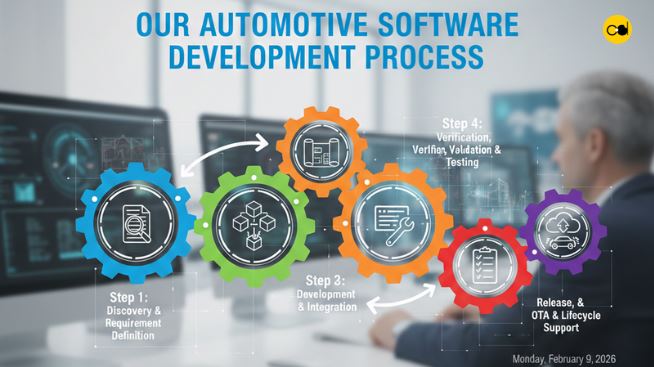
Effective automotive software development services require a transparent process with clear control points, tailored to the safety-critical nature of the industry.
Step 1: Discovery & Requirement Definition
Every project begins by clarifying scope and technical objectives.
At this stage, the development partner:
- Analyzes functional and non-functional requirements
- Defines system boundaries and related components
- Assesses initial technical, safety, and security risks
The goal is to avoid requirement misalignment the most common cause of automotive project delays.
Step 2: System Architecture & Design
Once requirements are defined, the next step is overall system architecture design.
This phase focuses on:
- Software structure and data flows
- Responsibility separation between modules
- Ensuring the architecture supports safety and scalability
A solid architecture makes the system easier to develop, test, and maintain over many years.
Step 3: Development & Integration
This is the phase where software is developed according to the agreed plan.
Key activities include:
- Iterative feature development
- Integration with hardware and related systems
- Continuous quality control throughout development
In automotive software development, development and testing occur in parallel to detect issues early.
Step 4: Verification, Validation & Testing
Automotive testing goes far beyond “running test cases.”
This phase aims to:
- Verify that software meets initial requirements
- Validate system behavior across different scenarios
- Collect technical evidence for compliance purposes
This step is critical to determine whether the software is ready for production or real-world deployment.
Step 5: Release, OTA & Lifecycle Support
Once software enters use, its lifecycle continues.
Automotive software development services continue to support:
- Official production releases
- Over-the-air updates (OTA)
- Monitoring, maintenance, and continuous improvement throughout the vehicle lifecycle
This approach ensures long-term product quality rather than focusing solely on launch.
Why This Process Matters to Buyers?
A clear process enables organizations to:
- Track progress and quality more effectively
- Reduce late-stage project risks
- Proactively adjust scope or scale when needed
For decision-makers, this process serves as a benchmark to evaluate the true capabilities of an automotive software development partner.
Engagement Models & Cost Drivers
In automotive software development services, cost is not limited to development hours. Most budgets are driven by system complexity, compliance requirements, and the scope of responsibility a partner assumes across the product lifecycle.
Before asking “How much does it cost?”, organizations need to understand engagement models and the real cost drivers.
1. Common Engagement Models
Each automotive project suits a different collaboration model. There is no universally “cheapest” option.
| Model | Best Suited For | Key Advantage |
| Fixed-Price | Clear requirements, short projects | Predictable budgeting |
| Time & Materials | Complex, evolving projects | High flexibility |
| Dedicated Team | Long-term, deeply integrated projects | Knowledge retention |
1.1 Fixed-Price Projects
Best suited when:
- Scope and requirements are clearly defined
- Minimal changes are expected
- Timelines and objectives are fixed
This model simplifies budgeting but offers limited flexibility if requirements change or risks emerge.
1.2 Time & Materials (T&M)
Commonly used when:
- Requirements may evolve
- Projects involve research or gradual development
- Feature priorities need flexibility
This model is widely adopted in complex automotive projects where adaptability outweighs rigid scope commitments.
1.3 Dedicated Automotive Teams
Best suited for:
- Long-term or multi-phase projects
- Organizations seeking rapid technical capacity scaling
- Deep integration between internal teams and partners
Dedicated teams preserve project knowledge instead of losing it after each phase.
2. What Really Drives Automotive Software Costs?
Focusing only on hourly rates often underestimates true costs. The following factors have the greatest impact.
2.1 Safety and Compliance Requirements
Projects requiring:
- High ISO 26262 levels
- Multiple ASPICE processes
- Strict cybersecurity compliance
demand more time for design, testing, and documentation.
2.2 System Complexity
Costs rise significantly when projects involve:
- Multiple ECUs or sensors
- Cloud connectivity and OTA
- Integration with third-party systems
Each integration point adds development and testing effort.
2.3 Verification and Validation Requirements
In automotive projects, testing is continuous not a final step.
Projects requiring:
- Extensive scenario-based system testing
- Compliance evidence collection
- Audit or assessment support
have higher upfront costs but significantly lower long-term risk.
4. A Smarter Cost Approach for Decision-Makers
Rather than seeking the lowest initial price, successful automotive organizations typically:
- Clearly define required compliance levels
- Select engagement models aligned with product maturity
- Invest early in architecture and processes to reduce future costs
In automotive software development, low upfront cost without risk control is often the most expensive choice in the long run.
How to Choose the Right Automotive Software Development Partner?
When selecting an automotive software development partner, technology alone is not enough. Long-term success depends on industry experience, compliance capability, and risk management throughout the product lifecycle.
Below are key criteria OEMs, Tier-1 suppliers, and mobility companies should consider.
1. Real Automotive Industry Experience
Not every skilled software team is suitable for automotive projects.
A reliable partner should:
- Have experience delivering production-level automotive systems
- Understand long vehicle product lifecycles
- Be familiar with collaboration across OEMs, Tier-1s, and hardware vendors
Practical experience helps avoid common mistakes that theoretical knowledge alone cannot prevent.
2. Compliance and Regulatory Capability
Automotive software development services are inherently standards-driven.
Verify whether the partner has:
- Experience with ISO 26262 and Automotive SPICE
- A clear approach to cybersecurity and OTA
- The ability to produce and maintain technical documentation and evidence
Partners unfamiliar with compliance introduce significant risks during assessment and production phases.
3. Transparent Development and Testing Processes
Processes are not just for documentation they exist to:
- Control quality
- Detect issues early
- Reduce costly late-stage fixes
A partner should clearly explain:
- Each step from requirements to release
- Quality control checkpoints at every phase
- How changes and incidents are handled
Vague processes often reveal problems late, when they are most expensive.
4. Scalability and Long-Term Collaboration
Automotive software does not end at vehicle launch.
The right partner should:
- Support long-term maintenance, updates, and expansion
- Scale teams as project needs evolve
- Retain project knowledge within the organization
This is especially critical for SDV and OTA-driven products.
5. Clear Communication and Accountability
Human factors still matter.
Ensure the partner:
- Communicates clearly and consistently
- Defines responsibilities for every role
- Proactively flags risks not just reports progress
A strong partner collaborates with you on difficult decisions, not just task execution.
Key Questions to Ask Before Signing:
To quickly assess real capability, ask:
- What is the most recent automotive project you delivered?
- How do you manage safety and security in your projects?
- Who owns compliance documentation and evidence?
- How are requirement changes handled?
- What long-term support is provided after release?
Clear, concrete answers typically signal real expertise rather than marketing claims.
FAQs – Automotive Software Development Services
1) What are automotive software development services?
They include the design, development, testing, and operation of vehicle software across the product lifecycle, covering embedded software, ADAS, digital cockpit, cloud connectivity, OTA, and system security.
2) How is automotive software different from conventional software?
The main difference lies in safety, compliance, and legal responsibility. Automotive software must meet strict standards, undergo extensive testing and documentation, and cannot rely on “fix-after-release” approaches.
3) Why is ISO 26262 important in automotive software development?
ISO 26262 ensures functional safety for automotive systems. It requires risk analysis, safety-oriented design, testing, and clear technical evidence before production release.
4) Do automotive software development services include cybersecurity?
Yes. Cybersecurity is mandatory. Services typically include security risk analysis, data protection, access control, and secure update mechanisms to reduce attack risks.
5) How is the cost of automotive software development calculated?
Costs depend on system complexity, compliance requirements, testing scope, and engagement model. There is no fixed price applicable to all automotive software projects.
6) How do you choose the right automotive software development partner?
Evaluate industry experience, compliance capability, transparent processes, testing strength, and long-term support. A good partner reduces risk, not just delivers code.
Conclusion
Today, automotive software development services directly influence vehicle safety, scalability, and long-term cost. In the era of software-defined vehicles, building software correctly from the start is essential to reduce risk, meet standards, and sustain competitive advantage.
Partner selection should be based not on short-term cost, but on technical capability, industry experience, and long-term collaboration potential. The right decision enables organizations to better control product lifecycles and avoid costly downstream issues.
If you are planning or evaluating an automotive software project, start with a focused discussion.
Contact us to discuss your technical requirements and business objectives, or request a consultation to receive an initial assessment of scope, risks, and an appropriate delivery roadmap.