
 Services
 Solutions
 Main platform
 Technology
 White Label
  Offshore
 Hire developers



Last year, a fintech company in Singapore signed an outsourcing contract with a $50,000 budget. Six months later, they had spent an additional $28,000 on “unexpected” expenses. This story isn’t an exception; it’s a direct result of not knowing how to calculate outsourcing cost accurately from the start.
According to a Deloitte survey, 40-60% of businesses exceed their initial outsourcing budget. In extreme cases, one in six IT projects runs over budget by more than 200%. The real issue isn’t the vendor’s rate, but the lack of a framework on how to calculate outsourcing cost beyond the surface pricing. To make sound strategic decisions, you must uncover infrastructure investments, management overhead, and concealed operational expenses.
In this comprehensive guide, we’ll break down the main cost layers, reveal common hidden fees, and provide a step-by-step framework on how to calculate outsourcing cost to protect your ROI.
What Are Outsourcing Costs?
Outsourcing costs are the total financial commitment a company makes when a third-party provider performs a business function instead of an internal team. It’s not just the hourly rate or the project quote it’s everything attached to making outsourcing actually work.
Many people stop at the headline number: $30/hour for a developer or $15,000 for a fixed-price project. That figure is only the visible surface. In practice, outsourcing costs are layered and variable, shaped by the service scope, location, and pricing model.
They typically fall into three critical categories:
1. Main costs
The obvious, contractual expenses hourly rates, monthly retainers, or fixed project fees.
2. Hidden expenses
Often overlooked items like onboarding, coordination, rework, communication overhead, tooling alignment, and quality assurance. These can quietly add 30–40% to the real cost.
3. Opportunity costs
What you give up by outsourcing slower feedback loops, reduced internal capability building, or missed chances to develop core expertise in-house.
Understanding all three layers is essential for accurate budgeting and for deciding whether outsourcing truly supports your long-term strategic goals, not just short-term cost savings.
What Are The Main Outsourcing Costs?
When evaluating outsourcing strategies, enterprise leaders face a complex web of financial considerations that extend far beyond the obvious service fees. The main outsourcing cost components fall into three critical categories that directly impact your budget and operational efficiency.
1. Direct Service Fees
Direct service fees represent the most visible portion of your outsourcing cost structure. These include the actual payments to your outsourcing provider, whether structured as:
- Hourly rate: common for flexible projects with frequent changes
- Fixed price: for projects with clear scope from the start
- Monthly retainer: when you need a dedicated team working long-term
For IT outsourcing cost scenarios, rates can vary significantly based on service complexity and geographic location. In Asia-Pacific markets like Japan, Korea, and Singapore, dedicated development teams typically range from $25 to $65 per hour, while call center operations may cost between $8-$30 per agent hourly.
In Vietnam, rates typically fall in the middle to lower end of this range, but quality is no less competitive than more expensive countries like Singapore or Australia.
2. Infrastructure And Technology Setup Expenses
Infrastructure and technology setup expenses are other substantial costs to outsource IT services that many organizations underestimate.
These include:
- Software licensing fees: project management tools (Jira, Asana), communication platforms (Slack, Microsoft Teams), design tools (Figma, Adobe CC)
- Hardware procurement: if you need to provide laptops and work equipment
- System integration costs: connecting your systems with your partner’s
- Compliance-related technology investments: VPN, firewall, encryption – especially critical for fintech and healthcare
The complexity of your existing systems directly influences these setup costs, which can represent 15-25% of your total first-year outsourcing investment. From the second year onward, it decreases significantly since most of the setup is complete.
3. Management And Coordination Of Overhead Expenses
Management and coordination of overhead expenses constitute the third major component, encompassing internal resources dedicated to overseeing outsourced operations.
This includes:
- Time from internal Project Managers or Technical Leads
- Regular meetings (daily standup, sprint planning, review)
- Training costs for both internal teams and outsourced staff
- Communication infrastructure
- Quality assurance processes
A PM might spend 20-30% of their time just coordinating with the outsourcing team. If your PM earns $5,000/month, that means you’re spending an additional $1,000-1,500/month on outsource management.
Studies indicate that management overhead can account for 10-20% of total outsourcing costs, making it essential to factor these expenses into your ROI calculations when comparing in-house vs outsourcing software development scenarios.
What Are The Hidden Costs Of Outsourcing?
While you’ve calculated the obvious outsourcing cost components, the hidden expenses often represent the difference between a successful partnership and a budget disaster. This concealed cost of outsourcing software development can inflate your total investment by 30-50%, making it crucial to identify them before signing any agreements.
1. Communication and Language Barrier Mitigation Expenses
Language differences and time zone challenges create unexpected financial drains that many enterprises underestimate. You’ll need to invest in:
- Translation services for technical or business requirements documentation
- Cultural training programs to bridge gaps effectively
- Extended communication tools and platforms
- Additional meeting time to clarify requirements
In Asia-Pacific markets, communication overhead can add 10-15% to your base IT outsourcing cost, particularly when working across different business cultures in Japan, Korea, and Singapore.
Additionally, you’ll face costs for redundant communication channels, extended meeting hours to accommodate multiple time zones, and potential productivity losses during the adjustment period. These expenses compound quickly when cultural misunderstandings lead to project delays or rework.
2. Quality Assurance and Rework Costs

The cost of outsourcing IT services extends beyond initial delivery to include comprehensive quality control measures. You’ll need dedicated resources for:
- Testing and validation of deliverables
- Correction of work that doesn’t meet your standards
- Re-testing after fixing bugs
- Sometimes refactoring code that doesn’t follow best practices
Studies show that quality assurance can represent 15-20% of total project costs, especially during the initial phases of outsourcing relationships.
Moreover, rework expenses emerge when deliverables require significant modifications or complete redevelopment. These IT support costs include both the vendor’s time for corrections and your internal team’s effort for additional review cycles, creating a compounding effect on your overall budget.
3. Knowledge Transfer and Training Investments
Successful outsourcing requires substantial upfront investment in knowledge transfer, often overlooked in initial cost calculations. Your internal teams must dedicate significant time to:
- Documenting processes and technical architecture
- Training outsourced staff on business requirements
- Establishing operational procedures
- Sharing domain knowledge and coding standards
This knowledge transfer phase can consume 20-30% of your senior staff’s time for several months, representing a substantial hidden cost in terms of reduced internal productivity.
If a Senior Developer earning $8,000/month spends 25% of their time training the outsource team, you’re “losing” $2,000/month for 3 months = $6,000 just for knowledge transfer alone.
Furthermore, ongoing training costs continue throughout the partnership as your outsourced team adapts to evolving business requirements, new technologies, and changing compliance standards.
4. Contract Management and Legal Compliance Fees
Navigating international outsourcing agreements requires specialized legal expertise and ongoing contract management resources. You’ll incur costs for:
- Contract negotiations and legal review
- Compliance auditing across different jurisdictions
- Intellectual property protection
- Regulatory adherence and data protection regulations
- Insurance and liability coverage
Legal and compliance costs can add 5-10% to your annual outsourcing budget, particularly when dealing with data protection regulations and cross-border business requirements.
Contract management also involves ongoing monitoring, performance evaluation, and relationship management activities that require dedicated internal resources or external consulting support.
What Are The Opportunity Costs Of Outsourcing?
Opportunity cost refers to the value of the next best alternative that is foregone when a particular choice is made. When a company decides to outsource a specific task or function, it must consider the potential benefits it could have gained from using its resources differently.
This is the hardest part to calculate because it’s not a specific number, but the impact is very significant in the long run.
1. Loss of In-House Knowledge & Institutional Insight
When critical IT tasks are outsourced, companies risk losing internal expertise and valuable institutional knowledge. According to Computerworld, this can lead to fragmented governance and a lack of holistic oversight as outsourced teams operate in silos without seamless collaboration or a cohesive understanding of the organization’s broader goals.
Over time, this leads to vendor dependency, diminished negotiating power, and difficulty in transitioning back in-house or switching providers.
An e-commerce company once outsourced their entire platform development for 3 years. When they wanted to develop it in-house again, they had to spend 8 months and nearly $200,000 just to “relearn” their own codebase.
2. Reduced Control & Flexibility
Outsourcing inevitably shifts a degree of control to the service provider. Decisions around workflow, tool selection, or even project timelines may be influenced by the vendor’s methods, capacity, or priorities.
As a result, the company may face constraints in pivoting to new requirements, adapting to sudden market changes, or enforcing rapid shifts in project direction. Every change must go through a process: discuss with vendor, negotiate additional costs, adjust timeline.
The opportunity cost lies in the lost agility and autonomy that could have supported more dynamic business responses. In a startup environment or fast-changing industry, this delay can cause you to lose competitive advantage.
3. Delayed or Limited Innovation
Internal IT teams tend to develop a strong understanding of the company’s uniqueness. This proximity often sparks customized innovation, as employees are motivated to propose ideas that align directly with business goals.
Outsourced providers, by contrast, typically focus on applying standardized solutions across clients. While this ensures reliability, it can reduce the likelihood of breakthrough ideas.
The opportunity cost is missing out on proprietary innovation that could give the business a competitive edge, increase efficiency, or create new revenue streams. Outsourcing teams typically work according to specs, with less motivation to suggest breakthrough ideas or improvements not within scope.
What Factors Influence Your Outsourcing Costs?
Understanding the variables that impact outsourcing expenses helps you make more accurate budget projections and select the right partner for your needs.
1. Geographical Location
IT service costs differ widely across countries and are closely tied to the local cost of living, which impacts salaries and operating expenses. Costs vary significantly between countries:
- Philippines: $15-35/hour, popular for customer service and BPO
- Vietnam: $20-50/hour for IT, especially strong in mobile and web development
- India: $18-45/hour, large selection but inconsistent quality
- Thailand: $25-45/hour, growing tech hub with competitive pricing
- Singapore, Japan, Korea: $60-120/hour, expensive but high quality and convenient timezone
However, don’t just look at the hourly rate. A $25/hour developer with high productivity might be cheaper than a $15/hour developer who works slowly with many bugs.
2. Developer Experience and Skill Level
Rates also depend on the developer’s expertise. The level of experience and specialization significantly impacts pricing:
- Entry-level (0-2 years): $15-30/hour – suitable for simple tasks with available guidelines
- Mid-level (3-5 years): $30-50/hour – can handle complex features, requires less supervision
- Senior (5+ years): $50-80/hour – highly autonomous, can lead small teams
- Specialists (AI/ML, blockchain, cloud architect, cybersecurity): $80-150/hour – for projects requiring high expertise
A common mistake is hiring an all-junior team to save money, but ending up spending more time on review and bug fixes compared to having some seniors from the start.
3. Project Scope and Duration
The complexity and timeline of your project directly influence total costs:
- Short-term projects (< 3 months): relatively higher setup costs due to rapid onboarding and quick delivery demands
- Long-term projects (6+ months): setup costs are spread out, efficiency increases over time, may come with discounted pricing
- New or cutting-edge technology: requires learning curve, can increase costs by 20-30%
- Legacy systems: complex, few people have experience, usually more expensive than greenfield projects
If the project involves constant changes, cutting-edge features, or a fast-paced development environment, it typically requires additional resources and flexibility leading to higher expenses.
4. Engagement Models and Service Level Agreements
The choice of engagement model also shapes cost:
- Fixed-price: clear on budget but less flexible when changes are needed. Vendors typically add a 15-25% buffer to cover risks.
- Time & Materials: flexible but hard to control total costs. Charges based on actual hours and resources consumed.
- Dedicated team: suitable for long-term projects, builds ownership but requires large financial commitment. Allows you to hire offshore developers who focus solely on your project.
In addition, Service Level Agreements (SLAs) significantly affect final expenses. The tighter the SLA (99.9% uptime, <2 hour response time, bug fix within 24h), the higher the cost because vendors need to invest more resources to guarantee service expectations such as quality standards, availability guarantees, and response times.
How Do You Calculate Outsourcing Cost Step By Step?
Calculating outsourced IT pricing requires a comprehensive approach that goes beyond surface-level pricing to capture the true financial impact of your decision. Many businesses underestimate total expenses by focusing solely on vendor quotes, thereby missing critical components that can significantly inflate budgets.
1. Total Cost of Ownership (TCO) Framework Methodology
The most effective approach uses a Total Cost of Ownership framework that encompasses direct service fees, implementation expenses, and ongoing operational costs.
Step 1: Identify all direct costs
Start by documenting your provider’s base rates – whether hourly, project-based, or monthly retainer fees:
- Base hourly/monthly rate
- Estimated hours or number of people
- License fees if they provide tools
- Any upfront setup fees
Example: Team of 5 developers, $40/hour average, 160 hours/month/person = $32,000/month for 6 months = $192,000 base cost
Step 2: Calculate deployment and infrastructure costs
Factor in setup and integration expenses, including:
- Onboarding fees and training: $5,000
- Tools and software licenses: $200/month x 6 = $1,200
- System compatibility requirements and integration: $8,000
- Technology infrastructure investments (security setup): $3,000
Total infrastructure: $17,200
Step 3: Calculate long-term operational costs
Include ongoing expenses for management and quality assurance:
- Internal PM spending 30% time ($6,000 salary): $1,800/month x 6 = $10,800
- QA resource: $3,000/month x 6 = $18,000
- Communication tools: $50/month x 6 = $300
- Legal & compliance: $2,000 one-time
Total operational: $31,100
Step 4: Estimate hidden costs
Account for communication barriers, rework, and knowledge transfer:
- Communication overhead (10%): $19,200
- Rework buffer (15%): $28,800
- Knowledge transfer (senior dev 25% time, $8K salary): $2,000/month x 3 = $6,000
Total hidden costs: $54,000
2. Calculate Total Cost of Ownership (TCO)
$192,000 + $17,200 + $31,100 + $54,000 = $294,300
Compared to the initial quote of $192,000, the actual total cost is 53% higher. This is why many companies are shocked about the budget.
3. Return on Investment (ROI) Calculation Models
Develop side-by-side financial models comparing your current in-house vs outsourcing software development costs over a 3-5 year timeline. Include internal salary expenses, benefits, training costs, and infrastructure investments for your in-house scenario.
Calculate Return on Investment (ROI) for outsourcing:
ROI% = [(Return − Investment Cost) / Investment Cost] × 100
4. In-House vs Outsourcing Costs Comparison Table
| Cost Aspect | In-House | Outsourcing |
|---|---|---|
| Recruitment & Hiring | High cost and time-consuming ($15,000) | Often included in vendor fees ($0) |
| Salaries & Benefits | Fixed, ongoing costs ($240,000 for 6 months) | Typically embedded in service fees ($192,000) |
| Infrastructure | Office space, equipment, utilities ($25,000) | Minimal or usually borne by the vendor ($17,200) |
| Training & Onboarding | Internal training programs ($10,000) | Vendor-led onboarding and knowledge transfer ($6,000) |
| Technology & Software | Licenses and maintenance | Vendor handles most tech needs |
| Management & Supervision | Internal oversight and quality control ($10,800) | Monitoring of vendor performance required ($10,800) |
| Rework & QA | Staff turnover, underperformance ($20,000) | Quality lapses, downtime risks ($46,800) |
| Transition Costs | N/A | Can be significant initially |
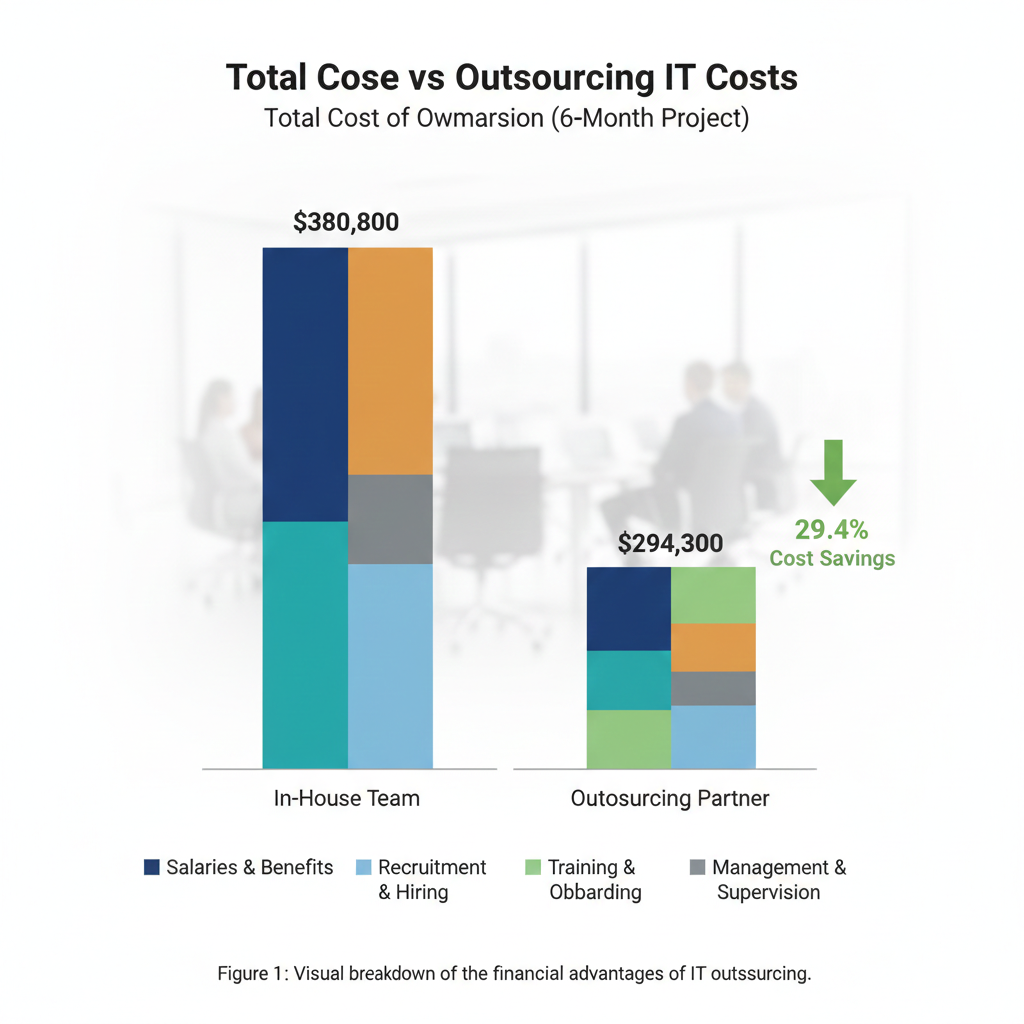
| TOTAL | $380,800 | $294,300 |
ROI = [($380,800 – $294,300) / $294,300] × 100 = 29.4% cost savings
The following chart visualizes the financial gap and cost distribution between these two models, highlighting the 29.4% potential savings:
5. Sensitivity Analysis
Use sensitivity analysis to test different scenarios, adjusting variables such as:
- Scenario 1: Team size decreases to 3 people – where’s the break-even?
- Scenario 2: Project extends by 3 more months – how does total cost change?
- Scenario 3: SLA requirements increase – what’s the impact?
This approach reveals the true cost differential, helps identify break-even points for your specific situation, and provides IT outsourcing cost reduction opportunities.
How Can You Optimize Your Outsourcing Costs?
Successfully calculating outsourcing costs means seeing the complete financial picture, not just vendor pricing. Here are proven strategies to maximize value while controlling expenses.
1. Create a comprehensive budget from the start
Don’t just look at the vendor’s quote. Build a complete TCO model including all the factors mentioned above – direct fees, infrastructure costs, management overhead, and hidden expenses. Reserve an additional 20% buffer for unexpected costs.
By accounting for direct fees, hidden expenses, and long-term operational impacts, you can make informed decisions that protect your budget and deliver genuine value.
2. Negotiate the appropriate engagement model
Choose your pricing structure based on project characteristics:
- For short projects with clear scope: choose fixed-price
- For long-term projects with many changes: dedicated team or T&M with clear milestones
- Hybrid model: fixed price for core features, T&M for enhancements
3. Invest in knowledge transfer from the beginning
Don’t rush the onboarding phase to “save” 2-3 weeks. Good onboarding can reduce rework costs by 50% later.
Prepare clear documentation, record training sessions to make onboarding new members easier later. Take time to build comprehensive cost models before committing to any outsourcing partnership.
4. Build relationships, not just transactions
Vendors will be more motivated and provide better value if they feel this is a partnership, not just “hiring people to work.”
Regular feedback, celebrate wins together, involve them in product decisions when appropriate. This approach often results in better quality, faster delivery, and proactive problem-solving.
5. Measure and optimize continuously
Track actual costs vs budgeted costs monthly. Identify areas where you’re overspending and adjust.
Review productivity metrics: velocity, bug rate, code quality. Sometimes increasing the rate slightly to hire more senior people will reduce total costs through higher efficiency.
Frequently Asked Questions (FAQ)
1. Is outsourcing IT always cheaper than building an in-house team?
Not necessarily. While the base salary in offshore locations like Vietnam or India is lower, the Total Cost of Ownership (TCO) includes hidden expenses such as management overhead, quality assurance, and communication barriers. As shown in our analysis, the real cost saving is often around 20-30%, rather than the 50% headline figure many expect.
2. What are the most common hidden costs in IT outsourcing?
The three most significant hidden costs are:
- Management Overhead: Internal PMs often spend 20-30% of their time coordinating with the vendor.
- Rework: Fixing bugs or refactoring code that doesn’t meet quality standards can add 15-20% to the project cost.
- Knowledge Transfer: The time your senior staff spends training the outsourced team is a direct productivity loss.
3. Which engagement model is most cost-effective?
It depends on your project’s nature:
- Fixed-price is best for small projects with a crystal-clear scope.
- Time & Materials (T&M) is more efficient for R&D or complex projects where requirements evolve, as it avoids the “risk buffer” fees vendors usually add to fixed-price quotes.
- Dedicated Team offers the best long-term value for scaling products.
4. How can I avoid budget overruns when outsourcing?
To stay within budget, you should:
- Create a TCO model instead of just looking at the hourly rate.
- Maintain a 20% contingency buffer for unexpected rework or scope changes.
- Invest heavily in documentation and onboarding from day one to reduce later communication costs.
Final Thoughts
Successfully learning how to calculate outsourcing cost means seeing the complete financial picture, not just vendor pricing. In an era where IT efficiency determines market speed, an accurate budget plan is your strongest competitive advantage.
Choosing the right partner is not about finding the lowest hourly rate it’s about finding a collaborator who delivers the highest value through transparency, technical excellence, and a shared commitment to your ROI. By applying the TCO framework and accounting for hidden expenses today, you prevent 90% of the “budget drama” tomorrow.
Stop guessing and start scaling with confidence. Are you planning an IT project and need a precise financial roadmap? The team at Onext Digital is ready to help you build a detailed, transparent TCO model tailored to your specific needs.
Contact us today for a deep dive into your technical requirements, or Request a Free Consultation to receive an initial assessment of your project’s scope, risks, and optimized cost structure.