
 Services
 Solutions
 Main platform
 Technology
 White Label
  Offshore
 Hire developers



Picture this. You have a solid product idea. You know the market is ready. You’re set to build. But then your frontend? It’s slow, buggy, and your developer just stopped replying halfway through the job.
This happens more than you think.
Founders, CTOs, and project leads search for Vue js development services every day. Not because they love frameworks. But because they need a team they can rely on. One that understands speed, structure, clean code, and real-world delivery.
The hard part? Everyone sounds good on paper. Slick websites. Bold claims. But who can actually get things done, on time, without wrecking your roadmap or your budget?
What makes one Vue.js team better than another? How do you avoid paying for a project twice because the first one failed? And how do you know what a fair price even looks like in 2026?
This guide will walk you through all of it. From cost and quality to tech stack, timelines, and common traps to avoid. Whether you’re launching a SaaS, revamping your eCommerce frontend, or building something new from scratch, this article will help you hire smarter, avoid headaches, and build faster.
Let’s get started.
What should you look for when hiring Vue js development services?
Hiring a Vue js development team isn’t just about checking tech boxes. It’s about finding people who can actually build what you need, within your timeline, and without drama.

The biggest mistake? Picking someone just because they’re cheap or have a nice-looking website. A lot of teams can talk Vue, but very few can deliver clean, scalable code that won’t break three months later.
Here’s what really matters.
1. How can you tell if a team really knows Vue 3 and the Composition API?
Vue 3 isn’t just an update. It changes how apps are structured and maintained. The Composition API allows for better organization, cleaner logic, and makes it easier to scale later.
Ask these questions:
- Have they built real projects using Vue 3? Not just toy apps.
- Can they show working code or repos? GitHub is a good place to check.
- Do they use modern tools like Vite, Vue Router, Tailwind CSS, or TypeScript?
One more tip. If they’ve contributed to open-source, published tutorials, or share insights on Vue regularly, they probably know their stuff.
2. Why does Nuxt.js matter for SEO and speed?
If your site needs to rank on Google, Nuxt.js should be part of the conversation. Most Vue apps are single page, which can be fast but not always search friendly.
Nuxt adds server side rendering and static site generation. What does that do for you?
- Your pages load faster, which users love
- Google can crawl and index your content properly
- You can set custom meta titles, descriptions, and structured data
- It works well with content systems like Strapi and Contentful
Bottom line: If SEO or fast first loads matter, ask about Nuxt. If they don’t know it, that’s a problem.
3. What are the red flags when choosing a Vue.js agency or freelancer?
A good developer doesn’t just write code. They communicate, deliver consistently, and help you make the right choices for your product.
Be cautious if you see any of the following:
- Portfolios with pretty designs but no working demos
- Teams that say they do Vue, React, Angular, Svelte all at once, but don’t specialize
- No sign of testing (like Cypress, Vitest) or proper QA
- Delayed replies, unclear timelines, or vague estimates
Also, look for teams that document their process. If they can’t explain how they’ll work with you, it might be chaos once the project begins.
How much do Vue js development services typically cost and how long do projects take?
Most Vue.js projects cost between $20,000 and $50,000, depending on scope. Hourly rates range from $30 to $150 based on location and team type. Timelines usually fall between 2 to 6 months for full projects.
1. What are the typical hourly rates for Vue.js developers in different regions?
Pricing depends on who you hire and where they’re located. Here’s a general idea of current hourly rates:
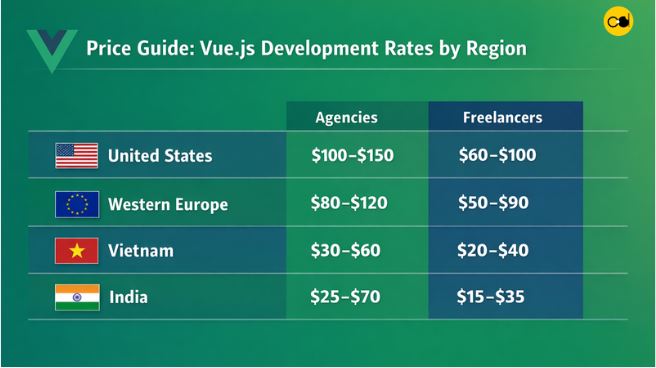
Hiring from Vietnam or India is often a smart move if you want to reduce cost but still get good results. Many of these teams are well-versed in Vue 3, Nuxt, Tailwind, and modern frontend tools. Offshore doesn’t mean low quality it means you need to vet properly.
2. What affects the total cost of your project?
There’s no fixed price for a Vue.js project because every product is different. But a few factors play a big role:
- Type of app: A simple admin dashboard is much easier to build than a full eCommerce platform.
- Features: Think about what you need server-side rendering, real-time chat, complex forms, payments, user roles, etc.
- Tech stack integration: Will the app connect with a backend API, CMS, third-party services?
- Team size: A project might need 2 developers, or it might need 8 including QA, backend, and a project manager.
A well-built eCommerce SPA using Vue 3 and Nuxt with SSR and a custom UI typically costs between $20,000 and $40,000. Timeline? Around 3 to 5 months.
Keep in mind: cutting corners to save money now often leads to more expensive problems later.
3. How long does it usually take to build a Vue.js project?
This depends on how complex your idea is and how prepared you are when you start. But here’s a general timeline:
- Simple MVP or landing page: 2–4 weeks
- Custom business app or dashboard: 1.5–3 months
- Full-feature SaaS or eCommerce site: 3–6 months
Want a more accurate estimate? Ask the agency to break it down by milestones:
- Wireframes and UI design
- Frontend development
- Backend integration
- Testing and QA
- Launch and post-launch support
Many good teams will offer a free scoping session or checklist to help you get clarity before you spend a dollar.
Which companies offer the best Vue js development services in 2026?
The most recommended Vue.js development providers in 2026 include Toptal, SimtechDev, Rikkeisoft, Onext Digital, and a range of experienced offshore agencies in Vietnam that deliver strong Vue 3 and Nuxt-based applications at competitive rates.

1. How do top Vue.js agencies compare in expertise and pricing?
From premium platforms to cost-effective offshore teams, here’s how several popular providers stack up when it comes to Vue.js development capabilities and pricing:
| Agency | Region | Vue.js Focus | Average Hourly Rate |
| Toptal | Global | High – Vetted engineers, global elite | $80–$120 |
| SimtechDev | EU / SEA | Medium – Strong in mid-size web platforms | $50–$90 |
| Rikkeisoft | Vietnam | High – Nuxt.js, PWA, enterprise solutions | $30–$60 |
| Onext Digital | Vietnam | High – Vue 3, Nuxt, UI-focused SPAs | $20–$50 |
| Upwork / Fiverr | Global | Varies – Freelancers of all levels | $20–$100 |
While Toptal tends to attract high-budget clients and platforms like Upwork offer a wide range of freelance options, many Vietnam-based agencies are quietly building a strong reputation in the Vue.js space.
Some smaller teams stand out thanks to their clean codebase structure, thoughtful UI implementation, and hands-on use of modern tools like Pinia, Tailwind, and Vite. These are the kinds of agencies often behind well-optimized SPAs, dashboards, and product frontends especially in fast-growing tech ecosystems like Southeast Asia.
2. Where can you find reliable Vue.js developers or teams?
If you’re comparing options, start with platforms that give you visibility into both talent and track record:
- Toptal: A solid choice for premium, high-stakes work
- Upwork: Flexible for fast hiring or short-term needs
- Clutch: Offers detailed agency profiles, verified reviews, and project data
- Official agency websites: Many capable teams focus more on real case studies and client results than aggressive marketing. The best ones let their work not just their words speak for them.
3. Which sources should you trust when evaluating Vue.js service providers?
Don’t just go by visuals or slogans. Use these sources to dig deeper into a team’s capability and reliability:
- Clutch.co: Features verified client reviews and transparent project breakdowns
- GoodFirms: Helpful for narrowing by tech specialization or industry served
- GitHub / Medium:Valuable for checking if a team actively contributes Vue 3 or Nuxt-related code, shares tutorials, or maintains internal libraries
How do you evaluate the scalability and performance of a Vue.js app?
A well built Vue.js app should load fast, handle more users over time, and stay easy to maintain as it grows. But not all apps do especially when built in a rush or without a long term structure in mind.
To assess real performance, look at three things: metrics, code structure, and the tools used.
Here are the key benchmarks to expect from a solid Vue app:
- First Contentful Paint: under 1.5 seconds
- Time to Interactive: under 3 seconds
- Lighthouse score: ideally 90 or higher
These numbers reflect what your users actually feel not just how it performs in a test.
To hit these benchmarks, good teams use techniques like lazy loading, bundle splitting, and image compression. They often replace legacy tools with faster modern ones like Vite, and structure their code to load only what’s needed on each page.
State management also plays a big role. Larger projects should use something like Pinia, which works seamlessly with Vue 3, keeps logic clean, and scales better than older options like Vuex. The tool itself matters less than how well the team organizes and maintains state over time.
Finally, if speed and SEO are priorities, server side rendering with Nuxt should be on the table. It lets Google crawl your pages more effectively and significantly improves first load time. In fact, projects using Nuxt often see measurable gains one case saw a 38% traffic boost in just three months.
In short, performance is not about one tool. It’s about habits, structure, and whether your development team is thinking long term from day one.
What kind of ongoing support and security can you expect?
A successful Vue.js launch is only the beginning. Real-world usage starts to surface edge cases, browser updates can break layouts, and performance may degrade over time. That’s why long-term support is not optional it’s essential.
A reliable Vue.js partner will offer structured post-launch services that typically include:
- Bug fixes within agreed timeframes (often 30 to 90 days)
- Security patches tied to updated frameworks or new vulnerabilities
- Performance monitoring and optimization based on user feedback or traffic spikes
- Regular upgrades of key dependencies like Vue, Pinia, Tailwind, and third-party libraries
When it comes to security, responsible teams implement best practices from day one not just when something breaks. That includes:
- Sanitizing all user input
- Protecting against common threats like XSS or CSRF
- Enforcing secure token handling and session expiration
- Using HTTPS and setting strict headers across the app
And for teams that take delivery seriously, you’ll also see strong processes behind the scenes:
- Git based version control so all changes are traceable
- CI/CD pipelines to automate testing and deployment
- QA checkpoints for every update not just the initial launch
These layers of support ensure your app runs smoothly, stays secure, and is ready to scale as your business grows.
If your Vue.js partner cannot clearly explain how they handle bugs, upgrades, or security that’s your signal to keep looking.
How do Vietnamese and offshore Vue js development services compare to teams in the United States or Europe?
Offshore teams, especially in Vietnam, are becoming a strong alternative to US or EU based agencies. They offer noticeable cost savings, solid technical skills, and working hours that can align well with global clients.
1. What are the advantages of outsourcing Vue.js development to Vietnam?
Many startups and mid sized companies are turning to Vietnamese teams for their frontend development needs. And it is not just about the lower price. The quality has also improved significantly in recent years.
Here is why Vietnam is now seen as a reliable option:
- Cost savings of up to 60 percent compared to hiring in the United States
- Strong technical education many developers come from engineering focused universities
- English skills are improving, especially in the tech sector
- Hands on experience with modern stacks, including Vue 3, TypeScript, Tailwind, and server side rendering tools
Rather than just taking orders, many teams now act as true tech partners asking the right questions, suggesting better solutions, and focusing on long term scalability.
2. What about communication, time zones, and daily workflows?
One common concern with offshore development is how well teams can collaborate across time zones. In Vietnam’s case, the overlap is often better than expected.
- You usually get two to four hours of shared working time with teams in Europe or the early hours in the United States
- Most teams use tools like Slack, Jira, and Loom to keep communication clear and async friendly
- Agile practices are now standard, with regular sprints, demos, and retrospectives
If communication is a priority for you, ask potential agencies how they structure daily check ins, handle time sensitive feedback, and share progress.
3. Which Vietnamese Vue.js companies are gaining international recognition?
Several agencies in Vietnam have started to attract attention from clients across North America, Europe, and Australia.
A few names to watch include:
- Rikkeisoft
- Designveloper
- Onext Digital
….
These teams often showcase their work on Clutch, Behance, GitHub, or through detailed case studies involving Vue.js or Nuxt based solutions.
You may also find smaller boutique agencies that do not advertise heavily but deliver clean, well structured apps with excellent attention to detail. These teams often rely on referrals and long term client relationships instead of big marketing budgets.
How can you avoid common mistakes when outsourcing Vue.js projects?
To prevent problems down the line, take time to review past work, define your project clearly from the start, agree on deliverables with milestones, and make sure post launch support is included in your agreement.
1. What are the most common reasons Vue.js projects fail and how can you avoid them?
Many outsourcing problems have less to do with technical skill and more to do with planning and communication.
Some typical issues include:
- Starting without a clear list of requirements
- Not using version control like Git, which makes changes hard to track
- Vague or delayed communication between stakeholders and developers
How to prevent these issues:
- Create a detailed project brief that outlines features, priorities, and user flows
- Choose a pricing structure that combines fixed fees with clear milestones
- Set up weekly reviews or sprint check ins so both sides stay aligned
Avoiding these early mistakes saves time, money, and frustration especially in longer projects like building a full single page application.
2. How do unclear expectations hurt single page app development?
When the frontend is complex and heavily interactive, small misunderstandings can lead to big setbacks.
For example, if you do not clearly define what kind of user experience you want, the design may not match your vision. If server side rendering is assumed but not implemented, the app might fall short on speed or SEO.
A helpful solution: Ask your team to create clickable prototypes in tools like Figma. Combine that with a staging environment that shows real Nuxt or Vue code in action before launch. It makes a huge difference in aligning expectations with reality.
3. What should be included in your contract or service level agreement to reduce risk?
A good contract does more than protect you legally. It also sets clear expectations for how problems will be handled.
Here are some key points to include:
- A clause that confirms you own the source code once the project is finished
- A defined period of post launch support, often around three months for bug fixes
- Agreed upon key performance indicators such as loading speed, security practices, or delivery timelines
These terms help turn a handshake into a real partnership. They also reduce friction if the unexpected happens, which it often does in software.
How do you scope your Vue.js project so it aligns with your business goals?
Start with the outcomes you want. Define your key users, focus on the features that truly matter, and build step by step. A well scoped project saves time, money, and sets the stage for future growth.
1. What should you prepare before reaching out to a development agency?
The clearer your vision is from the start, the smoother the project will go.
Before your first agency call, have answers to these questions:
- Who will use the app? What do they expect it to do?
- What are your business goals and how will you measure success?
- Which features are absolutely essential in version one?
- Are there any technical limits, like a backend system the app must integrate with?
Agencies do not expect a perfect plan. But the more context you provide, the more tailored and realistic their proposal will be.
2. How can a project audit help you define your scope better?
A project audit is like a second set of eyes on your idea. It helps uncover gaps you might miss and makes sure your tech plan matches your business needs.
Here is what a good audit often reveals:
- Hidden performance risks, like poor caching or unoptimized state logic
- Whether you actually need server side rendering or if a standard single page app is enough
- Whether your priorities are clear, or if your scope is likely to balloon as you build
This kind of review is especially helpful if you have an existing app that needs upgrades, or if you are not quite sure where to begin.
3. Should you start with an MVP or go all in from day one?
Most Vue.js projects benefit from launching with a minimum viable product. You build only what is needed to test your core idea, then improve based on real feedback.
Why MVP makes sense:
- It keeps your costs lower at the beginning
- You can launch faster and test with real users
- It gives you space to pivot if needed
But in some cases, a full featured version might be the right move for example, if you already know the product has demand, or if you are on a deadline driven by investors or competition.
The key is to match your build approach with where your business is today not where you hope it will be two years from now.
What guarantees and extra services can a reliable Vue.js agency provide?
Trusted Vue.js teams often offer clear service agreements, performance targets, free audits, and hands-on demos to help you decide with confidence.

1. Do reliable providers offer performance, security, or delivery guarantees?
Yes and the best ones put it in writing.
You will often find these guarantees included in a service agreement:
- Performance benchmarks, like a Lighthouse score above 95, or they will fix it at no cost
- Security audits that follow industry standards, such as OWASP compliance
- Delivery timelines tied to project milestones, with built-in buffer and accountability
These types of commitments show the agency understands both the technical and business impact of what they are building.
2. Do they include interactive demos or design prototypes as part of the service?
In most cases, yes especially during the planning and early development stages.
Look for teams that can offer:
- Nuxt based preview environments so you can test real app behavior before launch
- Storybook libraries that showcase individual components in isolation
- Figma to Vue workflows, which ensure your design vision carries through to production code
These tools help close the gap between idea and execution, and give you clarity before you commit to a full build.
3. Can you get a free Vue.js audit or consultation before starting?
Many experienced agencies offer audits or early reviews as a way to build trust and to make sure the project is a good fit.
These often include:
- A Vue.js audit checklist covering key areas like performance, security, and maintainability
- A short technical consultation usually around thirty minutes to walk through your goals and give initial advice
These services are often free, but the value they provide upfront can save weeks of uncertainty later.
What makes a Vue.js development partner trustworthy and focused on results?
A reliable partner is not just good with code. They show up with a strong track record, communicate clearly, and stay focused on outcomes not just deliverables.
1. What builds trust beyond just a pretty website?
There are a few markers that often signal a team takes their work seriously:
- Recognized credentials, like Vue Mastery or Vue School certifications
- Security standards, such as ISO 27001 for handling sensitive data
- Real project links, client logos, and case studies that include before and after performance numbers
- Portfolios hosted on GitHub or platforms like Clutch, not just in a PDF
You are not just hiring skills you are hiring judgment, structure, and the ability to deliver under pressure.
2. How do professional teams handle onboarding and day to day collaboration?
Good onboarding sets the tone for the entire project. Look for teams that:
- Start with discovery sessions to understand your business, not just your feature list
- Share transparent pricing and help you avoid surprise costs
- Use project dashboards to keep everyone aligned on what’s done, what’s next, and what’s blocked
A strong onboarding process is a sign they have done this before and that they value your time.
3. What tools help them stay in sync with clients?
The tools themselves are not what matter it is how they are used. That said, experienced teams usually rely on:
- GitHub to manage source code, deployments, and pull requests
- Trello or Jira for tracking tasks, issues, and roadmap updates
- Slack or email check-ins to keep communication flowing even across time zones
If they already have these systems in place, your job becomes much easier.
FAQs about hiring Vue js development services
Q1. How long does it take to migrate from React or Angular to Vue.js?
2–4 months depending on app size. Vue 3’s learning curve is moderate.
Q2. Can Vue.js be used effectively for e-commerce or headless CMS?
Absolutely. It integrates well with Shopify, Snipcart, and headless CMS like Strapi.
Q3. Is Tailwind CSS a good fit for Vue.js apps?
Yes. It speeds up UI development and works seamlessly with Vue’s component structure.
Final thoughts
Vue.js is powerful but choosing the right team to build with it is what truly determines success. A well structured, fast, and scalable app needs more than just good code. It needs a partner who understands product goals and gets the details right.
If you’re exploring reliable Vue.js development teams, especially for SPAs or Nuxt projects, some Vietnam based agencies like ONEXT DIGITAL have quietly built a strong reputation for clean execution and thoughtful design.
Take the first step. A short consultation can save months of guesswork.