
 Services
 Solutions
 Main platform
 Technology
 White Label
  Offshore
 Hire developers



Modern manufacturers are under constant pressure to improve productivity, reduce costs, and stay competitive in a rapidly evolving market. Yet many still struggle with outdated systems, data silos, and growing cybersecurity threats that slow down operations. As Industry 4.0 becomes the global standard, the need for reliable and scalable IT solutions for manufacturing industry operations has never been more critical.
From cloud platforms and IoT sensors to predictive analytics and real-time monitoring, advanced IT solutions are reshaping how factories run, make decisions, and deliver products. When implemented correctly, these technologies not only boost efficiency but also create long-term agility allowing manufacturers to respond faster to market changes, supply chain disruptions, and rising customer expectations.
This article explores the IT challenges manufacturers face today and highlights the essential digital solutions that drive higher output, stronger quality control, and smarter operational management.
Key IT Challenges Holding Back Modern Manufacturing
Despite rapid advancements in automation and smart factory technologies, many manufacturers still operate within IT environments that were never designed for today’s data-intensive production needs. These limitations create bottlenecks that directly affect output, quality, and operational reliability.
1. Legacy Systems Limit Scalability and Efficiency
Many manufacturing facilities continue to operate on legacy software and outdated control systems, which were never designed for today’s data-driven production environment. These older platforms lack compatibility with modern applications, making seamless integration and real-time data exchange extremely difficult.
Without synchronized systems, production teams are forced to rely on manual data entry, spreadsheets, and delayed reporting, slowing decision-making and increasing the likelihood of costly errors. Over time, these limitations restrict scalability, hinder automation efforts, and make it harder for manufacturers to compete in an environment that increasingly depends on digital agility.
2. Rising Cybersecurity Threats Target Critical Operations
Cybersecurity risks in manufacturing are escalating at an alarming rate. Ransomware attacks against the sector surged from 520 to 838 incidents a 61% increase, making manufacturing one of the most targeted industries for ransomware and data theft.
( Source: Cybersec Statistics)

A major reason for this vulnerability is the lack of proper network segmentation between operational technology (OT) and traditional IT systems. When attackers gain access, they can easily move across systems, disrupt entire production lines, steal intellectual property, and even force complete facility shutdowns.
The financial impact is equally severe. Manufacturers with weak cybersecurity defenses face average recovery costs exceeding $4 million per incident not including lost production time, reputational damage, or strained customer relationships. Without proactive security strategies in place, the consequences of a breach can escalate rapidly and become catastrophic.
3. Fragmented Systems Create Data Silos Across Production
Manufacturing operations often rely on a wide mix of disconnected systems MES, ERP, PLCs, SCADA, quality control tools, and warehouse management software. When these platforms cannot communicate with one another, they create data silos that block the flow of critical information across the production cycle.
This lack of system interoperability eliminates real-time visibility into inventory levels, machine performance, production accuracy, and workflow bottlenecks. As a result, decision-making becomes slower and less precise, automation delivers limited value, and digital transformation efforts stall. Over time, fragmented systems significantly reduce operational efficiency and prevent manufacturers from achieving a truly connected, intelligent factory ecosystem.
4. Lack of Real-Time Insights Reduces Operational Agility
Many manufacturers still depend on historical reports and delayed data, leaving teams blind to what’s happening on the factory floor in real time. Without immediate visibility into equipment performance, energy consumption, or process deviations, small issues often go unnoticed until they escalate into production delays, quality defects, or unplanned downtime.
This reactive approach not only drives up maintenance costs but also reduces overall equipment effectiveness (OEE). Without real-time analytics, manufacturers struggle to adjust quickly, identify inefficiencies early, or optimize operations proactively all of which are essential for maintaining agility in today’s fast-paced manufacturing environment.
5. Skills Gaps and Workforce Limitations
Even with advanced tools in place, many manufacturers struggle to fully leverage them due to limited in-house expertise. As operations become increasingly data-driven, gaps in areas like analytics, cybersecurity, cloud technologies, and automation prevent teams from maximizing the value of their IT investments. Without the right skill sets, organizations face slower adoption, inefficient system usage, and increased reliance on external support ultimately hindering long-term digital transformation.
Essential IT Solutions for Manufacturing Industry
To overcome long-standing operational barriers and fully benefit from Industry 4.0, manufacturers must adopt IT solutions that strengthen their data infrastructure, improve visibility, and support smarter decision-making. The following technologies play a central role in building a modern, resilient, and high-performing manufacturing environment.
1. Cloud Computing for Scalable and Centralized Operations
Cloud platforms provide the flexibility manufacturers need to store, analyze, and access large volumes of production data from any facility or device. By moving critical workloads to the cloud, manufacturers can:
- unify data from MES, ERP, and IoT systems
- support real-time analytics across multiple production lines
- scale storage and computing power without expensive hardware upgrades
Cloud-based systems also simplify disaster recovery, allowing factories to resume operations quickly in the event of disruptions.
2. Industrial IoT (IIoT) Sensors for Real-Time Monitoring
Industrial IoT sensors are essential for connecting machines, processes, and people across the factory floor. These devices continuously collect data on:
- equipment performance
- temperature, vibration, and pressure
- production speed and cycle times
- energy usage
When integrated into a centralized platform, IIoT data enables faster problem detection, more accurate quality control, and improved overall equipment effectiveness (OEE).
3. Predictive Analytics for Preventing Equipment Failures
Traditional maintenance relies on fixed schedules that often cause unnecessary downtime or unexpected breakdowns. Predictive analytics uses real-time sensor data and historical patterns to:
- forecast failures before they occur
- optimize maintenance scheduling
- extend asset lifespan
- reduce spare parts consumption
This shift from reactive to predictive operations significantly lowers maintenance costs and boosts production reliability.
4. Advanced Manufacturing Execution Systems (MES)
Modern MES platforms integrate with IoT, ERP, and quality systems to create end-to-end visibility across all production activities. A well-implemented MES helps manufacturers:
- monitor production workflows in real-time
- trace materials and components across batches
- enforce quality standards automatically
- identify bottlenecks and inefficiencies instantly
MES is the backbone of smart manufacturing because it connects physical operations with digital insights.
5. Cybersecurity Solutions for Securing OT and IT Systems
As factories become more connected, protecting both operational technology and traditional IT systems is critical. Core cybersecurity solutions for the manufacturing industry include:
- network segmentation between OT and IT
- endpoint detection and response (EDR)
- identity and access management
- 24/7 monitoring for abnormal activity
- regular vulnerability assessments
A strong security framework helps prevent ransomware attacks, protect intellectual property, and minimize downtime.
6. Data Integration Platforms for Eliminating Silos
Manufacturing data is often spread across dozens of tools, making it hard to analyze or use effectively. Integration platforms connect systems such as ERP, MES, CRM, SCADA, and IoT networks into a unified data ecosystem. This enables:
- smoother automation
- consistent reporting
- accurate forecasting
- faster decision-making
Removing silos is one of the fastest ways to improve production accuracy and operational transparency.
Benefits of Advanced IT Solutions for Manufacturing Industry
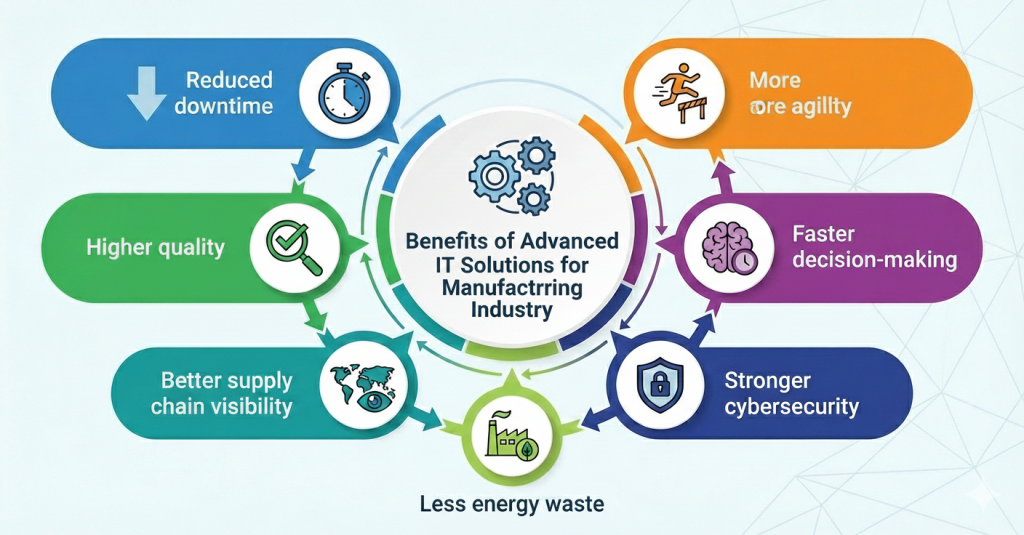
Adopting modern IT solutions offers far more than incremental improvements. When applied strategically, these technologies reshape how production facilities operate strengthening efficiency, product quality, and long-term competitiveness. The following benefits highlight why digital transformation has become essential for manufacturing success.
1. Reduced Downtime and More Reliable Operations
Unplanned downtime is one of the most costly challenges for manufacturers. With real-time monitoring, automated alerts, and predictive maintenance, IT systems help prevent disruptions by identifying early warning signs such as abnormal vibration, temperature spikes, or process deviations. This shift from reactive to proactive operations results in:
- fewer unexpected equipment failures
- faster issue resolution
- improved production stability
Manufacturers gain consistent output and avoid the costly interruptions that affect delivery schedules and customer satisfaction.
2. Higher Product Quality and Faster Defect Detection
Advanced analytics, IoT sensors, and automated quality control systems make it possible to identify defects at the earliest stage of production. Instead of relying solely on manual inspection, factories can monitor quality continuously using digital tools. This leads to:
- more accurate quality checks
- reduced scrap and rework
- standardized quality across shifts and locations
By catching defects earlier, manufacturers can lower production waste and deliver more reliable products to the market.
3. Improved Supply Chain Visibility and Coordination
Integrated IT systems create end-to-end visibility across procurement, inventory, production, and logistics. Manufacturers gain real-time insights into stock levels, shipment status, and supplier performance enabling smarter and faster decisions. Key advantages include:
- reduced stockouts and excess inventory
- faster response to demand fluctuations
- improved delivery accuracy
A connected supply chain also helps mitigate disruptions by providing early warnings and alternative planning options.
4. Optimized Resource and Energy Usage
Energy-intensive manufacturing processes benefit significantly from digital monitoring and automation. With the help of smart meters, analytics, and automated process adjustments, manufacturers can:
- track energy consumption by machine or production line
- optimize equipment usage
- reduce unnecessary energy waste
These improvements not only lower operational costs but also support sustainability targets an increasingly important requirement in global supply chains.
5. Stronger Cybersecurity Protection for Critical Systems
With cyberattacks on manufacturing operations rising globally, modern cybersecurity solutions play a vital role in protecting OT and IT environments. Benefits include:
- reduced likelihood of ransomware-related shutdowns
- stronger protection of intellectual property
- safer connectivity between machines, cloud systems, and external partners
Robust cybersecurity helps maintain business continuity and safeguards production data critical to operations.
6. Enhanced Decision-Making Through Real-Time Data
Manufacturers that rely on outdated or manual reporting often face delays and inaccuracies. Modern IT solutions provide access to real-time dashboards that visualize performance across machines, shifts, and plants. This empowers managers to:
- identify bottlenecks immediately
- adjust production plans quickly
- track KPIs with higher accuracy
Better insights lead to smarter, faster decisions boosting efficiency across the entire operation.
7. Increased Agility in a Rapidly Changing Market
With markets shifting faster than ever, manufacturers must adapt quickly to new customer needs, supply chain disruptions, or production challenges. Integrated digital systems support agility by enabling:
- rapid scaling of production
- seamless integration of new technologies
- faster rollout of product changes
This flexibility helps manufacturers maintain a competitive edge even during economic or industry-wide uncertainties.
Long-Term Impact of IT Solutions on the Manufacturing Industry
The adoption of advanced IT solutions does more than optimize day-to-day operations it fundamentally reshapes the long-term direction of manufacturing organizations. As digital transformation becomes an industry standard, manufacturers that invest in modern technologies gain structural advantages that compound over time. These long-term impacts highlight how IT solutions influence growth, resilience, and competitiveness across the sector.
1. A More Resilient and Future-Proof Production Ecosystem
Integrated digital systems make manufacturing operations more adaptable to disruptions from supply chain delays to global economic shifts. By relying on real-time data and predictive intelligence, factories can anticipate problems earlier, adjust workflows faster, and maintain productivity even under pressure. This long-term resilience reduces operational risk and helps companies stay stable during periods of uncertainty.
2. Continuous Improvement Through Data-Driven Insights
With IoT sensors, analytics platforms, and automated reporting, manufacturers generate a continuous stream of process data. Over time, this data becomes a valuable strategic asset that supports:
- better production optimization
- more accurate forecasting
- refined quality improvements
- smarter long-term planning
This ongoing feedback loop allows manufacturers to evolve faster and maintain operational excellence.
3. Stronger Innovation Capabilities and Technology Readiness
Manufacturers using modern IT infrastructure can adopt new tools and innovate more easily. Cloud-native applications, open APIs, and integrated systems allow facilities to add:
- AI-driven process automation
- robotics advancements
- digital twins for simulation
- smart supply chain technologies
This long-term technological readiness accelerates innovation cycles and positions manufacturers to take advantage of future breakthroughs.
4. Sustainable Operations and Reduced Environmental Impact
Energy optimization technologies, smart monitoring, and data-driven process adjustments help manufacturers reduce environmental footprints over the long term. With sustainability now central to global supply chain requirements, IT-enabled improvements support:
- lower carbon emissions
- more efficient resource usage
- compliance with environmental regulations
- improved sustainability reporting
Sustainability becomes both a competitive advantage and a regulatory necessity.
5. Workforce Transformation and Higher-Value Roles
As automation handles repetitive tasks, the workforce shifts toward roles that require more analytical and technical skills. Over time, IT solutions support a more empowered workforce capable of:
- supervising automated systems
- interpreting real-time data
- optimizing digital workflows
- performing higher-value problem-solving tasks
This creates a stronger, more skilled labor force equipped for the future of manufacturing.
6. Accelerated Growth and Long-Term Competitiveness
Manufacturers that modernize early typically grow faster due to improved efficiency, stronger supply chain control, and better product quality. In the long term, IT solutions help companies:
- launch new products faster
- reduce operational costs sustainably
- respond to market changes more quickly
- maintain strategic advantages over competitors
These cumulative benefits make digital transformation a key driver of long-term industry leadership.
Conclusion
Digital transformation is reshaping the manufacturing industry, pushing companies to modernize their systems and rely more heavily on real-time data, automation, and integrated technologies. By adopting the right IT solutions whether through cloud infrastructure, IoT connectivity, or predictive analytics manufacturers can strengthen operational efficiency, improve product quality, and respond to market demands with far greater agility.
However, implementing these technologies successfully requires more than simply choosing new tools. It demands careful planning, strong technical execution, and solutions that align with each facility’s unique processes. Many manufacturers therefore turn to experienced development teams to help them navigate this transition. Partners like ONEXT DIGITAL, with expertise in custom software development and system integration, often support businesses in building stable, scalable digital foundations that fit long-term goals.
By investing in modern IT solutions and the right technical guidance, manufacturers set themselves up for sustainable growth and gain a lasting competitive edge in an increasingly technology-driven world.
FAQs about IT Solutions for Manufacturing Industry
1. Why are IT solutions essential for the manufacturing industry?
They improve productivity, streamline operations, reduce downtime, enhance quality control, and provide real-time insights needed for smarter decision-making.
2. What are the biggest IT challenges manufacturers face today?
Common challenges include legacy systems, data silos, cybersecurity risks, lack of real-time visibility, and workforce skill gaps.
3. Which IT solutions have the biggest impact on manufacturing operations?
Cloud platforms, Industrial IoT (IIoT) sensors, predictive analytics, MES systems, cybersecurity tools, and data integration platforms drive the most significant improvements.
4. How can IT solutions help reduce production downtime?
Through real-time monitoring, automated alerts, and predictive maintenance allowing manufacturers to detect issues early and prevent equipment failures.
5. What role does IoT play in modern manufacturing?
IoT enables continuous data collection from machines and processes, improving OEE, enhancing quality control, and supporting automation.
6. Can small or mid-sized manufacturers adopt Industry 4.0 technologies?
Yes. Many modern IT solutions are scalable and cost-effective. Cloud platforms, modular MES, and plug-and-play IoT devices allow smaller manufacturers to transform digitally without heavy infrastructure investments.