
 Services
 Solutions
 Main platform
 Technology
 White Label
  Offshore
 Hire developers



The Internet of Things is transforming everyday life and business operations. From connected homes to smart factories, IoT solutions are changing how data is collected and used. Behind this innovation is IoT software development, which makes devices communicate, analyze information, and deliver real value.
For companies, IoT offers new opportunities for efficiency, automation, and customer experience. But starting a project without preparation can lead to high costs, security risks, or limited scalability.
This guide gives you the essentials you need to know before beginning an IoT project. You will learn what IoT software development is, how it works, what challenges to expect, and how to build a solid plan for success.
What Is IoT Software Development?
IoT software development is the process of designing and building applications that enable connected devices to communicate and work together seamlessly. Unlike traditional software, these solutions must integrate hardware, sensors, networks, and cloud systems, which makes the process more challenging but also far more transformative.
An IoT ecosystem typically consists of smart devices that collect data, communication channels that transfer information securely, and software platforms that analyze and present insights to users. Imagine a fitness tracker that measures your heart rate, sends the data to an application, and then provides personalized recommendations to improve your health and lifestyle.
At its heart, IoT software development is about turning streams of raw data into meaningful actions that drive efficiency, increase safety, and create richer customer experiences. It is the bridge that transforms ordinary devices into intelligent systems capable of reshaping the way businesses and individuals interact with the world.
Why IoT is a Game-Changer for Modern Businesses
In today’s digital first world, the Internet of Things (IoT) is more than a technological trend. It is a driving force that transforms how companies operate, compete, and scale. By connecting people, devices, and processes in real time, IoT delivers what every organization seeks: efficiency, intelligence, and innovation at scale. With the right IoT software development strategy, businesses can do more than reduce costs or automate tasks. They can reinvent the way they serve customers, make decisions, and create lasting value.
Why IoT Truly Matters for Businesses:
- Unmatched Efficiency: IoT enables machines, tools, and systems to collaborate seamlessly. Through real time data and predictive insights, companies gain smoother workflows, proactive maintenance, and faster responses that convert downtime into productivity.
- Lower Costs and Higher Returns: By combining IoT software development with smart automation, businesses optimize energy consumption, reduce labor costs, and maximize profitability. Every improvement in efficiency becomes a long term competitive advantage.
- Data Driven Decision Making: Connected devices generate vast amounts of valuable data. With IoT platforms analyzing this information, organizations gain deeper visibility into customer behavior, market dynamics, and performance gaps empowering leaders to act quickly and strategically.
- A Stronger Customer Experience: IoT goes beyond personalization by enabling smart, interactive experiences. Whether it is connected homes, intelligent retail systems, or next generation vehicles, IoT solutions help businesses deliver services that delight customers and build loyalty.
- New Opportunities for Growth: With IoT software development, companies can create subscription models, embed technology into smart products, and offer digital services that open new revenue streams and differentiate them in crowded markets.
- Automation at Scale: IoT allows routine processes to run independently without human intervention, freeing teams to focus on strategy, innovation, and growth. This level of automation accelerates productivity and supports long term scalability.
- A Catalyst for Digital Transformation: IoT is not simply a tool. It is the foundation for modernizing operations, replacing outdated systems, and embracing new business models. In a fast changing world, IoT software development empowers organizations to adapt, innovate, and thrive.
Core Components of IoT Software Development
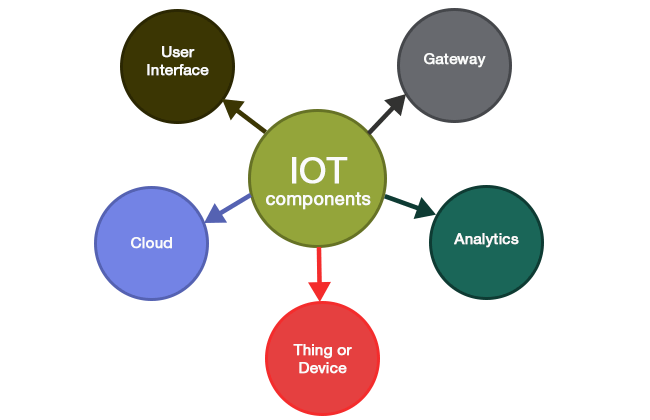
In the world of IoT software development, building a reliable system requires multiple components working seamlessly together. Each element plays a unique role, from capturing data to transforming it into business value. When designed and implemented correctly, these components enable efficiency, scalability, and innovation across industries. Here are the key building blocks that developers must focus on:
1. Sensors and Actuators
Sensors are embedded in physical devices to collect real-world data, such as temperature, humidity, motion, or light. Actuators respond to this information by performing specific actions, like turning off a machine, adjusting lighting, or activating a motor. The synergy between accurate data collection and responsive actuation is fundamental to any IoT ecosystem.
2. Connectivity Protocols
Connectivity is the backbone of IoT software development, allowing devices to exchange information in real time. Depending on the application, different protocols are used:
- Wi-Fi for high-speed data transmission over short distances
- Bluetooth for energy-efficient, short-range communication
- Zigbee and Z-Wave for smart home and low-power systems
- 5G and NB-IoT for large-scale, long-range applications with high bandwidth needs
Choosing the right protocol ensures reliable communication, optimized performance, and energy efficiency.
3. Platforms and Cloud Services
IoT platforms like AWS IoT or Azure IoT Hub provide the infrastructure needed to manage devices, store data, and run applications. Cloud services make it possible to scale systems effortlessly, host massive datasets securely, and integrate advanced analytics. Without robust platforms and cloud support, IoT systems would struggle to achieve flexibility and long-term growth.
4. Data Processing and Analytics
IoT devices generate enormous volumes of data that must be processed and analyzed. Cloud computing, big data tools, and machine learning algorithms convert raw information into actionable insights that drive automation and smarter decision-making. In many cases, edge computing is used to process data near the source, reducing latency and enabling real-time responsiveness.
5. Security and Privacy
Security is one of the most critical aspects of IoT software development. Protecting sensitive data, ensuring device authentication, and maintaining system integrity are essential to prevent breaches and build user trust. Encryption, secure communication channels, and proactive monitoring must be embedded at every layer of the IoT architecture.
6. User Interfaces and Control Systems
The user interface is where humans interact with IoT systems. Whether through mobile apps, web dashboards, or voice assistants, the UI should be intuitive, responsive, and visually clear. A well-designed interface enhances usability, increases adoption rates, and ultimately determines the success of an IoT solution.
Benefits of IoT Software Development
Investing in IoT software development offers businesses far more than just technical improvements. It transforms how organizations operate, interact with customers, and innovate in competitive markets. By turning connected devices into intelligent ecosystems, IoT creates tangible value that drives both efficiency and growth.
1. Improved Operational Efficiency
IoT solutions enable real-time monitoring of assets, predictive maintenance, and automated workflows. This reduces downtime, prevents costly failures, and ensures resources are used more effectively. From manufacturing floors to supply chains, efficiency becomes a built-in advantage.
2. Significant Cost Savings
By automating manual tasks and optimizing resource consumption, businesses can cut expenses while increasing output. Energy-efficient IoT systems, for example, can lower utility costs, while smart logistics solutions reduce fuel usage and labor demands.
3. Smarter Decision-Making Through Data
Every connected device generates valuable insights. With IoT analytics, companies can uncover patterns, predict market trends, and respond to customer needs with greater accuracy. Data-driven strategies empower leaders to make decisions that are faster, more informed, and more impactful.
4. Enhanced Customer Experience
IoT software development allows businesses to personalize interactions and deliver seamless services. From smart retail experiences to connected healthcare systems, IoT solutions deepen engagement and strengthen customer loyalty through meaningful, real-time interactions.
5. New Revenue Opportunities
IoT paves the way for innovative business models such as subscription services, connected products, and value-added digital solutions. By embedding intelligence into everyday devices, companies can diversify their offerings and create entirely new streams of income.
6. Scalable Automation
IoT systems make it possible to automate processes at scale, reducing human intervention in repetitive tasks. This not only boosts productivity but also frees up employees to focus on strategic, creative, and value-driven work.
7. Catalyst for Digital Transformation
Perhaps most importantly, IoT accelerates digital transformation. It equips businesses with the tools to modernize operations, experiment with new models, and remain agile in industries that are constantly evolving.
Challenges in IoT Software Development
While the potential of IoT software development is immense, businesses must also be prepared to address the unique challenges that come with it. Developing IoT solutions involves managing complexity at multiple levels, from hardware integration to data security, and overcoming these obstacles is essential for long-term success.
1. Complex Integration of Devices and Systems
IoT solutions require seamless communication between diverse hardware, sensors, protocols, and cloud platforms. Ensuring that devices from different vendors work harmoniously can be difficult, especially when dealing with legacy systems. This complexity often slows development and demands careful planning.
2. Scalability Concerns
As IoT networks grow, handling increasing numbers of devices and the data they produce becomes a challenge. Without a scalable architecture, performance issues and system instability can arise, limiting the effectiveness of the solution.
3. Security and Privacy Risks
IoT devices are often targeted by cyberattacks due to their constant connectivity. Weak authentication, unencrypted communication, and outdated firmware can expose businesses to data breaches. Robust security measures must be embedded at every stage of IoT software development to protect sensitive information and maintain trust.
4. High Development and Maintenance Costs
Building and maintaining IoT solutions can be costly, particularly when specialized hardware, secure infrastructure, and skilled development teams are required. Businesses need to carefully balance investment with expected returns.
5. Data Overload and Management
IoT systems generate massive volumes of data, which can overwhelm traditional storage and processing methods. Without efficient data management strategies, companies may struggle to derive meaningful insights, slowing down decision-making.
6. Standardization Issues
The lack of universal standards for IoT protocols, security, and device compatibility makes development more challenging. Developers must often customize solutions for specific ecosystems, which increases time and complexity.
7. User Adoption and Experience
Even the most advanced IoT solution can fail if users find it difficult to interact with. Creating intuitive user interfaces and ensuring a seamless experience across devices remain critical hurdles in adoption.
Best Practices for Successful IoT Software Development
Overcoming the challenges of IoT software development requires a thoughtful approach that balances technology, security, and user needs. By following best practices, businesses can build solutions that are not only functional but also scalable, secure, and future ready.
1. Define Clear Business Objectives
Every IoT project should begin with a well defined purpose. Whether the goal is to reduce operational costs, improve customer experiences, or create new revenue streams, clarity ensures that the solution is aligned with business priorities and delivers measurable value.
2. Prioritize Security from Day One
Security cannot be treated as an afterthought in IoT software development. From device authentication and encrypted communication to regular software updates, every layer must be designed to protect against cyber threats and safeguard sensitive data.
3. Build Scalable Architectures
IoT systems should be designed with scalability in mind, allowing businesses to easily add devices, handle growing data volumes, and integrate new services without compromising performance. Leveraging cloud and edge computing can help achieve this flexibility.
4. Choose the Right Connectivity and Protocols
Selecting the appropriate communication protocol is critical for system performance and reliability. Developers should evaluate factors like range, power consumption, and bandwidth requirements to ensure seamless connectivity across devices.
5. Focus on Data Management and Analytics
IoT generates vast amounts of information, but its true value lies in actionable insights. Implementing advanced analytics, machine learning, and efficient data storage strategies ensures that raw data is transformed into decisions that drive growth.
6. Design Intuitive User Interfaces
The success of an IoT system often depends on how easily users can interact with it. Clean, responsive, and intuitive interfaces whether on mobile apps, dashboards, or voice controlled systems encourage adoption and enhance user satisfaction.
7. Embrace Interoperability and Standards
With so many devices and platforms in the IoT ecosystem, ensuring interoperability is crucial. Following industry standards and adopting modular development approaches allow solutions to integrate smoothly and remain adaptable as technology evolves.
8. Test Thoroughly and Continuously
IoT systems are complex, with many moving parts that must work together. Rigorous testing from device performance and connectivity to security and user experience helps identify issues early and ensures reliability in real world conditions.
Future Trends in IoT Software Development
The landscape of IoT software development is evolving at an incredible pace, shaped by emerging technologies, growing user expectations, and the need for more intelligent, secure, and adaptable solutions. Looking ahead, several key trends are set to redefine how businesses design and implement IoT systems.
1. Integration of Artificial Intelligence and Machine Learning
AI and ML are becoming integral to IoT software development, enabling systems to learn from data and make autonomous decisions. From predictive maintenance in manufacturing to personalized healthcare recommendations, this combination will unlock unprecedented levels of efficiency and intelligence.
2. Expansion of Edge Computing
As the number of connected devices grows, processing data closer to the source is becoming essential. Edge computing reduces latency, improves responsiveness, and lowers bandwidth costs, making IoT applications faster and more reliable in real time environments.
3. 5G Powered Connectivity
The global rollout of 5G networks is a game changer for IoT. With higher bandwidth and ultra low latency, 5G will support massive device deployments, accelerate smart city initiatives, and enable advanced use cases such as autonomous vehicles and remote surgery.
4. Greater Emphasis on Cybersecurity
With IoT ecosystems expanding, security risks are rising. Future IoT software development will focus heavily on advanced encryption, zero trust models, and automated threat detection to protect sensitive data and ensure user trust.
5. Interoperability and Open Standards
To overcome fragmentation in the IoT ecosystem, the future will see a stronger push toward open standards and interoperable platforms. This will allow devices from different vendors to work together seamlessly, fostering collaboration and innovation across industries.
6. Sustainability and Green IoT
As environmental concerns grow, IoT solutions will increasingly prioritize energy efficiency and sustainability. From smart grids to eco friendly supply chain monitoring, IoT software development will play a central role in building greener, smarter systems.
7. Rise of Digital Twins
Digital twin technology virtual replicas of physical assets will gain traction in IoT development. By simulating real world scenarios, digital twins will help businesses optimize performance, predict failures, and reduce operational risks.
8. Human Centered IoT Experiences
Beyond technical capabilities, future IoT software development will focus on creating intuitive, user centric experiences. Systems that are accessible, adaptive, and responsive to human needs will drive broader adoption and long term success.
Conclusion
IoT software development is no longer just about connecting devices; it is about creating intelligent, secure, and scalable ecosystems that empower businesses to innovate and grow. By embracing best practices and staying ahead of trends like AI integration, edge computing, and 5G connectivity, companies can transform IoT from a simple tool into a powerful driver of long-term success. The future lies in solutions that are not only smarter and faster but also more sustainable and user centric.
For organizations ready to take the next step, partnering with an experienced team is key. ONEXT DIGITAL specializes in IoT software development, offering end-to-end services that help businesses design, build, and scale connected systems tailored to their unique needs. Our focus is on reducing time to market, optimizing costs, and ensuring security at every level, helping businesses adopt IoT effectively and sustainably.
FAQs about IoT software development
1. How do businesses measure ROI from IoT software development?
Businesses measure ROI from IoT software development by tracking efficiency improvements, cost savings, and new revenue streams. Metrics include reduced downtime, lower energy consumption, faster decision-making, and enhanced customer experiences. By comparing pre- and post-IoT performance, companies can quantify benefits and make informed investment decisions.
2. How can IoT software handle large volumes of data effectively?
IoT software handles large volumes of data through cloud storage, edge computing, and optimized databases. Real-time analytics and data filtering reduce overload, while structured pipelines and machine learning help extract actionable insights. Efficient data management ensures the system remains fast, scalable, and reliable.
3. What are common mistakes to avoid in IoT software development?
Common mistakes include neglecting security, underestimating device compatibility issues, overloading networks, and skipping user testing. Ignoring scalability and data management can also cause long-term problems. Avoiding these pitfalls ensures smoother deployment and better adoption of IoT solutions.
4. How do IoT software developers ensure system reliability?
Developers ensure system reliability by implementing redundancy, monitoring device health, conducting rigorous testing, and using fault-tolerant architectures. Predictive maintenance and automated alerts also reduce downtime. Regular updates and robust infrastructure help IoT systems remain stable under varying loads and conditions.
5. How can IoT software support sustainability initiatives?
IoT software supports sustainability by optimizing energy use, monitoring environmental conditions, and reducing waste. Smart grids, efficient logistics, and connected sensors help organizations track and lower their carbon footprint. IoT analytics enable data-driven decisions that improve operational sustainability.
6. How do companies plan for future upgrades in IoT systems?
Companies plan future upgrades by adopting modular software, open standards, and scalable architectures. This allows new devices, protocols, or analytics features to integrate without major redesigns. Continuous monitoring and feedback loops help anticipate needs and keep the IoT ecosystem adaptable over time.