
 Services
 Solutions
 Main platform
 Technology
 White Label
  Offshore
 Hire developers


The manufacturing sector is undergoing one of the most profound digital transformations in its history. From smart factories to predictive maintenance, technology is no longer a support function it is the foundation of competitiveness. At the heart of this shift lies manufacturing software development, which enables organizations to integrate operations, analyze data in real time, and innovate at scale.
Why is this so critical? Because efficiency and speed define survival in today’s industrial economy. Custom-built software solutions whether ERP systems for supply chain management or MES platforms for shop-floor visibility allow manufacturers to break down silos, reduce waste, and optimize productivity.
Recent studies highlight the impact: according to McKinsey, factories that adopt advanced digital solutions can achieve up to 30% productivity gains, while Deloitte reports that manufacturers leveraging ERP and AI-powered platforms see a 20 – 25% reduction in operational costs. These numbers prove that software isn’t just a tool it’s the competitive edge for modern manufacturing.
What is Manufacturing Software Development?
Manufacturing software development refers to the process of designing, building, and implementing digital solutions that streamline and optimize operations across the production lifecycle. Unlike generic business tools, these systems are tailored to address the specific challenges of manufacturing such as managing complex supply chains, monitoring shop-floor activities, ensuring compliance, and enabling real-time data insights.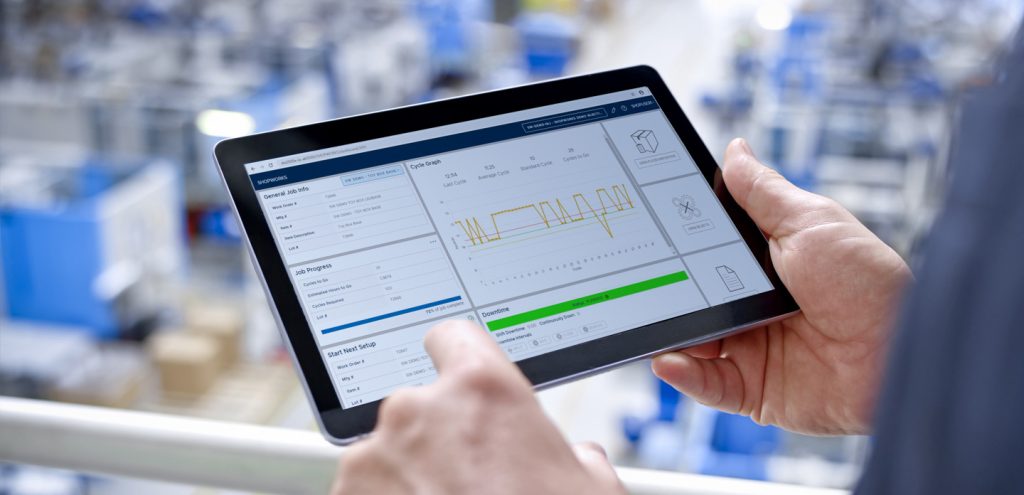
At its core, manufacturing software connects every layer of a factory, from resource planning to machine-level monitoring. For example, ERP (Enterprise Resource Planning) platforms manage finances, procurement, and logistics, while MES (Manufacturing Execution Systems) track production processes in real time. Together, they create a transparent ecosystem where managers can reduce downtime, optimize resources, and deliver products faster to market.
Custom vs. Off-the-Shelf Manufacturing Software
| Feature | Off-the-Shelf Software | Custom Manufacturing Software |
| Flexibility | Limited to predefined features | Tailored to unique workflows |
| Integration | May not align with legacy systems | Built to fit existing tech stack |
| Cost | Lower upfront but higher adaptation costs | Higher initial investment, lower long-term cost |
| Scalability | Hard to expand beyond vendor’s scope | Designed to scale with business growth |
| Competitive Edge | Similar tools used by competitors | Unique capabilities as a differentiator |
While off-the-shelf solutions are faster to deploy, they often lack the adaptability required in complex manufacturing environments. By contrast, custom manufacturing software provides scalability, seamless integration, and strategic advantages that directly support digital transformation.
Types of Manufacturing Software
The manufacturing industry relies on a wide spectrum of software solutions, each designed to address a specific part of the production ecosystem. Understanding these categories is essential before deciding whether to invest in custom manufacturing software development or adopt off-the-shelf tools.
1. Enterprise Resource Planning (ERP)
ERP platforms unify core business functions such as finance, procurement, and supply chain into a single system. For manufacturers, ERP ensures better resource allocation, real-time inventory visibility, and streamlined logistics. For instance, SAP and Oracle are widely used ERP providers in global factories.
2. Manufacturing Execution Systems (MES)
MES focuses on the shop floor. It provides real-time tracking of production processes, quality control, and workforce management. By connecting machines and operators, MES improves efficiency and reduces downtime.
3. Product Lifecycle Management (PLM)
PLM solutions manage a product’s journey from design and prototyping to manufacturing and retirement. This is crucial for industries like automotive and electronics, where design iterations must be tightly controlled and compliant with regulations.
4. Supervisory Control and Data Acquisition (SCADA)
SCADA systems are essential for monitoring and controlling industrial equipment. They collect data from sensors and devices, allowing engineers to remotely supervise production lines, identify bottlenecks, and respond quickly to failures.
5. IoT & AI-Powered Solutions
Emerging technologies like IoT sensors and AI-driven analytics bring predictive capabilities to manufacturing. For example, predictive maintenance systems can analyze machine data to forecast breakdowns before they occur reducing unplanned downtime by up to 50%.
Comparison Overview
Software Type | Primary Function | Best For | Example Use Case |
| ERP | Integrates business operations | Large-scale resource & supply chain management | Managing global suppliers |
| MES | Tracks shop-floor processes | Real-time production monitoring | Reducing downtime in assembly lines |
| PLM | Manages product lifecycle | Design-heavy industries | Automotive prototyping |
| SCADA | Supervises industrial equipment | Process-heavy plants | Monitoring chemical production |
| IoT & AI | Predictive analytics & automation | Smart factories | Predictive maintenance for machines |
By combining these tools or building custom solutions that integrate multiple functions manufacturers can move toward a connected, data-driven ecosystem that powers the next generation of smart factories.
Key Benefits of Manufacturing Software Development
Investing in manufacturing software development is not just a matter of upgrading technology it directly shapes a company’s ability to compete in today’s global market. Below are the most impactful benefits, along with insights into why they matter and how they translate into measurable outcomes.
1. Improved Operational Efficiency
Custom manufacturing software automates repetitive tasks, reduces manual errors, and streamlines processes across departments. For instance, integrating ERP with MES allows managers to connect supply chain data with real-time shop-floor performance, reducing production delays and material waste. According to Deloitte, companies that adopt integrated systems achieve 20 – 30% faster production cycles.
2. Cost Reduction & Higher ROI
Although initial investment in software can be significant, the long-term savings are substantial. Predictive maintenance systems powered by IoT and AI help manufacturers avoid unexpected breakdowns cutting maintenance costs by up to 25% while improving machine uptime. Similarly, real-time inventory tracking reduces overstocking and lowers storage costs.
3. Enhanced Product Quality
Software-driven quality control tools ensure that defects are detected early, minimizing costly recalls. For example, MES platforms can automatically flag deviations in production parameters, while PLM systems enforce compliance across product iterations. The result is consistent product quality and stronger brand trust.
4. Real-Time Data & Smarter Decisions
Modern factories generate massive amounts of data from machines, sensors, and employees. Without a connected system, this data often remains underutilized. Manufacturing software centralizes and analyzes it, empowering leaders to make informed decisions quickly. McKinsey reports that data-driven manufacturing can improve decision accuracy by up to 80%.
5. Scalability & Flexibility
Custom manufacturing software adapts as businesses grow. Unlike rigid off-the-shelf tools, custom solutions can evolve with new product lines, additional factories, or regulatory changes. This scalability ensures that the system continues to deliver value over time rather than becoming obsolete.
6. Competitive Advantage
Perhaps the most overlooked benefit is differentiation. When competitors use the same off-the-shelf platforms, the playing field is level. A custom solution tailored to unique workflows becomes a strategic asset, enabling faster delivery times, leaner operations, and better customer experiences.
Manufacturing Software Development Process
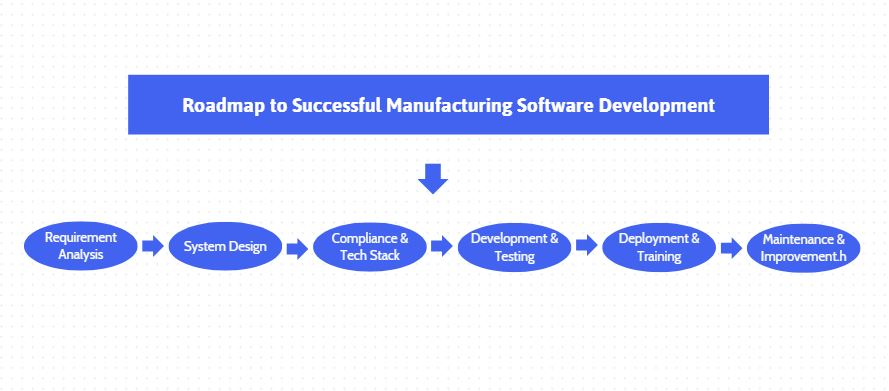
Developing manufacturing software is a complex journey that requires strategic planning, technical expertise, and industry alignment. Unlike generic software projects, manufacturing solutions must integrate with physical equipment, comply with strict regulations, and support mission-critical operations. Below is a roadmap that illustrates the key stages of development.
Step 1: Requirement Analysis & Consulting
The process begins with a deep dive into business needs. This includes mapping existing workflows, identifying bottlenecks, and setting measurable goals such as reducing downtime or improving supply chain visibility. Engaging stakeholders early ensures that the software aligns with both operational and strategic priorities.
Step 2: System Design & Architecture
Once requirements are clear, the software architecture is designed. This step defines how the system will integrate with ERP, MES, or legacy platforms. For manufacturing, scalability and interoperability are essential. Cloud-native or hybrid designs are often favored for flexibility and long-term growth.
Step 3: Compliance & Technology Stack Selection
Manufacturers must adhere to industry standards (ISO, FDA, or OSHA depending on the sector). At this stage, compliance frameworks are built into the system. The choice of technology stack programming languages, databases, IoT platforms also occurs here, ensuring the solution is robust and future-proof.
Step 4: Development & Testing
Using agile methodologies, the software is developed in iterations. Continuous testing is critical, covering unit tests, integration tests, and real-world simulations. For example, stress tests ensure that the system can handle data surges from IoT devices without downtime.
Step 5: Deployment & Training
After rigorous testing, the solution is deployed across the factory environment. Equally important is employee training operators and managers must understand how to use the software effectively. Training reduces resistance to change and maximizes adoption.
Step 6: Maintenance & Continuous Improvement
Manufacturing software is not static. Ongoing updates, bug fixes, and feature enhancements are required to keep the system aligned with evolving business needs. Many companies also leverage data analytics post-deployment to fine-tune processes and unlock additional ROI.
To make this roadmap easier to follow, here’s a visual overview of the process:
Challenges in Manufacturing Software Development
While manufacturing software development unlocks significant efficiency and innovation, companies must navigate several critical challenges before achieving long-term success. Ignoring these barriers can lead to failed implementations, cost overruns, or technology that quickly becomes outdated.
1. Legacy Systems and Integration Issues
Many manufacturers still rely on outdated ERP or production management tools that were never designed to integrate with modern platforms. Custom APIs and middleware often become necessary, which increases project complexity and costs.
2. Data Silos and Quality
Software is only as effective as the data it processes. Inconsistent or incomplete data from different machines, departments, or suppliers can undermine predictive analytics and automation features. Establishing unified data standards is essential.
3. High Development and Implementation Costs
Custom software development in manufacturing requires deep domain expertise, rigorous testing, and compliance with industry standards (such as ISO and OSHA). This makes initial investment substantial, which can deter small and mid-sized manufacturers.
4. Security and Compliance Risks
With the rise of IoT-enabled factories, cyberattacks targeting production systems are increasing. Manufacturers must ensure strict compliance with regulations like GDPR, CCPA, or industry-specific cybersecurity standards.
5. Workforce Adoption and Training
Even the best manufacturing software can fail if employees resist adoption. Bridging the digital skills gap and ensuring adequate training is a persistent challenge for companies in transition.
6. Scalability and Future-Proofing
The pace of technological change in AI, IoT, and cloud computing means software must be built to scale. Without modular and flexible architecture, businesses risk costly re-developments within a few years.
Overcoming these challenges requires a mix of technical expertise, change management, and strategic vision. Manufacturers that address these head-on are far more likely to see measurable ROI and long-term competitiveness.
Conclusion
Manufacturing software development is no longer just a support function it has become the backbone of digital transformation in modern factories. From predictive analytics and AI-driven automation to cloud-based ERP systems, the right software enables manufacturers to cut costs, optimize efficiency, and build resilience in an increasingly competitive market. However, success depends not only on technology but also on strategy: integrating legacy systems, ensuring data quality, and preparing the workforce for change.
For manufacturers ready to move beyond incremental improvements, now is the time to invest in scalable, future-proof solutions. Partnering with an experienced development team ensures your software is designed with both compliance and innovation in mind.
At ONEXT DIGITAL, we specialize in building custom manufacturing software that empowers businesses to achieve measurable ROI and sustainable growth. Let’s turn your digital vision into a competitive advantage reach out today to start the conversation.
FAQs about Manufacturing Software Development
These FAQs address the most common concerns manufacturers have when evaluating custom software solutions. Read on for practical answers about timelines, costs, industry fit, and the real business impact of technologies like AI and IoT.
1. What is manufacturing software development?
Manufacturing software development is the process of designing and building custom digital solutions to manage production, supply chains, quality control, and compliance. Unlike off-the-shelf tools, it’s tailored to the unique workflows and challenges of factories.
2. How long does it take to implement custom manufacturing software?
Implementation timelines vary based on complexity and scale. Small projects may take 3 – 6 months, while large, enterprise-wide solutions can take 9 – 18 months, including analysis, development, testing, and training.
3. What industries benefit the most from custom manufacturing software?
Industries with complex production cycles such as automotive, aerospace, electronics, pharmaceuticals, and food & beverage gain the most value. These sectors rely heavily on efficiency, compliance, and real-time data.
4. How much does custom manufacturing software development cost?
Costs depend on project scope, features, and compliance requirements. On average, investments range from $30,000 to $200,000+. While upfront costs are higher than off-the-shelf solutions, long-term ROI is significantly better.
5. What are the main challenges during implementation?
Common challenges include integrating with legacy systems, managing data quality, ensuring workforce adoption, and meeting regulatory standards. With proper planning and an experienced development team, these risks can be minimized.
6. How does AI and IoT improve manufacturing software?
AI and IoT bring predictive analytics and automation to factories. For example, IoT sensors monitor equipment health, while AI predicts maintenance needs, reducing downtime by up to 50% and optimizing production efficiency.
7. How long before we see ROI from custom manufacturing software?
ROI depends on the project scope and the specific challenges the software addresses. In most cases, manufacturers start seeing measurable returns such as reduced downtime, lower maintenance costs, or faster production cycles within 12 – 24 months of implementation. For smaller, targeted projects, ROI can appear in as little as 6 – 9 months.
8. Can small and mid-sized manufacturers afford custom software?
Yes. While custom solutions are often associated with large enterprises, many development teams now offer modular and scalable approaches tailored to SMEs. By focusing on critical pain points first such as predictive maintenance or supply chain visibility smaller manufacturers can invest gradually and still achieve high-impact results without overspending.