
 Services
 Solutions
 Main platform
 Technology
 White Label
  Offshore
 Hire developers



Financial software development is at the heart of digital transformation in the finance industry. In 2025, it goes beyond processing transactions it enables banks, fintech startups, and businesses to deliver secure, scalable, and compliant solutions that meet rising customer expectations. From mobile banking apps and e-wallets to AI-driven trading platforms and blockchain-powered payment systems, financial software is reshaping how people and organizations interact with money.
Yet, building such solutions is complex. Companies must balance security, compliance, and scalability while keeping up with rapid technological changes. This guide explores the essentials of financial software development in 2025 its key features, costs, challenges, and future trends to help you design innovative and future-ready solutions.
What is Financial Software Development?
Financial software development refers to the process of designing, building, and maintaining software applications tailored for the finance and banking sector. Unlike generic software, these solutions must meet high standards of security, compliance, and reliability because they handle sensitive financial data and transactions that directly impact both individuals and organizations.

At its core, financial software development aims to create digital systems that simplify complex financial operations, improve customer experience, and ensure strict adherence to regulations. These systems can range from everyday tools like mobile banking apps to enterprise-grade platforms managing billions of dollars in assets.
Key Areas of Financial Software:
1. Core Banking Systems
- Provide essential banking services such as account management, deposits, withdrawals, and transaction processing.
- They are the backbone of traditional and digital banks, ensuring accurate and real-time operations.
2. Mobile Banking & Digital Wallets
- Allow customers to access accounts, transfer money, pay bills, and manage finances through smartphones.
- E-wallets such as PayPal, Apple Pay, or MoMo (in Vietnam) are revolutionizing daily financial transactions.
3. Investment & Trading Platforms
- Enable users to buy, sell, and manage stocks, bonds, or cryptocurrencies.
- Often include features like AI-driven portfolio management, real-time analytics, and robo-advisory.
4. Accounting & ERP Finance Modules
- Help businesses manage invoices, payroll, taxes, and compliance.
- Integrating financial data into enterprise systems improves transparency and decision-making.
5. Payment Gateways & Fintech APIs
- Process online transactions securely, enabling e-commerce and cross-border payments.
- APIs allow fintech startups to plug into banking systems quickly, fostering innovation.
Why It Matters
Financial software is no longer optional it is essential. With customers expecting instant services, secure digital experiences, and seamless integration, businesses that fail to invest in robust financial software risk falling behind. For financial institutions, it ensures not just efficiency, but also compliance with global regulations and protection against cyber threats.
In short, financial software development is about much more than writing code. It is about building trust, enabling innovation, and shaping the future of finance in a world where digital-first is the new normal.
Why Financial Software Matters in 2025
In 2025, the financial sector is evolving faster than ever, driven by digital transformation, customer expectations, and global economic shifts. Financial software development plays a central role in this transformation, enabling organizations to remain competitive, compliant, and innovative.
1. Rising Demand for Digital-First Services
Customers now expect to access their finances instantly through mobile apps, digital wallets, and online platforms. Traditional banking hours are no longer enough 24/7, real-time access is the new standard. Financial software provides the backbone for this seamless digital experience.
2. Global Market Growth
The financial technology (fintech) market continues to expand at a rapid pace. According to recent industry reports, the global fintech market is projected to reach over $300 billion by 2025, with a compound annual growth rate (CAGR) of more than 20%. This growth reflects not only consumer adoption of digital finance but also the increased reliance of businesses on tailored financial solutions.
3. Security and Compliance Imperatives
With the rise of cybercrime, data breaches, and financial fraud, secure software development is no longer optional. Financial software must comply with international standards such as PCI DSS, GDPR, SOC 2, and PSD2, depending on the region. Organizations that fail to meet these standards risk heavy fines, reputational damage, and loss of customer trust.
4. Empowering Businesses and Startups
Financial software is not limited to large banks. Small and medium-sized enterprises (SMEs) use accounting tools, ERP modules, and payment solutions to streamline operations. Fintech startups rely on financial software to disrupt traditional models, offering innovative services like peer-to-peer lending, robo-advisory, and blockchain-based payments.
5. Integration of Emerging Technologies
In 2025, financial software increasingly incorporates artificial intelligence, blockchain, cloud computing, and biometrics. These technologies improve fraud detection, enhance personalization, enable faster cross-border payments, and make systems more resilient. For example, AI-powered risk models can analyze millions of data points to assess creditworthiness in seconds.
6. Building Trust and Customer Loyalty
Finance is one of the most sensitive industries when it comes to data. Customers will only adopt digital solutions they can trust. A well-developed financial software system ensures transparency, reliability, and data protection, which are crucial for customer loyalty.
In summary, financial software in 2025 is more than a support tool it is a strategic asset. It enables organizations to innovate, scale globally, comply with strict regulations, and provide customer experiences that define the future of finance. Companies that invest wisely in financial software development will not just survive in this competitive landscape they will thrive.
Types of Financial Software Solutions
In today’s fast-changing financial landscape, software is no longer just a tool it’s a strategic enabler. Each type of financial software acts like a vital “puzzle piece” in the digital transformation journey, helping businesses streamline operations, strengthen security, and deliver superior customer experiences. Understanding these categories is the first step toward selecting the right solution for your organization.
1. Banking Software – The Beating Heart of Modern Finance
Banking software is the circulatory system of global finance, powering every deposit, transfer, and digital interaction.
- Core features: core banking, real-time payment processing, mobile banking, biometric authentication.
- Who uses it: traditional banks, digital banks (neobanks), credit unions.
- Value delivered: customers are no longer bound by physical branches; financial services are now available 24/7, at their fingertips.
- Examples: Temenos T24, Finastra, Revolut.
2. Accounting and Bookkeeping Software – The Custodian of Clarity
Accounting is the language of business, and accounting software is its faithful translator turning messy ledgers into crystal-clear insights.
- Core features: invoicing, expense management, payroll, tax automation, financial reporting.
- Who uses it: accountants, CFOs, small business owners, startups.
- Value delivered: reduces manual errors, ensures compliance, and frees leaders to focus on growth rather than paperwork.
- Examples: QuickBooks, Xero, FreshBooks.
3. Investment & Wealth Management Software – The Investor’s Compass
Investing is a delicate balance of risk and reward. Wealth management platforms serve as a digital compass, guiding investors with data, analytics, and strategy.
- Core features: portfolio management, robo-advisors, market analysis, financial planning, risk assessment.
- Who uses it: individual investors, asset managers, hedge funds, retirement planners.
- Value delivered: empowers investors to spot opportunities in the chaos of the market and make informed, data-driven decisions.
- Examples: Robinhood, Betterment, Charles Schwab.
4. Insurance Software – The Digital Shield of Trust
In insurance, trust is currency. Insurance software acts as a digital shield, ensuring that claims are processed transparently and customers feel protected.
- Core features: policy administration, underwriting, claims management, fraud detection, AI-driven chatbots.
- Who uses it: insurance carriers, brokers, agents.
- Value delivered: transforms a traditionally complex process into a seamless, trustworthy customer journey.
- Examples: Guidewire, Duck Creek Technologies.
5. FinTech & Digital Payment Solutions – The Spark of Financial Inclusion
Digital payments are the universal language of commerce. FinTech platforms are rewriting how people transact: faster, easier, and without borders.
- Core features: e-wallets, peer-to-peer transfers, QR code payments, cross-border transactions, blockchain integration.
- Who uses it: FinTech startups, neobanks, e-commerce businesses.
- Value delivered: opens access to financial services for millions of unbanked individuals, fueling global financial inclusion.
- Examples: PayPal, Stripe, Revolut.
6. ERP with Financial Modules – The Enterprise Nerve Center
ERP systems with financial modules act as the command center of large organizations, connecting finance with HR, supply chain, and operations.
- Core features: cash flow management, budgeting, profitability analysis, consolidated reporting.
- Who uses it: multinational corporations, manufacturers, enterprises with complex operations.
- Value delivered: breaks down data silos, enables holistic decision-making, and gives leaders a 360° view of performance.
- Examples: SAP S/4HANA, Oracle NetSuite, Microsoft Dynamics 365.
7. RegTech Software – The Silent Gatekeeper
In a world of growing regulations and financial crime, RegTech software is the silent gatekeeper, ensuring organizations remain compliant and secure.
- Core features: AML (anti-money laundering), KYC (know-your-customer), suspicious transaction monitoring, compliance reporting.
- Who uses it: banks, stock exchanges, financial institutions operating under strict regulations.
- Value delivered: saves companies from multimillion-dollar fines and safeguards customer trust through transparency and compliance.
- Examples: ComplyAdvantage, Riskified.
Each category of financial software is more than just technology it’s a response to a specific industry challenge. Choosing the right solution is not about features alone, but about aligning software with long-term business strategy, customer expectations, and regulatory realities.
Key Benefits of Financial Software Development

Financial software development is not just about building tools; it’s about unlocking long-term advantages that transform the way financial institutions and businesses operate. Here are some of the most significant benefits:
1. Enhanced Efficiency and Automation
Manual processes such as reconciliation, loan approvals, or expense tracking are time-consuming and prone to human error. Custom financial software automates these workflows, reducing errors, speeding up processes, and freeing employees to focus on high-value tasks.
2. Improved Data Accuracy and Insights
Finance depends heavily on accurate data. With advanced reporting, predictive analytics, and AI-driven forecasting, financial software ensures real-time visibility into cash flow, transactions, and investments. This empowers leaders to make informed, data-backed decisions.
3. Stronger Security and Compliance
Financial data is highly sensitive, and breaches can be devastating. Custom-built solutions can integrate advanced security measures like encryption, biometric authentication, and compliance checks (e.g., GDPR, PCI DSS). This ensures both trust and regulatory adherence.
4. Scalability and Flexibility
Off-the-shelf solutions often lack the flexibility to grow with a business. Financial software development offers scalability, enabling companies to add new modules (e.g., digital payments, robo-advisors, or blockchain integrations) as needs evolve.
5. Better Customer Experience
Whether it’s faster loan approvals, personalized investment advice, or seamless digital payments, financial software directly improves customer satisfaction by offering convenience, speed, and transparency.
In short, investing in financial software development helps organizations stay competitive, secure, and customer-centric in today’s digital-first financial landscape.
Technology Stack for Financial Software Development
Behind every successful financial software product lies a carefully chosen technology stack. The right combination of programming languages, frameworks, databases, and cloud services determines not only performance and scalability but also long-term security and compliance two factors that are non-negotiable in the finance industry.
1. Programming Languages & Frameworks
- Java & .NET – Long-standing choices for enterprise-grade banking and trading systems, offering unmatched reliability and compliance support.
- Python – Widely adopted for financial analytics, AI-driven risk modeling, and algorithmic trading thanks to its rich ecosystem of data science libraries.
- Node.js & JavaScript frameworks (React, Angular, Vue) – Perfect for building responsive, real-time dashboards, mobile banking apps, and customer portals.
2. Databases & Storage Solutions
- PostgreSQL & MySQL – Open-source relational databases known for stability, scalability, and advanced security features.
- MongoDB & Cassandra – NoSQL solutions ideal for handling high-volume, unstructured financial data such as customer interactions or transaction logs.
- In-Memory Databases (Redis, Memcached) – Enable ultra-fast transaction processing and real-time fraud detection.
3. Cloud Infrastructure & Deployment
- AWS (Amazon Web Services) – Popular for fintech startups thanks to its wide range of financial compliance certifications and global availability.
- Microsoft Azure – Strong choice for enterprises that need hybrid cloud setups and seamless integration with existing Microsoft ecosystems.
- Google Cloud Platform (GCP) – Known for advanced AI/ML capabilities, supporting predictive analytics and risk management tools.
4. Security & Compliance Layer
Beyond the core stack, financial software must embed technologies like:
- Encryption protocols (TLS, AES-256) to safeguard sensitive data.
- Identity and access management (IAM) for role-based security.
- RegTech tools to ensure compliance with regulations like PCI DSS, GDPR, or PSD2.
By selecting and customizing the right technology stack, financial software development teams can create solutions that are secure, scalable, and future-ready empowering institutions to adapt swiftly to digital transformation and regulatory shifts.
Key Challenges in Financial Software Development
While financial software development promises innovation and efficiency, the journey is rarely straightforward. Companies face a number of critical challenges that can slow down progress or even derail projects if not addressed with foresight and strategy.
1. Security and Data Privacy
In finance, trust is everything. One single data breach can cause irreparable reputational damage and massive financial loss. Developers must integrate multi-layered security encryption, two-factor authentication, biometric verification while also complying with stringent regulations like GDPR, PSD2, and PCI DSS. The challenge is creating a seamless user experience without compromising safety.
2. Regulatory Compliance Across Borders
Financial regulations are complex and constantly evolving. A solution that is compliant in the U.S. may not meet the same standards in Europe or Asia. Development teams need deep domain knowledge and must remain agile to adapt to ever-changing laws, from anti-money laundering (AML) policies to know-your-customer (KYC) requirements.
3. Scalability for Growing User Demands
A fintech app that works for 1,000 users may fail under the weight of 1 million. Ensuring scalability means designing with cloud-native architecture, modular microservices, and real-time data processing. Startups often underestimate this, leading to downtime during critical growth phases.
4. Integration with Legacy Systems
Traditional banks still rely on decades-old core systems. Integrating modern financial software with these infrastructures is often like fitting a high-speed electric car engine into a vintage vehicle it requires precision, patience, and significant expertise.
5. Balancing Innovation with Reliability
The finance industry is hungry for innovation AI, blockchain, real-time analytics but customers demand absolute reliability. Striking this balance is a delicate act: move too fast, and you risk instability; move too slow, and you fall behind competitors.
6. Talent and Expertise Shortage
Financial software development isn’t just about coding it requires a rare combination of technical skills, financial knowledge, and regulatory understanding. Finding and retaining this talent is one of the biggest hurdles for both startups and enterprises.
Overcoming these challenges requires not only advanced technology but also the right development partner who understands the financial domain inside and out.
Future Trends in Financial Software Development
Financial software is no longer just a tool it is becoming the backbone of how economies operate. As we move deeper into the digital era, several transformative trends are shaping the future of financial solutions. These trends are not only redefining user expectations but also rewriting the rules of competition in the financial industry.
1. Artificial Intelligence and Predictive Analytics
AI is moving from hype to necessity. In financial software, AI-driven algorithms detect fraud in milliseconds, provide hyper-personalized investment advice, and predict market movements with increasing accuracy. Predictive analytics is giving businesses the power to anticipate customer needs, reduce risks, and design smarter financial products. In the near future, AI won’t just assist it will become a decision-making partner for financial institutions.
2. Blockchain and Decentralized Finance (DeFi)
Blockchain has already disrupted payments and cross-border transfers, but its potential goes far beyond cryptocurrency. Smart contracts are automating complex agreements, decentralized finance platforms are opening up lending and investing without intermediaries, and tokenization is creating new digital assets. Financial software developers who harness blockchain are not just building apps they are shaping the next financial ecosystem.
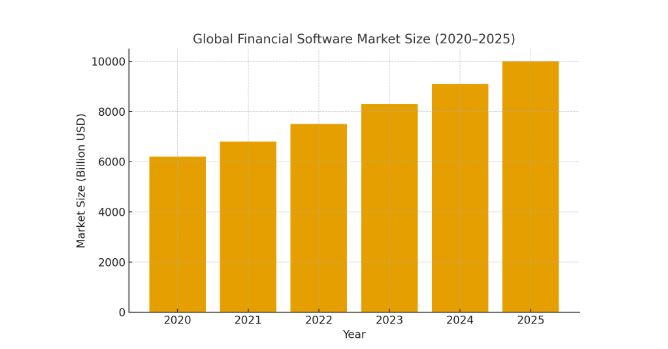
📊 Market Growth Outlook (2022–2030)
The rise of fintech is backed by rapid market expansion. According to Statista, the global fintech market was valued at USD 257 billion in 2022 and is projected to reach USD 882 billion by 2030, representing a CAGR of 17% (2023–2030).
This exponential growth underscores the urgency for businesses to invest in advanced financial software solutions. Organizations that adopt future-ready technologies today will be well-positioned to capture a share of this booming market.
3. Open Banking and API Economy
The age of closed systems is ending. Open banking, powered by secure APIs, is enabling banks and fintechs to collaborate and deliver integrated services. Customers can now see all their financial data bank accounts, loans, investments on a single dashboard. For developers, APIs are the new building blocks, unlocking innovation at a scale we’ve never seen before.
4. Cloud-Native and Real-Time Processing
Tomorrow’s financial systems will not tolerate downtime. Cloud-native architecture, combined with real-time data processing, ensures apps can scale instantly and provide seamless experiences whether processing millions of transactions or enabling live stock trades. As customer patience shrinks to seconds, real-time responsiveness will be a defining feature of successful financial software.
5. Cybersecurity Powered by Next-Gen Tech
With cyberattacks growing more sophisticated, financial software will increasingly rely on advanced defense mechanisms AI-based threat detection, zero-trust security models, and even quantum-safe encryption. The future of finance depends on software that not only enables transactions but also protects trust at every level.
6. Embedded Finance and Beyond
Financial services are moving outside of banks. Through embedded finance, everyday apps from e-commerce platforms to ride-sharing services are integrating payments, lending, and insurance directly into their user flows. This trend blurs the line between finance and lifestyle, making financial software development central to almost every industry.
The future of financial software is not just digital it is intelligent, decentralized, open, and omnipresent. Those who innovate boldly today will define the financial experiences of tomorrow.
Conclusion
Financial software development is no longer optional it is the lifeblood of modern finance. From AI-driven insights and blockchain-powered transactions to real-time processing and embedded finance, the industry is undergoing a seismic shift. Businesses that embrace these innovations will not only stay competitive but also redefine how people interact with money.
Yet, building future-ready financial software requires more than cutting-edge technology. It demands deep domain expertise, regulatory awareness, and a commitment to security and scalability. The challenges are complex, but so are the opportunities and those who act now will set the standard for the next decade of financial innovation.
If your organization is ready to transform ideas into secure, scalable, and customer-centric financial solutions, partnering with the right development team is key. At Onext Digital, we specialize in crafting innovative financial software tailored to your unique needs helping you stay ahead in a rapidly evolving digital economy.
Frequently Asked Questions (FAQ)
1. What is financial software development?
Financial software development is the process of designing, building, and maintaining digital solutions for the financial industry such as banking apps, trading platforms, e-wallets, payment gateways, and risk management systems.
2. Why is financial software important in 2025?
In 2025, customers expect faster, safer, and more personalized financial services. Financial software enables businesses to deliver real-time transactions, AI-powered insights, and secure digital experiences while staying compliant with regulations.
3. How much does financial software development cost?
The cost depends on the complexity, features, technology stack, and compliance requirements. On average, custom financial software can range from $30,000 to $250,000+, depending on scale and functionality.
4. What technologies are used in financial software?
Modern financial software often leverages cloud computing, blockchain, AI and machine learning, big data analytics, API integrations, and cybersecurity frameworks to ensure scalability, speed, and safety.
5. What are the biggest challenges in developing financial software?
Some of the key challenges include strict regulatory compliance, ensuring data security, integrating with legacy systems, managing scalability, and finding skilled talent with both technical and financial expertise.
6. How long does it take to build financial software?
The timeline varies based on scope. A simple fintech app might take 3–6 months, while a fully featured enterprise-grade platform could take 12–18 months or more.
7. How do I choose the right financial software development company?
Look for a partner with proven expertise in fintech, strong security practices, knowledge of global compliance standards, and a portfolio of scalable, high-performing financial solutions.