
 Services
 Solutions
 Main platform
 Technology
 White Label
  Offshore
 Hire developers



In today’s rapidly evolving business landscape, companies face growing pressure to stay competitive while overcoming skill shortages and limited resources. Traditional hiring methods often fall short, being too slow and costly to meet urgent demands. As a result, many organizations are now exploring flexible workforce solutions most notably Staff Augmentation vs Outsourcing to bridge capability gaps and drive efficiency.
Recent research shows that nearly 70% of businesses adopted alternative workforce strategies in the past year, reflecting a clear shift toward agility and adaptability. While both models can reduce operational costs and accelerate growth, their differences in execution, control, and long-term impact make the choice far from simple.
This article breaks down the key distinctions of Staff Augmentation vs Outsourcing, supported by real-world case studies and industry insights. By understanding how each approach influences performance, innovation, and scalability, you’ll be better equipped to decide which strategy best aligns with your business goals in 2025 and beyond.
1. Understanding the Basics
1.1 What is Staff Augmentation?
Staff Augmentation is a flexible staffing strategy where companies bring in external professionals to temporarily fill skill gaps within their existing teams. Unlike traditional hiring, this model enables organizations to scale their workforce quickly without committing to long-term contracts. It allows businesses to maintain direct control over projects while gaining access to specialized expertise.
For example, a technology company preparing for a product launch may require additional developers to meet tight deadlines. Instead of hiring permanent staff, they can augment their team with skilled professionals for the project’s duration. This approach ensures that deadlines are met while keeping long-term overheads manageable.
The growing adoption of this model highlights its efficiency: studies reveal that companies leveraging staff augmentation often report improved project timelines and up to a 30% increase in productivity. By integrating temporary specialists seamlessly into existing teams, organizations can foster innovation and maintain agility in a competitive market.
1.2 What is Outsourcing?
Outsourcing, on the other hand, involves delegating specific business functions or projects to external service providers. Rather than managing additional staff internally, companies entrust entire processes to third-party experts. This model enables organizations to focus on core operations while benefiting from specialized skills and cost efficiencies.
For instance, a retail brand struggling with high call volumes during peak seasons may outsource its customer support function. By doing so, the company reduces response times, enhances customer satisfaction, and allows internal teams to concentrate on strategic initiatives.
The impact of outsourcing is reflected in its global growth. In 2021 alone, the outsourcing market was valued at over $90 billion, with 77% of companies relying on external partners to strengthen their capabilities. Beyond cost savings, outsourcing offers scalability, innovation, and access to cutting-edge technology factors that are increasingly vital in today’s dynamic business environment.
2. Comparative Analysis: Staff Augmentation vs Outsourcing
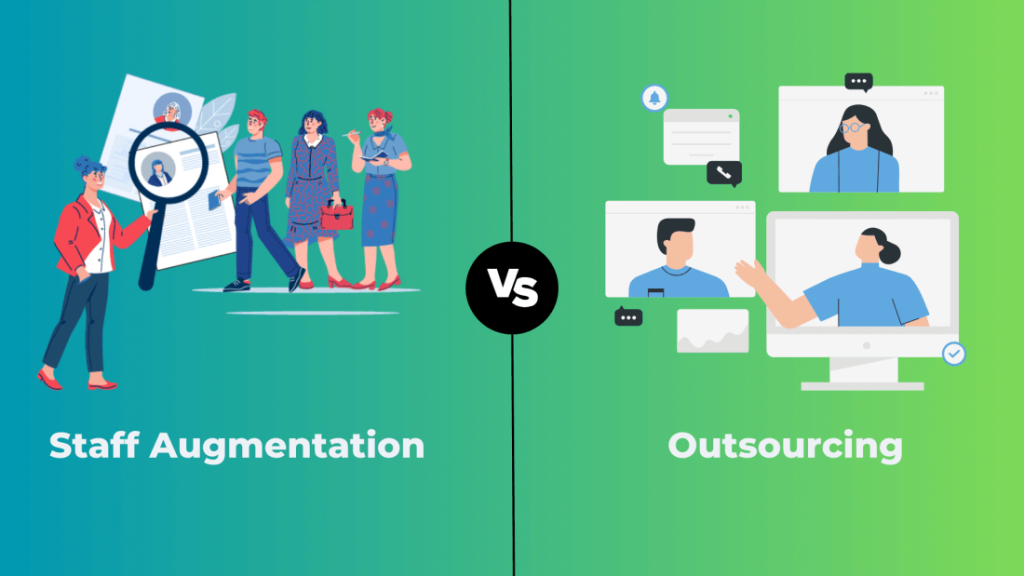
When comparing Staff Augmentation vs Outsourcing, it’s clear that both models can help organizations boost capabilities, but they differ sharply in execution, level of control, and long-term outcomes. Understanding these differences is vital for businesses that want to align their workforce strategy with overall operational goals and sustainable growth.
2.1 Key Dimensions of Comparison
Control and Oversight:
Staff Augmentation allows companies to retain direct management of augmented professionals, ensuring alignment with internal processes. Outsourcing shifts control to an external provider, which can reduce oversight but streamline execution.
Cost Considerations:
Staff Augmentation is generally cost-effective for short-term needs, as it avoids the long-term financial commitments of full-time hiring. Outsourcing, meanwhile, often delivers larger savings when entire functions or processes are delegated for extended periods.
Speed and Flexibility:
Staff Augmentation enables rapid onboarding of specialized talent with minimal disruption. Outsourcing typically requires more setup and communication upfront, but once established, it delivers scalable solutions.
Specialization and Innovation:
Outsourcing partners often bring end-to-end solutions, advanced tools, and fresh perspectives. Staff Augmentation focuses on filling specific gaps, offering precision in expertise but less holistic innovation.
Risk and Accountability:
With Staff Augmentation, risks center on higher costs if temporary staff are retained longer than expected. Outsourcing carries risks of misalignment, communication gaps, or over-reliance on external partners.
2.2 Side-by-Side Comparison:
| Factor | Staff Augmentation | Outsourcing |
| Level of Control | High – internal teams manage and direct augmented staff | Lower – external provider manages the project/task |
| Cost Efficiency | Best for short-term or project-based needs | Best for long-term and large-scale operations |
| Onboarding Speed | Rapid – professionals integrate quickly | Slower initially due to setup and alignment |
| Access to Expertise | Specific, role-based skills | Broad, process-oriented capabilities |
| Innovation Potential | Moderate – expertise applied within existing processes | High – external providers introduce new solutions |
| Risks | Higher costs if used too long | Miscommunication or lack of alignment |
| Best Use Case | Short-term projects, quick scalability | Large projects, ongoing support, or non-core tasks |
By weighing these factors, organizations can better determine which model suits their immediate needs and long-term objectives. For many, the decision lies not in choosing one over the other, but in finding the right balance or hybrid approach to maximize results.
3. Real-Life Case Studies
Examining real-world examples helps clarify how Staff Augmentation vs Outsourcing can generate measurable business results. These cases highlight the situations where each model proves most effective, making it easier for organizations to decide which approach best fits their needs.
3.1 Staff Augmentation in Action
A mid-sized fintech company preparing for a regulatory audit faced a shortage of compliance experts. Instead of going through lengthy recruitment, the firm turned to staff augmentation to quickly onboard specialists for a six-month engagement.
Outcome:
- Reduced compliance risks by 25%.
- Met audit deadlines without diverting internal teams from core functions.
- Enhanced knowledge transfer to in-house staff, strengthening long-term capabilities.
This case demonstrates how staff augmentation provides rapid access to critical expertise while preserving control and flexibility.
3.2 Outsourcing for Operational Efficiency
A leading retail brand struggled with high call volumes during peak shopping seasons, leading to long wait times and declining customer satisfaction scores. To resolve this, the company outsourced its customer support to a specialized service provider.
Outcome:
- Reduced average call waiting times by 40%.
- Improved customer satisfaction ratings by 15%.
- Enabled internal staff to focus on strategic initiatives like e-commerce expansion.
This example highlights how outsourcing entire functions can alleviate operational bottlenecks, drive efficiency, and enhance the customer experience.
3.3 Comparative Insight
- Staff Augmentation is most effective for short-term, skill-specific gaps, such as compliance, IT development, or healthcare support.
- Outsourcing excels when organizations require long-term, process-oriented solutions, such as customer support, payroll, or large-scale IT services.
Both approaches when applied strategically can deliver measurable improvements in performance, cost efficiency, and scalability.
4. Industry Insights and Statistics (2025 Outlook)
The adoption of flexible workforce solutions continues to accelerate as companies seek to balance efficiency, innovation, and cost control. Industry data highlights a clear trend toward both Staff Augmentation and Outsourcing as integral components of modern business strategies.
4.1 Growth of Staff Augmentation
- Nearly 70% of organizations report adopting flexible staffing models in the past year.
- Businesses utilizing staff augmentation report an average 30% improvement in project efficiency, largely due to faster onboarding and specialized expertise.
- A recent survey revealed that firms implementing augmented teams dedicated 25% more time to strategic initiatives, as temporary specialists handled operational workloads.
4.2 Expansion of Outsourcing
- The global outsourcing market surpassed $92 billion in 2021 and continues to grow, with projections pointing toward steady expansion by 2025.
- 77% of businesses now rely on outsourcing partners to strengthen operational capacity, reduce costs, and gain access to advanced technology.
- Data shows that companies outsourcing non-core functions achieve, on average, a 20% cost reduction and a 15% improvement in customer satisfaction scores.
4.3 Comparative Success Rates by Industry
| Industry | Positive Outcome Rate (%) | Key Challenges (%) |
| IT Services | 82 | 18 |
| Customer Support | 78 | 22 |
| Marketing | 70 | 30 |
| Manufacturing | 65 | 35 |
These statistics reveal that technology-driven sectors (such as IT services and customer support) tend to see the highest success rates, while industries like manufacturing face greater integration challenges.
4.4 Outlook for 2025 and Beyond
As businesses adapt to an increasingly dynamic marketplace, hybrid models combining both Staff Augmentation and Outsourcing are emerging as a preferred strategy. Organizations are also leveraging AI-powered platforms to optimize talent matching, streamline communication, and enhance decision-making in external workforce management.
The overarching trend is clear: companies that embrace flexibility and innovation in their workforce strategies will be better positioned to achieve sustainable growth in 2025 and beyond.
5. How to Decide Which Model is Right for Your Business
Choosing between Staff Augmentation and Outsourcing is not simply a matter of cost. It requires a thoughtful evaluation of your company’s goals, resources, and long-term strategy. Below are the key factors to guide your decision:
5.1 Level of Control and Oversight
- Staff Augmentation is ideal if you need to retain direct control over workflows, quality standards, and day-to-day project management. You manage the external professionals as if they were part of your internal team.
- Outsourcing is better suited when you’re comfortable entrusting end-to-end ownership of processes or functions to a partner. This reduces the burden of supervision but requires strong vendor alignment.
5.2 Project Duration and Scope
- Short-term or clearly defined projects: Staff Augmentation allows you to plug skill gaps quickly without committing to long-term contracts.
- Ongoing or large-scale operations: Outsourcing ensures continuity, efficiency, and the ability to scale processes without overloading your internal workforce.
5.3 Cost Structure and Budget Priorities
- Staff Augmentation is cost-effective when you only need specialized talent for a limited time. However, prolonged reliance on augmented staff may drive costs higher than planned.
- Outsourcing often delivers larger savings for standardized or repetitive tasks, as vendors benefit from economies of scale and established infrastructure.
5.4 Access to Expertise and Innovation
- Staff Augmentation offers precise expertise tailored to specific tasks (e.g., a cloud engineer or compliance specialist). It strengthens your existing team but keeps innovation within your current framework.
- Outsourcing partners typically bring broad capabilities, new technologies, and innovative approaches that can transform entire workflows. This is particularly valuable if your business is aiming for process reengineering or digital transformation.
5.5 Risk Tolerance and Accountability
- With Staff Augmentation, risks are internal: higher costs if projects extend longer, or dependency on temporary professionals. You remain accountable for overall results.
- With Outsourcing, risks include misalignment, communication barriers, or over-reliance on external providers. However, accountability for outcomes is shifted more toward the vendor.
5.6 Strategic Alignment with Business Goals
- If your objective is to strengthen internal teams while maintaining agility, Staff Augmentation supports knowledge transfer and capability building.
- If your goal is to focus on core competencies and free up internal resources, Outsourcing provides efficiency and scale by taking non-core tasks off your plate.
There is no universal “best” model. The right choice depends on whether your business needs control and flexibility (Staff Augmentation) or efficiency and scalability (Outsourcing). In many cases, a hybrid approach combining augmentation for short-term skills with outsourcing for long-term processes offers the best balance of agility, cost savings, and innovation.
6. Conclusion
Outsourcing and Staff Augmentation have moved beyond being mere cost-saving tactics they are now strategic levers for driving innovation and sustainable growth. Each approach offers distinct advantages, depending on your business objectives, project scope, and long-term vision. The key is to carefully assess your internal needs, desired level of control, and future scalability to make the right choice.
In many cases, a hybrid strategy proves most effective using Staff Augmentation to quickly bridge short-term skill gaps while relying on Outsourcing for long-term processes and non-core functions. This balance allows companies to maintain agility, optimize costs, and foster innovation.
For organizations seeking a trusted partner in navigating both models, ONEXT DIGITAL brings experienced teams and flexible solutions designed to help businesses scale with confidence and achieve lasting success.
7. FAQs: Staff Augmentation vs Outsourcing in 2025
1. How does Staff Augmentation vs Outsourcing impact project control and accountability?
Staff Augmentation gives you full oversight of day-to-day operations, but requires stronger internal management. Outsourcing transfers accountability to the vendor, which can streamline delivery but reduces direct control.
2. What risks should businesses consider when choosing between Staff Augmentation and Outsourcing?
For Staff Augmentation, risks include cultural misalignment and management overhead. For Outsourcing, risks often involve dependency on vendors, hidden costs, or potential quality issues if not managed properly.
3. How do these models affect long-term innovation and knowledge retention?
Staff Augmentation helps retain know-how within your organization since augmented staff integrate into internal teams. Outsourcing may limit knowledge transfer, as expertise often stays with the vendor, unless structured contracts ensure shared learning.
4. Which model better supports scalability for startups vs enterprises in 2025?
Startups often benefit from Outsourcing to quickly scale without fixed costs, while enterprises may prefer Staff Augmentation to strengthen teams while maintaining internal standards and governance.
5. How do cost structures differ between Staff Augmentation vs Outsourcing in the long run?
Staff Augmentation costs are typically hourly or monthly rates, offering transparency but potentially higher total costs for longer projects. Outsourcing uses project-based or fixed-fee models, which can provide savings but require clear scope to avoid overruns.
6. Can emerging technologies (AI, automation, cloud platforms) change the balance between Staff Augmentation and Outsourcing?
Yes. In 2025, AI-driven collaboration tools make it easier to manage remote augmented staff, while automation reduces reliance on outsourcing repetitive tasks. Businesses must evaluate how technology reshapes cost-benefit dynamics for both models.