
 Services
 Solutions
 Main platform
 Technology
 White Label
  Offshore
 Hire developers



Ecommerce automation with AI is transforming how online stores operate. By automating repetitive tasks like order processing, customer support, and inventory tracking, AI helps save time, reduce human error, and improve the overall shopping experience.
This smart approach allows store owners to focus less on manual work and more on growing sales or building stronger customer relationships. For instance, AI powered chatbots can instantly answer common questions, while recommendation engines suggest personalized products based on user behavior.
As the ecommerce landscape becomes more competitive, adopting ecommerce automation with AI is no longer optional it is essential. According to a McKinsey report, businesses that integrate AI into their operations can reduce costs by up to 30% and boost efficiency by 50%.
In this guide, we will explore how AI driven automation is helping online businesses run faster, sell smarter, and scale more easily and how you can start applying it to your store today.
Why is AI important in ecommerce today?
Today’s online shoppers move fast and they expect brands to keep up. Whether it’s instant answers, personalized offers, or flawless delivery, the pressure is on.
That’s where AI comes in.
AI doesn’t just automate tasks; it transforms how ecommerce businesses operate. It empowers smarter decisions, faster service, and hyper-personalized experiences all driven by real-time data.
Here’s how AI is redefining success in ecommerce:
- Faster customer service: AI chatbots can instantly answer questions, process returns, or guide shoppers 24/7, without delays.
- Smarter marketing: AI tools analyze customer behavior and send personalized emails or product recommendations that lead to higher conversions.
- Better inventory planning: AI can predict demand based on trends, helping avoid stockouts or overstock.
- Improved decision-making: AI uses real-time data to optimize pricing, promotions, and even website layouts.
According to Salesforce, 84% of customers say the experience a company provides is as important as its products or services. AI helps brands meet these expectations by delivering faster, smarter, and more personalized interactions.
Example:
An online electronics store uses AI to recommend the best accessories for each product. As a result, the average order value increases, and customers are more satisfied with their purchases.
Which Ecommerce Tasks Can Be Automated with AI?
Ecommerce today moves fast and so should your operations. AI doesn’t just help you automate routine tasks. It transforms how your business runs, scales, and connects with customers.
Imagine a system that updates orders in real time, replies to customer inquiries instantly, recommends products based on behavior, and even forecasts what to stock next month. That’s not the future, it’s already happening.
With the right AI-powered tools, you can streamline operations, cut manual work, and deliver smarter experiences at every step of the customer journey.
Let’s take a closer look at the key ecommerce functions AI is already automating and how each one can unlock real results for your business.
1. Order Management
Manual order processing slows you down. With AI, every step from updating order status to sending shipping notifications can be handled automatically. If a delay occurs, the system can alert the customer instantly, maintaining trust and minimizing support tickets. This level of automation ensures your backend keeps pace with frontend demand.
2. Customer Support
AI chatbots and virtual assistants are now smart enough to handle a wide range of customer interactions from answering FAQs to processing returns. These tools work 24/7, never take a break, and deliver consistent support. Even better, they can personalize conversations based on a customer’s browsing or purchase history, turning simple support into strategic engagement.
3. Email and SMS Marketing
Forget mass emails that get ignored. AI tailors every message based on real-time behavior, sending the right content at the right moment. For example, when a customer abandons their cart, AI can trigger a timely follow-up with a relevant product suggestion or limited-time offer, automatically boosting conversion rates.
4. Product Recommendations
AI analyzes browsing patterns, purchase history, and even time spent on specific pages to surface the products each shopper is most likely to want. These personalized recommendations appear in real time whether on product pages, in emails, or during checkout, driving both upsells and customer satisfaction.
5. Inventory and Demand Forecasting
Knowing what to stock and when is critical. AI helps by tracking historical sales data, seasonal trends, and customer behavior to predict future demand. It can even recommend when to reorder or shift inventory across warehouses, reducing both overstock and missed sales.
6. Fraud Detection
AI systems constantly monitor transactions for unusual patterns. If something looks suspicious, it gets flagged or blocked before the order goes through. This proactive approach protects your business from chargebacks, financial losses, and fake accounts without slowing down the checkout experience for legitimate customers.
What Tools Help Automate Ecommerce with AI?
In today’s fast-paced digital marketplace, AI-powered tools play a vital role in enabling ecommerce automation. These solutions help online businesses reduce manual workload, improve operational efficiency, and deliver personalized customer experiences at scale.
From customer service and marketing to inventory forecasting and product recommendations, AI can be applied across nearly every stage of the ecommerce journey. Below are key categories of tools that help automate ecommerce processes using artificial intelligence:
1. AI Chatbots and Virtual Assistants
Chatbots powered by AI offer real-time support, guiding customers, resolving inquiries, recommending products, and even managing returns 24/7 and without human intervention.
Popular tools:
- ChatGPT: Conversational AI for product recommendations and customer assistance
- Tidio: AI chatbot with sales automation features
- Intercom: Intelligent customer messaging and live chat support
Use case: A fashion retailer uses a chatbot to help customers find their ideal fit or get style suggestions based on browsing behavior boosting both engagement and conversion rates.
2. AI-Powered Email and Marketing Automation
These platforms leverage machine learning to analyze customer behavior and automate personalized email and SMS campaigns at scale, improving open rates and sales performance.
Popular tools:
- Klaviyo: Marketing automation tailored for ecommerce
- Mailchimp (with AI): Smart content and audience insights
- ActiveCampaign: Customer experience automation with deep segmentation
Use case: A customer who abandons their cart receives an automated follow-up email featuring relevant product suggestions and a personalized discount.
3. Product Recommendation Engines
AI recommendation systems personalize the shopping experience by suggesting products based on user behavior, purchase history, and preferences.
Popular tools:
- Dynamic Yield: Personalization platform for real-time recommendations
- Segmentify: Ecommerce-specific AI recommendation engine
- Recombee: Customizable machine learning-based recommendations
Use case: A home decor store uses AI to dynamically change homepage content and suggest products tailored to each visitor’s interests and past purchases.
4. Inventory and Demand Forecasting Tools
AI-driven forecasting tools help ecommerce businesses optimize stock levels, predict demand patterns, and automate purchasing decisions—reducing waste and missed sales.
Popular tools:
- Lokad: Advanced demand forecasting and inventory analytics
- NetSuite: Cloud-based inventory planning with AI enhancements
- InFlow Inventory: Real-time stock tracking and alerts
Use case: An electronics retailer forecasts a spike in demand before the holidays and auto-generates purchase orders in advance to ensure timely restocking.
5. AI Analytics and Business Insights
These platforms help ecommerce businesses collect and interpret complex data offering insights into customer behavior, sales trends, and marketing effectiveness.
Popular tools:
- Google Analytics 4 (GA4): Predictive insights and behavior modeling
- Zoho Analytics: AI-powered business intelligence
- Tableau (with Einstein AI): Advanced data visualization and predictive analytics
Use case: GA4 identifies which traffic sources generate the most revenue and uses predictive metrics to highlight users most at risk of churning.
6. AI Content Generation Tools
AI writing platforms help ecommerce teams scale content creation generating product descriptions, ad copy, blog posts, and social media content quickly and consistently.
Popular tools:
- Jasper: AI copywriter for ecommerce and marketing teams
- Copy.ai: Automated writing assistant for short-form and long-form content
- Writesonic: Content generation tailored for ecommerce
Use case: A small ecommerce brand uses Jasper to instantly create SEO-friendly descriptions for hundreds of new product listings.
By integrating the right AI tools for ecommerce automation, businesses can reduce manual effort, respond to customers faster, personalize every touchpoint, and scale with greater agility. Whether you’re a startup or a large online retailer, these solutions offer a competitive edge in today’s data-driven ecommerce landscape.
What Are the Benefits of Using AI in Ecommerce Automation?
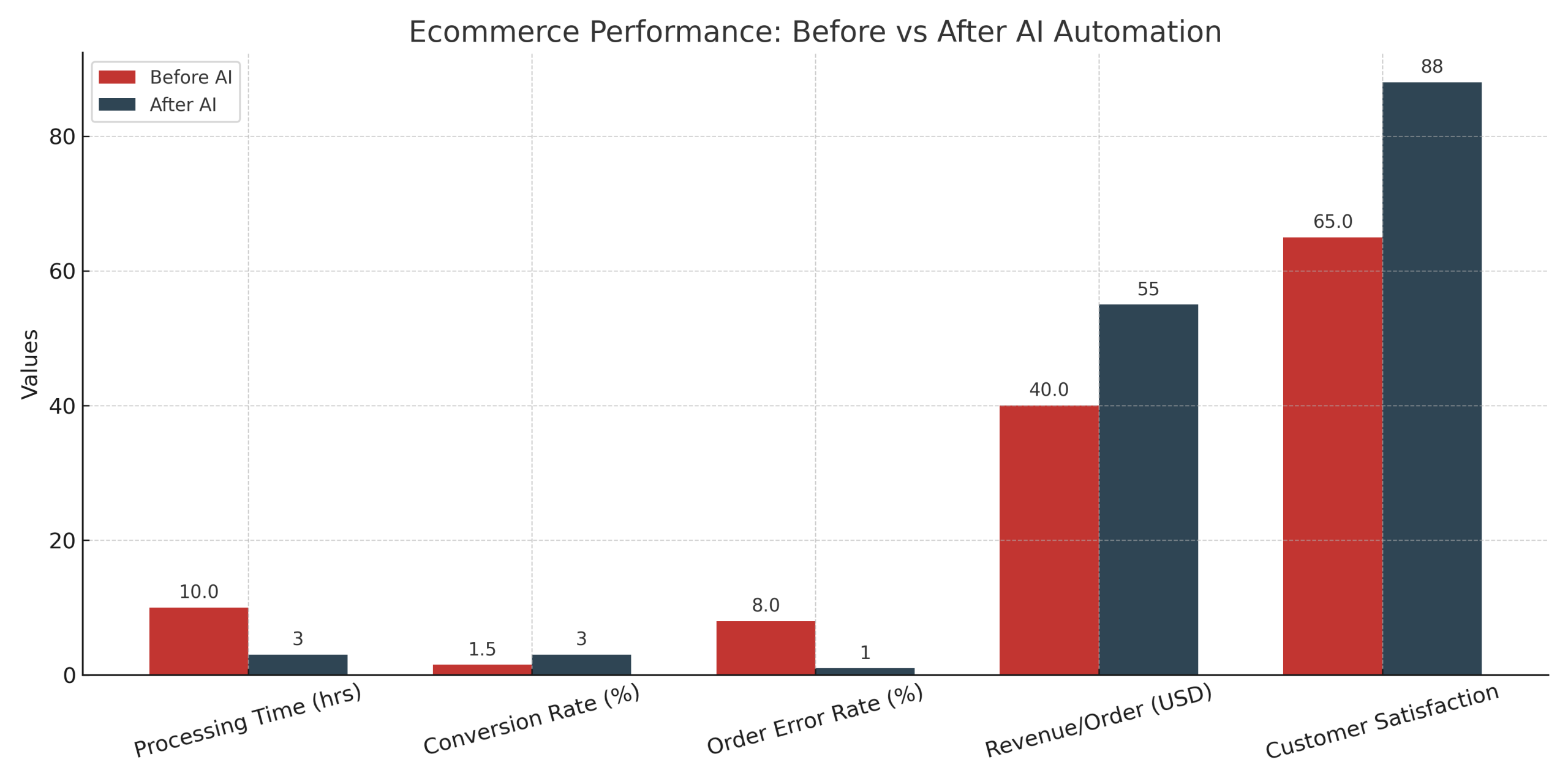
Using AI to automate ecommerce operations offers much more than just saving time. It helps businesses grow faster, cut down on costs, and deliver personalized shopping experiences that keep customers coming back. Below are the main advantages:
1. Faster and More Efficient Operations
AI can take over repetitive tasks like processing orders, managing inventory, or responding to customer inquiries. This not only reduces manual work but also cuts down on human errors and frees up your team to focus on bigger goals.
2. 24/7 Customer Support
With AI-powered chatbots and virtual assistants, you can provide instant customer support at any time day or night. These tools answer questions, resolve problems, and guide shoppers, all without needing a human to be online constantly.
3. Personalized Shopping Experience
AI analyzes customer data to show the right products, send relevant messages, and adapt website content to each shopper. This personal touch increases engagement, boosts sales, and encourages repeat purchases.
4. Smarter Business Decisions
AI tools offer insights through predictive analytics, helping you spot trends and make data-driven choices on pricing, marketing, or stock levels leading to better planning and results.
5. More Accurate Inventory and Demand Forecasting
By studying shopping patterns, seasonal trends, and customer behavior, AI helps predict what products will be in demand. This minimizes overstock and out-of-stock issues and keeps your supply chain running smoothly.
6. Stronger Fraud Protection
AI systems can quickly detect suspicious activity by monitoring transactions in real-time. This helps flag potential fraud and protect your business from financial losses or chargebacks.
7. Lower Operational Costs
Automation reduces the need for large customer service teams or manual handling of tasks, which lowers your long-term operating costs.
8. Easier Scalability
As your business grows, AI makes it easier to keep up. Whether you’re handling 100 or 10,000 orders a day, automation ensures everything runs smoothly without slowing down.
Are There Any Challenges or Risks to Consider?
While ecommerce automation with AI offers numerous advantages, businesses should also be aware of potential challenges and risks during implementation:
1. Upfront Implementation Costs
Integrating AI-powered automation tools often requires a significant initial investment, especially for small and medium-sized businesses. These costs may include software licenses, infrastructure upgrades, and staff training.
2. Integration with Legacy Systems
Many ecommerce platforms still operate on outdated systems that may not be fully compatible with modern AI solutions. Ensuring seamless integration can require substantial customization and technical expertise.
3. Data Security Concerns
As AI systems process large volumes of customer and transactional data, there is an increased risk of data breaches or misuse if robust security protocols are not in place.
4. Quality of Input Data
AI tools rely heavily on accurate and well-structured data to function effectively. Poor-quality or incomplete data can lead to incorrect recommendations, flawed predictions, or missed opportunities.
How to Start with Ecommerce Automation Using AI?
Getting started with AI-driven automation may seem overwhelming at first, but breaking it down into clear, manageable steps can make the process smoother and more effective. Here’s a step-by-step guide to help you launch your ecommerce automation journey:
1. Identify Tasks That Can Be Automated
Begin by analyzing your current ecommerce operations to pinpoint repetitive, time-consuming, or data-driven tasks. Common areas include inventory updates, order processing, customer support, and marketing campaigns. Focus on tasks that consume resources but offer high potential for automation gains.
2. Choose the Right Tools for Your Business Size
Select AI-powered tools that align with your specific business needs and budget. For small businesses, lightweight platforms with user-friendly interfaces and basic automation features may suffice. Larger businesses may require more robust solutions with advanced AI capabilities, custom integrations, and analytics.
3. Start with a Small-Scale Test
Before rolling out automation across your entire operation, run a pilot test on a limited process or product line. This allows you to observe how the AI performs, fine-tune the settings, and gather feedback from your team without disrupting your business.
4. Measure Results and Scale Gradually
Use key performance indicators (KPIs) to evaluate the success of your automation efforts such as reduced handling time, improved customer satisfaction, or increased conversion rates. Once you see measurable benefits, gradually scale automation to other parts of your ecommerce business.
Pro Tip: Combining human insights with AI-powered automation often leads to the best outcomes. While AI handles repetitive tasks efficiently, human oversight ensures creativity, strategic decisions, and a personal touch that AI cannot replicate.
Conclusion
Artificial intelligence is fundamentally transforming the ecommerce landscape, driving greater operational efficiency, enabling hyper-personalized customer experiences, and offering a level of scalability that traditional methods cannot match. As AI technologies continue to evolve, early adoption is no longer a competitive advantage – it’s a strategic imperative. Whether you’re a growing startup or an established enterprise, integrating AI into your ecommerce operations can unlock significant long-term value.
Looking to implement AI-driven solutions for your online business? Partner with ONEXT DIGITAL to receive expert guidance and a tailored strategy that fits your goals.
FAQs About Automating Ecommerce with AI
1. How does AI actually save time for ecommerce businesses?
AI takes over repetitive tasks like order processing, inventory updates, and customer support, freeing up time so store owners can focus on growth and strategy.
2. Which parts of an online store can be automated with AI?
AI can automate product recommendations, chat support, abandoned cart emails, dynamic pricing, fraud detection, and even supply chain management.
3. Is AI-powered ecommerce only for big businesses?
Not at all. Many AI tools are affordable, scalable, and easy to integrate perfect for small and mid-sized online stores.
4. Can automation improve the customer shopping experience?
Yes. AI delivers personalized product suggestions, fast responses via chatbots, and smoother checkout experiences that boost satisfaction.
5. What are the best tools for automating ecommerce with AI in 2025?
Top tools include Shopify Magic, Klaviyo, Tidio, ChatGPT plugins, and Rebuy Personalization Engine each designed to streamline different store functions.
6. How can small online stores start using AI without coding
Platforms like Shopify and BigCommerce offer AI-powered apps and plugins that require no coding- just plug, play, and automate.
7. What are the risks of relying too much on AI for ecommerce?
Over-automation can make interactions feel impersonal or result in errors if AI is poorly trained. Human oversight is still important.
8. Can AI help reduce cart abandonment and increase conversions?
Definitely. AI can trigger timely reminders, offer discounts, and personalize follow-ups turning abandoned carts into completed sales.