
 Services
 Solutions
 Main platform
 Technology
 White Label
  Offshore
 Hire developers



IT Business Process Outsourcing (IT BPO) refers to contracting specific IT-related business operations to third-party service providers. These operations typically include software development, IT support, data management, cloud services, cybersecurity, and technical customer support. The goal of IT BPO is to allow businesses:
- Reduce Costs: By outsourcing to regions with lower labor and operational costs.
- Increase Efficiency: Focus on core business activities while specialized providers handle IT functions.
- Access Expertise: Leverage the technical skills and advanced infrastructure of outsourcing providers.
- Scale Operations: Quickly adjust IT services to match business growth or changing needs.
IT BPO is commonly used across industries, including finance, healthcare, retail, and technology, and plays a vital role in supporting digital transformation and operational agility. This article will delve into the key destinations for IT BPO and compare their advantages and challenges, supported by specific data and real-world examples.
Global IT BPO Market Outlook
The global IT BPO market is expected to grow at a healthy pace, driven by increasing demand for cost-effective solutions, digital transformation, and the adoption of advanced technologies such as artificial intelligence (AI), machine learning (ML), cloud computing, and cybersecurity. Industry reports indicate the following projections:
Market Growth Rate:
The global BPO market (including both IT and non-IT services) is projected to grow at a CAGR of 8-10% from 2023 to 2025.
The IT outsourcing market, specifically, is expected to grow by 6-8% CAGR, reaching over $450 billion by 2025.
Key Trends Driving Growth:
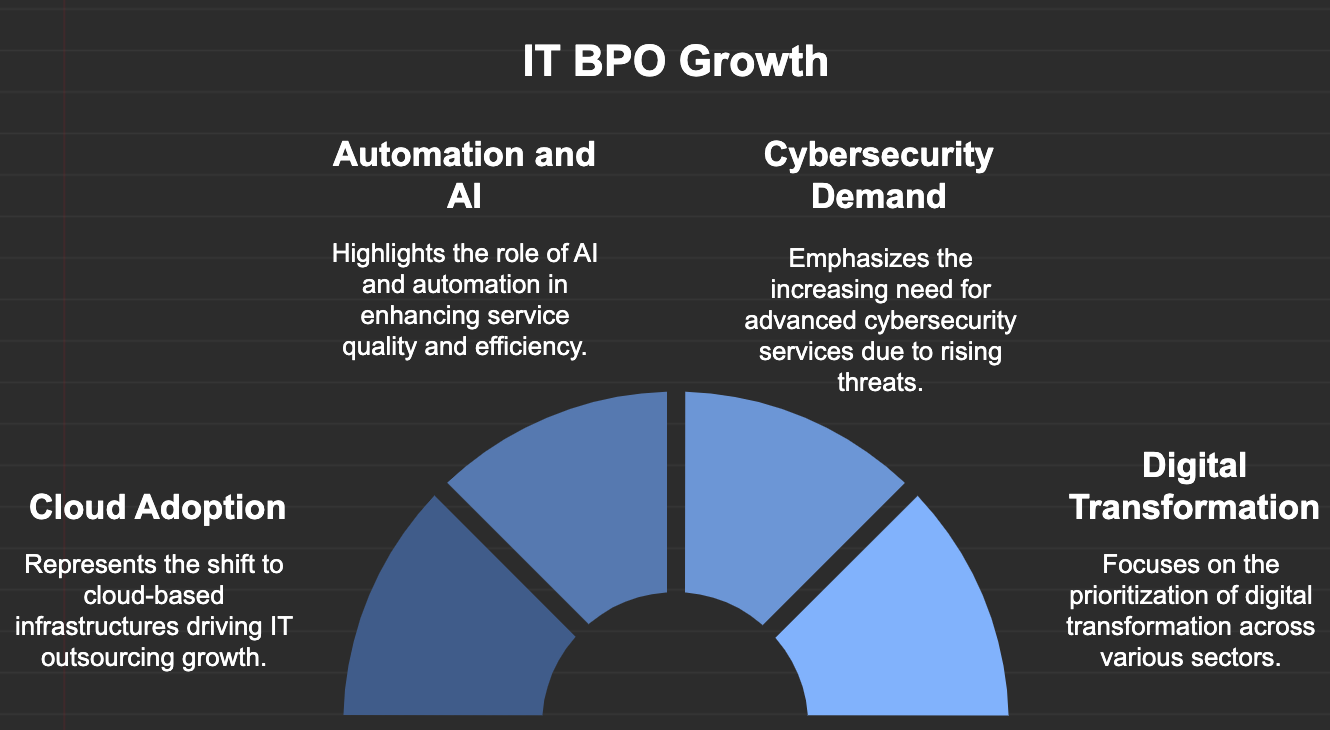
Cloud Adoption: As businesses continue to migrate to cloud-based infrastructures, IT outsourcing services related to cloud management and support are expected to see significant growth.
Automation and AI: The integration of AI and automation in IT BPO services is becoming a key differentiator, enhancing service quality and reducing operational costs.
Cybersecurity Demand: With the rise of cyber threats, there is a growing demand for IT BPO providers offering advanced cybersecurity services.
Digital Transformation: Enterprises in various sectors will continue to prioritize digital transformation, leading to a surge in demand for IT support services that align with these strategies.
IT Business Process Outsourcing (BPO) Destinations
1. India – The Traditional IT BPO Powerhouse
India remains one of the largest and most well-established destinations for IT outsourcing, commanding over 50% of the global BPO market. The country’s highly skilled workforce, cost-effective services, and vast infrastructure make it a popular choice for many companies.
Key Advantages:
- Large Talent Pool: India is home to over 4.5 million IT professionals and boasts a strong presence in areas like software development and IT support.
- Cost Advantage: Labor costs in India are significantly lower than in Western countries, offering companies substantial cost savings of around 60-70%.
- Established Infrastructure: Cities like Bengaluru, Hyderabad, and Pune are recognized global IT hubs, equipped with world-class infrastructure.
Challenges:
- Service Quality Variability: While India has many high-quality providers, the quality of service can vary between companies.
- Lack of Privacy and Security Laws: When outsourcing to Indian companies, there’s a high risk of copyright and licensing issues. Projects may be copied or resold, and there’s no guarantee they will stay secure
- Time Zone Differences: India’s time zone can be a challenge for real-time collaboration with North American companies, leading to potential delays.
- Cultural and Regional Differences: Working with Indian outsourcing companies can be challenging due to cultural and regional differences. Adjusting to local customs and social norms is often needed for smooth collaboration.
2. Philippines – A Rising Contender
The Philippines is well-known for its success in the customer service BPO market but is also making strides in the IT BPO sector. It accounts for a significant portion of the global IT outsourcing market and is known for its strong English proficiency and cultural alignment with Western countries.
Key Advantages:
- Cultural Compatibility: Due to its historical ties with the U.S., the Philippines has a workforce that understands Western business practices, making it a natural choice for U.S.-based companies.
- English Proficiency: The Philippines ranks among the top countries globally for English proficiency, with a literacy rate of 97%.
- Competitive Costs: The Philippines offers cost savings of about 30-40% compared to other outsourcing destinations.
Challenges:
- Infrastructure Issues: While major cities have good infrastructure, rural areas can face challenges with internet connectivity and utilities.
- Unpredictable Weather
The Philippines experiences an average of 12 tropical typhoons annually, leading to floods and disruptions. These weather events can impact software outsourcing projects, particularly in affected regions. - Dependence on the U.S. Market: The Philippine BPO industry is highly dependent on U.S. clients, making it vulnerable to economic fluctuations in the U.S.
- Numerous Holidays
The Philippines has 18 national holidays compared to the U.S.’s 11. Additionally, Holy Week, a long holiday, can cause delays, making it costly for time-sensitive projects. - Employee-Friendly Labor Laws
Labor laws in the Philippines strongly protect employees. Employers must provide documentation and valid reasons for dismissals, and must also offer severance pay and benefits for worker retirements.
3. Vietnam – The Emerging IT Outsourcing Hub
While countries like India and the Philippines have long been dominant players in IT BPO, Vietnam is quickly emerging as a serious contender, especially in areas like software development, IT support, and quality assurance. In 2023, Vietnam’s IT outsourcing sector grew by 15% year-on-year, reaching nearly $8 billion.
Key Advantages:
- Young and Skilled Workforce: With over 30% of its population under the age of 30, Vietnam boasts a large, youthful, and highly educated workforce. The country produces a steady stream of tech graduates, including software engineers, developers, and IT specialists, making it an attractive destination for IT BPO services.
- Cost-Effectiveness: One of Vietnam’s biggest advantages is its affordable pricing, which is around 30-50% lower than Western countries. This makes Vietnam an ideal choice for businesses that want high-quality services at competitive rates, offering excellent value for money.
- Government Support and Development: The Vietnamese government has been proactive in fostering the IT sector through various incentives, including tax breaks, funding for tech startups, and a focus on IT education and training. This has helped to create a supportive ecosystem for outsourcing.
- Proximity to Global Markets: Vietnam’s location in Southeast Asia offers advantages in terms of time zone alignment, especially for businesses in the U.S. and Europe. Its growing tech ecosystem also ensures that companies can find the talent and resources they need to scale.
- Focus on Quality and Innovation: As the country builds its reputation in IT outsourcing, many companies in Vietnam are investing in advanced technologies like AI, cloud computing, and cybersecurity, ensuring that businesses can access the latest tech solutions at competitive prices.
Challenges to Consider:
- Language Proficiency: While English is widely spoken in major cities like Hanoi and Ho Chi Minh City, proficiency can still be a barrier in rural areas and for senior-level positions.
- Senior Talent Pool: Although there are many skilled junior professionals, the availability of senior IT professionals is still growing as the industry continues to mature.
- Too Many Outsourcing Vendors
As software outsourcing grows in Vietnam, more vendors are entering the market. However, many new companies make avoidable mistakes, focusing on profits over quality. According to a 2023 report by VINASA, the number of software outsourcing firms in Vietnam has increased by over 10% annually, leading to intense competition. Additionally, 56% of new firms struggle to keep up with the latest technology and trends (Source: Vietnam IT Outsourcing Market Research, 2023).
4. Poland – A European IT Outsourcing Hub
Poland has emerged as a strong player in the European IT BPO market, offering a combination of a highly educated workforce and geographic proximity to Western Europe.
Key Advantages:
- Highly Educated Workforce: Poland produces around 40,000 IT graduates annually, many of whom have strong technical expertise.
- Cultural Proximity: As a member of the European Union, Poland offers a workforce that aligns culturally with Western European businesses.
- Time Zone Advantage: Poland’s location in Central Europe makes it easy for European companies to collaborate with outsourcing teams during working hours.
Challenges:
- Higher Costs: Labor costs in Poland are higher than in Asia, with IT services being 40-60% more expensive than in Vietnam or India.
- Competitive Market: As demand for IT outsourcing grows in Europe, talent competition is becoming more intense.
5. Mexico – A Nearshore IT Outsourcing Destination
For companies in North America, Mexico offers a strategic nearshore outsourcing solution, with the added benefit of minimal time zone differences.
Key Advantages:
- Geographic Proximity: Mexico’s location makes it an ideal destination for North American companies looking for real-time communication and collaboration.
- Cultural Similarities: The business culture in Mexico is closely aligned with that of the U.S., making integration smoother for U.S.-based teams.
- Cost Savings: Mexico offers significant cost savings—up to 40% compared to the U.S.—while maintaining a high level of service quality.
Challenges:
- Security Concerns: Certain regions of Mexico face security challenges, which may deter some companies from outsourcing to the country.
- Infrastructure Gaps: While major cities like Mexico City and Guadalajara have strong infrastructure, rural areas may still lack reliable internet and utilities.
Conclusion
As the IT BPO market expands, choosing the right outsourcing destination will be key for businesses to stay competitive. Companies must evaluate cost, talent, and service specialization to make informed decisions. By 2025, IT BPO will continue to evolve, offering new opportunities for businesses to scale, innovate, and improve operational efficiency.